
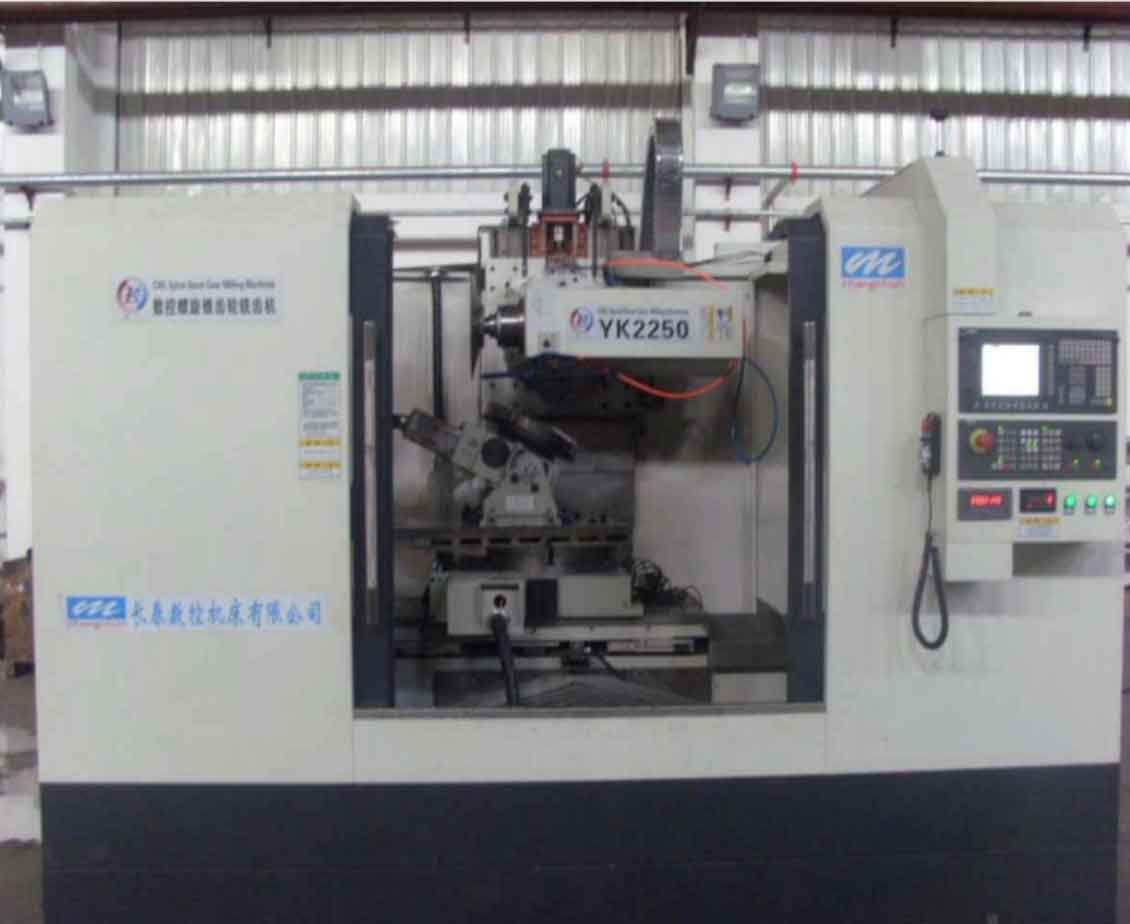
Spiral bevel gears are critical transmission components in aerospace, marine, and industrial machinery sectors, manufactured exclusively using specialized gear milling machines. These machines utilize gear transmission systems in their turntable feed mechanisms, where intentional backlash prevents jamming but compromises positioning accuracy and induces oscillatory behavior. This research presents a PMAC-based dual-motor anti-backlash solution to eliminate transmission nonlinearity in CNC spiral bevel gear milling systems.
Dual-Motor Anti-Backlash Mechanism
The dual-motor system employs two identical servo motors coupled to pinion gears engaging a common bull gear. During operation, offset torques ($M_0$) force pinions to contact opposing flanks of the bull gear teeth, mathematically expressed as:
$$|M_1| = |M_2| = |M_0|$$
$$M = |M_1 – M_2| = 0$$
Key transitional states during motion include:
| Operational Phase | Motor A Torque ($M_1$) | Motor B Torque ($M_2$) | Net Torque ($M$) |
|---|---|---|---|
| Stationary | +$M_0$ | -$M_0$ | 0 |
| Forward Acceleration | ↑ +$M_1$ | ↓ -$M_2$ | |M₁ – M₂| |
| Steady Forward | +$M_f$ | +$M_f$ | |M₁ + M₂| |
| Direction Reversal | ↓ +$M_1$ | ↑ -$M_2$ | |M₂ – M₁| |
Dynamic Modeling of Transmission System
The dead-zone model characterizes backlash nonlinearity ($2\alpha$) in the gear transmission:
$$M(t) =
\begin{cases}
K(\Delta\theta – \alpha) + c\Delta\dot{\theta}, & \Delta\theta > \alpha \\
0, & |\Delta\theta| \leq \alpha \\
K(\Delta\theta + \alpha) + c\Delta\dot{\theta}, & \Delta\theta < -\alpha
\end{cases}$$
where $\Delta\theta = \theta_i – i\theta_o$. Dual-motor dynamics incorporate two single-motor systems coupled at the load:
$$\begin{bmatrix} \dot{\theta}_d \\ \dot{\omega}_d \\ \dot{\theta}_f \\ \dot{\omega}_f \end{bmatrix} =
\begin{bmatrix}
0 & 1 & 0 & 0 \\
-\frac{k_s}{J_d} & -\frac{b_d + c_s}{J_d} & \frac{k_s}{J_d} & \frac{c_s}{J_d} \\
0 & 0 & 0 & 1 \\
\frac{k_s}{J_f} & \frac{c_s}{J_f} & -\frac{k_s}{J_f} & -\frac{b_f + c_s}{J_f}
\end{bmatrix}
\begin{bmatrix} \theta_d \\ \omega_d \\ \theta_f \\ \omega_f \end{bmatrix} +
\begin{bmatrix} 0 \\ \frac{1}{J_d} \\ 0 \\ 0 \end{bmatrix} M_d$$
Simulation Analysis
Simulations evaluated step and sinusoidal responses under 5mil backlash conditions:
| Input Signal | Backlash State | Peak Error (rad) | Error Reduction |
|---|---|---|---|
| Step (1rad) | Uncompensated | -0.2572 | – |
| Compensated | -0.2485 | 3.3% | |
| Sine (1rad) | Uncompensated | 0.0093 | – |
| $M_0$=1N·m | 0.0090 | 3.2% | |
| $M_0$=5N·m | 5.57e-8 | 99.9994% | |
| $M_0$=10N·m | 3.32e-8 | 99.9996% |
Optimal offset torque threshold was observed at 5N·m, beyond which accuracy improvements plateaued.
Experimental Validation
An EtherCAT-based testbed implemented PMAC-controlled dual motors driving a rack-pinion mechanism. Velocity differential ($\Delta n$) created offset torque for backlash elimination:
$$\Delta n = n_{\text{master}} – n_{\text{slave}}$$
Velocity fluctuation attenuation under increasing $\Delta n$:
| $\Delta n$ (ct/s) | Master Fluctuation | Slave Fluctuation | Reduction |
|---|---|---|---|
| 5000 | 2.5 | 2.4 | – |
| 10000 | 1.5 | 1.6 | 40% |
| 15000 | 0.5 | 0.4 | 84% |
| 20000 | 0.3 | 0.35 | 88% |
Position tracking maintained ±0.01rad accuracy during reversal cycles in gear milling simulations.
Conclusion
The dual-motor anti-backlash system effectively eliminates nonlinear transmission errors in spiral bevel gear milling machines. Implementation requires:
1. Offset torque exceeding 5N·m threshold
2. Velocity differential control via PMAC’s EtherCAT network
3. Cross-coupled compensation during direction reversals
This approach enhances gear milling accuracy by 99.99% in sinusoidal tracking while reducing velocity fluctuations by 88%, significantly improving surface quality in spiral bevel gear production.