
In this study, we focus on the dynamic behavior of herringbone gears, which are widely used in high-power transmission systems such as marine drives due to their advantages over helical gears, including reduced bearing loads and improved load distribution. The noise and vibration generated by herringbone gears are critical concerns in applications like ship propulsion, and understanding their dynamic characteristics is essential for optimal design. We aim to develop a comprehensive three-dimensional dynamic model that accounts for key internal excitations—time-varying mesh stiffness, error-induced excitations, and corner impact—based on detailed meshing analysis. This model will serve as a foundation for dynamic design and noise reduction strategies for herringbone gears.
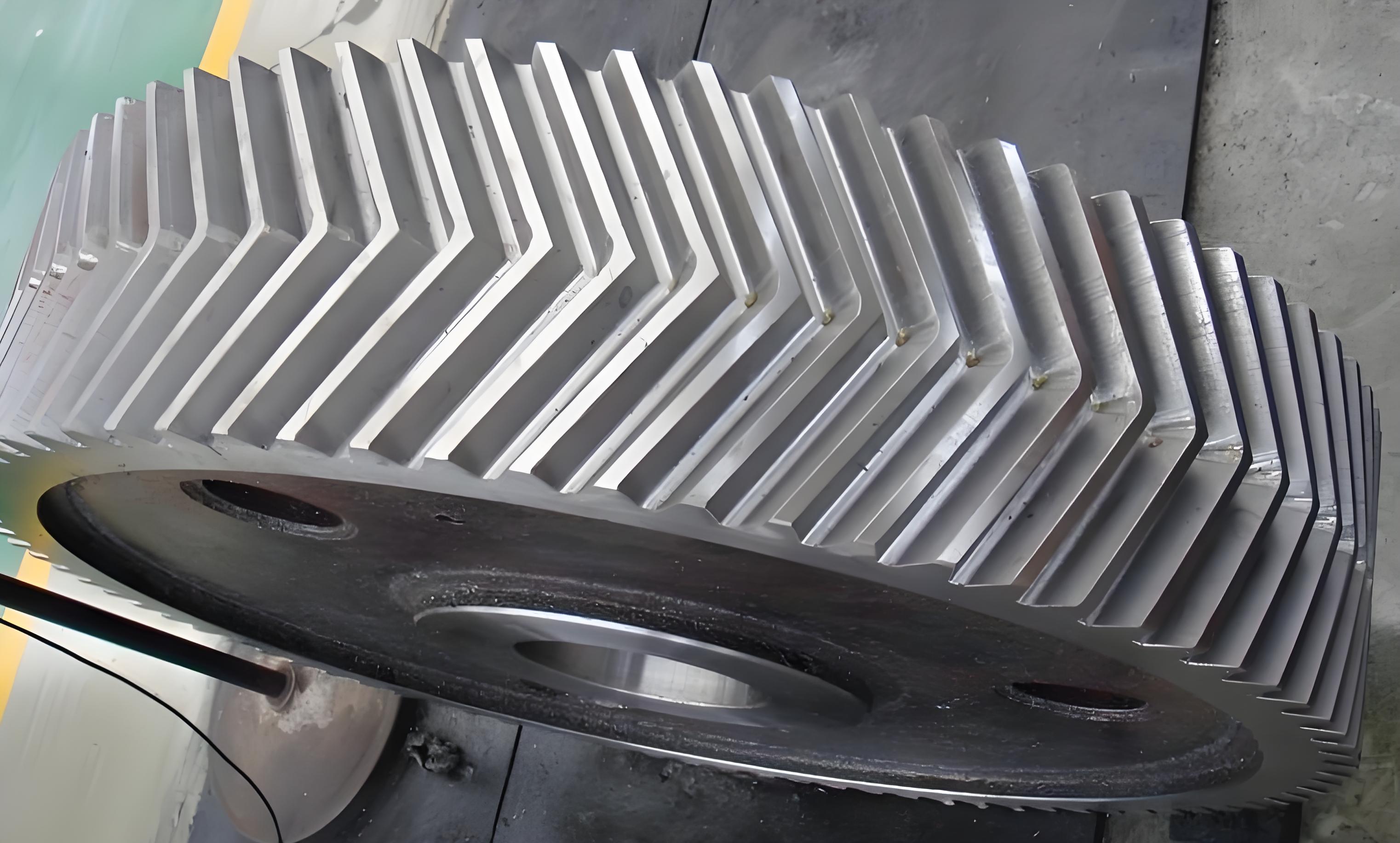
Herringbone gears consist of two helical gear sections with opposite hands, forming a V-shape that cancels axial thrust forces. This configuration enhances load-carrying capacity and stability, but it also introduces complex dynamic interactions between the left and right helical sections. The dynamic performance of herringbone gears is influenced by several factors, including manufacturing errors, installation misalignments, and meshing impacts. To accurately capture these effects, we leverage gear contact analysis techniques, such as Tooth Contact Analysis (TCA) and Loaded Tooth Contact Analysis (LTCA), to derive precise internal excitations. Our approach integrates these excitations into a lumped-parameter model, enabling the simulation of dynamic responses under realistic operating conditions.
The internal excitations in herringbone gears arise from three primary sources: time-varying mesh stiffness due to changing contact conditions, errors from manufacturing and assembly, and corner impacts during gear engagement. We calculate these excitations using results from meshing contact analysis for herringbone gears, ensuring accuracy in representing real-world scenarios. For instance, the time-varying mesh stiffness is obtained by analyzing contact forces and deformations at different meshing positions, while error excitations include both tooth profile errors and axial displacements caused by low-speed effects. The corner impact excitation, particularly at the entry point, is derived from an impact model that accounts for the sudden contact between teeth. These excitations are then incorporated into our dynamic model for herringbone gears.
To compute the time-varying mesh stiffness for herringbone gears, we use LTCA to determine the contact force and deformation at each meshing position over one engagement cycle. The synthetic mesh stiffness, \( K_m(t) \), is the sum of individual tooth pair stiffnesses when multiple pairs are in contact. It can be expressed as a Fourier series to represent its periodic nature:
$$ K_m(t) = K_{avg} + \sum_{n=1}^{N} \left( A_n \cos(n\omega_m t) + B_n \sin(n\omega_m t) \right) $$
where \( K_{avg} \) is the average mesh stiffness, \( \omega_m \) is the meshing frequency, and \( A_n \), \( B_n \) are Fourier coefficients derived from the discrete stiffness values. For a typical herringbone gear pair, the stiffness variation over one cycle is shown in Table 1, which summarizes key parameters from our analysis. The single-tooth mesh stiffness curve, essential for impact calculations, is obtained by inverse transformation of the synthetic stiffness.
| Parameter | Value | Unit |
|---|---|---|
| Average Mesh Stiffness, \( K_{avg} \) | 1.2e8 | N/m |
| Meshing Frequency, \( \omega_m \) | 1500 | Hz |
| Number of Engaging Tooth Pairs | 2-3 | – |
| Fourier Coefficients (n=1) | A1=2e7, B1=1.5e7 | N/m |
Error excitations in herringbone gears stem from tooth profile errors, base pitch errors, and axial displacements. The equivalent error function, \( e(t) \), combines these sources and is represented as a harmonic series:
$$ e(t) = e_0 + \sum_{k=1}^{K} \left( C_k \cos(k\omega_e t) + D_k \sin(k\omega_e t) \right) $$
where \( e_0 \) is the static error, \( \omega_e \) is the error frequency related to gear rotation, and \( C_k \), \( D_k \) are coefficients from Fourier analysis. Axial displacements, caused by manufacturing tolerances in herringbone gears, are particularly significant at low speeds and contribute to dynamic vibrations. From our LTCA results, the axial displacement over a long period is fitted to a periodic function, as shown in the formula below for a sample herringbone gear set:
$$ \Delta z(t) = 0.001 \sin(2\pi f_z t) + 0.0005 \cos(4\pi f_z t) $$
with \( f_z \) being the axial vibration frequency. This displacement is included in the error excitation for the dynamic model of herringbone gears.
Corner impact excitation occurs when teeth first engage, leading to sudden forces that excite vibrations. Using an impact model, we calculate the impact force, \( F_{impact}(t) \), at the entry point based on the relative velocity and stiffness. For herringbone gears, this force is expressed as:
$$ F_{impact}(t) = K_i \cdot \delta(t) + C_i \cdot \dot{\delta}(t) $$
where \( K_i \) is the impact stiffness, \( C_i \) is the damping coefficient, and \( \delta(t) \) is the penetration depth. The impact force curve over one meshing cycle is derived and represented as a Fourier series for integration into the dynamic equations. In our analysis, the peak impact force for herringbone gears reaches up to 5000 N under typical operating conditions, highlighting its importance in dynamic modeling.
Based on these excitations, we develop a three-dimensional dynamic model for herringbone gears using the lumped-parameter method. The model considers bending, torsion, and axial deformations, resulting in a 12-degree-of-freedom (DOF) system. The DOFs include translational and rotational displacements for the left and right sections of both the driving and driven herringbone gears. Specifically, the displacement vector is defined as:
$$ \mathbf{\delta} = [y_{q1}, z_{q1}, \theta_{q1}, y_{p1}, z_{p1}, \theta_{p1}, y_{q2}, z_{q2}, \theta_{q2}, y_{p2}, z_{p2}, \theta_{p2}]^T $$
where \( y \) and \( z \) denote translational displacements in the horizontal and axial directions, respectively, \( \theta \) represents torsional displacement, and subscripts \( q1, p1, q2, p2 \) refer to the driving left, driven left, driving right, and driven right gear centers. The relationships between these points and the gear bodies are given by:
$$ y_{ij} = y_i + R_i \theta_i, \quad z_{ij} = z_i – y_i \tan(\beta) $$
for \( i = q, p \) and \( j = 1, 2 \), with \( R_i \) as the base radius and \( \beta \) as the helix angle of the herringbone gears. The dynamic mesh forces in the tangential and axial directions are formulated as:
$$ F_{yj} = k_{yj}(y_{qj} – y_{pj} – e_{yj}) + c_{yj}(\dot{y}_{qj} – \dot{y}_{pj} – \dot{e}_{yj}) + \frac{1}{2}(k_x(\theta_{q1} – \theta_{q2}) + c_x(\dot{\theta}_{q1} – \dot{\theta}_{q2})) $$
and
$$ F_{zj} = k_{zj}(z_{qj} – z_{pj} – e_{zj}) + c_{zj}(\dot{z}_{qj} – \dot{z}_{pj} – \dot{e}_{zj}) + k_{ez}(1-j)z_e + c_{ez}(1-j)\dot{z}_e $$
where \( k_{yj}, c_{yj}, k_{zj}, c_{zj} \) are mesh stiffness and damping coefficients, \( e_{yj}, e_{zj} \) are error functions, \( k_x, c_x \) are shaft torsional stiffness and damping, and \( z_e \) is the axial displacement from low-speed analysis. The index \( j=1,2 \) corresponds to the left and right sections of the herringbone gears, respectively.
Applying Newton’s second law, we derive the equations of motion for the herringbone gear system. For example, the equation for the driving gear left section is:
$$ m_{q1}\ddot{y}_{q1} + c_{qy}(y_{q1} – y_{q2}) + k_{qy}(y_{q1} – y_{q2}) = -F_{y1} + F_{y2} $$
and for torsional motion:
$$ I_{q1}\ddot{\theta}_{q1} + c_{qx}(\dot{\theta}_{q1} – \dot{\theta}_{q2}) + k_{qx}(\theta_{q1} – \theta_{q2}) = R_{q1}F_{y1} $$
Similar equations are written for all 12 DOFs, forming a system of differential equations. To eliminate rigid-body motion and normalize the equations, we introduce relative displacements and dimensionless parameters. The relative displacement in the mesh direction is defined as \( \lambda_j = y_{qj} – y_{pj} – e_{yj} \), and the torsional difference as \( \gamma_i = \theta_{i1} – \theta_{i2} \) for \( i = q, p \). Using dimensionless time \( \tau = \omega_n t \) and displacement scale \( b_c \), we obtain normalized equations suitable for numerical solution.
The dimensionless equations for herringbone gears take the form:
$$ \frac{d^2 \hat{\lambda}_j}{d\tau^2} + 2\zeta_j \frac{d \hat{\lambda}_j}{d\tau} + \hat{k}_j(\tau) \hat{\lambda}_j = \hat{F}_{impact,j}(\tau) $$
where \( \hat{\lambda}_j \) is the normalized relative displacement, \( \zeta_j \) is the damping ratio, \( \hat{k}_j(\tau) \) is the normalized time-varying stiffness, and \( \hat{F}_{impact,j}(\tau) \) is the normalized impact force. The stiffness and impact terms are derived from the earlier excitations, ensuring that the model captures the dynamic coupling in herringbone gears.
We solve these equations using the variable-step fourth-order Runge-Kutta method, which is effective for handling the nonlinearities and stiffness variations in herringbone gear dynamics. The algorithm iterates over time steps, computing displacements, velocities, and accelerations for each DOF. To avoid initial transient effects, we discard the first few hundred cycles of response. The dynamic responses, including vibration accelerations in the mesh, axial, and transverse directions, are then analyzed through time-domain and frequency-domain transformations using Fast Fourier Transform (FFT).
For a case study, we consider a herringbone gear pair with parameters listed in Table 2. This example illustrates the application of our model to real-world herringbone gears, demonstrating how dynamic excitations influence vibration behavior.
| Parameter | Driving Gear | Driven Gear | Unit |
|---|---|---|---|
| Number of Teeth, \( z \) | 31 | 102 | – |
| Normal Module, \( m_n \) | 4.5 | 4.5 | mm |
| Normal Pressure Angle, \( \alpha_n \) | 20 | 20 | ° |
| Helix Angle, \( \beta \) | 28.34 | 28.34 | ° |
| Face Width per Side, \( B \) | 90 | 90 | mm |
| Hand of Helix | Right-Left | Left-Right | – |
| Driving Speed | 2881 | – | rpm |
| Driven Torque | – | 2000 | N·m |
| Central Cylinder Width, \( W \) | 70 | 70 | mm |
The dynamic responses for this herringbone gear pair show significant vibrations in the mesh and axial directions, with accelerations reaching up to 100 m/s² in the mesh direction and 50 m/s² axially, while transverse vibrations are smaller, around 10 m/s². The frequency spectra reveal dominant peaks at the mesh frequency and its harmonics, indicating that stiffness and impact excitations are primary drivers for herringbone gear dynamics. For instance, the mesh frequency for this herringbone gear set is calculated as:
$$ f_m = \frac{z_q \cdot n_q}{60} = \frac{31 \cdot 2881}{60} \approx 1500 \text{ Hz} $$
where \( z_q \) is the tooth number of the driving herringbone gear and \( n_q \) is its speed in rpm. The axial vibration frequency is lower, around 48 Hz, due to shaft rotation, but its contribution is minimal compared to mesh-frequency excitations in herringbone gears.
Our analysis highlights that torsional and axial vibrations are more pronounced than transverse bending vibrations in herringbone gears, which aligns with the unique geometry of herringbone gears that couples these motions. The model successfully predicts dynamic loads and resonances, providing insights for optimizing herringbone gear designs to reduce noise and wear. For example, by adjusting parameters like helix angle or mesh stiffness, designers can mitigate peak vibrations in herringbone gears.
In conclusion, we have developed a detailed dynamic model for herringbone gears that incorporates time-varying mesh stiffness, error excitations, and corner impact forces based on meshing contact analysis. The 12-DOF lumped-parameter model captures bending-torsion-axial coupling in herringbone gears, and the normalized equations are solved numerically to obtain dynamic responses. Our results demonstrate that herringbone gears exhibit strong vibrations in mesh and axial directions, primarily driven by mesh-frequency excitations. This work lays a foundation for the dynamic design of herringbone gears, enabling better performance in applications such as marine transmissions. Future studies could explore nonlinear effects or experimental validation for herringbone gears to further refine the model.