
In modern mechanical transmission systems, spur and pinion gears are fundamental components due to their simplicity and efficiency. However, these gears are susceptible to various failure modes such as cracking and pitting, which can lead to catastrophic system failures if undetected. Traditional experimental approaches to simulate different failure types and severities are often costly and complex, limiting the ability to build comprehensive fault diagnosis databases. Therefore, developing accurate dynamic models that incorporate fault mechanisms is crucial for understanding vibration characteristics and enabling predictive maintenance. This article presents a detailed dynamic modeling approach for spur and pinion gears with faults, utilizing a lumped-parameter method to establish a bending-torsion coupled vibration analysis model. The time-varying meshing stiffness is calculated using the energy method, and the effects of different failure types, including cracks and pitting, on the stiffness are investigated. Through system model modification techniques, parameters in the dynamic model are adjusted to better align with actual system behavior, ensuring high fidelity. Numerical examples based on modified spur and pinion gear systems reveal time-domain and frequency-domain response features under various failure conditions. Experimental validation through vibration signal analysis confirms the accuracy of the proposed model. The results demonstrate that this model can effectively identify multiple failure types in spur and pinion gears, providing robust data support for establishing fault diagnosis databases. Throughout this work, the focus remains on spur and pinion gear systems, emphasizing their dynamic behavior under fault conditions.
The dynamic behavior of spur and pinion gears is inherently complex due to factors such as time-varying stiffness, damping, and external loads. In healthy gears, the meshing stiffness varies periodically as teeth engage and disengage, leading to stiffness excitation that can cause vibrations. When faults like cracks or pitting are present, the stiffness profile changes, altering the dynamic response and introducing unique vibration signatures. Understanding these changes is essential for fault detection and diagnosis. This article explores the modeling process in detail, starting with the derivation of the dynamic equations, followed by stiffness calculations, fault incorporation, model modification, and experimental comparison. The goal is to create a scalable framework that can simulate various fault scenarios for spur and pinion gears, reducing reliance on expensive physical tests.
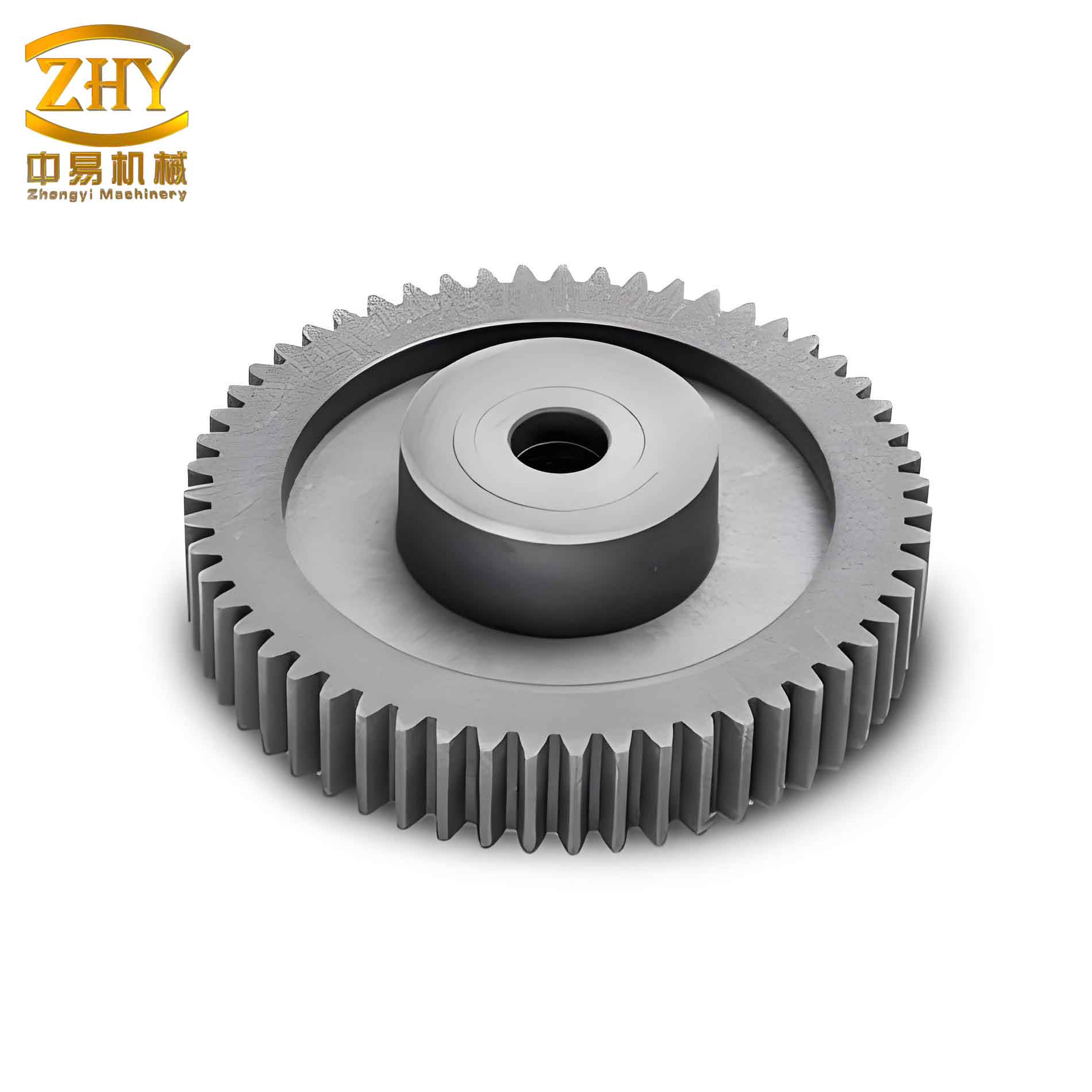
To model the spur and pinion gear system, a lumped-parameter approach is employed, considering both translational and rotational degrees of freedom. The system includes six degrees of freedom: four translational (x and y directions for both gears) and two rotational (torsional vibrations). This bending-torsion coupled model accounts for gear mass, inertia, support stiffness, damping, and meshing forces. The generalized displacement vector is defined as:
$$\{\delta\} = \{x_p, y_p, \theta_p, x_g, y_g, \theta_g\}^T$$
where \(x_p\) and \(y_p\) are the translational displacements of the pinion (driver gear), \(\theta_p\) is its torsional displacement, and similarly for the gear (driven gear). The relative displacement along the line of action, \(y\), is given by:
$$y = y_p + R_p \theta_p – y_g + R_g \theta_g$$
Here, \(R_p\) and \(R_g\) are the base circle radii of the spur and pinion gear, respectively. The dynamic meshing force \(F_p\) on the pinion and \(F_g\) on the gear are expressed as:
$$F_p = c_m \dot{y} + k_m y$$
$$F_g = -F_p = -c_m \dot{y} – k_m y$$
where \(c_m\) is the meshing damping and \(k_m\) is the time-varying meshing stiffness. The friction force \(F_f\) is approximated as \(F_f = f F_p\), with \(f\) being the equivalent friction coefficient. The equations of motion are derived using Newton’s second law, resulting in a matrix form:
$$M \ddot{\delta} + C \dot{\delta} + K \delta = F$$
The mass matrix \(M\), damping matrix \(C\), and stiffness matrix \(K\) are constructed based on gear parameters. For instance, the mass matrix is diagonal:
$$M = \text{diag}(m_p, m_p, I_p, m_g, m_g, I_g)$$
where \(m_p\) and \(m_g\) are the masses, and \(I_p\) and \(I_g\) are the moments of inertia of the spur and pinion gear, respectively. The stiffness matrix \(K\) includes time-varying terms due to \(k_m\), making the system nonlinear. The force vector \(F\) accounts for external torques \(T_p\) and \(T_g\). Solving these equations using numerical methods like the Runge-Kutta algorithm yields the dynamic response of the spur and pinion gear system.
A critical aspect of this model is the calculation of time-varying meshing stiffness \(k_m\). For spur and pinion gears, the energy method is applied, considering various potential energy components: bending, shear, axial compression, Hertzian contact, and gear body deformation. The total stiffness for a tooth pair is the sum of these contributions:
$$\frac{1}{K} = \frac{1}{K_b} + \frac{1}{K_s} + \frac{1}{K_a} + \frac{1}{K_h} + \frac{1}{K_f}$$
where \(K_b\) is bending stiffness, \(K_s\) is shear stiffness, \(K_a\) is axial compression stiffness, \(K_h\) is Hertzian contact stiffness, and \(K_f\) is gear body deformation stiffness. Each component is derived using integral expressions. For example, bending stiffness is given by:
$$\frac{1}{K_b} = \int_0^l \frac{[(l-x)\cos \alpha_p – h \sin \alpha_p]^2}{E I_x} dx$$
Here, \(E\) is Young’s modulus, \(I_x\) is the area moment of inertia at distance \(x\) from the tooth root, \(l\) is the tooth length, \(\alpha_p\) is the pressure angle, and \(h\) is the tooth height. Similar integrals define other stiffness components. For spur and pinion gears, these calculations must account for geometric parameters such as tooth width \(W\), modulus, and number of teeth. The meshing stiffness for a gear pair is then the sum of stiffnesses for all simultaneously engaged tooth pairs:
$$k_m(t) = \sum_{i=1}^N K_i^j$$
where \(N\) is the number of tooth pairs in contact, and \(K_i^j\) is the stiffness of the \(i\)-th pair at contact point \(j\). This approach provides a realistic stiffness profile for healthy spur and pinion gears.
When faults are present, the stiffness calculation changes. For crack faults in spur and pinion gears, the crack is modeled as a straight line starting from the tooth root, with parameters like crack length \(q_0\), crack angle \(\alpha_c\), and distance from the tooth centerline \(h_c\). The effective area moment of inertia \(I_x\) and cross-sectional area \(A_x\) are modified based on crack geometry. For instance, if the crack affects a section, these become:
$$I_x = \begin{cases} \frac{1}{12}(h_x + h_x)^3 W & \text{if } h_x \leq h_q \\ \frac{1}{12}(h_x + h_q)^3 W & \text{if } h_x > h_q \end{cases}$$
where \(h_q = h_c – q_0 \sin \alpha_c\). Substituting these into the stiffness integrals yields the reduced stiffness for cracked teeth. For pitting faults, which are common in spur and pinion gears due to surface fatigue, the pit is modeled as a rectangular cavity with length \(a_s\), width \(w_s\), and depth \(h_s\). The effective tooth width \(\Delta W_x\), area \(\Delta A_x\), and moment of inertia \(\Delta I_x\) are adjusted:
$$\Delta W_x = \begin{cases} w_s & \text{if } x \in [\mu – \frac{a_s}{2}, \mu + \frac{a_s}{2}] \\ 0 & \text{otherwise} \end{cases}$$
where \(\mu\) is the distance from the pit center to the tooth root. The modified parameters \(I_x’ = I_x – \Delta I_x\), \(A_x’ = A_x – \Delta A_x\), and \(W_x’ = W – \Delta W_x\) are used in stiffness calculations. These adjustments capture the localized stiffness reduction caused by pitting in spur and pinion gears.
To illustrate the impact of faults, consider a spur and pinion gear pair with parameters summarized in Table 1. The pinion has 23 teeth, and the gear has 84 teeth, both with a modulus of 2 mm and a pressure angle of 20°. The pinion mass is 0.22 kg, and the gear mass is 1.9 kg. For a healthy spur and pinion gear, the time-varying meshing stiffness shows periodic variations due to single and double tooth contact regions. When cracks are introduced in the pinion tooth root with a depth of 1 mm, 1.5 mm, and 2 mm, the stiffness decreases progressively, as shown in Figure 1. Similarly, for pitting faults on the pinion tooth surface with pit lengths of 0.5 mm, 0.7 mm, and 0.9 mm, the stiffness reduction is more pronounced during the engagement of the faulty tooth. These changes directly affect the dynamic response of the spur and pinion gear system.
| Parameter | Pinion (Driver) | Gear (Driven) |
|---|---|---|
| Number of Teeth | 23 | 84 |
| Modulus (mm) | 2 | 2 |
| Pressure Angle (°) | 20 | 20 |
| Tooth Width (mm) | 20 | 20 |
| Mass (kg) | 0.22 | 1.9 |
| Moment of Inertia (kg·m²) | 4.86 × 10⁻⁵ | 3.51 × 10⁻³ |
| Base Circle Radius (mm) | Calculated from geometry | Calculated from geometry |
The dynamic response of spur and pinion gears under fault conditions is obtained by solving the equations of motion with the modified stiffness. For a pinion speed of 1800 rpm, the displacement responses in the y-direction are computed. In healthy spur and pinion gears, the response is steady with consistent amplitude. For cracked spur and pinion gears, periodic impulses appear in the time-domain signal, corresponding to the faulty tooth engagement. The frequency spectrum shows sidebands around the meshing frequency \(f_m\) and its harmonics, modulated by the pinion rotational frequency \(f_r\). For pitted spur and pinion gears, the impulses are less severe but still observable, with sidebands concentrated around higher harmonics. These features are crucial for fault diagnosis in spur and pinion gear systems.
To ensure the model accuracy, system parameters such as support stiffness and damping must be calibrated using experimental data. For spur and pinion gears mounted in a gearbox, the support structure influences vibration transmission. The gear-shaft-bearing system is modeled as a two-degree-of-freedom system in x and y directions, with stiffness coefficients \(k_{xx}\), \(k_{xy}\), \(k_{yx}\), \(k_{yy}\) and damping coefficients \(c_{xx}\), \(c_{xy}\), \(c_{yx}\), \(c_{yy}\). The equations of motion are:
$$m \ddot{x} + 2(c_{xx} \dot{x} + c_{xy} \dot{y} + k_{xx} x + k_{xy} y) = f_x(t)$$
$$m \ddot{y} + 2(c_{yx} \dot{x} + c_{yy} \dot{y} + k_{yx} x + k_{yy} y) = f_y(t)$$
Assuming harmonic excitation, the frequency response functions (FRFs) are derived. For example, the FRF between x-direction force and x-direction acceleration is:
$$R_{xx} = \frac{X}{F_x} = \frac{m \omega^2 – 2j \omega c_{yy} – 2k_{yy}}{\omega^2 H}$$
where \(H\) is a determinant involving all stiffness and damping terms. Experimental FRFs are obtained through impact testing on the gearbox housing. By minimizing the error between experimental and simulated FRFs, the support parameters are identified. For spur and pinion gears, this process refines the model to match real-world conditions. The identified parameters are then used in the dynamic model for spur and pinion gears, improving prediction accuracy.
Experimental validation is conducted on a test rig with spur and pinion gears. Vibration acceleration signals are acquired from the gearbox housing in the radial direction at a sampling rate of 51,200 Hz. The signals are processed using time-synchronous averaging to reduce noise. For healthy spur and pinion gears, the time-domain signal shows steady vibrations, and the frequency spectrum is dominated by the meshing frequency \(f_m = 690 \text{ Hz}\) (for 23 teeth at 1800 rpm) and its harmonics, without significant sidebands. For cracked spur and pinion gears, periodic impacts are observed every 0.034 s, matching the pinion rotation period. The spectrum exhibits sidebands around \(2f_m\) and \(3f_m\), spaced by \(f_r = 30 \text{ Hz}\). For pitted spur and pinion gears, under loaded conditions, slight amplitude modulations occur, with sidebands appearing around higher harmonics. These experimental results align well with simulations, confirming the model’s ability to capture fault features in spur and pinion gears.
To further explore fault severity, simulations are performed for different crack depths and pit sizes in spur and pinion gears. As crack depth increases from 1 mm to 2 mm, the impulse amplitude in the time-domain response grows, and sideband magnitude in the spectrum rises. For pitting, as pit length increases from 0.5 mm to 0.9 mm, the stiffness reduction becomes more severe, leading to higher vibration levels. These trends are summarized in Table 2, which correlates fault severity with dynamic features for spur and pinion gears. Such data is valuable for building fault databases and training diagnostic algorithms.
| Fault Type | Severity Parameter | Time-Domain Feature | Frequency-Domain Feature |
|---|---|---|---|
| Crack | Depth: 1 mm | Small periodic impulses | Weak sidebands around \(2f_m\) |
| Depth: 1.5 mm | Moderate impulses | Clear sidebands around \(2f_m\) and \(3f_m\) | |
| Depth: 2 mm | Large impulses | Strong sidebands across harmonics | |
| Pitting | Length: 0.5 mm | Slight amplitude modulation | Minor sidebands near \(f_m\) |
| Length: 0.7 mm | Noticeable modulation | Sidebands around \(2f_m\) | |
| Length: 0.9 mm | Pronounced modulation | Sidebands around \(2f_m\) and \(3f_m\) |
The model’s versatility allows for simulating various fault scenarios in spur and pinion gears without physical testing. For instance, combined faults like cracks and pitting can be analyzed by superimposing stiffness modifications. Additionally, the model can incorporate other factors such as gear misalignment or tooth wear, though these are beyond the current scope. The key advantage is the ability to generate large datasets for machine learning applications in fault diagnosis of spur and pinion gear systems. By running simulations under different operating conditions (e.g., speed, load), a comprehensive database can be created, enabling the development of robust diagnostic tools.
In conclusion, this article presents a dynamic modeling framework for spur and pinion gears with faults, integrating lumped-parameter modeling, energy-based stiffness calculation, and system parameter modification. The model accurately captures the effects of cracks and pitting on time-varying meshing stiffness and dynamic response. Experimental validation shows good agreement between simulations and measured vibrations, confirming the model’s reliability. The approach facilitates the generation of fault data for spur and pinion gears, supporting the creation of diagnostic databases. Future work could extend the model to include more complex fault types, nonlinear damping effects, and advanced signal processing techniques. Ultimately, this research enhances the understanding of fault mechanisms in spur and pinion gears, contributing to improved maintenance strategies and system reliability.
The mathematical formulations throughout this work emphasize the importance of precise stiffness calculation. For spur and pinion gears, the meshing stiffness can be expressed in a generalized form as:
$$k_m(t) = \left[ \sum_{i=1}^N \left( \int_0^l \frac{[(l-x)\cos \alpha_p – h \sin \alpha_p]^2}{E I_x} dx + \int_0^l \frac{1.2 \cos^2 \alpha_p}{G A_x} dx + \int_0^l \frac{\sin^2 \alpha_p}{E A_x} dx \right)^{-1} + \frac{\pi E W}{4(1-\nu^2)} + \frac{WE}{\cos^2 \alpha_p} \left( L^* \left( \frac{u_f}{s_f} \right)^2 + M^* \left( \frac{u_f}{s_f} \right) + P^* (1+Q^* \tan^2 \alpha_p) \right) \right]^{-1}$$
This comprehensive expression accounts for all energy components. When faults are present, modifications to \(I_x\), \(A_x\), and \(W\) are incorporated as described. For practical applications, numerical integration is used to compute these integrals efficiently. The dynamic equations are solved iteratively to obtain responses like displacement, velocity, and acceleration for spur and pinion gears.
Furthermore, the model modification process involves optimizing parameters to minimize the error function:
$$\epsilon = \min \sum_{i=x,y} \sum_{j=x,y} \sum_{\omega} | R_{ij}(\omega)_s – R_{ij}(\omega)_e |$$
where \(R_{ij}(\omega)_s\) are simulated FRFs and \(R_{ij}(\omega)_e\) are experimental FRFs. This optimization ensures that the model reflects actual support conditions for spur and pinion gears. The identified parameters, such as \(k_{px} = k_{xx} + k_{xy}\) and \(k_{py} = k_{yy} + k_{yx}\), are then used in the dynamic model, enhancing its predictive capability for spur and pinion gear systems.
In summary, the proposed methodology offers a systematic approach to modeling and analyzing faulty spur and pinion gears. By combining theoretical modeling with experimental calibration, it provides a powerful tool for fault simulation and diagnosis. The repeated focus on spur and pinion gears throughout this article underscores their significance in mechanical systems and the need for advanced diagnostic techniques. As technology evolves, such models will play a crucial role in enabling condition-based maintenance and improving the longevity of spur and pinion gear transmissions.