
As a fundamental component in countless mechanical power transmission applications, the reliability and longevity of spur gear pairs are paramount. Among the various failure modes that plague these systems, surface wear stands out as a prevalent and gradual degradation mechanism that can significantly alter system dynamics, increase noise and vibration, and ultimately lead to catastrophic failure if left unchecked. Traditional wear models often simplify the complex interactive process by assuming static load distribution or constant wear coefficients. This work aims to bridge this gap by developing a comprehensive dynamic wear model for spur gear systems that concurrently accounts for the time-varying nature of mesh stiffness, the resulting dynamic loads, and the instantaneous lubrication-dependent wear coefficient. The objective is to reveal the nuanced characteristics of wear distribution along the involute profile and to quantitatively assess the sensitivity of wear progression to key design parameters.
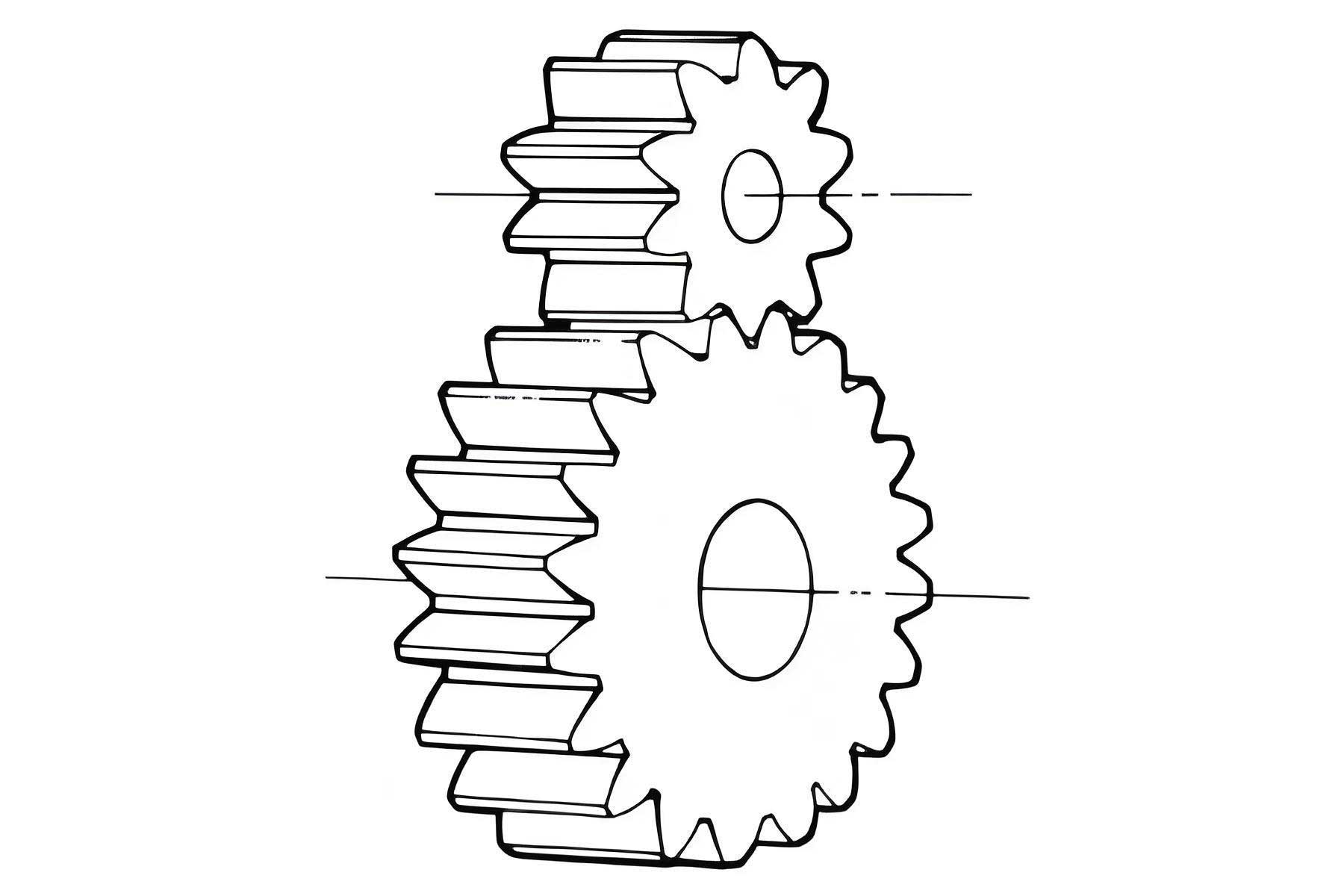
The core of the dynamic analysis lies in accurately capturing the forces acting between meshing teeth. We begin by modeling the spur gear pair as a lumped-parameter, two-degree-of-freedom torsional system. The equations of motion incorporate key nonlinearities and excitations inherent to geared systems:
$$
\begin{aligned}
T_{in} &= J_1 \ddot{\theta}_1 + c_m (r_{b1}\dot{\theta}_1 – r_{b2}\dot{\theta}_2 – \dot{e}(t)) + k_m(t) f(r_{b1}\theta_1 – r_{b2}\theta_2 – e(t), b_g) \\
-T_{out} &= J_2 \ddot{\theta}_2 – c_m (r_{b1}\dot{\theta}_1 – r_{b2}\dot{\theta}_2 – \dot{e}(t)) – k_m(t) f(r_{b1}\theta_1 – r_{b2}\theta_2 – e(t), b_g)
\end{aligned}
$$
Here, $T_{in}$ and $T_{out}$ are the input and output torques, $J_1$, $J_2$ are polar moments of inertia, and $\theta_1$, $\theta_2$ are angular displacements. $r_{b1}$ and $r_{b2}$ denote base circle radii. The mesh damping $c_m$ is derived from the average mesh stiffness $\bar{k_m}$ and a damping ratio $\zeta$. The function $f(\delta, b_g)$ represents the nonlinear backlash element, where $\delta = r_{b1}\theta_1 – r_{b2}\theta_2 – e(t)$ is the dynamic transmission error and $b_g$ is the constant gear backlash. $e(t)$ models internal static transmission error excitations.
A critical component is the time-varying mesh stiffness $k_m(t)$. For a spur gear pair, this stiffness fluctuates periodically as the number of tooth pairs in contact alternates between one and two. We employ the Weber-Banaschek method to calculate the comprehensive tooth deflection, considering bending, shear, foundation deformation, and Hertzian contact compliance. The single tooth stiffness $k_g(t)$ is thus obtained, and the total mesh stiffness for a pair is the summation of the stiffness of all contacting tooth pairs. The transition points between single and double tooth contact are determined by the pressure angles at the start and end of the single-pair contact zone:
$$
\begin{aligned}
\varphi_{s} &= \arctan\left( \sqrt{(r_{a2}/r_{b2})^2 – 1} – (2\pi / N_1) \right) – \alpha’ \\
\varphi_{e} &= \arctan\left( \sqrt{(r_{a1}/r_{b1})^2 – 1} \right) + \alpha’
\end{aligned}
$$
where $r_{aj}$, $r_{bj}$ are addendum and base circle radii, $N_1$ is the pinion tooth number, and $\alpha’$ is the operating pressure angle. The dynamic mesh force $W_d(t)$ is then computed from the system’s dynamic response:
$$
W_d(t) =
\begin{cases}
k_g(t) \delta(t) + c_m \dot{\delta}(t), & \delta(t) > 0 \\
0, & -\delta(t) > b_g \\
k_g(t) (\delta(t) + b_g) + c_m \dot{\delta}(t), & \delta(t) \le 0
\end{cases}
$$
This force, oscillating around the static load, is a primary driver of the wear process.
Wear is not merely a function of load; the interfacial conditions play a crucial role. We model the instantaneous wear coefficient $k_w$ as a function of the specific film thickness $\lambda$, which is the ratio of the minimum elastohydrodynamic lubrication (EHL) film thickness $H_{min}$ to the composite surface roughness $\sigma$. The relationship captures three distinct lubrication regimes:
$$
k_w(\lambda) =
\begin{cases}
k_0, & \lambda < 0.5 \quad \text{(Boundary Lubrication)} \\
k_0 \cdot \frac{2}{7}(4 – \lambda), & 0.5 \le \lambda < 4 \quad \text{(Mixed Lubrication)} \\
0, & \lambda \ge 4 \quad \text{(Full-Film EHL)}
\end{cases}
$$
where $k_0$ is the constant wear coefficient for boundary lubrication. The minimum film thickness at any contact point along the line of action is estimated using the Dowson-Higginson formula:
$$
H_{min} = 1.6 \alpha^{0.53} (\eta_0 U)^{0.67} (E’)^{0.067} R^{0.464} W^{-0.073}
$$
Here, $\alpha$ is the pressure-viscosity coefficient, $\eta_0$ is the dynamic viscosity, $U$ is the entraining velocity, $E’$ is the equivalent elastic modulus, $R$ is the equivalent radius of curvature, and $W$ is the load per unit width. The composite roughness $\sigma = \sqrt{\sigma_1^2 + \sigma_2^2}$, where $\sigma_1$ and $\sigma_2$ are the root-mean-square roughness of the pinion and gear surfaces, respectively.
To predict wear distribution, the involute profile is discretized. The contact path is divided into $M$ intervals between the start of approach $\varphi_{start}$ and the end of recess $\varphi_{end}$. For the $m$-th discrete point with pressure angle $\varphi_m$, the following local parameters are calculated: the radii of curvature $\rho_{1m}, \rho_{2m}$, the sliding velocities $u_{1m}, u_{2m}$, the dynamic load $W_{dm}$, and the corresponding dynamic wear coefficient $k_{wm}$. The incremental wear depth $\Delta h_{jm}$ for gear $j$ (1 for pinion, 2 for gear) at this point over a small number of cycles $\Delta n$ is given by a modified Archard/Flodin model:
$$
\Delta h_{jm} = k_{wm} \cdot \frac{|u_{1m} – u_{2m}|}{\max(u_{1m}, u_{2m})} \cdot P_{hm} \cdot s_m \cdot \Delta n
$$
where $P_{hm} = \frac{2 W_{dm}}{\pi a_m B}$ is the maximum Hertzian contact pressure, $a_m = \sqrt{\frac{8 W_{dm} \rho_{eqm}}{\pi B E’}}$ is the semi-contact width, $\rho_{eqm}=(\rho_{1m}\rho_{2m})/(\rho_{1m}+\rho_{2m})$, $B$ is the face width, and $s_m$ is the sliding distance per mesh cycle at point $m$. The total accumulated wear depth $H_{jm}$ after $N$ cycles is the summation of all incremental wears at that point.
A series of simulations were conducted for a standard spur gear pair with baseline parameters: pinion teeth $z_1=30$, gear teeth $z_2=40$, module $m_n=4$ mm, pressure angle $\alpha=20^\circ$, face width $B=30$ mm, input torque $T_{in}=60$ Nm. The dynamic response was solved numerically.
The computed time-varying mesh stiffness exhibits the characteristic pattern with two double-pair and one single-pair contact zones per mesh cycle, as shown in Table 1.
| Parameter | Symbol | Value | Unit |
|---|---|---|---|
| Average Mesh Stiffness | $\bar{k_m}$ | 4.5e8 | N/m |
| Peak-to-Peak Dynamic Load Variation ($\zeta=0.05$) | $\Delta W_d$ | ~40% of Static | — |
| Single-Pair Contact Pressure Angle Range | $[\varphi_s, \varphi_e]$ | [22.5°, 24.8°] | deg |
The resulting dynamic load $W_d(t)$ oscillates significantly, with amplitude heavily dependent on the damping ratio $\zeta$. Lower damping leads to larger load fluctuations, which profoundly impacts wear accumulation.
The accumulated wear depth along the involute profile for the baseline case after $10^6$ cycles is non-uniform. Key observations are summarized below and in Table 2.
| Gear | Location | Accumulated Wear Depth (µm) | Primary Contributing Factor |
|---|---|---|---|
| Pinion | Tip (Approach) | 25.7 | High Sliding Velocity |
| Root (Recess) | 18.3 | ||
| Gear | Tip (Recess) | 17.2 | High Sliding Velocity |
| Root (Approach) | 12.1 | ||
| Pitch Point (Both) | < 5.0 | Pure Rolling, High $\lambda$ | |
The wear is minimum near the pitch point due to near-zero sliding velocity and the likely transition to mixed/full-film EHL ($\lambda$ increases). Maximum wear occurs at the tip of the driving gear (pinion) and the root of the driven gear (gear), which are the points where both sliding velocity and pressure are high at the start of engagement. The pinion consistently exhibits more severe wear than the gear because its teeth undergo more frequent loading cycles ($z_1 < z_2$).
The influence of the gear ratio $i = z_2/z_1$ on wear was investigated. Figure 6 in the original text illustrated a clear trend: wear severity increases dramatically for speed-increasing ratios ($i < 1$). This is quantified in Table 3 for the tip wear of the smaller gear in each pair.
| Transmission Ratio (i) | System Type | Smaller Gear | Wear Depth (µm) | Sensitivity |
|---|---|---|---|---|
| 0.83 ($z_1=30, z_2=25$) | Speed Increase | Gear (z2) | 43.3 | Very High |
| 1.00 ($z_1=30, z_2=30$) | 1:1 | Both | ~30.5 | High |
| 1.33 ($z_1=30, z_2=40$) | Speed Reduction | Pinion (z1) | 25.7 | Medium |
| 2.00 ($z_1=30, z_2=60$) | Speed Reduction | Pinion (z1) | 19.8 | Low |
The high sensitivity for $i < 1$ is attributed to the rapid increase in the sum of angular velocities $\omega_1 + \omega_2$, which amplifies sliding velocities and contact fatigue frequency. For $i > 1.5$, the wear depth becomes less sensitive to further ratio changes.
The module $m_n$ directly affects tooth size, stiffness, and curvature. Its impact on wear at the tip is shown in Table 4.
| Module, $m_n$ (mm) | Pinion Tip Wear (µm) | Relative Change | Sensitivity Region |
|---|---|---|---|
| 1 | 48.9 | — | Very High ($m_n < 2$ mm) |
| 2 | 36.1 | -26% | |
| 3 | 29.5 | -18% | High ($2 \le m_n < 4$ mm) |
| 4 | 25.7 | -13% | Low ($m_n \ge 4$ mm) |
| 5 | 23.2 | -10% |
Smaller modules lead to significantly higher wear due to reduced contact radii (higher contact pressure) and potentially lower single-tooth stiffness, which can exacerbate dynamic load effects. The sensitivity is most pronounced for fine-pitch gears ($m_n < 2$ mm), a critical consideration for precision spur gear systems where wear-induced accuracy loss is detrimental.
This integrated dynamic analysis of spur gear wear leads to several critical conclusions. Firstly, wear distribution along the involute profile is inherently non-uniform, dictated by the interplay of dynamic loads, sliding velocity, and the transient lubrication regime. The common engineering observation of increased wear at the pinion is quantitatively confirmed by the model, stemming from its higher meshing frequency. Secondly, transmission ratio is a dominant design factor. Speed-increasing spur gear stages ($i < 1$) exhibit exponentially higher wear rates and should be avoided or carefully designed for in single-stage applications, whereas the wear in speed-reducing stages becomes less sensitive beyond a ratio of about 1.5. Thirdly, module selection has a non-negligible impact, especially for fine-pitch gears. While smaller modules save space, they can accelerate wear progression; therefore, selecting an adequately large module is crucial for maintaining long-term accuracy in precision drives.
The presented model, by synthesizing dynamics and tribology, provides a more realistic framework for predicting spur gear wear life. Future work should focus on incorporating the feedback effect of progressive wear on the system’s dynamic parameters (e.g., modifying tooth profile and thereby $k_m(t)$ and $e(t)$), creating a true two-way coupled simulation to predict long-term wear evolution and its impact on vibration signatures.