
The strain wave gear, also known as a harmonic drive, is a unique and highly effective gearing mechanism known for its exceptional reduction ratios, compactness, high torque capacity, and near-zero backlash when properly designed. The minimization and precise control of meshing backlash stand as one of the most critical challenges in the design of high-performance strain wave gear transmissions. Backlash, the clearance between mating teeth, directly influences positional accuracy, stiffness, and dynamic response, making its accurate prediction paramount for applications in robotics, aerospace, and precision instrumentation. This article delves into a detailed methodology for the precise calculation of backlash in strain wave gears with involute tooth profiles, employing an advanced conjugate envelope algorithm based on the exact deformed geometry of the flexspline.
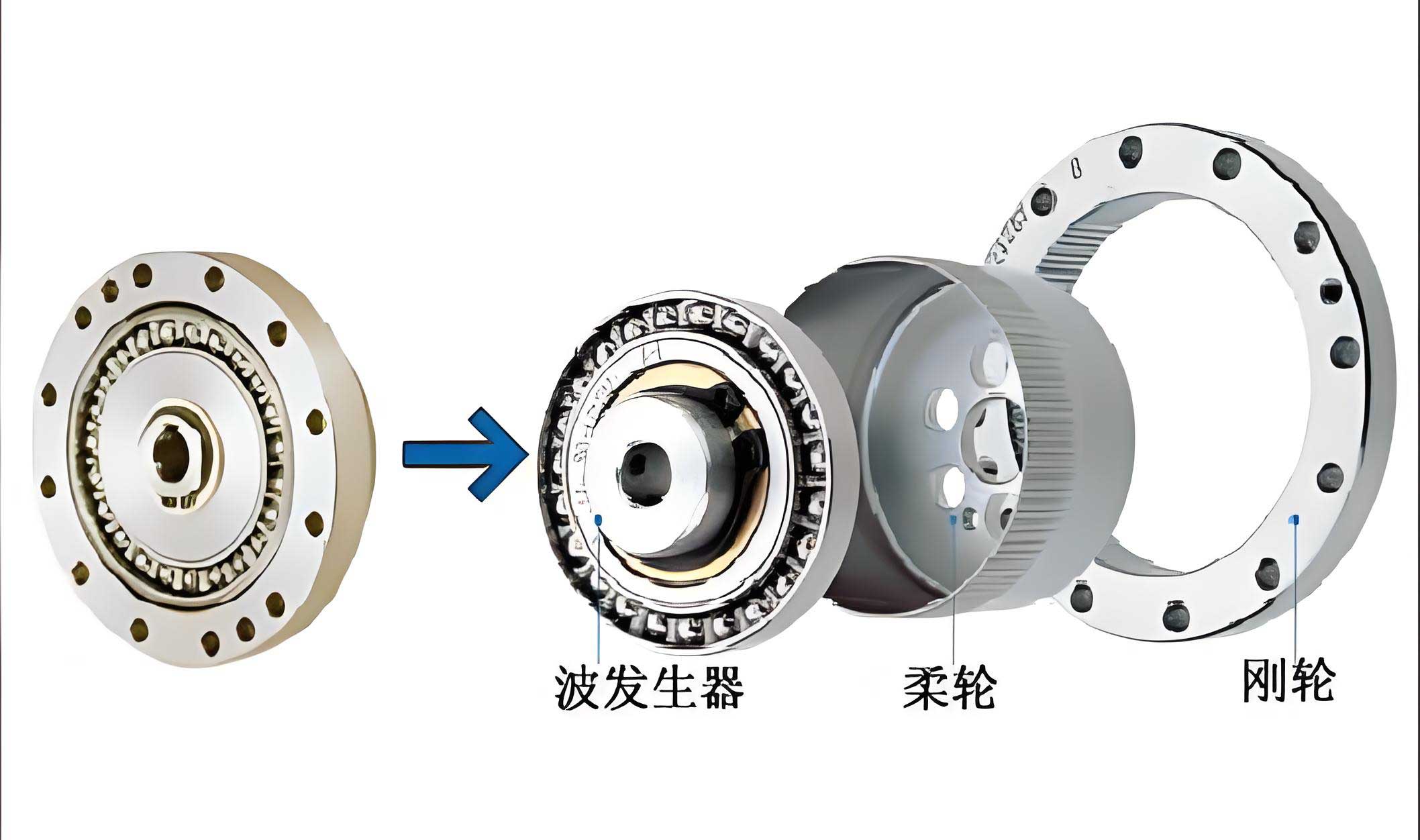
The fundamental operation of a strain wave gear involves three key components: a rigid Circular Spline (CS) with internal teeth, a flexible Flexspline (FS) with external teeth, and an elliptical Wave Generator (WG) placed inside the flexspline. The wave generator deforms the flexspline into a non-circular shape, causing its teeth to engage with those of the circular spline at two diametrically opposite regions. As the wave generator rotates, the engagement zones travel, resulting in a high reduction ratio between the input (wave generator) and output (flexspline or circular spline, depending on configuration). The performance of this elegant system hinges on the accurate kinematic and geometric modeling of the tooth engagement, which is complicated by the significant elastic deformation of the flexspline.
Traditional simplified methods for designing strain wave gear teeth often rely on approximate assumptions regarding the flexspline’s deformation, particularly neglecting or linearizing the relationship between radial displacement and the resulting rotation of the tooth centerline. While these methods provide a foundational understanding, they can introduce inaccuracies in predicting the true conjugate tooth profile of the circular spline and, consequently, the resulting meshing backlash. This work emphasizes a more rigorous approach: a conjugate precise algorithm that accurately determines the position of the flexspline teeth in their assembled, deformed state by calculating both the tangential displacement-induced rotation and the precise rotation of the tooth profile’s symmetry line relative to the radius vector.
Mathematical Foundation: The Conjugate Envelope Theory
The core of the precise tooth profile generation for the strain wave gear lies in the theory of conjugate surfaces, solved via the envelope method. We consider a fixed coordinate system \(\{OXY\}\) attached to the stationary wave generator, with the Y-axis aligned with its major axis. Two moving coordinate systems are defined: \(\{o_1x_1y_1\}\) attached to the flexspline and \(\{o_2x_2y_2\}\) attached to the circular spline.
The fundamental premise is the “straight normal” assumption for the flexspline’s neutral surface: a plane that is perpendicular to the neutral surface before deformation remains a plane and stays perpendicular to the deformed neutral surface. This allows us to trace the motion of a flexspline tooth profile. When the flexspline rotates with an angular velocity \(\omega_1\), its motion is a composite of translation along the deformed neutral curve \(C\) and an additional rotation about the instantaneous center on that curve.
The condition for the circular spline tooth profile to be conjugate to the moving flexspline profile is that it must be the envelope of the family of curves generated by the flexspline tooth in the coordinate system of the circular spline. This leads to a system of equations. The coordinates \((x_2, y_2)\) of a point on the generated circular spline profile are given by the coordinate transformation of the flexspline point \((x_1, y_1)\), and the envelope condition is derived by setting the determinant of the Jacobian of this transformation with respect to the motion parameter to zero.
The general mathematical formulation, relating the geometry of the deformed flexspline neutral curve (defined by its radial displacement \(w(\phi)\) from a base circle of radius \(r_m\)), the flexspline involute parameters, and the motion parameters, is complex. For an involute flexspline tooth, its profile coordinates in its local system \(\{o_1x_1y_1\}\) are:
$$
\begin{cases}
x_1 = r_1[-\sin(u_1 – \theta_1) + u_1 \cos\alpha_0 \cos(u_1 – \theta_1 + \alpha_0)] \\
y_1 = r_1[\cos(u_1 – \theta_1) + u_1 \cos\alpha_0 \sin(u_1 – \theta_1 + \alpha_0)] – r_m
\end{cases}
$$
where \(r_1\) is the flexspline pitch radius, \(\alpha_0\) is the standard pressure angle, \(u_1\) is the generating parameter (related to the roll angle of the tool), and \(\theta_1\) is half the angular tooth thickness on the pitch circle.
The complete system for the conjugate circular spline profile \((x_2, y_2)\), derived via envelope theory and accounting for the deformed flexspline position characterized by angles \(\phi_1\) (rotation of deformed end), \(\mu\) (tooth symmetry line rotation), and the mesh phase angle \(\gamma = \phi_1 – \phi_2\), can be summarized as:
$$
\begin{aligned}
x_2 &= r_1(\sin \varepsilon + u_1 \cos\alpha_0 \cos\lambda) – r_m \sin\Phi + \rho \sin \phi_1 \\
y_2 &= r_1(\cos \varepsilon – u_1 \cos\alpha_0 \sin\lambda) – r_m \cos\Phi + \rho \cos \phi_1 \\
F(\phi, u_1) &= 0 \quad \text{(The Envelope Condition)}
\end{aligned}
$$
with the auxiliary angles defined as:
$$
\rho = r_m + w, \quad \Phi = \mu + \gamma, \quad \varepsilon = \Phi – (u_1 – \theta_1), \quad \lambda = \Phi – (u_1 – \theta_1 + \alpha_0)
$$
The specific form of the envelope condition \(F(\phi, u_1)=0\) is a differential equation involving derivatives of \(w\), \(\rho\), \(\mu\), and \(\gamma\) with respect to the independent motion parameter \(\phi\).
The Precise Algorithm for Flexspline Tooth Positioning
A critical innovation in this analysis is the use of a precise algorithm for calculating the key angles \(\mu\) and \(\phi_1\) that define the position and orientation of the flexspline tooth in its deformed state. Older, simplified methods often used approximations that become less valid for certain deformation shapes or higher wave amplitudes.
1. Precise Rotation of Tooth Symmetry Line (\(\mu\)):
The angle \(\mu\) that the tooth’s symmetric axis rotates relative to the radial vector is not simply proportional to the derivative of radial displacement. From differential geometry, for a neutral curve defined in polar coordinates by \(\rho(\phi) = r_m + w(\phi)\), the precise expression is:
$$
\mu(\phi) = -\arctan\left( \frac{dw/d\phi}{r_m + w(\phi)} \right)
$$
2. Precise Relation between Angular Coordinates (\(\phi\) and \(\phi_1\)):
The condition of zero elongation of the neutral surface is enforced exactly, not linearly. The length of an undeformed arc (\(r_m \phi\)) must equal the length of the corresponding deformed curve segment:
$$
r_m \phi = \int_{0}^{\phi_1} \sqrt{ \rho^2 + \left( \frac{d\rho}{d\phi_1} \right)^2 } \, d\phi_1
$$
This integral equation implicitly defines \(\phi_1\) as a function of the undeformed angle \(\phi\). An iterative numerical method (e.g., Newton-Raphson) is required to solve for \(\phi_1\) for any given \(\phi\).
These precise calculations for \(\mu\) and \(\phi_1\) are then fed into the conjugate envelope equations to generate the theoretically exact tooth profile for the circular spline, which we denote as curve \(G\). This profile is a non-standard curve, not a perfect involute.
| Calculation Aspect | Simplified (Approximate) Algorithm | Precise (Exact) Algorithm |
|---|---|---|
| Tooth Symmetry Line Rotation (\(\mu\)) | $\mu \approx -\frac{1}{r_m} \frac{dw}{d\phi}$ | $\mu = -\arctan\left( \frac{dw/d\phi}{r_m + w} \right)$ |
| Angle Relationship (\(\phi_1\) vs \(\phi\)) | $\phi_1 \approx \phi + \frac{\nu(\phi)}{r_m}$ (linearized) | $r_m \phi = \int_{0}^{\phi_1} \sqrt{\rho^2 + (\frac{d\rho}{d\phi_1})^2} \, d\phi_1$ |
| Primary Assumption | Small $w$, linearized geometry | Exact differential geometry, neutral surface incompressibility |
| Computational Effort | Low (direct calculation) | High (requires solving integral/iterative equations) |
Curve Fitting for Practical Manufacture
The theoretically generated circular spline profile \(G\) is a complex curve. For practical manufacturing using standard gear cutting tools (hobbers, gear shapers), it is highly desirable to approximate this profile with a standard involute. This is achieved through a curve fitting optimization process.
Let the set of discrete points defining the theoretical profile \(G\) be \((x_{2k}, y_{2k})\) for \(k=1, 2, …, n\). The goal is to find the parameters of an involute profile (primarily the profile shift coefficient \(x_2\) and the effective operating pressure angle) that best approximates \(G\) from the “metal side” (i.e., without interference). The standard involute curve \(G_W\) is described by:
$$
\begin{cases}
x_{2W} = r_2[ \sin(\phi_2 – (u_2 – \theta_2)) + u_2 \cos\alpha_0 \cos(\phi_2 – (u_2 – \theta_2 + \alpha_0)) ] \\
y_{2W} = r_2[ \cos(\phi_2 – (u_2 – \theta_2)) – u_2 \cos\alpha_0 \sin(\phi_2 – (u_2 – \theta_2 + \alpha_0)) ]
\end{cases}
$$
where \(r_2\) is the circular spline pitch radius, \(u_2 = \tan\alpha_2 – \tan\alpha_0\), \(\alpha_2 = \arccos(r_b / r_k)\), \(r_b = r_2 \cos\alpha_0\), and \(\theta_2\) is half the angular tooth space on the circular spline pitch circle.
The fitting procedure is as follows:
1. For each point \(K\) on \(G\) with radial distance \(r_k = \sqrt{x_{2k}^2 + y_{2k}^2}\), find the corresponding point \(K_W\) on the candidate involute \(G_W\) that lies at the same radius \(r_k\).
2. The corresponding involute parameter is \(\alpha_{2k} = \arccos(r_2 \cos\alpha_0 / r_k)\), giving \(u_{2k} = \tan\alpha_{2k} – \tan\alpha_0\).
3. To avoid interference, enforce a unilateral fit: \(\Delta x_k = x_{2Wk} – x_{2k} \ge 0\) for all points.
4. The objective is to minimize the average radial deviation \(\epsilon_m\) between the two curves:
$$
\epsilon_m = \frac{\sum_{k=1}^{n} d_k}{n}, \quad \text{where} \quad d_k = \sqrt{(x_{2Wk} – x_{2k})^2 + (y_{2Wk} – y_{2k})^2}
$$
5. The primary variable in this optimization is the profile shift coefficient \(x_2\) of the circular spline. The optimal \(x_2\) is found iteratively to satisfy: \(\epsilon_m = \min\) subject to \(\Delta x_k \ge 0\).
Backlash Calculation Methodology
With the flexspline parameters (profile shift \(x_1\)) chosen and the circular spline parameters (profile shift \(x_2\), tooth depth) determined via the fitting process, the meshing backlash can be calculated. Backlash is evaluated at discrete angular positions of engagement, \(\phi\), around the gear.
For a given meshing position \(\phi\), the circumferential backlash \(j_t\) is the shortest distance between the non-working flanks of adjacent teeth. The calculation process is:
1. Select a point \(K_1\) on the flexspline tooth profile in the global coordinate system. Its coordinates \((X_{K1}, Y_{K1})\) are found by transforming its local coordinates using the precise deformation angles \(\phi_1\) and \(\mu\), and the wave generator geometry.
2. Calculate the radial distance to this point: \(r_k = \sqrt{X_{K1}^2 + Y_{K1}^2}\).
3. Find the intersection point \(K_2\) on the adjacent circular spline tooth profile that lies at the same radial distance \(r_k\). This involves solving for the involute parameter \(u_2\) that satisfies the radial distance condition for the circular spline profile equation.
4. The circumferential backlash \(j_t\) for that point-pair is approximated by the linear distance:
$$
j_t \approx \sqrt{ (X_{K2} – X_{K1})^2 + (Y_{K1} – Y_{K2})^2 }
$$
5. Steps 1-4 are repeated for multiple points \(K_1\) along the active portion of the flexspline tooth height (from root to tip). The minimum value of \(j_t\) found across all these points is recorded as the backlash for that specific meshing position \(\phi\).
A critical finding from this detailed analysis is that the minimum backlash for a given meshing position always occurs at one of two extreme locations: either between the circular spline tooth tip and the opposing flexspline flank, or between the flexspline tooth tip and the opposing circular spline flank. The backlash varies monotonically between these two extremes across the tooth depth.
Comprehensive Calculation Example and Results Analysis
To illustrate the complete methodology and compare the precise and simplified algorithms, a detailed example is presented for a standard double-wave strain wave gear.
Gear Parameters:
– Teeth: \(z_1 = 140\) (Flexspline), \(z_2 = 142\) (Circular Spline)
– Module: \(m = 0.2 \text{ mm}\)
– Pressure Angle: \(\alpha_0 = 20^\circ\)
– Helix Angle: \(\beta = 30^\circ\)
– Flexspline Profile Shift: \(x_1 = 2.13\)
– Wave Generator Radial Deformation: \(w_0 = 1.0m = 0.2 \text{ mm}\)
1. Conjugate Tooth Generation:
Using both the precise and simplified algorithms, the conjugate tooth profile for the circular spline was generated via the envelope method. Visually, the two profiles were very close, suggesting the approximate algorithm has a relatively small impact on the gross shape of the conjugate tooth in this case.
2. Curve Fitting Results:
The numerical points of the theoretical conjugate profile \(G\) were fitted with an involute. The resulting optimal profile shift coefficients for the circular spline were:
– Simplified Algorithm: \(x_2 = 1.859\)
– Precise Algorithm: \(x_2 = 1.861\)
This small but non-zero difference (0.002) indicates that while the shapes are similar, the precise deformation modeling does influence the final manufacturable gear parameter.
3. Backlash Calculation Results:
Backlash was calculated around the entire circumference. The following patterns were observed and are critical for strain wave gear design:
| Observation | Description | Implication |
|---|---|---|
| Location of Minimum Backlash | On the left side of the major axis (max radial displacement), min backlash occurs at the CS tooth tip vs. FS flank. On the right side, it occurs at the FS tooth tip vs. CS flank. | Backlash is not symmetric about the major axis. Tooth contact analysis must check both extremes. |
| Shift of Absolute Minimum | The absolute minimum backlash value around the entire gear does not occur precisely at the point of maximum radial deformation (\(\phi=0^\circ\)). It is shifted in the direction of flexspline rotation (calculated shift: \(5.14^\circ\)). | Validates findings from finite element analysis; critical for ultra-precision designs aiming for zero backlash at a specific load point. |
| Algorithm Comparison | In the region left of the major axis, the simplified algorithm predicted smaller min backlash. In the region right of the major axis, the precise algorithm predicted smaller backlash for a significant portion of the arc. | The precise algorithm provides a more accurate and potentially conservative estimation, crucial for ensuring no interference while minimizing backlash. |
The variation of the minimum circumferential backlash \(j_t\) versus the engagement angle \(\phi\) is the final key result. The curves generated by both algorithms show similar trends but with measurable differences in magnitude at various points. The precise algorithm generally results in a slightly broader range of backlash values (lower minima and higher maxima) compared to the simplified algorithm, reflecting a more realistic modeling of the elastic deformation effects in the strain wave gear.
Conclusion
This detailed exposition has presented a comprehensive framework for the precise calculation of meshing backlash in involute tooth profile strain wave gears. The methodology integrates several advanced techniques: a conjugate envelope theory based on exact deformed geometry of the flexspline, a numerical curve-fitting process to derive practical manufacturing parameters, and a rigorous point-by-point search for minimum clearance.
The key conclusions are:
1. The simplified algorithm, while useful for initial design and producing a broadly correct conjugate shape, can be refined by the precise algorithm which accounts for exact geometric relationships during flexspline deformation.
2. The impact of the precise algorithm is more subtly reflected in the final optimized gear parameters (like profile shift coefficient) and the detailed distribution of backlash, rather than a drastic change in tooth shape.
3. The minimum backlash in a strain wave gear engagement consistently occurs at one of two critical locations: the tip of the circular spline tooth or the tip of the flexspline tooth, depending on the position relative to the wave generator’s major axis.
4. The point of absolute minimum backlash is not aligned with the point of maximum radial deformation but is angularly offset in the direction of rotation, a phenomenon correctly captured by this analytical model.
5. Employing the precise conjugate algorithm provides a more reliable foundation for designing high-performance strain wave gear transmissions where backlash control is critical, such as in robotic joints or precision pointing mechanisms. It enables designers to minimize backlash predictably while guaranteeing the absence of tooth interference across the entire meshing cycle.
The analysis underscores the intricate relationship between elastic deformation, conjugate geometry, and manufacturing practicality in the unique context of strain wave gear systems. The presented methods form a robust analytical toolkit for engineers seeking to push the boundaries of precision and performance in this compact and powerful gearing technology.