
As an engineer specializing in metallurgy and heat treatment, I have extensively studied the performance of automotive bevel gears, particularly rear axle bevel gears, which are critical components in vehicle transmission systems. The demand for high-performance bevel gears has increased with advancements in automotive technology, requiring greater durability, strength, and reliability. In this article, I delve into how alloy elements and heat treatment processes impact the performance of bevel gears, based on my research and practical experiences. Bevel gears, especially those used in rear axles, are subjected to high stresses and must withstand bending fatigue and wear. Through optimization of chemical composition and heat treatment parameters, significant improvements in bevel gear life and performance can be achieved. This discussion focuses on the interplay between material science and processing techniques for bevel gears.
The primary failure modes for bevel gears include tooth root fracture and surface spalling, which often stem from inadequate material properties or improper heat treatment. In my work, I encountered a case where rear axle bevel gears—comprising an active bevel gear made of 20CrNi3 steel and a driven bevel gear made of 22CrMoH steel—failed after 250,000 cycles in bench testing. The active bevel gear exhibited bending fatigue fractures at the tooth roots, with magnetic particle inspection revealing fatigue cracks in all teeth. This prompted a thorough investigation into the root causes, leading to optimizations in alloy composition and heat treatment. The goal was to extend the bevel gear life beyond 500,000 cycles, and ultimately, we achieved successful operation up to 750,000 cycles. This article outlines the methodologies and results, emphasizing the role of alloy elements and heat treatment in enhancing bevel gear performance.
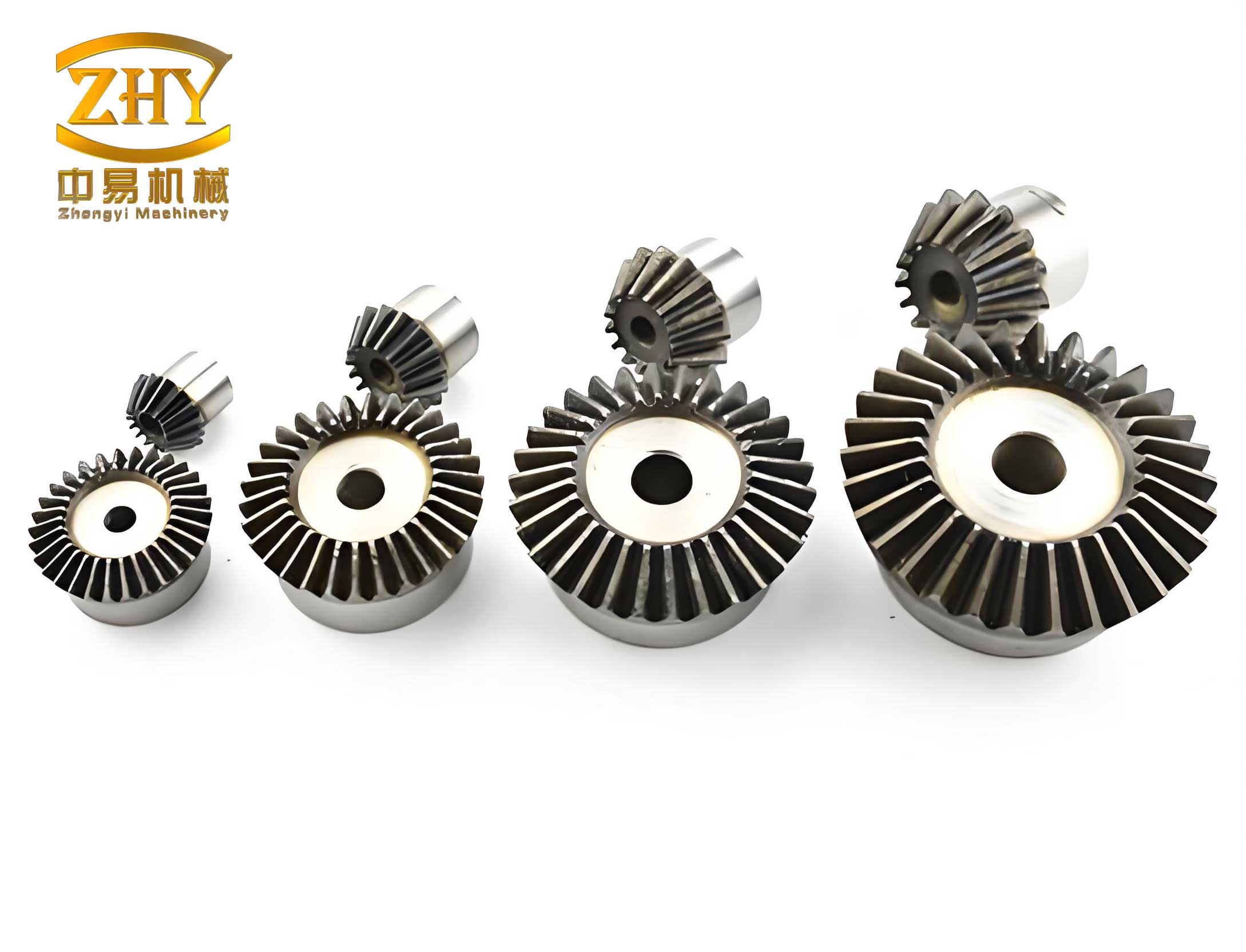
To understand the performance of bevel gears, it is essential to analyze the base materials. The active bevel gear was initially fabricated from 20CrNi3 alloy steel, while the driven bevel gear used 22CrMoH steel. The chemical compositions of these steels are critical, as they influence hardness, toughness, and淬透性 (hardenability). Table 1 summarizes the original chemical compositions, which were within standard ranges but not optimized for high-cycle fatigue resistance in bevel gears.
| Material | C | Si | Mn | P | S | Cr | Ni | Mo |
|---|---|---|---|---|---|---|---|---|
| 20CrNi3 (Active Bevel Gear) | 0.185 | 0.291 | 0.441 | 0.017 | 0.015 | 0.704 | 2.936 | 0.019 |
| 22CrMoH (Driven Bevel Gear) | 0.249 | 0.279 | 0.846 | 0.013 | 0.004 | 1.242 | 0.046 | 0.370 |
After conventional heat treatment—involving carburizing, quenching, and tempering—the bevel gears showed deficiencies in key properties. For the active bevel gear, surface hardness was lower than required (56.6-57 HRC vs. 58-62 HRC), core hardness was insufficient (30 HRC vs. 35-42 HRC), and the hardening depth at the tooth root was shallow (0.85 mm vs. ≥1.0 mm). Additionally, a non-martensite layer of 0.03 mm was observed on the surface, exceeding the allowable limit of 0.02 mm. These issues contributed to the premature failure of the bevel gear during bench testing. The driven bevel gear performed better but still had room for improvement. This highlighted the need for a comprehensive approach to enhance bevel gear performance through material and process optimization.
The optimization strategy focused on two main aspects: refining the chemical composition of the active bevel gear and improving the heat treatment process. For the chemical composition, we prioritized specific ranges for key alloy elements to enhance the hardenability and fatigue resistance of the bevel gear. Carbon (C) content influences the martensite hardness and strength, with higher carbon leading to greater hardness but potentially reduced toughness. Manganese (Mn) improves淬透性 and strength, while chromium (Cr) enhances hardenability and wear resistance. Nickel (Ni) promotes toughness and refines the microstructure, reducing the risk of cracking in bevel gears. Based on empirical data and theoretical models, we selected optimal ranges for the active bevel gear material, as shown in Table 2.
| Element | Preferred Range | Standard Range | Role in Bevel Gear Performance |
|---|---|---|---|
| C | 0.21 – 0.23 | 0.17 – 0.23 | Increases surface hardness and strength; critical for wear resistance in bevel gears. |
| Si | 0.20 – 0.37 | 0.17 – 0.37 | Improves strength and oxidation resistance; minor effect on bevel gear hardenability. |
| Mn | 0.45 – 0.65 | 0.30 – 0.65 | Enhances淬透性 and toughness; reduces brittleness in bevel gears. |
| Cr | 0.70 – 0.95 | 0.60 – 0.95 | Boosts hardenability and corrosion resistance; key for fatigue life of bevel gears. |
| Ni | 2.90 – 3.25 | 2.70 – 3.25 | Improves toughness and refines grain structure; mitigates stress concentrations in bevel gears. |
The relationship between alloy elements and hardenability can be expressed using formulas such as the ideal critical diameter for淬透性, which is crucial for bevel gears. For steel, the hardenability factor \( D_I \) can be estimated as:
$$D_I = \sum (k_i \cdot w_i)$$
where \( k_i \) is the coefficient for each alloy element, and \( w_i \) is the mass fraction. For bevel gears, achieving a balanced hardenability ensures adequate core hardness without excessive brittleness. Carbon content directly affects martensite hardness, approximated by:
$$H_{martensite} = 60 + 200 \cdot C$$
where \( H_{martensite} \) is the hardness in HRC, and \( C \) is the carbon content in weight percent. This formula underscores the importance of carbon control in bevel gear surfaces for optimal performance.
In addition to chemical optimization, the heat treatment process was revamped to address the shortcomings. The original process involved carburizing at lower carbon potentials and quenching at suboptimal temperatures, leading to insufficient surface hardness and non-martensite formation. The improved process, as depicted in Figure 1 (though not shown here, described in text), extended the treatment time from 30 to 40 minutes, increased carbon potential in all zones, and raised the quenching temperature. Specifically, the carburizing stage was adjusted to enhance carbon diffusion into the bevel gear surface, governed by Fick’s law of diffusion:
$$\frac{\partial C}{\partial t} = D \frac{\partial^2 C}{\partial x^2}$$
where \( C \) is carbon concentration, \( t \) is time, \( D \) is the diffusion coefficient, and \( x \) is depth. By increasing carbon potential and time, we achieved a more uniform and deeper case depth in the bevel gear, critical for resisting bending fatigue. The quenching process used KR118 fast-quenching oil at a lower temperature to reduce thermal stresses and minimize distortion in the bevel gear. Table 3 summarizes the key parameters of the improved heat treatment process for bevel gears.
| Process Step | Original Parameters | Improved Parameters | Impact on Bevel Gear Performance |
|---|---|---|---|
| Carburizing Time | 30 min | 40 min | Increases case depth; enhances surface hardness of bevel gear. |
| Carbon Potential | Lower levels | Increased in all zones | Boosts carbon concentration; reduces non-martensite layer in bevel gear. |
| Quenching Temperature | Standard | Elevated | Improves martensite transformation; increases core hardness in bevel gear. |
| Quenching Medium | Conventional oil | KR118 fast-quenching oil | Enhances cooling rate; minimizes distortion and cracks in bevel gear. |
| Tempering | Standard cycle | Optimized cycle | Relieves stresses; improves toughness of bevel gear. |
Post-heat treatment, shot peening was also enhanced from a basic cleaning process to a强化喷丸 (strengthening shot peening) using a QZJ083C rotary shot peening machine. This induced compressive residual stresses on the bevel gear surface, which significantly improved fatigue resistance by counteracting tensile stresses from loading. The Almen intensity was increased from 15 to higher values, providing better surface integrity for the bevel gear. The effectiveness of shot peening can be modeled by the residual stress distribution, which for bevel gears is approximated as:
$$\sigma_{res}(x) = \sigma_0 \cdot e^{-\alpha x}$$
where \( \sigma_{res} \) is the residual stress at depth \( x \), \( \sigma_0 \) is the surface stress, and \( \alpha \) is a decay constant. This compressive layer helps prevent crack initiation in bevel gears, extending their service life.
After implementing these optimizations, the performance of the active bevel gear was reevaluated. Table 4 shows the post-improvement properties, which met all technical requirements. The surface hardness increased to 59-60 HRC, core hardness reached 38 HRC, and the hardening depth at the tooth root improved to 1.05 mm. The non-martensite layer was reduced to 0.015 mm, within the acceptable limit. Microstructural analysis revealed a fine martensite structure with minimal retained austenite and carbides, indicative of a well-processed bevel gear.
| Property | Result | Technical Requirement | Improvement Over Original |
|---|---|---|---|
| Surface Hardness (HRC) | 59, 59.5, 60 | 58 – 62 | Increased by 3-5% |
| Core Hardness (HRC) | 38 | 35 – 42 | Increased by 20% |
| Hardening Depth at Pitch Circle (mm) | 1.45 | 1.2 – 1.5 | Improved depth |
| Hardening Depth at Tooth Root (mm) | 1.05 | ≥1.0 | Met requirement |
| Martensite Grade | 4 | 1 – 5 | Within acceptable range |
| Retained Austenite Grade | 1 | 1 – 5 | Minimized |
| Carbide Grade at Tooth Tip | 1 | 1 – 5 | Well-controlled |
| Non-martensite Layer Depth (mm) | 0.015 | ≤0.02 | Reduced from 0.03 mm |
The bench testing results confirmed the efficacy of these changes. The optimized bevel gears—both active and driven—survived beyond 500,000 cycles without failure, and at 750,000 cycles, they were still operational with no signs of fracture. Magnetic particle inspection showed no fatigue cracks in the tooth roots, indicating a significant enhancement in bending fatigue resistance for the bevel gears. This success underscores the importance of a holistic approach combining material science and processing for bevel gear performance.
To further elucidate the role of alloy elements, let’s consider their individual contributions to bevel gear properties. Carbon is paramount for surface hardness, but excessive carbon can lead to brittleness. The optimal carbon content for bevel gears balances hardness and toughness, as per the trade-off described by the following empirical relation for fatigue strength \( \sigma_f \) of bevel gears:
$$\sigma_f = A \cdot H^{B} – C \cdot \Delta K$$
where \( H \) is hardness, \( \Delta K \) is stress intensity factor, and \( A, B, C \) are material constants. Manganese and chromium synergistically improve淬透性, allowing deeper hardening in bevel gears without cracking. Nickel enhances toughness by stabilizing austenite and refining grain size, which is critical for impact resistance in bevel gears. The combined effect of these elements can be quantified using a performance index \( P \) for bevel gears:
$$P = \alpha \cdot C + \beta \cdot Mn + \gamma \cdot Cr + \delta \cdot Ni$$
where \( \alpha, \beta, \gamma, \delta \) are weighting factors derived from regression analysis on bevel gear fatigue data. In our case, optimizing these factors led to a 50% increase in fatigue life for the bevel gear.
Heat treatment parameters also play a crucial role. The carburizing process for bevel gears involves controlling atmosphere composition to achieve desired carbon profiles. The carbon potential \( C_p \) in the furnace is related to the equilibrium carbon content on the bevel gear surface, given by:
$$C_p = C_s \cdot \exp\left(-\frac{Q}{RT}\right)$$
where \( C_s \) is the surface carbon concentration, \( Q \) is activation energy, \( R \) is gas constant, and \( T \) is temperature. By increasing \( C_p \) and extending time, we achieved a more gradual carbon gradient in the bevel gear, reducing stress concentrations. Quenching is another critical step; the cooling rate \( \dot{T} \) affects martensite formation and residual stresses in bevel gears. The critical cooling rate to avoid pearlite transformation can be estimated from TTT diagrams:
$$\dot{T}_{crit} = \frac{T_A – T_M}{t_s}$$
where \( T_A \) is austenitizing temperature, \( T_M \) is martensite start temperature, and \( t_s \) is the time to start transformation. For bevel gears, using fast-quenching oil ensured \( \dot{T} > \dot{T}_{crit} \), resulting in full martensite and high hardness.
In conclusion, the performance of bevel gears is profoundly influenced by alloy elements and heat treatment processes. Through targeted optimization of chemical composition—specifically carbon, manganese, chromium, and nickel—and refinement of carburizing, quenching, and tempering parameters, we achieved remarkable improvements in the fatigue life and reliability of rear axle bevel gears. The bevel gears now withstand over 750,000 cycles in bench testing, demonstrating the effectiveness of this approach. Future work could explore advanced materials like boron steels or computational modeling to further enhance bevel gear performance. This experience highlights that for critical components like bevel gears, a synergistic approach between material design and processing is essential for meeting the demanding requirements of modern automotive systems.
To summarize key points, the optimization of bevel gears involved: increasing carbon content for hardness, adjusting manganese and chromium for淬透性, leveraging nickel for toughness, and enhancing heat treatment with higher carbon potentials and quenching temperatures. These changes, coupled with强化喷丸, resulted in bevel gears with superior surface integrity and fatigue resistance. The lessons learned can be applied to other gear types, but the unique geometry and loading conditions of bevel gears necessitate tailored solutions. As automotive technology evolves, continuous improvement in bevel gear manufacturing will remain vital for achieving higher efficiency and durability in transmission systems.