
In the field of precision mechanical transmissions, the harmonic drive gear system stands out for its unique ability to provide high reduction ratios with compact design and minimal backlash. My research focuses on a critical aspect of its performance: the lubrication between the flexspline and the wave generator. Proper lubrication is paramount, as it directly influences meshing efficiency, fatigue life of components, and overall transmission reliability. In this comprehensive analysis, I apply elastohydrodynamic lubrication (EHL) theory to model the contact conditions specifically for a harmonic drive gear employing a cam-type wave generator with a flexible rolling bearing. This approach establishes a foundational method for analyzing the lubrication state, which can be similarly extended to other wave generator types like disk or pin-type.
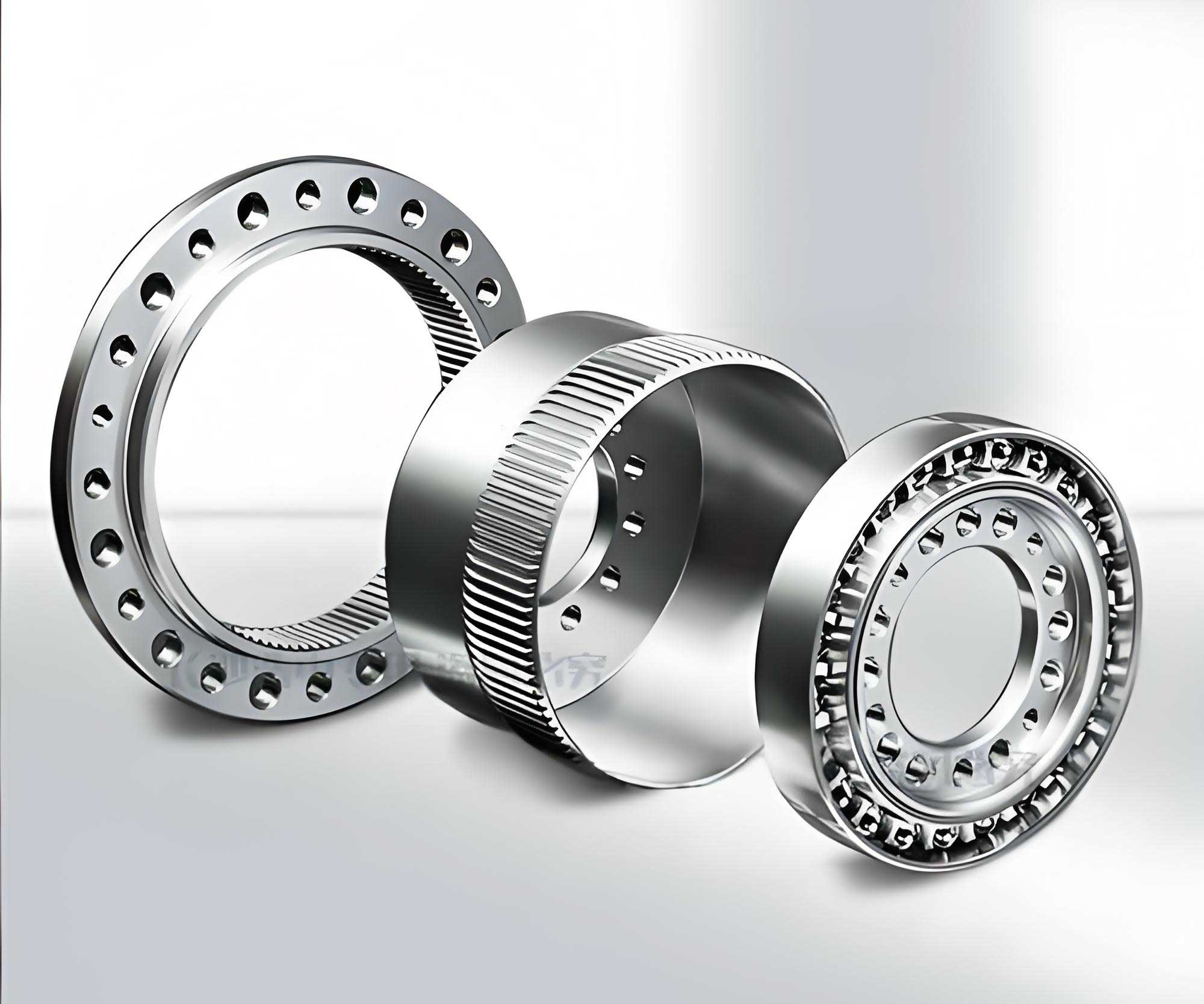
The core principle of a harmonic drive gear involves three main components: a rigid circular spline, a flexible flexspline, and a wave generator. The wave generator, often an elliptical cam, deforms the flexspline, causing it to engage with the circular spline at two opposing points. This interaction generates the speed reduction. The contact between the flexspline’s inner surface and the wave generator is typically mediated by a flexible rolling bearing in cam-type designs. This bearing’s outer ring conforms to the deformed flexspline, while its inner ring rotates with the cam. Understanding the lubrication in this contact is not merely about adding oil; it is about ensuring a sufficient elastohydrodynamic film to separate the surfaces and prevent wear. The performance of the entire harmonic drive gear hinges on this often-overlooked interface.
I begin by detailing the operational state. For a double-wave harmonic drive gear transmission with a cam-type wave generator, the flexspline is usually the output member. The flexible rolling bearing has thin-walled rings that deform with the cam’s profile. During operation, for typical reduction ratios, the angular velocity of the flexspline is significantly lower than that of the rolling elements. Consequently, it is reasonable to model the flexspline and the bearing’s outer ring as relatively stationary, while the bearing’s inner ring rotates with the wave generator. This simplifies the problem to analyzing the lubrication within the flexible rolling bearing itself. The contacts between the rolling elements (whether balls or rollers) and the races become the subjects for EHL analysis, which can be treated as either point or line contacts depending on the rolling element geometry.
The foundation of my calculation rests on established EHL film thickness equations. For point contact scenarios, such as with ball bearings, the widely accepted Hamrock-Dowson formula is employed. The dimensionless minimum film thickness is given by:
$$H_{min} = \frac{h_{min}}{R} = 3.63 U^{0.68} G^{0.49} W^{-0.073}$$
Here, \(U\) is the speed parameter, \(G\) is the materials parameter, and \(W\) is the load parameter. They are defined as:
$$U = \frac{\eta_0 u}{E’ R}, \quad G = \alpha E’, \quad W = \frac{w_T}{E’ R^2}$$
where \(\eta_0\) is the dynamic viscosity at atmospheric pressure, \(u\) is the entraining surface velocity, \(E’\) is the effective elastic modulus, \(R\) is the equivalent radius of curvature, \(w_T\) is the total normal load on the contact, and \(\alpha\) is the pressure-viscosity coefficient of the lubricant.
For line contact, applicable to cylindrical roller bearings in a harmonic drive gear, the Dowson-Higginson formula is used:
$$H_{min} = \frac{h_{min}}{R} = 2.65 G^{0.54} U^{0.7} W^{-0.13}$$
In this case, the load parameter is adjusted to account for the roller length \(B\):
$$W = \frac{w_T}{E’ R B}$$
The critical task is to correctly derive the input parameters—\(R\), \(u\), and \(w_T\)—specifically for the flexible rolling bearing within the deformed state of the harmonic drive gear. These parameters are not standard bearing catalogue values; they are influenced by the gear’s kinematics and load distribution.
First, the equivalent radius of curvature \(R\) for the contact between a rolling element and the inner race (which is the critical contact) is calculated considering the deformed geometry. If \(r_g\) is the rolling element radius and \(R_1\) is the radius of the inner raceway at the contact point after deformation, then:
$$\frac{1}{R} = \frac{1}{R_1} + \frac{1}{r_g}$$
The radius \(R_1\) itself is a sum of the nominal inner race radius \(R_{b1}\) and the maximum radial deformation of the flexspline \(w_0\), which is typically equal to the gear module \(m\) in a properly designed harmonic drive gear: \(R_1 = R_{b1} + w_0\).
Second, the entraining surface velocity \(u\) is the average speed of the two surfaces in the contact. For the inner race (rotating with wave generator angular speed \(\omega_H\)) and the rolling element (with relative angular speed \(\omega_r\)), the velocity is:
$$u = \frac{\omega_H (R_{b1} + w_0) + \omega_r r_g}{2}$$
The relative angular speed \(\omega_r\) can be derived from the kinematics of the bearing in its undeformed state for simplification.
Third, and most complex, is the determination of the total normal load \(w_T\) on the most heavily loaded rolling element. This load has two components: one from the elastic deformation force of the flexspline and another from the gear meshing force.
- Load from Flexspline Deformation (\(q_{d,max}\)): The pressure from the flexspline is distributed over a finite arc. The force on an individual rolling element at angular position \(\phi_i\) is \(q_{d,i} = q_{d,max} \cos\left(\frac{\pi \phi_i}{2\phi_0}\right)\), where \(\phi_0\) defines the contact arc. By balancing the total radial force \(p_{r1}\) from the flexspline on the wave generator, the maximum load can be derived as:
$$q_{d,max} = \frac{p_{r1}}{2 \sum_{i=1}^{n} \cos\left(\frac{\pi \phi_i}{2\phi_0}\right) \cos \theta_i}$$
where \(n\) is the number of rolling elements in the load zone and \(\theta_i\) is their angular position relative to the force direction.
- Load from Gear Meshing (\(q_e\)): For a double-wave harmonic drive gear, the torque \(T_2\) on the circular spline (output torque) creates a meshing force. The average load per rolling element in one meshing zone can be approximated as:
$$q_e = \frac{T_2 (\tan \alpha_0 + f_s)}{2 n r_2}$$
where \(\alpha_0\) is the gear pressure angle, \(f_s\) is the coefficient of friction, and \(r_2\) is the pitch radius of the circular spline.
The total load on the critical rolling element is then:
$$w_T = q_{d,max} + q_e$$
With these parameters defined, the minimum film thickness \(h_{min}\) can be calculated. To assess the lubrication regime and risk of surface damage, the film thickness ratio \(\lambda\) is used:
$$\lambda = \frac{h_{min}}{\sqrt{R_{q1}^2 + R_{q2}^2}}$$
where \(R_{q1}\) and \(R_{q2}\) are the root-mean-square roughness of the two surfaces. Often, \(R_q \approx (1.18 \text{ to } 1.27) R_a\), where \(R_a\) is the arithmetic average roughness. A \(\lambda > 3\) indicates full-film EHL lubrication, \(1.5 < \lambda < 3\) indicates partial lubrication, and \(\lambda < 1.5\) indicates boundary lubrication with high wear risk.
To illustrate the entire methodology, I present a detailed numerical example for a harmonic drive gear. The key parameters are summarized in the following table:
| Parameter | Symbol | Value | Unit |
|---|---|---|---|
| Input Power | \(P\) | 0.76 | kW |
| Input Speed | \(n_H\) | 3000 | rpm |
| Wave Generator Angular Speed | \(\omega_H\) | \(2\pi \times 3000 / 60\) | rad/s |
| Flexspline Number of Teeth | \(z_1\) | 200 | – |
| Circular Spline Number of Teeth | \(z_2\) | 202 | – |
| Module | \(m\) | 0.5 | mm |
| Max Radial Displacement (Deformation) | \(w_0\) | \(m = 0.5\) | mm |
| Pressure Angle | \(\alpha_0\) | 24°43’2″ | deg |
| Flexspline Midline Radius (Undeformed) | \(r_m\) | 50.3723 | mm |
| Flexspline Length | \(l\) | 90 | mm |
| Flexspline Wall Thickness | \(\delta\) | 0.75 | mm |
| Flexible Bearing Type | – | FB815 (example) | – |
| Rolling Element Radius (assumed ball) | \(r_g\) | Derived from bearing geometry | mm |
| Inner Race Radius (nominal) | \(R_{b1}\) | Derived from bearing geometry | mm |
| Lubricant Pressure-Viscosity Coefficient | \(\alpha\) | \(2.5 \times 10^{-8}\) | m²/N |
| Lubricant Dynamic Viscosity (@ atm) | \(\eta_0\) | 0.135 | Pa·s |
| Effective Elastic Modulus | \(E’\) | \(2.3 \times 10^{11}\) | Pa |
| Surface Roughness (Arithmetic Average) | \(R_a\) | 0.63 | µm |
Through geometric and kinematic calculations specific to the harmonic drive gear and bearing, the derived operating parameters are:
| Derived Parameter | Symbol | Calculated Value | Unit |
|---|---|---|---|
| Equivalent Radius of Curvature | \(R\) | 0.00409 | m |
| Entraining Surface Velocity | \(u\) | 9.216 | m/s |
| Total Normal Load on Contact | \(w_T\) | 45.76 | N |
| Speed Parameter | \(U\) | \(13.5 \times 10^{-10}\) | – |
| Load Parameter | \(W\) | \(1.623 \times 10^{-5}\) | – |
| Materials Parameter | \(G\) | 5750 | – |
Assuming a point contact model for a ball bearing, the minimum film thickness is calculated using the Hamrock-Dowson formula:
$$H_{min} = 3.63 \times (13.5 \times 10^{-10})^{0.68} \times (5750)^{0.49} \times (1.623 \times 10^{-5})^{-0.073} \approx 6.11 \times 10^{-5}$$
$$h_{min} = H_{min} \times R = 6.11 \times 10^{-5} \times 0.00409 \, \text{m} \approx 2.5 \, \mu\text{m}$$
To evaluate the surface protection, the film thickness ratio \(\lambda\) is computed. Using \(R_q \approx 1.25 R_a = 1.25 \times 0.63 \, \mu\text{m} = 0.7875 \, \mu\text{m}\) for both surfaces:
$$\lambda = \frac{2.5 \, \mu\text{m}}{\sqrt{(0.7875 \, \mu\text{m})^2 + (0.7875 \, \mu\text{m})^2}} = \frac{2.5}{\sqrt{2 \times (0.7875)^2}} \approx \frac{2.5}{1.114} \approx 2.24$$
This result, \(\lambda \approx 2.24\), indicates a partial elastohydrodynamic lubrication regime. While this provides some protection, for optimal longevity and reliability of the harmonic drive gear, a full-film condition (\(\lambda > 3\)) is desirable. In this specific instance, the geometric and operational parameters of the harmonic drive gear are largely fixed by design. The surface finish is also set by manufacturing capabilities. Therefore, the most practical lever to improve the lubrication state is the selection of the lubricant. The speed parameter \(U\), which has the strongest influence on film thickness (exponent of 0.68-0.7), is directly proportional to the atmospheric viscosity \(\eta_0\). For example, if a lubricant with \(\eta_0 = 0.198 \, \text{Pa·s}\) is used, recalculating yields:
$$U_{new} = \frac{0.198 \times 9.216}{2.3 \times 10^{11} \times 0.00409} \approx 19.8 \times 10^{-10}$$
$$H_{min,new} \propto U_{new}^{0.68} \quad \Rightarrow \quad h_{min,new} \approx 3.3 \, \mu\text{m}$$
$$\lambda_{new} \approx \frac{3.3}{1.114} \approx 2.96 \approx 3$$
This demonstrates that by choosing a lubricant with higher base viscosity, the harmonic drive gear can operate closer to a full-film EHL condition, significantly reducing wear and improving performance.
The methodology I have described is explicitly for a cam-type wave generator with a flexible rolling bearing. However, the fundamental approach is adaptable. For other wave generators in a harmonic drive gear, such as a disk-type or a pin-type (roller-type), the contact mechanics differ, but the lubrication analysis follows a similar logical path. For a disk-type, the contact might be modeled as a line contact between a cylindrical roller and the flexspline. For a pin-type with multiple free rollers, each roller-flexspline contact becomes an individual EHL problem, potentially with different kinematics for load sharing. The core steps remain: (1) model the contact geometry to find \(R\), (2) determine the surface velocities \(u\) based on the kinematics of that specific harmonic drive gear configuration, (3) calculate the load distribution \(w_T\) from the flexspline deformation and gear meshing forces pertinent to that design, and (4) apply the appropriate EHL formula and surface criteria. The formulas for load distribution would need to be re-derived based on the specific force transmission path of the alternative wave generator design.
In conclusion, my analysis integrates elastohydrodynamic lubrication theory directly into the design and performance evaluation framework for harmonic drive gears. By deriving the specific lubrication parameters from the unique deformed geometry and load conditions of the harmonic drive gear transmission, a quantitative assessment of the interfacial film thickness is possible. The provided calculation example for a cam-type generator reveals that even with fixed mechanical design, lubricant selection is a critical factor in achieving a satisfactory lubrication regime. This work establishes a foundational calculative method. Future research could involve more sophisticated modeling of the time-varying load and curvature as the wave generator rotates, thermal effects on viscosity, and the impact of lubricant additives tailored for the high-stress, slow-sliding conditions found in harmonic drive gear contacts. Ultimately, a deep understanding of this lubrication interface is key to pushing the limits of torque density, efficiency, and service life for these remarkable precision transmission systems.
To further encapsulate the key relationships and formulas central to this harmonic drive gear lubrication analysis, the following summary table and formula list are provided.
| Aspect | Parameter/Formula | Description |
|---|---|---|
| Geometry | \( \dfrac{1}{R} = \dfrac{1}{R_1} + \dfrac{1}{r_g} \) | Equivalent radius for ball/inner race contact. |
| \( R_1 = R_{b1} + w_0 \) | Deformed inner race radius. | |
| \( w_0 = m \) (typical) | Max radial displacement, often equal to module. | |
| Kinematics | \( u = \dfrac{\omega_H (R_{b1} + w_0) + \omega_r r_g}{2} \) | Entraining surface velocity. |
| Loading | \( q_{d,max} = \dfrac{p_{r1}}{2 \sum_{i=1}^{n} \cos\left(\frac{\pi \phi_i}{2\phi_0}\right) \cos \theta_i} \) | Max load from flexspline deformation. |
| \( q_e = \dfrac{T_2 (\tan \alpha_0 + f_s)}{2 n r_2} \) | Average load from gear meshing. | |
| \( w_T = q_{d,max} + q_e \) | Total normal load on critical element. | |
| EHL Film Thickness | Point Contact: \( H_{min} = 3.63 U^{0.68} G^{0.49} W^{-0.073} \) | Hamrock-Dowson formula for balls. |
| Line Contact: \( H_{min} = 2.65 G^{0.54} U^{0.7} W^{-0.13} \) | Dowson-Higginson formula for rollers. | |
| Dimensionless Groups | \( U = \dfrac{\eta_0 u}{E’ R}, \quad G = \alpha E’, \quad W = \dfrac{w_T}{E’ R^2} \text{ (point)} \) | Speed, material, and load parameters. |
| Surface Condition | \( \lambda = \dfrac{h_{min}}{\sqrt{R_{q1}^2 + R_{q2}^2}}; \quad R_q \approx 1.25 R_a \) | Film thickness ratio for wear assessment. |
| Design Guideline | Target \( \lambda > 3 \) for full-film EHL in harmonic drive gear. | Ensures adequate surface separation. |
The harmonic drive gear’s exceptional capabilities come with the responsibility of managing its intricate internal stresses. Through diligent lubrication analysis as outlined, engineers can ensure that the vital interface between the flexspline and the wave generator operates not on the brink of failure, but within a protective film of lubricant, enabling the harmonic drive gear to reliably deliver precision motion for countless cycles.