
In the realm of power transmission, particularly for right-angle drives, the miter gear holds a position of critical importance. As a subtype of bevel gears with a 1:1 ratio and typically a 90-degree shaft angle, its performance is paramount in applications requiring precise motion transfer and smooth operation. Among the various quality metrics, the analysis and control of manufacturing errors are fundamental to ensuring the functional integrity and longevity of a miter gear pair. This article delves into a comprehensive examination of key error types—Radial Runout, Pitch Accumulated Error, and Single Pitch Error—exploring their origins, interrelationships, and methodologies for minimization in the production of high-precision miter gears.
The radial runout of the gear tooth ring is arguably the most critical inspection item during the manufacturing of a miter gear. It serves as a primary indicator of geometric accuracy and is a significant contributing factor to other composite errors. In practical workshop experience, it is consistently observed that if the radial runout is maintained within its specified tolerance, or exhibits only minor deviation, the associated pitch errors generally remain compliant. Therefore, meticulous control of radial runout is a cornerstone in the process planning and machining of any miter gear.
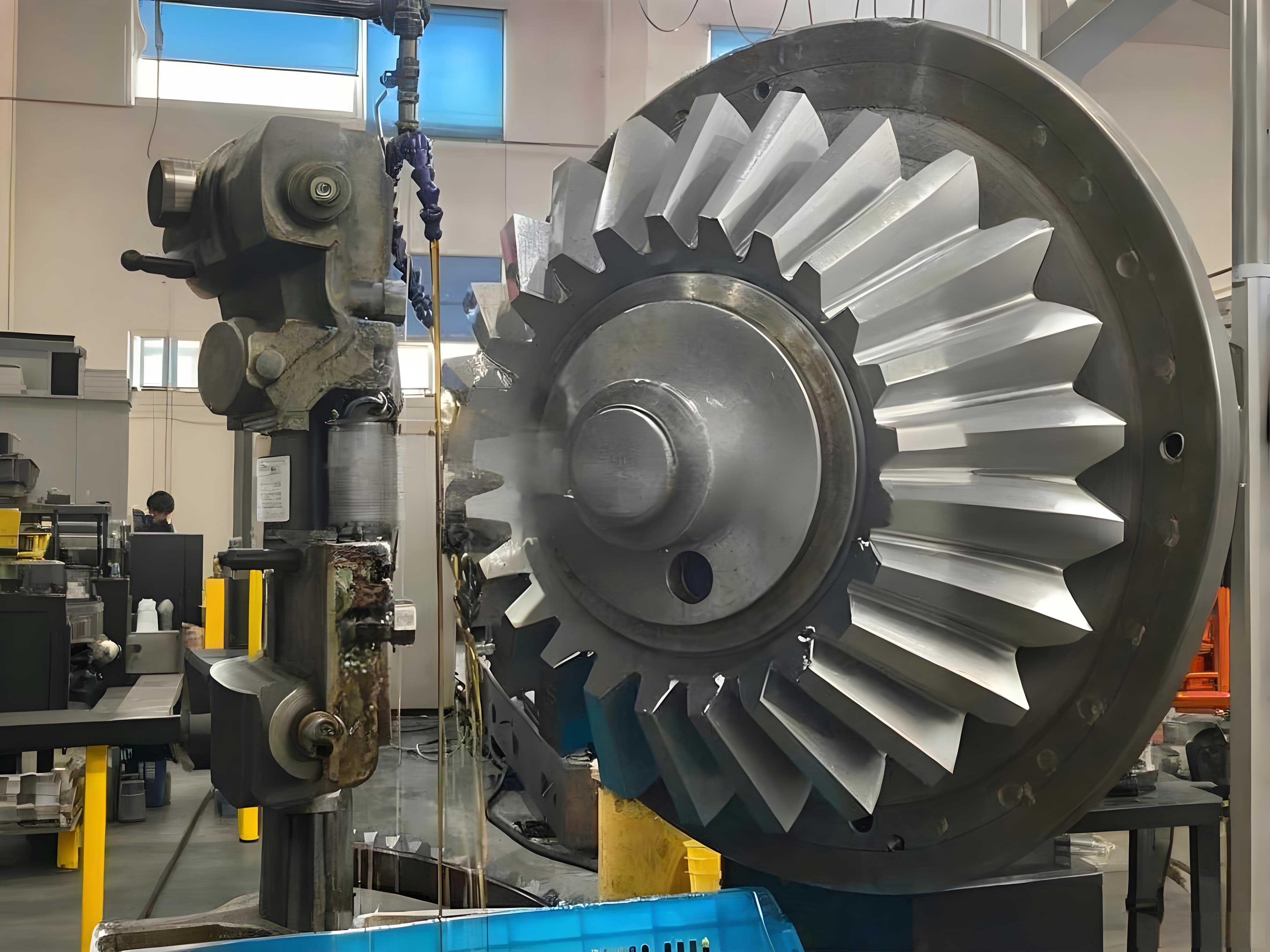
1. Radial Runout of the Tooth Ring: Manifestations and Root Causes
Radial runout, often measured in a direction normal to the pitch cone surface, represents the variation in the distance from a datum axis to the tooth profile. Its manifestations can be categorized, leading to targeted diagnostic approaches.
1.1 Systematic Eccentricity
This pattern indicates a consistent offset of the gear’s effective center from its theoretical rotational axis. Primary causes include:
- Workpiece Fixturing Eccentricity: Clearance between the gear blank’s bore and the machining arbor (mandrel) leads to an installation eccentricity \( e \). This eccentricity is magnified in the radial runout measurement. The relationship can be modeled as:
$$ \Delta F_r \approx \Delta F_{r1} \cdot \cos \delta = 2 e \cdot \cos \delta $$
where \( \Delta F_r \) is the radial runout error, \( \Delta F_{r1} \) is the related longitudinal error, \( e \) is the eccentricity, and \( \delta \) is the pitch cone angle. For a standard miter gear with \( \delta = 45^\circ \), \( \cos \delta \approx 0.707 \), making the runout sensitive to fixturing errors. - Blank Face Runout: Excessive axial wobble of the gear blank’s locating face induces eccentricity when clamped. The tolerance for this face runout should typically be less than half the allowable radial runout tolerance.
- Arbor Inaccuracies: Manufacturing errors in the arbor itself (radial/axial runout) or deflection under clamping force introduce systematic offsets. Precision arbors must be regularly verified, with runout often held below 0.005 mm for high-grade miter gear production.
- Blank Bore Geometry: Poor bore quality, such as a pronounced “bell mouth” effect, prevents consistent and true location on the arbor.
1.2 Irregular (Non-Systematic) Runout
An irregular pattern with high and low points not following a sinusoidal pattern suggests issues with the machining process dynamics:
| Potential Cause | Effect on Miter Gear |
|---|---|
| Index Plate/Divider Inaccuracy | Directly transfers its own division errors to the gear teeth. |
| Looseness in Drive Keys | Causes intermittent slippage or non-uniform indexing. |
| Tool Head Looseness or Infeed Instability | Results in varying depth of cut per tooth space. |
| Machine Tool Geometric/ Motion Errors | Leads to non-repetitive path inaccuracies during cutting. |
| Progressive Tool Wear | Causes gradual change in generated profile and tooth spacing. |
1.3 Single Low Tooth (“First Tooth” Phenomenon)
A common issue where one specific tooth exhibits significantly lower flank contact or larger space. This is frequently traced to the initial plunge cut of the first tooth slot. The infeeding cutter, especially if using a tool with a large negative rake on its non-cutting flank, can exert an upward force if machine rigidity is marginal. This may cause over-cutting on the first tooth’s thickness. Proper sequencing of cuts and rational allocation of roughing/finishing allowances are crucial to mitigate this effect in miter gear machining.
2. Pitch Accumulated Error: Influence Factors and Compensation
Pitch accumulated error \( \Delta F_p \) governs the kinematic accuracy (motion transmission constancy) of a miter gear. It is the maximum algebraic difference between the theoretical and actual arc distances over a sector of the gear. The primary sources are:
Base Circle Eccentricity: As with radial runout, an eccentric mounting or blank creates a sinusoidal variation in pitch. If the eccentricity is \( e_b \), the accumulated error as a function of rotation angle \( \phi \) is:
$$ \Delta F_p(\phi) = e_b \cdot \sin(\phi) $$
Over one full revolution, the maximum accumulated error becomes \( \Delta F_{p max} = 2 e_b \). The elimination methods are identical to those for systematic radial runout in a miter gear.
Indexing System Errors: The inherent pitch accumulated error of the machine’s dividing mechanism (index plate, CNC rotary table) is directly imparted to the workpiece. For manufacturing high-precision miter gears (e.g., AGMA Class 9-10), the divider’s accuracy must exceed that of the required gear.
The following table summarizes adjustment strategies for key errors in miter gear production:
| Error Type | Primary Influencing Factor | Corrective/Preventive Action |
|---|---|---|
| Radial Runout (\( \Delta F_r \)) | Fixturing Eccentricity | Use precision, matched arbors; lap blank bore; control face runout. |
| Arbor Deflection/Runout | Employ stiffer arbors; reduce overhang; pre-qualify arbor TIR. | |
| Machine & Tooling Instability | Lock tool heads; ensure consistent infeeds; maintain machine. | |
| Pitch Accumulated Error (\( \Delta F_p \)) | Base Circle Eccentricity | Same as for Radial Runout control. |
| Divider Inaccuracy | Use a higher-precision index system; implement error compensation. | |
| Single Pitch Error (\( \Delta f_{pt} \)) | Divider Error & Motion Unsteadiness | Ensure divider quality; stabilize tool head swing motion. |
3. Single Pitch Error and its Impact on Meshing Quietness
The single pitch error \( \Delta f_{pt} \) is the deviation between the actual and theoretical pitch for adjacent teeth. This periodic error critically affects the smoothness and noise level of a miter gear pair, as it causes instantaneous velocity fluctuations. Its dominant cause is the division error of the indexing mechanism during each individual step. Furthermore, non-uniformity in the cutter’s rocking or rolling motion during tooth generation, or inconsistencies in the tool head’s final positioning for each tooth, will manifest as single pitch errors. Control is achieved through the use of a certified high-accuracy dividing system and meticulous adjustment of the gear generator’s kinematic chain to ensure perfectly smooth and repeatable motions.
4. Mathematical Modeling of Error Interactions in a Miter Gear
The errors in a miter gear are not independent. A comprehensive model helps understand their synthesis. We can express the apparent tooth position error \( E(\theta) \) at a roll angle \( \theta \) as a superposition:
$$ E(\theta) = R_{ecc} \cdot \cos(\theta + \alpha) + \sum_{n=1}^{N} D_n \cdot \sin(n \cdot z \cdot \theta + \beta_n) + \epsilon(\theta) $$
Where:
- \( R_{ecc} \cdot \cos(\theta + \alpha) \): Term representing 1st order error due to eccentricity \( R_{ecc} \), contributing to both \( \Delta F_r \) and \( \Delta F_p \).
- \( \sum D_n \cdot \sin(n \cdot z \cdot \theta + \beta_n) \): Harmonic series representing errors related to the number of teeth \( z \), often linked to divider errors affecting \( \Delta f_{pt} \) and higher-order components of \( \Delta F_p \).
- \( \epsilon(\theta) \): Random/noise component from machine vibration, tool wear, etc.
The Total Composite Error \( (F_i’) \) of a miter gear, which can be measured on a gear checker, integrates all these effects.
5. Advanced Manufacturing and Inspection Considerations for Miter Gears
Modern CNC gear manufacturing offers superior control over the errors discussed. For a CNC-generated miter gear:
- Virtual Master Gear: The machine uses a digital perfect gear model for real-time comparison and correction.
- Closed-Loop Feedback: On-machine probing can measure cut teeth and compensate for detected errors like runout in subsequent operations or for the next workpiece.
- Process Stability Monitoring: Tracking cutting forces and vibrations can preempt issues leading to irregular runout or pitch errors.
Inspection goes beyond simple runout checks. Coordinate Measuring Machines (CMMs) and dedicated gear analyzers provide complete 3D mappings of the miter gear flank, allowing for Fourier analysis of the error function \( E(\theta) \) to pinpoint the exact harmonic source (e.g., 1st order = eccentricity, z-th order = divider error).
6. Conclusion: A Systems Approach to Miter Gear Quality
The production of a high-fidelity miter gear demands a holistic, systems-oriented approach. The radial runout of the tooth ring is a vital and telling metric, but it must be understood in concert with pitch accumulated and single pitch errors. As demonstrated, these errors often share common root causes—primarily in workpiece fixturing, indexing system accuracy, and machine tool rigidity/stability. Successful manufacturing hinges on: 1) Meticulous control of blank and arbor quality to minimize systematic eccentricity; 2) Employment of a dividing system whose accuracy surpasses the required gear tolerance; and 3) A stable, well-maintained machining process capable of consistent, chatter-free cutting. By rigorously addressing these factors and leveraging modern CNC and metrology technologies, manufacturers can reliably produce miter gears that meet the exacting demands of today’s precision drive systems, ensuring efficient, quiet, and reliable power transmission at right angles.