
The manufacturing of hardened internal spiral gears presents a significant challenge in modern precision engineering. Conventional machining techniques, such as hobbing or shaping, become entirely non-viable post-heat treatment due to the extreme hardness of the material. Grinding, while suitable for external gears, is notoriously difficult and often impractical for internal spiral gear forms due to accessibility constraints and the complexity of the required tool path. This article, from my research perspective, delves into an alternative manufacturing strategy: the use of Electrochemical Discharge Machining (EDM), specifically the sinking EDM process, to successfully fabricate these challenging components. The core advantage of this approach is the fundamental transformation of the problem—from directly machining a hard, intricate internal form to machining a relatively softer, external tool electrode whose inverse geometry is replicated onto the workpiece through controlled electrical discharges.
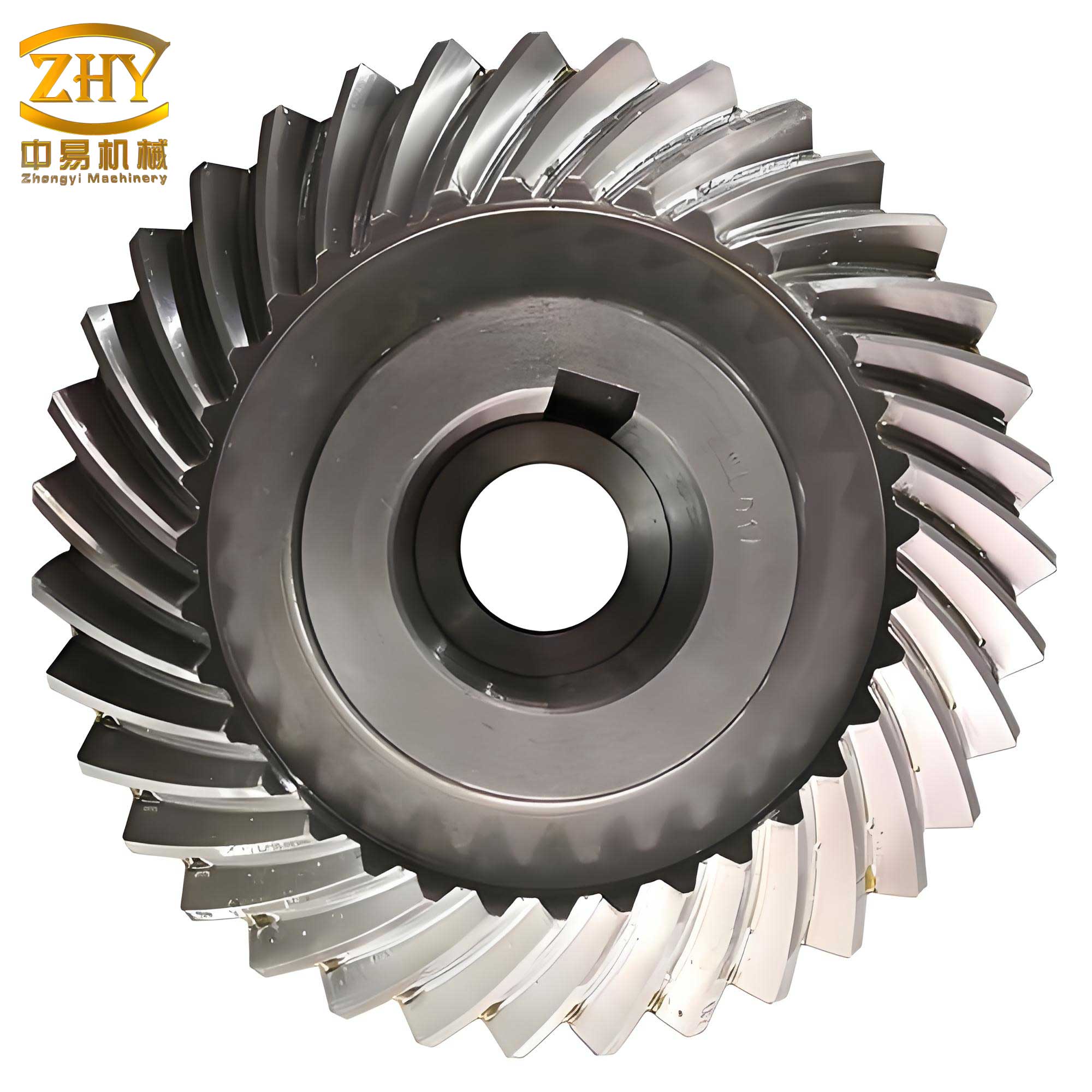
The successful EDM of an internal spiral gear hinges on a sophisticated understanding of the process kinematics, precise electrode design that accounts for physical phenomena like spark gap and tool wear, and rigorous error control within the auxiliary motion system. This discussion will comprehensively cover the working principle of the specialized setup, derive the critical formulas for electrode gear design (including modification for spark gap and wear compensation), analyze error sources, and propose methodologies for enhancing overall accuracy. The internal spiral gear, with its combination of complex geometry and hard material, thus finds a feasible and precise manufacturing route through this non-conventional process.
Fundamental Principles and System Architecture for Spiral Gear EDM
The principle of sinking EDM for internal spiral gears is based on generating the required helical motion between the tool electrode and the workpiece. The tool is a precisely machined external spiral gear. To replicate its form into a hardened blank, it must move relative to the workpiece with a combined rotational and translational motion that exactly corresponds to the helix of the desired internal spiral gear. Figure 1 illustrates this core kinematic concept schematically.
The realization of this principle requires a dedicated apparatus mounted onto a conventional sinker EDM machine. A representative system architecture is shown in Figure 2. The key component is a high-precision leadscrew assembly (or ball screw). The tool electrode gear is mounted on a spindle that is, in turn, coupled to the nut of this leadscrew. As the leadscrew is rotated by a servo motor (not shown in the simplified diagram), the nut—and consequently the tool electrode—translates along the screw axis. If the tool electrode is prevented from rotating freely relative to the machine frame (except for a controlled indexing), this translation forces it to rotate, thereby creating the precise helical motion. The relationship between the gear and screw parameters is fundamental.
Let us define the following parameters:
– For the tool electrode spiral gear: pitch circle diameter $d_t$, helix angle $\beta_t$, and lead $L_t$.
– For the desired internal workpiece spiral gear: pitch circle diameter $d_p$, helix angle $\beta_p$, and lead $L_p$.
– For the leadscrew: mean diameter $d_g$, helix angle $\beta_g$, and lead $L_g$.
The kinematic conditions for generating the correct helix are:
- The lead of the tool electrode gear must equal the lead of the workpiece gear and must be matched by the translational motion provided by the leadscrew: $L_t = L_p = L_g$.
- The helix angles of the tool and workpiece gears are therefore equal: $\beta_t = \beta_p$.
- The pitch circle diameters of the tool and workpiece gear may be equal or different, but this does not affect the generated lead as long as condition (1) is met. However, for simplicity in setup and calculation, they are often designed to be equal: $d_t = d_p$.
- The hand of the helix (left or right) must be identical for both the tool and the workpiece spiral gear.
- The transverse or normal profile of the tool electrode gear (e.g., involute) must be the conjugate counterpart to the desired internal profile.
The system also incorporates essential sub-systems for precision: a robust bearing assembly to support the leadscrew and minimize runout, a rigid framework or column to house the mechanism, and precise workpiece clamping and alignment fixtures to ensure the blank is correctly positioned relative to the tool’s helical path.
Comprehensive Design and Modification of the Tool Electrode Spiral Gear
The design of the tool electrode spiral gear is not a simple copy of the final internal gear dimensions. Two primary process phenomena—the spark gap and non-uniform electrode wear—must be proactively compensated for in the electrode’s geometry. Therefore, the electrode spiral gear is essentially a modified version of the internal spiral gear.
Spark Gap Compensation and Effective Tool Gear Shift
During EDM, a spark gap, $\delta$, is maintained between the tool and workpiece. This gap, which is essential for dielectric fluid flushing and de-ionization, means the tool electrode must be physically smaller than the cavity it produces. In gear terms, the tool can be considered a negatively shifted (or “thinned”) version of the internal gear. This is analogous to generating an internal gear with a pinion cutter that has been reduced in size.
We can quantify this shift using the concept of base tangent length (span measurement) for spur gears or its helical gear equivalent. For a helical gear, the normal base tangent length $W_{kn}$ over k teeth is given by:
$$W_{kn} = m_n \cos\alpha_n \left[ \pi (k – 0.5) + z \, \text{inv}\,\alpha_t \right] + 2 x_n m_n \sin\alpha_n$$
where:
$m_n$ is the normal module,
$\alpha_n$ is the normal pressure angle,
$z$ is the number of teeth,
$\alpha_t$ is the transverse pressure angle,
$\text{inv}\,\alpha_t$ is the involute function of $\alpha_t$,
$x_n$ is the normal profile shift coefficient.
Let $W_{kn1}$ be the base tangent length of the desired internal spiral gear, and $W_{kn2}$ be the base tangent length of the tool electrode spiral gear. Accounting for the spark gap $\delta$ on both flanks of the measured teeth, the relationship is:
$$W_{kn2} + 2\delta = W_{kn1}$$
Substituting the formula for $W_{kn}$ and solving for the tool electrode’s shift coefficient $x_{n2}$ yields:
$$x_{n2} = x_{n1} – \frac{\delta}{m_n \sin\alpha_n}$$
Here, $x_{n1}$ is the profile shift coefficient of the internal workpiece gear (often zero or a small negative value for internal gears). The result confirms that the tool electrode is a negatively shifted gear relative to the workpiece. Table 1 summarizes a comparative design parameter set for a sample spiral gear.
| Parameter | Internal Workpiece Spiral Gear (Target) | Roughing Electrode Spiral Gear | Finishing Electrode Spiral Gear |
|---|---|---|---|
| Number of Teeth, $z$ | 10 | 10 | 10 |
| Normal Module, $m_n$ (mm) | 5.5 | 5.5 | 5.5 |
| Normal Pressure Angle, $\alpha_n$ | 25° | 25° | 24.98° (Modified) |
| Helix Angle, $\beta$ | 8.1° | 8.1° | 8.1° |
| Profile Shift Coefficient, $x_n$ | -0.005 | -0.162 | -0.021 |
| Pitch Circle Diameter, $d$ (mm) | 55.55 | 55.55 | 55.55 |
| Tip Diameter, $d_a$ (mm) | N/A (Internal) | 68.75 | 69.25 |
| Root Diameter, $d_f$ (mm) | N/A (Internal) | 46.4 | 46.4 |
| Primary Compensation For | – | Large Spark Gap & Wear (Roughing) | Finishing Spark Gap & Profile Error |
Pressure Angle Modification for Wear Uniformity
A second critical modification arises from the non-uniform wear of the electrode. In EDM, the discharge probability is higher at points of smaller curvature radius due to a stronger local electric field. On an involute profile of a spiral gear, the curvature radius $\rho$ increases linearly from the root to the tip:
$$\rho = r_b \theta = \frac{m z \cos\alpha_t}{2} \theta$$
where $r_b$ is the base radius and $\theta$ is the involute roll angle. Consequently, the root region of the tool electrode spiral gear experiences more intense wear than the tip region. If uncorrected, this results in a corresponding error in the machined internal gear’s profile—the root area of the workpiece gear becomes undercut relative to the tip.
To compensate, the tool electrode’s pressure angle is deliberately reduced. This intentional “weakening” of the tool’s tooth means that after preferential root wear, its effective working profile more closely matches the desired ideal involute on the workpiece. The required pressure angle modification $\Delta\alpha_t$ can be derived from the error in the base circle radius $\Delta r_b$ caused by wear. The total profile error $\Delta\rho$ is:
$$\Delta\rho = \Delta r_b \theta + r_b \Delta\theta$$
Assuming the kinematic error $\Delta\theta$ from the short machine train is negligible, and relating $\Delta r_b$ to a pressure angle error $\Delta\alpha_t$ ($\Delta r_b = -r \sin\alpha_t \Delta\alpha_t$), we get:
$$\Delta\alpha_t = -\frac{1}{\sin\alpha_t} \cdot \frac{\Delta r_b}{r} = -\frac{1}{\tan\alpha_t} \cdot \frac{\Delta r_b}{r_b}$$
A positive $\Delta r_b$ (material loss from the tool’s base circle) requires a negative $\Delta\alpha_t$, meaning the tool’s nominal pressure angle $\alpha_{t,\text{tool}}$ should be less than the workpiece’s $\alpha_{t,\text{work}}$:
$$\alpha_{t,\text{tool}} = \alpha_{t,\text{work}} + \Delta\alpha_t$$
Typically, $\Delta\alpha_t$ is a small negative value, on the order of -0.02° to -0.05°, determined empirically or through process modeling. This correction is applied to the finishing electrode, as seen in Table 1 where the normal pressure angle is slightly reduced from 25.00° to 24.98°.
Electrode Material Strategy and Volumetric Wear Compensation
The machining of an internal spiral gear cavity involves a significant volume of material removal. A single electrode would undergo excessive and non-uniform wear, making it impossible to achieve the final required dimensions and surface finish. Therefore, a multi-electrode strategy is employed, comprising separate roughing and finishing operations.
- Roughing Electrode Spiral Gear: This electrode removes the bulk of the material. It is designed with a larger negative shift (more negative $x_n$) to account for a larger spark gap used in roughing and to leave a uniform finishing allowance. High material removal rate is prioritized over minimal wear. Suitable materials include copper or copper-tungsten alloys, which offer good machining stability. This electrode can be manufactured by hobbing or shaping to a commercial gear quality level (e.g., Grade 7 per ISO 1328).
- Finishing Electrode Spiral Gear: This electrode performs the final sizing and achieves the required surface finish and profile accuracy. It is designed with the precise modifications for the finishing spark gap and pressure angle. Minimizing wear is critical. Materials with high wear resistance under finishing EDM conditions are chosen, such as special copper alloys, graphite, or even hardened steel. For the highest precision, this electrode can be ground from a hardened steel blank to a very high gear quality (e.g., Grade 5 or better).
A further compensation technique is employed during the machining process itself. Wear is most pronounced at the leading tip and edges of the electrode. To ensure the full depth of the internal spiral gear cavity is accurately formed, the electrode’s initial length $H$ is made greater than the target gear face width $S$. The electrode is fed downward until its unworn upper section finally machines the top of the cavity, ensuring the entire depth has a consistent profile. This is a practical method for compensating for axial wear taper.
Error Analysis and Control of the Helical Motion System
The accuracy of the generated internal spiral gear is directly contingent on the precision of the auxiliary helical motion system. Errors in this system manifest as gear errors. A systematic analysis is crucial. The primary error sources can be categorized as manufacturing errors of the leadscrew assembly and installation errors of the system on the EDM machine.
| Error Type | Description & Cause | Mathematical Representation | Primary Effect on Internal Spiral Gear |
|---|---|---|---|
| Leadscrew Helix Error | Deviation of the actual lead or helix angle from the nominal value due to manufacturing inaccuracies. | Lead Error: $\Delta L_g = L_{g,\text{actual}} – L_{g,\text{nominal}}$ Helix Angle Error: $\Delta\beta_g = \beta_{g,\text{actual}} – \beta_{g,\text{nominal}}$ |
Pitch Error: Incorrect axial lead of the gear helix, causing cumulative pitch deviation along the face width. |
| Axis Misalignment (Verticality Error) | The axis of the helical motion is not perfectly perpendicular to the workpiece clamping plane (XY-plane of EDM). | Verticality error $f$ over travel $S$: $f = \frac{L}{S} \Delta L$, where $\Delta L$ is deviation in X or Y direction over measured length $L$. | Tooth Alignment Error & Helix Deviation: Results in a tapered tooth trace and erroneous helix angle across the gear face. |
| Radial Runout / Eccentricity | The axis of rotation/translation describes a small eccentric path (“bow” or “wobble”). | Minimum circle diameter encompassing the axis centerline trajectory. | Radial Runout & Profile Modulation: Causes cyclical variation in tooth thickness and root line, leading to increased noise and non-uniform load distribution. |
| Axial Play & Backlash | Unwanted clearance in the drive train (leadscrew-nut, bearings) causing non-linear response. | Backlash magnitude $b$ (mm or arc-min). | Cyclical Pitch Error & Surface Marking: Can create a repeating pattern on the tooth flank and affect motion reversals during machining strategy. |
The spiral gear errors induced can be mapped as follows:
– Helix Error ($\Delta\beta_g$) directly translates to an error in the workpiece spiral gear’s helix angle. If the tool’s theoretical lead is $L_t$, but the system provides $L_g = L_t + \Delta L_g$, then the actual helix angle on the workpiece $\beta_{p,\text{actual}}$ becomes $\arctan(\frac{\pi d_p}{L_t + \Delta L_g})$, deviating from the design $\beta_p$.
– Axis Misalignment causes the tool to trace a conical helix instead of a cylindrical one. This introduces a progressive profile deviation from one end of the gear to the other, severely impacting contact pattern.
– Radial Runout modulates the effective center distance during the helical motion, creating a once-per-revolution error in tooth spacing (single flank) and concentricity, analogous to eccentricity error in a gear.
– Backlash causes a lag in the motion transmission, which can lead to irregularities on the tooth flanks, especially if the machining path involves directional changes.
Mitigation strategies involve both precision manufacturing and meticulous installation:
- Component Selection: Use high-precision ground ball screws or hydrostatic leadscrews with minimal lead error and pre-loaded nuts to eliminate backlash.
- System Stiffness: Design the column, bearings, and spindle mount for maximum rigidity to minimize deflection under machining forces (however small in EDM) and vibration.
- Alignment Procedure: Employ precision levels, dial indicators, and laser alignment tools to ensure the helical motion axis is perpendicular to the machine’s XY plane within a tight tolerance (e.g., < 0.01 mm over 300 mm).
- Error Mapping & Software Compensation: The lead error of the screw can be mapped and compensated for in the CNC controller driving the servo motor, actively correcting the rotational command to achieve the true required linear displacement.
Conclusion and Synthesis
The electrochemical discharge machining process presents a robust and precise solution for manufacturing hardened internal spiral gears, which are otherwise near-impossible to produce. The success of this method is not merely in applying EDM, but in the integrated system encompassing specialized kinematics, intelligently modified tool electrodes, and a high-fidelity motion generation system. The tool electrode spiral gear is a purpose-designed component, not a duplicate. Its geometry incorporates negative profile shift to accommodate the spark gap and a slight reduction in pressure angle to pre-compensate for inherent non-uniform wear. Employing a multi-stage process with dedicated roughing and finishing electrodes further isolates and manages the conflicting demands of high stock removal and final precision. Finally, the accuracy of the internal spiral gear is inextricably linked to the quality of the helical motion attachment. A rigorous approach to analyzing and controlling leadscrew errors, alignment, and system stiffness is paramount to achieving gear quality that meets modern transmission standards. Through this holistic approach, EDM transcends its role as a mere cavity-sinking process and becomes a viable, precision manufacturing route for complex, hardened components like internal spiral gears.