
In the precision manufacturing of automotive drivetrains, ensuring the geometric accuracy of critical components is paramount. Among these, bevel gears, particularly large spiral bevel gears used in heavy-duty truck rear axles, present unique measurement challenges. One critical quality characteristic is the runout of the face cone relative to the primary datum features—typically a bore and a mounting face. Excessive runout can lead to uneven tooth loading, noise, vibration, and premature failure in the final gear assembly. Traditionally, verifying this runout required moving the machined gear to a Coordinate Measuring Machine (CMM), a process that is time-consuming, logistically cumbersome, and creates a bottleneck in high-volume production lines. This article details a first-person engineering journey to design a dedicated, on-machine or at-line runout measurement fixture for large bevel gears, leveraging the systematic problem-solving methodology of TRIZ (Theory of Inventive Problem Solving).
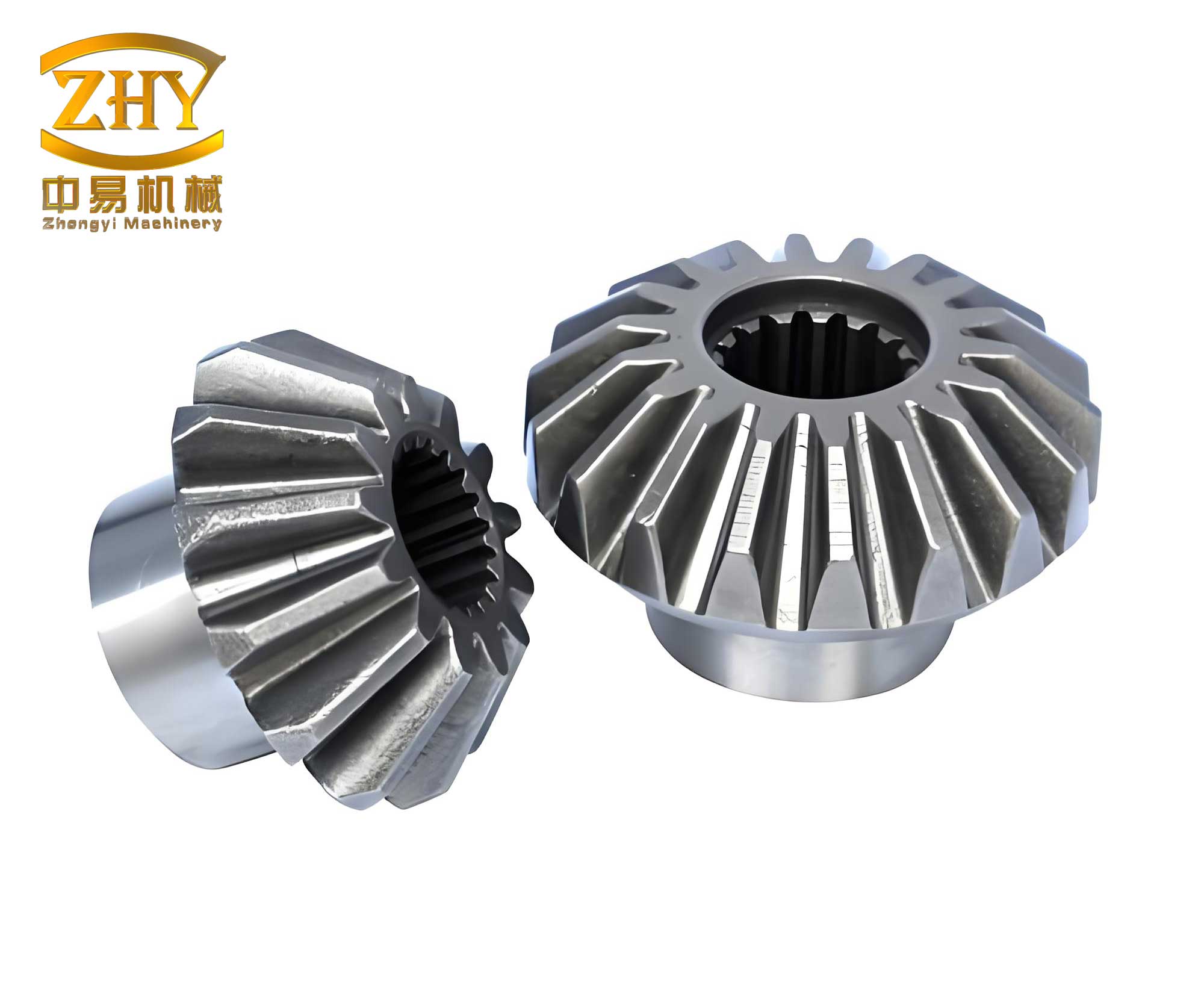
The specific component in focus is a large, ring-type driven bevel gear. Its machining sequence involves several turning and finishing operations. A critical turning operation finishes the face cone (with a specific face angle) and a secondary face, using the previously machined primary bore and primary face as datums. The technical specification mandates that the runout of the newly machined face cone relative to datum axis A (the primary bore) and datum plane B (the primary face) must be within a tight tolerance, for example, 0.04 mm. This runout check is a vital quality gate before the gear proceeds to the costly and complex spiral tooth cutting process. The existing method of using a CMM was identified as the primary constraint affecting production efficiency and real-time quality feedback.
1. Problem Definition and the TRIZ “Parameter Bridge”
TRIZ offers a structured framework for solving technical contradictions. The core model used here is the “Parameter Bridge” or “Technical Contradiction” model. It posits that inventive solutions often resolve trade-offs where improving one parameter (feature) of a system leads to the worsening of another. The solution process involves three key steps: translating the specific problem into generic TRIZ parameters (Building the “Bridge”), using the Altshuller’s Contradiction Matrix to find suggested inventive principles (Crossing the “Bridge”), and then interpreting these principles back into specific design concepts (Completing the “Bridge”).
The initial analysis of the bevel gear runout measurement problem framed it as a clear technical contradiction:
- Improving Parameter: We needed to significantly improve Productivity (TRIZ Parameter #44). This meant reducing the time and effort required to perform the runout check, eliminating the need to transport the gear to a separate CMM room.
- Worsening Parameter: Any faster, simpler method risked compromising Measurement Accuracy (TRIZ Parameter #48). The CMM, though slow, provides high, traceable accuracy. A new method must not sacrifice this critical requirement.
This pairing—Improving #44 (Productivity) while avoiding the worsening of #48 (Measurement Accuracy)—defines our standard TRIZ problem statement.
2. Crossing the Bridge: The Altshuller’s Contradiction Matrix and Inventive Principles
Consulting the Altshuller’s Contradiction Matrix (2003 version with 48 parameters) with the improving parameter (44) and the worsening parameter (48) yields a set of recommended inventive principles. These principles are generic prompts that have historically solved similar contradictions in other fields. For our case, the matrix suggested the following eight principles:
| Principle Number | Inventive Principle Name | Initial Relevance Assessment |
|---|---|---|
| 1 | Segmentation | High – Could imply breaking the measurement system into modular, portable parts. |
| 28 | Mechanics Substitution | Low – The measurement is inherently mechanical; substitution not immediately obvious. |
| 19 | Periodic Action | Medium – Could relate to making the measurement action cyclical/regular instead of a special event. |
| 37 | Thermal Expansion | Low – Not directly applicable to this measurement context. |
| 4 | Asymmetry | High – Suggests a non-symmetric fixture design to optimize function. |
| 13 | ‘The Other Way Round’ | High – Invert the approach: move the gauge to the gear, not the gear to the gauge. |
| 24 | Intermediary | High – Introduce an intermediary object (a fixture) to facilitate the measurement. |
| 3 | Local Quality | High – Optimize different parts of the fixture for different functions (locating, clamping, measuring). |
Principles #28 and #37 were deemed less feasible for this mechanical measurement problem. The remaining six principles (#1, #19, #4, #13, #24, #3) formed a powerful combinatorial guide for the design synthesis phase. Their interpretation led to the core design concept:
- Segmentation & ‘The Other Way Round’ (1, 13): Design a portable, decomposable measurement system that can be brought directly to the bevel gear at the machine tool or a nearby inspection station.
- Intermediary (24): The solution is the intermediary itself—a dedicated measurement fixture/stool that acts as a precision transfer standard.
- Local Quality & Asymmetry (3, 4): The fixture must have distinct, optimized zones: a high-precision locating section that mimics the gear’s datums (bore and face), a rigid but adjustable arm for holding the indicator, and a clamping mechanism. Its shape will likely be asymmetric to position the indicator correctly over the gear’s face cone.
- Periodic Action (19): The fixture enables frequent, “periodic” checks (e.g., first-piece inspection, periodic sampling) as part of the regular production cycle, rather than a batch-based, offline activity.
3. Detailed Design of the Bevel Gear Runout Measurement Fixture
The synthesized concept materialized into a dedicated runout measurement fixture. Its primary function is to provide a precise, repeatable kinematic mount for a dial indicator (or electronic probe), referencing the gear’s own datum features. The fixture essentially creates a portable metrology frame.
The fixture comprises several key components, each serving a specific purpose defined by the inventive principles:
- Fixture Body (Asymmetry, Local Quality): The main structure, typically made from a stable material like tool steel. It is designed with an offset arm to position the indicator squarely over the face cone of the bevel gear. It houses the precision locating elements.
- Locating Sleeve/Bush (Local Quality): A hardened and ground cylindrical sleeve that fits into the gear’s primary datum bore (e.g., Ø289.55 mm). This establishes the datum axis A for the measurement. It is a wear part and must be replaceable.
- Support Feet/Adjusters (Segmentation, Local Quality): Adjustable feet or fixed pads on the fixture body that contact the gear’s primary datum face (face 1). These establish datum plane B and ensure the fixture sits square to the gear’s axis.
- Indicator Mounting Arm & Clamps (Segmentation, Asymmetry): An adjustable arm extending from the body, with a clamping mechanism to secure a standard dial indicator or LVDT probe. The arm allows for radial adjustment to position the indicator’s stylus at different diameters on the face cone.
- Locking/Clamping Mechanism (Local Quality): A simple mechanism (e.g., a thumbscrew or cam) to lightly secure the fixture against the gear’s bore, ensuring stability during rotation without distorting the gear or fixture.
The dimensional design of the locating sleeve is critical. Its outer diameter must match the minimum size of the gear’s bore (considering tolerance) to provide a precise fit. The fixture’s overall geometry must ensure the indicator travel is sufficient and perpendicular to the measured surface. A summary of key design and material specifications is presented below.
| Component | Material | Heat Treatment / Hardness | Critical Function / Note |
|---|---|---|---|
| Fixture Body | 20Cr (or similar alloy steel) | Case hardened to 55-60 HRC, depth 0.8-1.2mm | Provides rigid, stable, and wear-resistant structure. |
| Locating Sleeve | T10A (or similar high-carbon tool steel) | Hardened to 58-62 HRC | Precision wear component. Must be calibrated and replaced periodically. |
| Indicator Arm & Clamp | T10A / 45 Steel | Hardened to 50+ HRC / Black oxide finish | Must provide rigid, vibration-free mounting for the indicator. |
| Support Feet | T10A | Hardened to 58-62 HRC | Provide stable, point/line contact on gear datum face. |
4. Mathematical Foundation and Measurement Protocol
The fixture enables the direct measurement of circular runout. Runout is a composite tolerance that controls the combined effects of eccentricity and surface form irregularities of a surface of revolution relative to a datum axis. For the face cone of a bevel gear, we measure face runout.
The mathematical definition of the measured runout error (\(\Delta_i\)) at a given diameter is:
$$\Delta_i = M_{max} – M_{min}$$
where \(M_{max}\) and \(M_{min}\) are the maximum and minimum readings of the dial indicator as the fixture (and thus the datum axis) is rotated through one full revolution about the gear’s bore.
The complete measurement procedure using the fixture is as follows:
- Place the finished bevel gear on a stable, flat surface (machine table or inspection bench), with the face cone accessible.
- Mount a calibrated dial indicator securely into the fixture’s holder.
- Insert the fixture’s locating sleeve into the gear’s primary datum bore. Gently engage the locking mechanism to stabilize the fixture. Ensure the support feet are sitting flush on the gear’s primary face.
- Adjust the fixture’s arm radially so the indicator’s stylus contacts the face cone at a desired diameter (e.g., near the outer edge). Position the stylus perpendicular to the cone surface. Pre-load the indicator (typically 1-2 turns).
- Set the dial indicator to zero.
- Slowly and smoothly rotate the entire fixture 360 degrees around the datum bore. Observe the indicator’s total pointer excursion. Record \(M_{max}\) and \(M_{min}\). Calculate \(\Delta_i\) for this diameter.
- Repeat steps 4-6 for at least four distinct diameters (e.g., near the heel, toe, and two intermediate points) across the face cone width of the bevel gear.
- The final runout value for the gear is the maximum \(\Delta_i\) observed across all measured diameters:
$$\text{Runout} = \max(\Delta_{i,1}, \Delta_{i,2}, \Delta_{i,3}, \Delta_{i,4})$$ - Compare this value to the specified tolerance (e.g., 0.04 mm). If \(\text{Runout} \leq \text{Tolerance}\), the gear passes this check.
5. Advantages, Calibration, and Adaptability
The TRIZ-driven design offers significant advantages over the CMM-based approach:
- Dramatically Improved Productivity (Parameter #44): Measurement time is reduced from tens of minutes (including handling) to under two minutes, enabling 100% inspection or high-frequency sampling.
- Maintained/Enhanced Measurement Accuracy (Parameter #48): The fixture uses the gear’s own functional datums, providing a direct and repeatable measurement that closely mirrors the gear’s operating condition. It eliminates errors associated with re-fixturing on a CMM.
- Simplicity and Robustness: The design is mechanically simple, reliable, and suitable for the shop-floor environment.
- Cost-Effectiveness: It eliminates the need to dedicate high-value CMM time for this routine check.
To ensure ongoing accuracy, the fixture, particularly the locating sleeve, must be part of a metrology management system. Regular calibration checks (e.g., every 6 months) against master rings or via CMM are essential to verify its critical dimensions and ensure it has not worn beyond acceptable limits.
Furthermore, the design embodies the TRIZ principle of Segmentation and Local Quality for adaptability. By designing a modular fixture body with interchangeable locating sleeves and adjustable arms, the same fixture platform can be adapted to measure the runout of different sizes and families of bevel gears. Simply swapping the sleeve to match a different bore diameter and adjusting the arm’s reach can extend the solution’s utility across a product line.
6. Conclusion
This application demonstrates the potent utility of TRIZ as a structured engine for inventive design in mechanical engineering. By framing the bevel gear runout measurement challenge as a classic technical contradiction between Productivity and Measurement Accuracy, and systematically applying the inventive principles derived from the Altshuller Matrix, a simple yet highly effective solution was conceived and realized. The resulting measurement fixture successfully bridges the gap between rigorous metrology and production efficiency. It empowers manufacturers of large bevel gears to implement real-time quality control at the point of manufacture, ensuring that only components meeting the critical runout specification proceed to final tooth cutting, thereby enhancing overall product quality and reliability while reducing waste and cost. The methodology and design philosophy are universally applicable, offering a template for solving similar inspection and fixturing challenges in precision manufacturing.