
In my extensive experience within the gear manufacturing industry, achieving and maintaining high precision in gear shaving operations has always been a paramount objective. The process of gear shaving is critical for refining tooth profiles, improving surface finish, and ensuring the overall functional quality of gears, especially for applications demanding high accuracy such as in machine tools and automotive transmissions. This article, presented from my first-person perspective as a manufacturing engineer specializing in gear production, delves into the multifaceted strategies and technical considerations essential for elevating gear shaving precision. The core challenge often lies not merely in the shaving process itself, but in the meticulous preparation and control of pre-shave gear quality. Every step, from blank preparation to final inspection, interlinks to influence the outcome of gear shaving. I will elaborate on key areas including blank quality control, optimization of shaving allowance, fixture and tooling accuracy, error compensation techniques, and process stability, utilizing tables and formulas to encapsulate critical data and relationships. The repeated emphasis on gear shaving throughout this discussion underscores its centrality to modern precision gear manufacturing.
The foundation for successful gear shaving is laid during the manufacturing of the gear blank. Imperfections in the blank inevitably propagate through subsequent processes, including gear shaving, and can severely limit achievable precision. The geometric relationships of the blank must be tightly controlled. Specifically, the coaxiality between the bore and the tip diameter, the perpendicularity of the reference face to the bore, and the parallelism between the clamping face and the reference face are non-negotiable prerequisites. In my practice, I enforce the following tolerances as a baseline for blanks intended for high-precision gear shaving:
| Blank Feature | Critical Relationship | Maximum Permissible Error (mm) |
|---|---|---|
| Bore & Tip Diameter | Coaxiality | 0.01 |
| Reference Face & Bore | Perpendicularity | 0.01 |
| Clamping Face & Reference Face | Parallelism | 0.01 |
Deviations from these specifications introduce eccentricities and misalignments that manifest as errors in tooth geometry post-gear shaving. The radial runout (Fr) of the gear, often stemming from geometric eccentricity (e) of the blank’s bore relative to the machine tool’s rotational axis, is a primary concern. This error can be approximated by the relationship: $$ F_r \approx 2e $$. Therefore, controlling ‘e’ is direct control over Fr. For pre-shave gears, I recommend compressing the permissible radial runout tolerance by approximately one-third compared to the final gear specification. This pre-compensation accounts for the fact that gear shaving can sometimes exacerbate certain error forms, like adjacent pitch error, while improving others. The installation error during hobbing or shaping directly contributes to the cumulative pitch error (Fp). A precise and repeatable mounting method is therefore crucial. One effective technique I employ is error compensation during setup, where the blank’s inherent runout is measured and oriented to partially cancel out the machine tool’s systematic errors.
The amount of material left for the gear shaving operation, commonly termed the shaving allowance, is a pivotal parameter. An excessive allowance reduces shaving efficiency, increases tool load and wear, and can accentuate undesirable tooth profile characteristics such as mid-point concavity. Conversely, an insufficient allowance may fail to clean up all pre-shave inaccuracies, leaving sub-surface defects or profile errors. The traditional, blanket specification of allowance (e.g., 0.12–0.15 mm) is often suboptimal. Through systematic experimentation and process capability analysis, I have developed a more refined approach. The optimal shaving allowance is not a fixed value but a function of the pre-shave gear’s actual measured size and its process capability. For stable processes where pre-shave gear quality (tooth profile, pitch, runout) is consistently high, the allowance can be significantly reduced. My methodology involves machining the pre-shave gear such that its over-pin measurement or base tangent length is at the upper limit of its pre-shave tolerance, then adding a minimal safety margin. This can be expressed as: $$ A_s = L_{max} + \delta $$ where \( A_s \) is the optimal shaving allowance, \( L_{max} \) is the maximum permissible pre-shave size (e.g., base tangent length), and \( \delta \) is a small incremental value, typically between 0.02 and 0.05 mm. This approach has yielded remarkable results, improving final gear shaving quality, reducing cycle time by nearly one-third, and extending shaving cutter life.
The following table summarizes the comparison between traditional and optimized shaving allowance strategies for a module 2-3 gear system:
| Strategy | Pre-Shave Quality Focus | Typical Allowance (mm) | Impact on Gear Shaving |
|---|---|---|---|
| Traditional | Low; relies on large allowance to cover errors | 0.12 – 0.15 | Higher load, potential profile distortion, lower efficiency |
| Optimized | High; stringent control of pre-shave parameters | Lmax + (0.02 – 0.05) | Lower load, better profile accuracy, higher efficiency, longer tool life |
The fixture system, particularly the arbor or mandrel used to hold the gear blank during pre-shave operations (hobbing/shaping) and sometimes during gear shaving itself, is a direct transmitter of precision. Minimizing the clearance between the gear bore and the arbor is essential to reduce random radial displacement, which directly translates into tooth-to-tooth variation and radial runout. For a nominal bore diameter, rather than using a standard sliding fit, I specify arbors with a much tighter tolerance, effectively a selective fit. For instance, for a Ø38H7 gear bore, an arbor of Ø38 g5 or even a custom-matched size is used. However, to account for practical wear and extend arbor life without sacrificing gear shaving precision, a wear tolerance extension is implemented. The manufacturing drawing specifies the ideal size, but in use, the arbor is allowed to wear down to a calculated limit before rejection. This limit ensures the fit remains sufficiently precise for high-quality gear shaving. The relationship is: $$ D_{arbor\_wear\_limit} = D_{nominal} – \Delta_{wear} $$ where \( \Delta_{wear} \) is typically around 0.005 mm for precision gear shaving applications. It is vital to note that this wear limit is for in-use control and not the manufacturing acceptance criterion.
The gear shaving process itself is a complex interaction between the shaving cutter and the gear workpiece. Understanding the kinematics and mechanics is key to diagnosing and preventing errors. The infamous “mid-point concavity” on the tooth flank after gear shaving is often linked to excessive shaving allowance and improper cutter/workpiece alignment. The theoretical tooth contact during gear shaving can be modeled to understand profile generation. The cross-axis angle between the cutter and gear introduces a sliding velocity component essential for the cutting action. The surface finish improvement during gear shaving is a function of cutting speed, feed, and cutter condition. Statistical Process Control (SPC) is an indispensable tool I use to monitor the gear shaving process. Key parameters such as post-shave tooth profile error (ff), helix deviation (fHβ), and single pitch deviation (fpt) are charted over time. Control charts for these characteristics help identify trends, such as gradual cutter wear, before they lead to non-conforming parts. For example, a gradual increase in the average value of ff might indicate cutter dressing is required. The process capability index (Cpk) for critical gear shaving outputs should be monitored to ensure robust production.
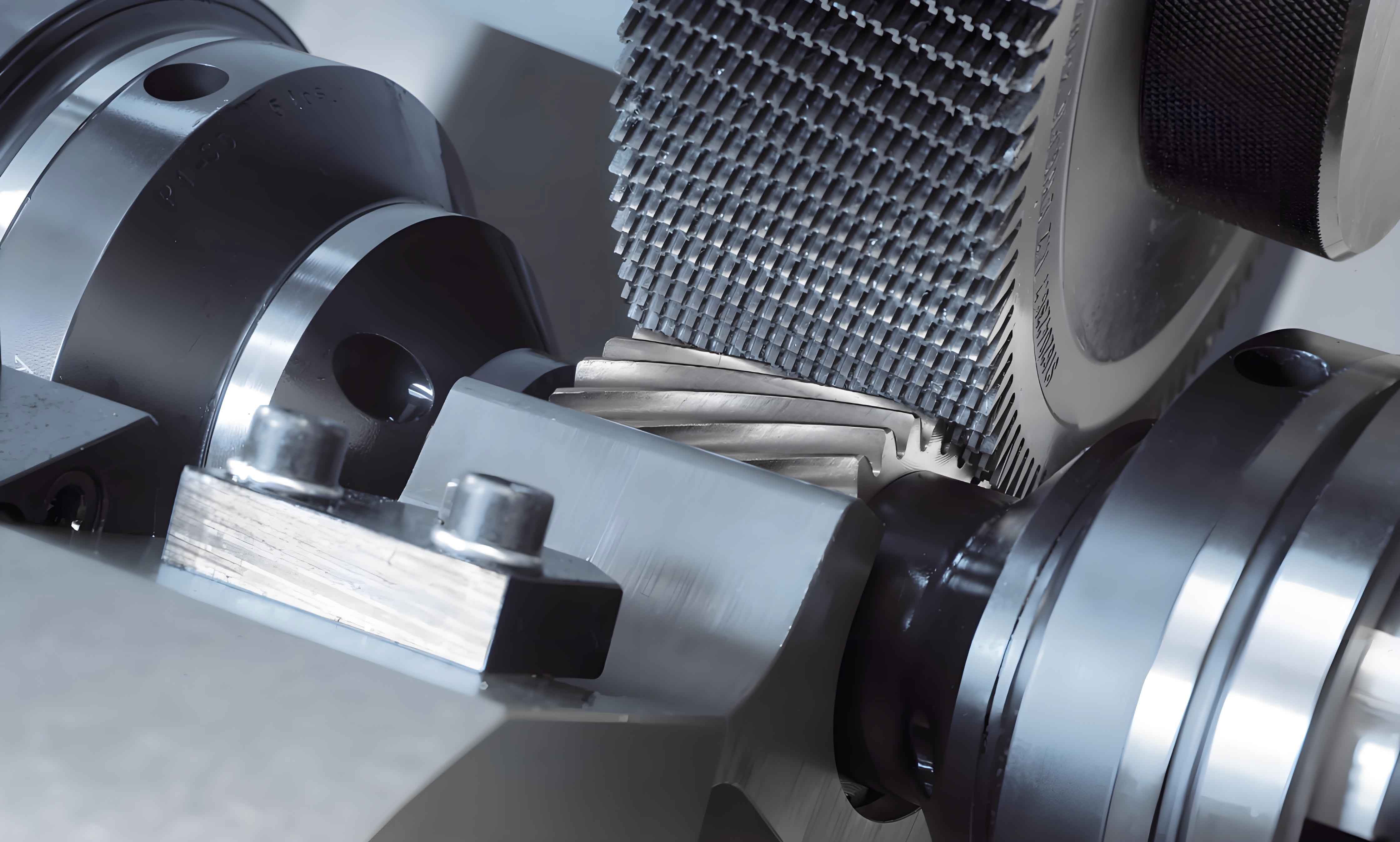
Error mapping and compensation is another advanced technique applicable to gear shaving. By characterizing the systematic errors of a specific gear shaving machine—such as axis misalignments, thermal drifts, or cutter mounting errors—a compensation file can be created. This file instructs the machine’s CNC to make minute adjustments to the relative positioning between the cutter and workpiece during the gear shaving cycle, effectively canceling out the known errors. This is particularly effective for improving tooth alignment and reducing helix angle errors. The compensation values are often derived from a master gear run and detailed measurement. The mathematical model for compensation can involve polynomial functions describing error as a function of table rotation angle or axial position. For instance, a lead correction ΔL(θ) might be applied: $$ \Delta L(\theta) = a_0 + a_1\theta + a_2\theta^2 $$ where θ is the rotational angle and an are coefficients determined from error mapping. Implementing such closed-loop correction strategies has consistently pushed the final quality of gears subjected to gear shaving beyond standard 7-grade accuracy, often reaching 5 or 6 grades as per ISO 1328.
Cutter selection and maintenance for gear shaving are equally critical. The geometry of the shaving cutter, including its pressure angle, profile modifications (like tip and root relief), and surface coating, must be matched to the specific gear design and material. A worn or improperly dressed cutter will not perform effective gear shaving and will introduce its own errors. I establish a rigorous regimen for cutter inspection, documenting parameters like effective diameter, profile deviation, and surface condition. The relationship between cutter wear and resultant gear quality in gear shaving is not linear; there is a threshold beyond which quality degrades rapidly. Monitoring the cutting forces or motor current during gear shaving can provide an indirect, real-time indicator of cutter condition. Dressing the shaving cutter is a skillful operation that restores its precise geometry. The frequency of dressing is a trade-off between cutter life and consistent gear shaving quality, best determined through SPC data rather than a fixed time interval.
Metrology forms the backbone of any precision gear shaving program. Measuring the pre-shave gear comprehensively, not just size but also profile, pitch, and runout, is essential for predictive control. For the final gear, a complete evaluation per ISO 1328 is necessary to validate the gear shaving process. Modern gear measuring instruments provide detailed error maps that are invaluable for diagnostic purposes. For example, a polar plot of cumulative pitch error can clearly indicate installation eccentricity from a previous operation. A profile trace showing a consistent deviation might point to a mismatch in the basic rack profile between the hob and the shaving cutter. I advocate for the measurement of every critical gear in a batch during the development phase and statistical sampling once the gear shaving process is proven stable. The measurement data feeds directly back into the control loops for blank machining, fixture maintenance, and shaving machine setup, creating a virtuous cycle of continuous improvement for gear shaving operations.
The integration of these elements—blank quality, optimized allowance, fixture precision, process control, error compensation, cutter management, and metrology—creates a robust system for excellence in gear shaving. It is a holistic view where gear shaving is not an isolated corrective step but the culmination of a carefully orchestrated sequence. To further illustrate the interaction of key parameters, consider the following summary table of factors influencing final gear shaving precision:
| Process Stage | Key Control Parameter | Target/Formula | Primary Impact on Gear Shaving Result |
|---|---|---|---|
| Blank Machining | Bore/Reference Face Geometry | Coaxiality ≤ 0.01 mm, Perp. ≤ 0.01 mm | Minimizes inherited radial runout & tilt errors |
| Pre-Shave Cutting (Hob/Shape) | Mounting Eccentricity (e) | Minimize e; \( F_p \propto e \) | Reduces cumulative pitch error input to gear shaving |
| Allowance Determination | Shaving Allowance (As) | \( A_s = L_{max} + (0.02 \text{ to } 0.05) \text{ mm} \) | Balances material removal with minimal process distortion |
| Fixture/Arbor | Fit Clearance (C) | \( C_{effective} \rightarrow 0 \); Use selective fits | Eliminates random radial displacement during gear shaving |
| Gear Shaving Process | Cross-Axis Angle (Σ), Feed | Optimized for material & finish; SPC on ff, fHβ | Directly controls finish, profile accuracy, and lead |
| Cutter Management | Wear Land (VB) | Maintain VB < Threshold; Monitor cutting force | Ensures consistent cutting action and profile generation |
| Error Compensation | Compensation Function Δ(θ) | \( \Delta(\theta) = f(\text{mapped errors}) \) | Actively corrects systematic machine tool errors |
In conclusion, the pursuit of supreme precision in gear shaving is a multidimensional engineering endeavor. It demands a departure from viewing gear shaving as a mere finishing touch and instead embracing it as an integrated system whose output is predicated on every preceding input. My journey in refining gear shaving processes has reaffirmed that there is no single magic solution; rather, it is the relentless attention to detail across the entire manufacturing chain—from the raw blank to the final measurement report. By rigorously controlling blank geometry, scientifically optimizing the shaving allowance, employing high-precision fixtures with managed wear, implementing real-time process control and error compensation, and maintaining cutters meticulously, the goal of consistently achieving gears of grade 7 and better through gear shaving is not only attainable but sustainable. The continuous evolution of machine tools, cutting tools, and metrology technology will further empower this pursuit, but the fundamental principle remains: excellence in gear shaving is built on a foundation of comprehensive process understanding and control.