
The rack and pinion gear system serves as a critical component in rack railway propulsion. Understanding the wear conditions and patterns on the tooth surfaces of the rack and pinion pair during vehicle operation is vital for ensuring stable and safe rail service. This work focuses on the unique challenges posed by rack railway configurations, specifically the Strub system, where the mounting distance between the pinion and the fixed rack is not constant. This variability necessitates a specialized approach to wear analysis, differing significantly from standard fixed-center gear or rack and pinion systems.
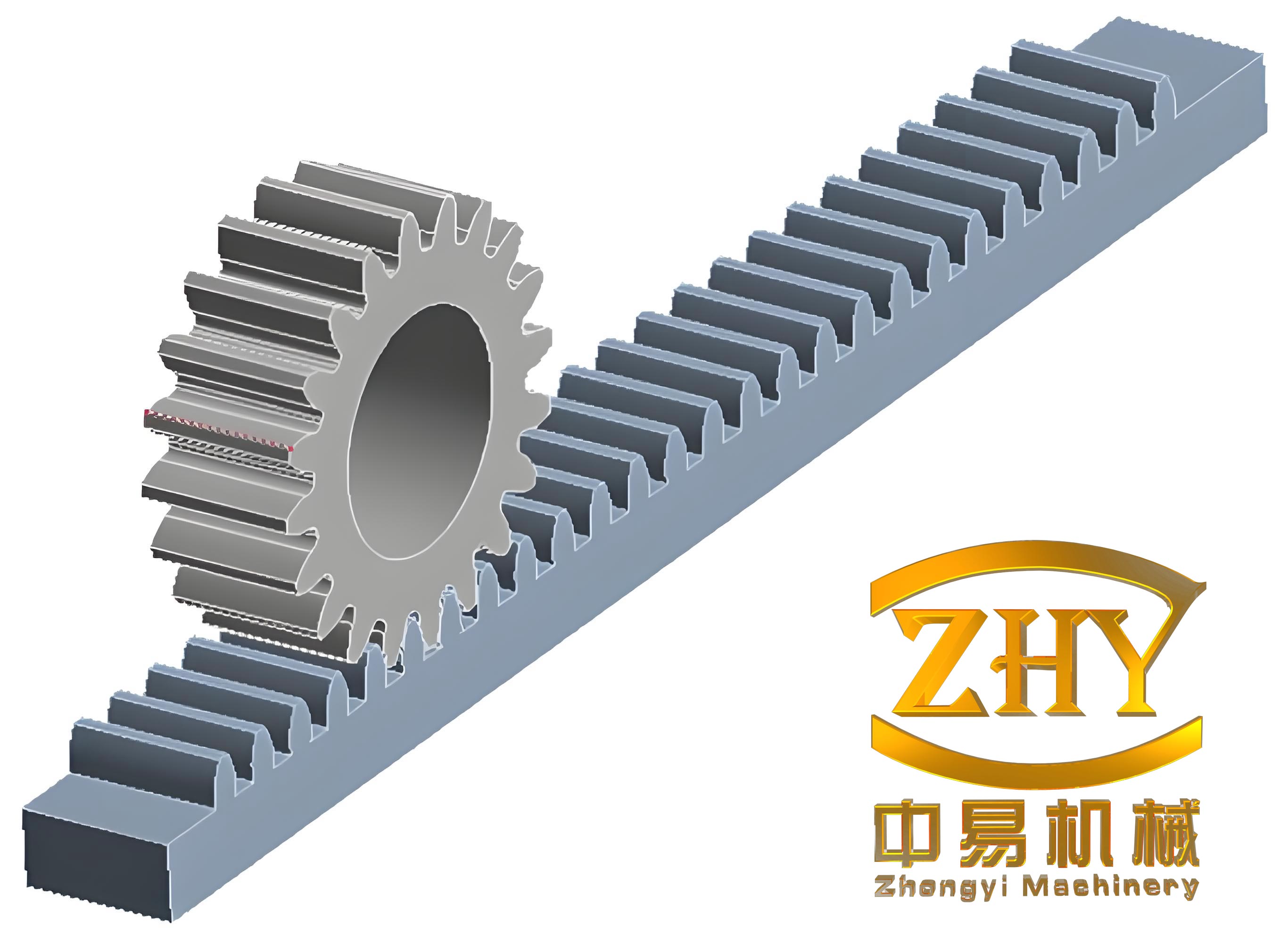
In the Strub system, the pinion is mounted on the same axle as the locomotive’s running wheels. The rack is fixed to the railway ties. The primary cause of the variable mounting distance is the progressive wear of the wheel tread. As the wheel diameter decreases due to circumferential wear, the entire axle, and consequently the pinion’s center, moves closer to the rack. Referring to typical design specifications, the allowable wear on the wheel’s rolling circle diameter can be as much as 30 mm over a service life of several years, leading to a significant and continuous change in the effective mounting distance of the rack and pinion gear set.
This variation in mounting distance critically affects the meshing performance of the rack and pinion pair. As the pinion moves from its initial ‘as-new’ position to its final ‘limit’ position (corresponding to maximum wheel wear), the backlash between teeth decreases from a maximum to a minimum, while the contact ratio increases from a minimum to a maximum. The design must ensure sufficient contact ratio at the initial position to minimize impact and noise, while simultaneously preventing jamming at the limit position due to excessively small backlash. Furthermore, the wear on the rack and pinion teeth themselves directly alters both backlash and contact ratio during service. Therefore, a predictive model for wear in such a variable mounting distance system is essential for optimal design and maintenance planning, aiming to maximize durability and operational smoothness.
Analysis of the Variable Mounting Distance Transmission Process
The transmission characteristics of a variable mounting distance rack and pinion gear differ fundamentally from a fixed-center system. The core of the analysis lies in quantifying how key meshing parameters evolve as the pinion center moves relative to the fixed rack. The primary parameters of interest are the radius of curvature at the point of contact, the resulting contact stress, and the sliding distance on the rack tooth flank. We define the wheel rolling circle radius wear amount as \( y \), where \( y = 0 \) at the initial position and \( y = Y_1 \) (the maximum allowable wear) at the limit position. For any intermediate mounting distance, the pinion center is lowered by \( y \) from its initial height.
Calculation of Radius of Curvature
For a rack and pinion gear pair, the radius of curvature for the pinion tooth at the meshing point is the distance from that point to the pinion’s base circle along the line of action. For the rack, the tooth flank is straight, so its radius of curvature is theoretically infinite. Therefore, the relative or equivalent radius of curvature \( \rho \) at the contact point is essentially determined by the pinion’s curvature. Referring to the geometry of meshing, when the pinion is at a lowered position \( y \), the minimum radius of curvature \( \rho_{min} \) occurs at the point where the rack tooth tip (considering tip rounding) enters contact. The maximum radius of curvature \( \rho_{max} \) occurs at the point where the pinion tooth tip leaves contact.
The calculations yield the following formulas. The minimum radius of curvature at any mounting offset \( y \) is:
$$\rho_{min}(y) = r_d \sin\alpha – \frac{(h_{a2}^* – k_2)m – x m}{\sin\alpha} + \frac{y}{\sin\alpha}$$
where:
- \( m \): Module
- \( z \): Number of pinion teeth
- \( x \): Pinion addendum modification coefficient
- \( \alpha \): Pressure angle
- \( h_{a2}^* \): Rack addendum coefficient
- \( k_2 \): Factor accounting for rack tip rounding
- \( r_d \): Pinion pitch radius, \( r_d = m z / 2 \)
The maximum radius of curvature is independent of \( y \) and is given by the geometry at the pinion tooth tip:
$$\rho_{max} = \sqrt{r_a^2 – r_b^2}$$
where \( r_a \) is the pinion tip radius and \( r_b \) is the pinion base radius.
Calculation of Contact Stress
Based on Hertzian contact theory, the contact stress \( \sigma \) at any meshing point for the rack and pinion gear is calculated as:
$$\sigma = \sqrt{\frac{W E^*}{b \pi \rho}}$$
where:
- \( W \): Normal load, \( W = \frac{1000 T}{r_d \cos\alpha} \), with \( T \) being the nominal torque.
- \( E^* \): Equivalent elastic modulus, \( \frac{1}{E^*} = \frac{1-\nu_1^2}{E_1} + \frac{1-\nu_2^2}{E_2} \).
- \( b \): Effective face width.
- \( \rho \): Radius of curvature at the contact point (from the previous section).
This formula highlights that for a given load and material, the contact stress on the rack and pinion tooth surface is inversely proportional to the square root of the radius of curvature \( \rho \).
Calculation of Sliding Distance on the Rack Flank
The total sliding distance \( S_y \) experienced by a single side of a rack tooth during one complete engagement, when the mounting offset is \( y \), is the length of the path of contact on the rack flank. Geometrical analysis shows that this distance decreases linearly as the pinion moves downward (\( y \) increases). The expression is:
$$S_y = \frac{P_1 – y}{\cos\alpha}$$
where \( P_1 \) is a constant derived from gear geometry:
$$P_1 = (h_{a2}^* – k_2 – x)m + \sin\alpha \left( \sqrt{r_a^2 – r_b^2} – r_d \sin\alpha \right)$$
This relationship is crucial for wear accumulation modeling, as it establishes how the operational history (through \( y \)) affects the sliding action on the rack and pinion interface.
Construction of the Wear Mathematical Model for Variable Mounting Distance
To model wear in this dynamic system, we adopt the widely recognized Archard wear equation, which relates wear volume to normal load, sliding distance, and material properties. The differential form for wear depth \( h \) at a point is:
$$dh = \frac{K \sigma}{3H} dS$$
where:
- \( K \): Dimensionless wear coefficient (dependent on materials, lubrication, and surface conditions).
- \( H \): Hardness of the softer material (typically the rack in this study).
- \( \sigma \): Contact stress at the point.
- \( dS \): Incremental sliding distance.
The continuous variation of both contact stress \( \sigma \) (through \( \rho(y) \)) and sliding distance \( S_y \) with mounting distance \( y \) makes direct integration complex. Therefore, we employ a discretization strategy to handle the variable mounting distance process of the rack and pinion gear.
Discretization Strategy:
- Mounting Distance Discretization: The total wheel wear range \( Y_1 \) is divided into \( q \) steps of size \( \Delta y \), such that \( q \Delta y = Y_1 \). Each step \( j \) corresponds to a quasi-static mounting distance \( A_j = A_{min} + j\Delta y \), where \( A_{min} \) is the minimum mounting distance (at \( y=Y_1 \)). For each step \( j \), the offset is \( y_j = j\Delta y \). The step size \( \Delta y \) is chosen so that during one step, each rack tooth experiences one complete meshing cycle.
- Sliding Distance Discretization: For a given mounting step \( j \), the total sliding distance on the rack flank is \( S_j = (P_1 – y_j)/\cos\alpha \). This distance is divided into \( n \) intervals (\( n = q \) for consistency), each of length \( \Delta S_j \approx P_1 / (n \cos\alpha) \), assuming \( P_1 \gg y_j \) for simplification. This defines a set of discrete points \( i \) along the rack tooth profile, where the distance from the start of contact is \( L_i = i \cdot \Delta S_j \).
This dual discretization allows us to approximate the continuous wear process over the rack and pinion gear’s service life as a summation over discrete operating conditions and profile points.
Wear Depth and Volume Calculation:
At a discrete point \( L_i \) on the rack tooth profile, under mounting condition \( j \):
- The effective radius of curvature is: $$\rho_{i,j} = \rho_{min}(y_j) + \frac{L_i \cos\alpha}{\sin\alpha}$$
- The contact stress \( \sigma_{i,j} \) is computed using the Hertz formula with \( \rho = \rho_{i,j} \).
- The incremental wear depth at this point for this operating condition is: $$\Delta h_{i,j} = \frac{K \sigma_{i,j}}{3H} \Delta S_j$$
- The incremental wear volume for the elemental area is: $$\Delta v_{i,j} = \Delta h_{i,j} \cdot \Delta S_j \cdot b$$
The total wear depth \( h_i \) at rack profile point \( i \) after the pinion has traversed all mounting conditions (from \( y=0 \) to \( y=Y_1 \)) is the summation over all \( j \):
$$h_i = \sum_{j=0}^{q} \Delta h_{i,j}$$
Similarly, the total wear volume \( V \) removed from the rack tooth flank is:
$$V = \sum_{j=0}^{q} \sum_{i=0}^{n} \Delta v_{i,j} = b \sum_{j=0}^{q} \sum_{i=0}^{n} \Delta h_{i,j} \Delta S_j$$
This model effectively captures the history-dependent wear evolution in a variable mounting distance rack and pinion gear transmission.
Experimental Validation of the Wear Model
To verify the accuracy of the proposed wear model for the rack and pinion gear system, a dedicated rack wear test was conducted using a specialized test rig. The rig comprised a driving system, a loading system, a control system, a fixed rack specimen, and a moving platform carrying the pinion. The setup simulated the reciprocal meshing motion under load.
The materials and key parameters for the test rack and pinion are summarized in the following table:
| Parameter | Pinion (Gear) | Rack |
|---|---|---|
| Material | Alloy Steel 18CrNiMo7-6 | Cast Steel G35CrNiMo6-6 |
| Surface Hardness | 56-61 HRC | 610 ±20 HV |
| Module, \( m \) (mm) | 62.667 | 62.667 |
| Number of Teeth, \( z \) | 16 | – |
| Addendum Modification Coeff., \( x \) | 0.5 | 0 |
| Pressure Angle, \( \alpha \) (°) | 20 | 20 |
| Face Width, \( b \) (mm) | 600 | 810 |
| Wear Coefficient, \( K \) | 2.23 × 10⁻⁵ (assumed for good lubrication) | |
The test ran for \( 4.22 \times 10^5 \) cycles under an average torque \( T = 438,150 \) N·m. Post-test inspection revealed a distinct step at the boundary between the meshed and un-meshed zones of the rack teeth, indicating measurable wear. The worn profile was captured via laser scanning. The wear depth along the tooth profile was extracted by comparing the scanned data with the unworn reference geometry.
The theoretical wear depth profile was calculated using the developed model with the parameters listed above. The comparison between the measured and theoretically predicted wear depth along the rack tooth profile is shown in the plot below. The results demonstrate that the trend and distribution pattern predicted by the model align well with the experimental data. Both show maximum wear at the rack tooth tip, with wear depth decreasing progressively towards the root. The quantitative differences are attributed to approximations in the constant wear coefficient \( K \) and average load used in the model, which is acceptable for such predictive engineering analyses. This agreement validates the fundamental soundness of the proposed wear model for the variable mounting distance rack and pinion gear system.
Analysis of Key Influencing Factors on Wear
Using the validated model, we analyze the influence of various operational and design parameters on the wear of the rack and pinion gear. A case study is defined based on a developing rack railway project with the following base parameters: a single vehicle trip duration of 3 hours, daily operation of 12 hours, maximum wheel wear \( Y_1 = 10 \) mm over a 3-year design life, nominal drive torque \( T = 16,000 \) N·m. The gear and rack materials have hardness values of 50-55 HRC and 270-292 HBS, respectively. The base geometric parameters are listed in the table.
| Parameter | Pinion (Gear) | Rack |
|---|---|---|
| Module, \( m \) (mm) | 31.83 | 31.83 |
| Number of Teeth, \( z \) | 22 | 1000 (length) |
| Addendum Modification Coeff., \( x \) | 0.4 | 0 |
| Pressure Angle, \( \alpha \) (°) | 14.036 | 14.036 |
| Face Width, \( b \) (mm) | 80 | 70 |
Effect of Mounting Distance and Lubrication Condition
The model was used to compute the contact stress distribution and wear depth distribution along the rack tooth profile for different mounting distances (i.e., different wheel wear states \( y \)). The results indicate that as the mounting distance decreases (pinion moves down, \( y \) increases), the contact stress increases, particularly near the rack tooth tip. Correspondingly, the wear depth at any given profile point also increases with decreasing mounting distance. The rack tooth tip consistently experiences the highest contact stress and the most severe wear across all mounting conditions.
A critical factor explored is lubrication. Under assumed good lubrication (\( K = 2.23 \times 10^{-5} \)), the cumulative wear depth after the wheel reaches its wear limit is minimal (on the order of nanometers). However, under poor lubrication conditions (\( K = 4 \times 10^{-4} \), representing a nearly two-order-of-magnitude increase), wear increases dramatically. For the same service life, the maximum wear depth at the rack tip can reach approximately 0.016 mm. This stark contrast underscores the paramount importance of maintaining effective lubrication for the longevity of the rack and pinion gear system.
Effect of Gear Design Parameters (Number of Teeth and Addendum Modification)
To identify key design factors mitigating wear, we investigate the influence of the pinion’s number of teeth \( z \) and its addendum modification coefficient \( x \), while keeping the module and pressure angle constant. For a given minimum mounting distance \( A_{min} \), combinations of \( z \) and \( x \) are selected to avoid undercutting. The total wear volume on the rack tooth flank over the system’s life is then calculated for each design combination.
The analysis reveals the following trends:
- Addendum Modification Coefficient (\( x \)): This parameter has a significant and dominant influence on the predicted wear volume. A strong negative correlation is observed: increasing \( x \) leads to a substantial decrease in the total wear volume on the rack.
- Number of Teeth (\( z \)): The influence of the number of pinion teeth on wear volume is comparatively minor. While variations exist, the effect is not as pronounced as that of the addendum modification.
- Interaction: The beneficial effect of a larger \( x \) in reducing wear is consistent across different choices of \( z \).
These findings lead to a clear design guideline: To minimize wear on the rack in a variable mounting distance rack and pinion gear system, the pinion should be designed with a larger positive addendum modification coefficient (\( x \)), provided other design constraints (like avoiding pointed teeth) are satisfied. For example, for an initial center distance of 343 mm, a design with higher \( x \) would be preferred over one with a lower \( x \) but similar \( z \).
| Design Scenario | Pinion Teeth (\( z \)) | Addendum Mod. Coeff. (\( x \)) | Relative Wear Volume |
|---|---|---|---|
| Scenario 1 | 20 | 0.3 | High |
| Scenario 2 | 20 | 0.7 | Low |
| Scenario 3 | 24 | 0.3 | Medium-High |
| Scenario 4 | 24 | 0.6 | Low |
Discussion and Conclusions
This work addresses the specific wear analysis needs of Strub-type rack railway systems characterized by a variable mounting distance between the pinion and the rack. We analyzed the transmission mechanics, deriving formulas for critical time-varying parameters like curvature radius, contact stress, and sliding distance. The core contribution is the development of a discretized mathematical model that predicts wear volume and wear depth distribution on the rack tooth flank by accumulating incremental wear over discrete steps of mounting distance change and sliding distance.
Experimental validation using a rack wear test confirmed the model’s accuracy in predicting the wear pattern, notably the severe wear at the rack tooth tip. The parametric study yielded significant insights:
- Wear Location: The rack tooth tip is consistently the most vulnerable to wear, a conclusion aligned with other gear wear studies where the pinion root/rack tip contact occurs.
- Key Design Factor: The pinion’s addendum modification coefficient (\( x \)) is a crucial design parameter for wear mitigation. Selecting a larger positive \( x \) is a highly effective strategy for reducing rack surface wear in a variable mounting distance rack and pinion gear system.
- Critical Operational Factor: Lubrication condition dramatically influences wear magnitude. Ensuring good lubrication is essential for practical service life.
The developed model and findings provide a theoretical foundation and practical guidance for optimizing the design parameters of rack and pinion gears in variable mounting distance applications. This aids in enhancing durability, reducing maintenance needs, and improving operational safety and smoothness. Future work could refine the model by incorporating the influence of sliding velocity on the wear coefficient and by using more advanced, non-Archard wear models for specific material pairs under mixed lubrication regimes.