
The machining accuracy of straight bevel gear tooth profiles is a critical determinant of their performance in power transmission systems, affecting factors such as noise, vibration, and load-carrying capacity. In practice, achieving the theoretical conjugate tooth form through generation on gear-cutting machines like bevel gear planers often encounters challenges due to the complex interplay of machine adjustments. This article, drawn from first-hand investigation and experimentation, details a systematic approach to diagnosing and correcting significant tooth profile errors in straight bevel gear production. The core of the solution lies in a refined understanding and recalculation of key machine parameters, specifically the rolling ratio and the cradle swing angle.
The fundamental principle behind generating a straight bevel gear on a planer is to simulate the meshing of a pair of conjugate bevel gears. However, for practical manufacturing reasons, one member of this pair is not a real gear but an imaginary crown gear, often simplified as a plane gear or a flat-top gear. The cutting tools (the two planer blades) represent a single tooth space of this imaginary gear. The machine’s cradle embodies this imaginary gear, and its oscillating rolling motion relative to the intermittently indexed workpiece generates the tooth flank. The synchronization of this motion is governed by two pivotal parameters.
The first is the rolling ratio (i), which defines the angular relationship between the cradle and the workpiece. As the imaginary crown gear (cradle) rotates through an angle \(\Delta \theta_c\), the workpiece must rotate through a corresponding angle \(\Delta \theta_w = \Delta \theta_c / i\). From the geometry of the bevel gear set, this ratio is intrinsically linked to the number of teeth on the workpiece (\(z\)) and its pitch cone angle (\(\delta\)). For a plane gear, the number of teeth on the imaginary gear \(z_c\) is given by:
$$ z_c = \frac{z}{\cos \delta} $$
Therefore, the theoretical rolling ratio is:
$$ i = \frac{\theta_c}{\theta_w} = \frac{z_c}{z} = \frac{1}{\cos \delta} $$
For a flat-top gear, the formula adjusts based on the pressure angle and addendum modification. The machine’s change gears approximate this theoretical value.
The second critical parameter is the cradle swing angle. The generation process is not continuous for a full revolution but occurs over a limited arc. The cradle swings back and forth through a total angle (\(\Theta_{total}\)), which must be sufficient to fully generate the tooth profile from tip to root. An insufficient swing angle results in an incomplete, under-generated profile. The calculation for the lower swing angle (\(\Theta_{lower}\)), from the pitch cone to the root, is particularly important and can be expressed as:
$$ \Theta_{lower} = \left[ \frac{\pi}{2z} – \text{inv}\,\alpha \right] \frac{1}{\sin \delta} $$
where \(\alpha\) is the pressure angle and \(\text{inv}\,\alpha\) is the involute function of \(\alpha\). The total swing angle is the sum of the upper and lower segments.
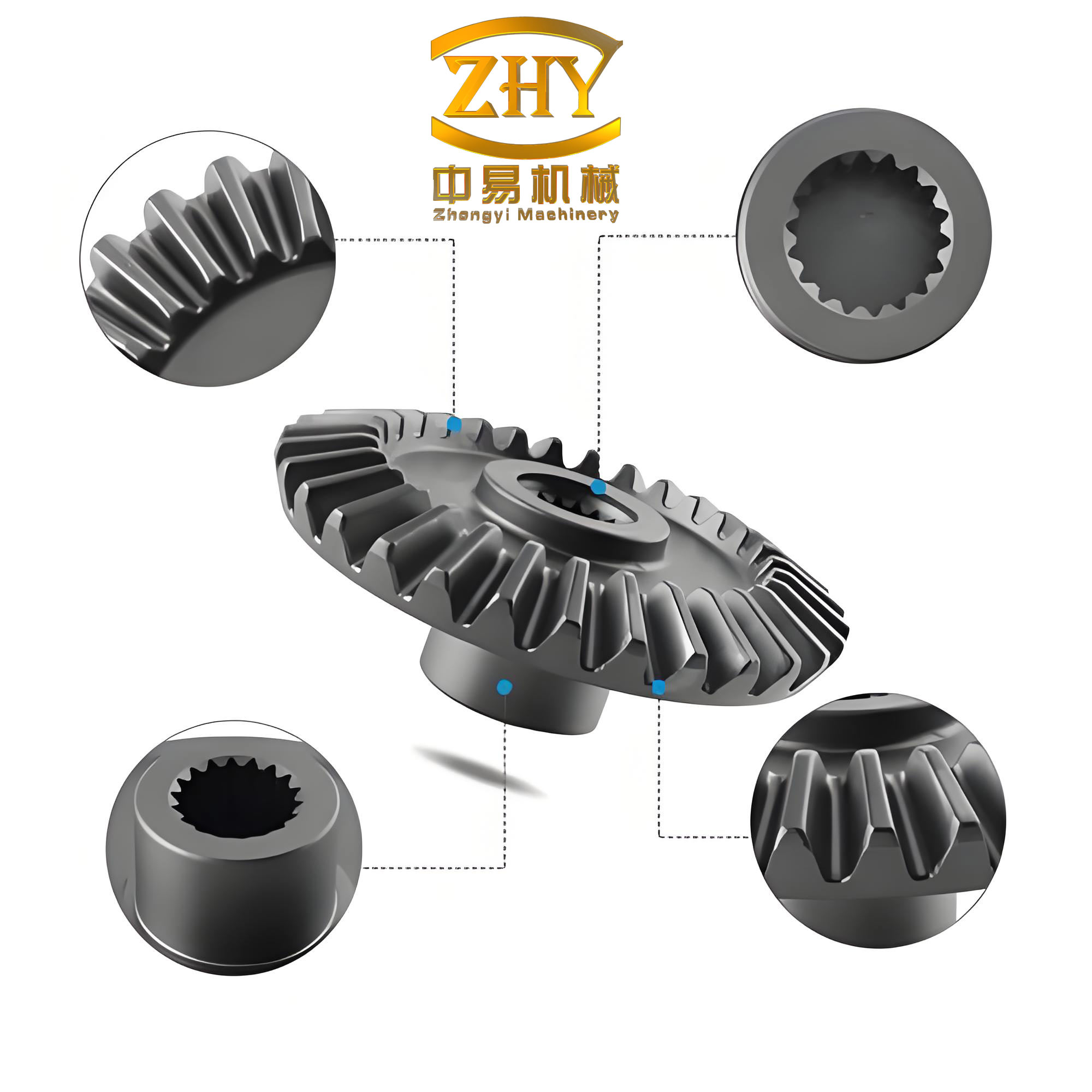
The problem emerged during the production of a specific straight bevel gear (part number illustrative, e.g., Gear Set A). Post-machining inspection revealed a profile that deviated significantly from the theoretical template. Measurement via optical projector against a master profile highlighted several concurrent errors, as summarized below:
| Error Symptom | Description | Probable Cause (Initial Hypothesis) |
|---|---|---|
| Insufficient Tooth Height | Overall tooth depth less than specified. | Incorrect tool setting or depth of cut. |
| Excessively Narrow Tooth Top, Wide Tooth Root | Chordal thickness at the tip too small, at the root too large. | Excessive pressure angle or under-generation. |
| Enlarged Pressure Angle | Flank angle steeper than designed. | Incorrect rolling ratio or machine kinematics. |
| Missing Root Fillet | Sharp transition at the tooth root. | Tool geometry or path not generating the fillet. |
A systematic root-cause analysis was conducted. First, the machine’s mechanical condition and its ability to correctly position all components (tool slide, cradle, etc.) were verified and found to be within tolerance. Second, a series of test cuts was performed on various straight bevel gear blanks with different tooth counts and modules. The results were revealing: only a few gear designs exhibited the error, and its severity varied, with Gear Set A being the most problematic. This isolated the issue from generic machine failure and pointed squarely towards the appropriateness of the process parameters for that specific gear geometry. Correcting baseline alignment errors did not resolve the issue, further confirming that the core problem was the specific combination of rolling ratio and cradle swing angle used for this gear.
The diagnosis pointed to incomplete generation. The observed profile—short, with a narrow top and wide root—is classic for a situation where the cradle does not swing through a large enough angle to fully “roll out” the tooth space. The tool path stops too soon, leaving excess material at the root and failing to properly form the tip. Concurrently, an improperly matched rolling ratio can distort the pressure angle. Therefore, the corrective strategy focused on recalculating and optimizing these two parameters.
For Gear Set A, with a pressure angle of 20°, module of 5 mm, and 25 teeth, the original and recalculated parameters are compared below:
| Parameter | Original Setup | Theoretical Calculation | Action |
|---|---|---|---|
| Cradle Total Swing Angle (\(\Theta_{total}\)) | Based on data: ~35° (implied) | Calculated \(\Theta_{lower}\) ≈ 1.15°, leading to a \(\Theta_{total}\) > 40° | Increase significantly. Change gear ratio selected to achieve a larger swing. |
| Rolling Ratio (i) | Set via change gears yielding a specific i_old | $$ i_{theory} = \frac{1}{\cos \delta} $$ For δ=45°, i_theory ≈ 1.414 |
Slightly decrease from original setting to correct pressure angle. |
| Change Gears (Cradle Swing) | e.g., A/B (specific ratio) | – | Changed to a ratio like C/D to increase angular travel. |
| Change Gears (Rolling Ratio) | e.g., E/F | – | Changed to a ratio like G/H to adjust i. |
The first test cut using the newly calculated parameters (increased swing angle, adjusted rolling ratio) yielded immediate and dramatic improvements. The tooth profile transformed: the root became notably thinner and the tip thicker, directly countering the original error. The pressure angle visibly decreased towards its correct value. This confirmed the diagnostic logic.
A subsequent, deliberate iterative process followed. The parameters were fine-tuned in a stepwise manner, primarily by further increasing the cradle swing angle via its change gears. The evolution of the tooth profile through these iterations is conceptually captured in the sequence below:
| Iteration | Primary Adjustment | Observed Profile Characteristic |
|---|---|---|
| Initial Problematic State | Original parameters from standard tables. | Short tooth, narrow top, wide root, large pressure angle. |
| Test Cut 1 | First recalculation of swing angle & rolling ratio. | Root thins, tip thickens significantly. Direction correct. |
| Test Cut 2 | Fine-tune swing angle increase. | Most of the profile within tolerance, but slight “top-heavy, lean-root” tendency remains. |
| Optimized Final Cut | Further optimized swing angle to a specific change gear ratio (e.g., 47/95). | Chordal tooth thickness, tip profile, and runout are合格. Root profile is slightly lean (beneficial for clearance), root fillet still requires tool geometry attention. |
The results clearly demonstrate the cause-and-effect relationship. The original error was fundamentally due to a cradle swing angle that was too small for this particular straight bevel gear geometry, likely compounded by a slightly high rolling ratio. The standard machine setting tables, while generally reliable, may not be optimal for all combinations of number of teeth and pitch angle. The incomplete generation left excess material at the tooth root, making it “fat,” and failed to fully form the tip. Increasing the swing angle allowed the generating motion to continue further, carving away the excess root material and properly forming the tip, thereby bringing the entire active profile closer to its theoretical conjugate form.
The influence of the cradle swing angle change gear ratio on the critical root thickness of the straight bevel gear is profound. As the ratio is increased, providing a larger cradle oscillation, the root thickness decreases monotonically towards its correct value. There exists an optimal point where the root and tip thicknesses are balanced according to the design specification. Exceeding this point can make the root too thin. The final optimized setting was found empirically to be at this apex of the curve relating swing gear ratio to root thickness.
In conclusion, the precision machining of straight bevel gear tooth profiles on generating planers requires a nuanced understanding of the machine’s kinematic adjustments. While standard tables provide a starting point, they can lead to suboptimal profiles for specific gear designs, manifesting as under-generation errors. The two most powerful levers for corrective action are the cradle swing angle and the rolling ratio. A methodological approach involving:
1. Accurate calculation of the theoretical lower swing angle and total required swing.
2. Comparison with the machine’s setting and its change gear options.
3. Strategic increase of the swing angle to ensure complete generation.
4. Complementary adjustment of the rolling ratio to fine-tune the pressure angle.
…proves highly effective. This process not only solved the immediate production issue for the problematic gear set but also provides a generalizable framework for troubleshooting and enhancing the tooth profile accuracy of straight bevel gears in manufacturing. The final quality is a compromise between a theoretically perfect profile and a functional, quiet, and durable gear, where a slightly lean root profile can often be beneficial for operational clearance and noise reduction.