
As a design and manufacturing engineer specializing in gear systems, I frequently encounter the challenge of achieving precise tooth profile geometry in hypoid bevel gears. The forming method, characterized by its simplicity and high production efficiency, is the predominant process for machining the ring gear (larger member) of a hypoid gear set. Its limited number of adjustable machine settings, however, poses a significant constraint on the ability to correct or modify the tooth form. In this article, I will explore an effective strategy for implementing a first-order tooth profile angle modification within the framework of the forming method, a technique crucial for quality control and performance optimization.
The performance of hypoid bevel gears, critical components in automotive, marine, and heavy machinery drivetrains, is intrinsically linked to the accuracy of their tooth surfaces. While extensive research exists on tooth flank modification for spiral and hypoid bevel gears using generating methods, literature on correction techniques specific to the non-generating forming process is scarce. The forming method fixes the relative motion between the cutter and the workpiece; the tooth profile is essentially an imprint of the cutter blade. Therefore, any discrepancy between the desired gear pressure angle and the cutter’s blade angle, or any inherent machining error requiring compensation, necessitates a methodological approach to adjust the effective cutting geometry.
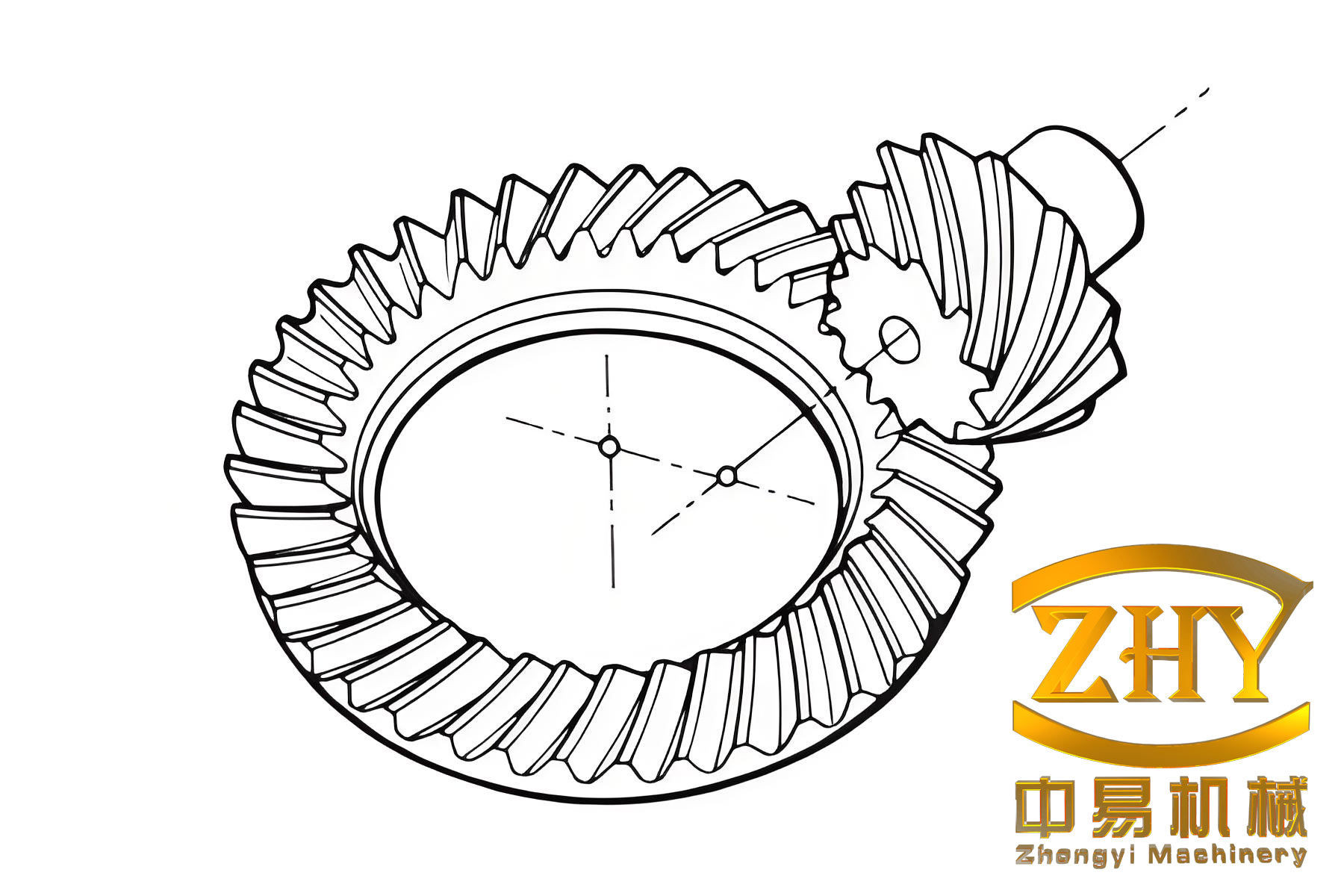
This article addresses this gap by proposing a principle of equivalent modification. The core idea is to conceptually rotate the gear blank around a tangent direction at the reference point on the tooth flank. This rotation directly alters the effective pressure angle. However, this rotated position is not practically feasible on standard horizontal-axis hypoid gear cutting machines. Consequently, I develop the mathematical framework to equivalently translate this conceptual rotation into actionable adjustments of standard machine settings: the cutter radial and angular positions, and the workpiece swivel angle. This methodology provides a systematic way to control the tooth profile angle of hypoid bevel gears cut by the forming method, laying the groundwork for higher-order flank corrections.
Mathematical Foundation of the Forming Method for Hypoid Bevel Gears
To establish the basis for modification, we must first model the standard forming process without any corrections. The setup typically involves a horizontal machine where the cutter axis is parallel to the machine plane. The gear blank is set at its root angle, and the cutting reference point coincides with the root cone apex. The fundamental machine settings include the radial distance from the machine center to the cutter center (radial setting, $S_1$), the angular orientation of the cutter axis relative to the machine (angular setting, $q_1$), the axial sliding base setting ($X_{G2}$), and the workpiece swivel or installation angle ($\gamma_1$). The basic coordinate systems are defined as follows:
- $S_m (O_m-X_m, Y_m, Z_m)$: The machine coordinate system. Origin $O_m$ is at the machine center. The $X_mO_mY_m$ plane coincides with the cutter tip plane.
- $S_c (O_c-X_c, Y_c, Z_c)$: The cutter coordinate system. Origin $O_c$ is at the center of the cutter head.
- $S_p (O_p-X_p, Y_p, Z_p)$: The reference point coordinate system. Origin $O_p$ coincides with the cutting reference point $P$. The $X_p$ axis aligns with the tooth lengthwise tangent at $P$, and $Y_p$ is perpendicular to the cutter axis $Y_c$.
The surface of the cutter blade can be represented in $S_c$ by a vector function $\mathbf{r}_c(u_c, \theta_c)$, where $u_c$ and $\theta_c$ are surface parameters. This surface is then transformed into the machine coordinate system:
$$\mathbf{r}_m = \mathbf{M}_{mc}(S_1, q_1) \cdot \mathbf{r}_c(u_c, \theta_c)$$
Here, $\mathbf{M}_{mc}$ is the coordinate transformation matrix from $S_c$ to $S_m$, dependent on the radial and angular settings. For a specific point $P$ on the tooth flank with corresponding cutter coordinates $(u_p, \theta_p)$, the nominal generating distance $R_{02}$ is given by the magnitude of the position vector in the machine plane:
$$R_{02} = |\mathbf{r}_m(S_1, q_1, u_p, \theta_p)|$$
The vector from the reference point $P$ to the root cone apex $O_r$ (which coincides with $O_m$ in the standard setup) expressed in $S_p$ is:
$$\overrightarrow{PO_r} = [-R_{02}\cos\beta_0, \quad R_{02}\sin\beta_0, \quad h_r]^T$$
where $\beta_0$ is the spiral angle at the reference point and $h_r$ is the dedendum. The direction vector of the workpiece axis $L_1$, pointing towards the mounting face, in $S_p$ is:
$$\mathbf{L}_1 = [\cos\gamma_1 \cos\beta_0, \quad -\cos\gamma_1 \sin\beta_0, \quad \sin\gamma_1]^T$$
Principle of Equivalent Tooth Profile Angle Modification
The need for profile angle modification arises when the desired pressure angle $\alpha_{gear}$ differs from the cutter blade angle $\alpha_{cutter}$, or to compensate for systematic errors. Let this difference be $\Delta\alpha = \alpha_{gear} – \alpha_{cutter}$. The proposed method involves two conceptual steps.
Step 1: Conceptual Blank Rotation. The gear blank, together with its coordinate system $S_p$, is conceptually rotated by an angle $\Delta\alpha$ around the $X_p$ axis (the tooth tangent at $P$). This rotation, denoted by the transformation matrix $\mathbf{T}(\Delta\alpha)$, creates a new coordinate system $S_{p2}$. In this new orientation, the effective pressure angle at the reference point is altered. The vector to the root cone apex and the workpiece axis direction become:
$$\overrightarrow{PO_{r2}} = \mathbf{T}(\Delta\alpha) \cdot \overrightarrow{PO_r}$$
$$\mathbf{L}_{20} = \mathbf{T}(\Delta\alpha) \cdot \mathbf{L}_1$$
In this state, the workpiece axis $\mathbf{L}_{20}$ is no longer parallel to the machine plane. The angle between $\mathbf{L}_{20}$ and the cutter axis direction $\mathbf{L}_c = [0, 0, 1]^T$ in $S_{p2}$ gives the new, non-feasible swivel angle $\gamma_2$:
$$\gamma_2 = \frac{\pi}{2} – \arccos(\mathbf{L}_c \cdot \mathbf{L}_{20})$$
Step 2: Equivalent Parameter Transformation. To achieve the same cutting geometry with a standard horizontal setup, we must find an equivalent configuration where the workpiece axis is returned to a horizontal orientation. This is accomplished by rotating the entire system (the conceptually rotated blank and the cutter) around the cutter axis. This rotation changes the angular setting $q_1$. The required rotation angle $\Delta\theta$ is determined by the projection of $\mathbf{L}_{20}$ onto the machine plane. First, we find the direction of the new machine $Y_{m2}$ axis, represented in $S_{p2}$ as $\mathbf{L}_{Ym2} = [\sin\beta_2, \cos\beta_2, 0]$, which must be perpendicular to $\mathbf{L}_{20}$:
$$\mathbf{L}_{Ym2} \cdot \mathbf{L}_{20} = 0$$
Solving this yields $\beta_2 = f(\gamma_1, \beta_0, \Delta\alpha)$. The workpiece axis direction in the new machine system $S_{m2}$ is $\mathbf{L}_2 = \mathbf{L}(\beta_2) \cdot \mathbf{L}_{20} = (X_{L2}, Y_{L2}, Z_{L2})$. The rotation angle $\Delta\theta$ needed to make the axis horizontal (i.e., to zero out the $Y_{L2}$ component relative to $X_{L2}$) is:
$$\Delta\theta = \arctan\left(\frac{Y_{L2}}{X_{L2}}\right)$$
Consequently, the corrected angular setting is:
$$q_2 = q_1 + \Delta\theta$$
Next, we determine the new radial setting $S_2$ and axial setting $X_{G2}$. In $S_{p2}$, the vector from $P$ to the cutter center $O_c$ is $\overrightarrow{PO_c} = [0, r_c, h_r]^T$, where $r_c$ is the cutter radius. The vector from the new root apex $O_{r2}$ to $O_c$ is:
$$\overrightarrow{O_{r2}O_c} = (X_{cr2}, Y_{cr2}, Z_{cr2}) = \overrightarrow{PO_c} – \overrightarrow{PO_{r2}}$$
The vector from $O_{r2}$ to the new machine center $O_{m2}$ (which lies along the line through $O_{r2}$ parallel to $\mathbf{L}_{20}$) in $S_{p2}$ is:
$$\overrightarrow{O_{r2}O_{m2}} = \left[0, \quad Z_{cr2} \tan \gamma_2, \quad Z_{cr2}\right]$$
Therefore, the new radial setting $S_2$, which is the distance from $O_c$ to $O_{m2}$, is calculated as:
$$S_2 = |\overrightarrow{O_cO_{m2}}| = |\overrightarrow{O_{r2}O_{m2}} – \overrightarrow{O_{r2}O_c}|$$
Finally, the corrected axial sliding base setting $X_{G2}$, representing the distance from the design crossing point $O_2$ to $O_{m2}$, is derived from the initial axial setting $X_{G20}$:
$$X_{G2} = X_{G20} – \frac{Z_{cr2}}{\sin \gamma_2}$$
The new, feasible workpiece installation angle is the $\gamma_2$ calculated earlier. The complete set of modified parameters $(S_2, q_2, X_{G2}, \gamma_2)$ provides an equivalent machining setup that produces the desired tooth profile angle modification $\Delta\alpha$ on the hypoid bevel gear.
Numerical Case Study and Flank Deviation Analysis
To validate the derived theory, I apply it to a practical hypoid gear pair. The basic geometric parameters of the gear set are summarized in the table below.
| Parameter | Pinion | Ring Gear |
|---|---|---|
| Number of Teeth | 6 | 37 |
| Module (mm) | 11.732 | |
| Shaft Angle (°) | 90 | |
| Offset (mm) | 35 | |
| Spiral Angle at Ref. Point (°) | 45 (Left) | 34.4 (Right) |
| Face Width (mm) | 67.63 | 62 |
| Pressure Angle – Drive Side (°) | 23 | 22 |
| Pressure Angle – Coast Side (°) | 22 | 23 |
The goal is to machine the ring gear using the forming method. The nominal cutter pressure angle is 22.5°. A modification of $\Delta\alpha = +0.5°$ is desired for the drive side (convex side) of the ring gear, making the target pressure angle 22°. For the coast side (concave side), a modification of $\Delta\alpha = -0.5°$ is desired, making the target 23°. The machine settings before and after the equivalent modification are calculated as follows:
| Machine Setting | Before Modification | After Modification (Drive Side) |
|---|---|---|
| Cutter Radius $r_c$ (mm) | 152.4 | 152.4 |
| Radial Setting $S$ (mm) | 163.19 | 162.48 |
| Angular Setting $q$ (°) | 50.40 | 52.27 |
| Axial Setting $X_{G2}$ (mm) | -0.78 | 0.18 |
| Workpiece Swivel Angle $\gamma$ (°) | 74.93 | 74.62 |
Using these parameters, I compute the theoretical tooth flanks. The deviation between the nominal tooth surface (designed with target pressure angles of 22° and 23°) and the surface generated with the unmodified settings reveals the error. Conversely, the deviation between the nominal surface and the surface generated with the modified settings should be minimal, confirming the correction.
Analysis of Unmodified Flanks:
For the convex side, the pressure angle from the unmodified process was larger than the target. Deviations at the toe-top, heel-top, toe-root, and heel-root were approximately +0.073 mm, +0.086 mm, -0.064 mm, and -0.087 mm, respectively. The cumulative profile slope deviation across the tooth depth was about 0.173 mm. For the concave side, the unmodified pressure angle was smaller than the target, with deviations of +0.084 mm, +0.076 mm, -0.097 mm, and -0.059 mm at the corresponding points, resulting in a profile slope error of 0.180 mm.
Analysis of Modified Flanks:
After applying the equivalent modification parameters, the deviations reduced dramatically. For the convex flank, deviations became: +0.0023 mm (toe-top), +0.0020 mm (heel-top), -0.0015 mm (toe-root), and +0.0029 mm (heel-root). The cumulative profile slope error was reduced to less than 0.004 mm. For the concave flank, deviations were: +0.0021 mm, +0.0012 mm, -0.0015 mm, and +0.0018 mm, with a profile slope error under 0.004 mm. This significant reduction in deviation, summarized by the profile slope error $f_{H\alpha}$, confirms the effectiveness of the equivalent modification theory for hypoid bevel gears.
The profile slope error can be expressed as the maximum range of deviations along a profile evaluation line:
$$f_{H\alpha} = \max(\delta_{top}, \delta_{root}) – \min(\delta_{top}, \delta_{root})$$
where $\delta$ represents the calculated deviation at specified points. The post-modification $f_{H\alpha}$ value is orders of magnitude smaller, validating the correction.
Experimental Machining and Measurement Verification
Theoretical validation must be complemented by physical evidence. I conducted a cutting trial on a domestic YK2260X hypoid gear cutting machine. The ring gear was machined using the calculated equivalent modification parameters for both flanks. Following machining, the tooth flanks were measured on a Gleason P65 precision gear measuring center. The measured coordinates were compared against the nominal theoretical tooth surface model.
The measurement results were in excellent agreement with the theoretical predictions. For the convex flank, the measured deviations at the control points were on the order of +0.001 to +0.007 mm, with a profile slope error of approximately 0.002 mm. For the concave flank, deviations ranged from +0.002 to +0.005 mm, with a profile slope error around 0.003 mm. The extremely close correlation between the measured data and the theoretical model, especially the near-elimination of systematic profile angle error, provides conclusive experimental proof that the derived method for equivalent modification of tooth profile angle is both correct and practically viable for manufacturing hypoid bevel gears via the forming method.
Discussion and Practical Implications
The methodology presented here transforms a conceptual geometric adjustment into a set of actionable machine tool commands. This is particularly valuable because it operates within the constrained parameter space of the forming method. Unlike free-form CNC machining or generating methods with multiple degrees of freedom, the forming method relies on a few key settings. The derived equations provide a direct, closed-form solution for recalculating these settings to achieve a desired first-order flank modification—specifically, the pressure angle.
The implications for the production of hypoid bevel gears are significant. First, it allows for the compensation of tooling errors. If the available cutter has a slight deviation from the specified pressure angle, this method can compensate for it without requiring a new, custom-made cutter. Second, it provides a means for intentional mild crowning or bias in the lengthwise direction when combined with other techniques, though its primary strength is profile angle control. Third, it enhances process capability by adding a layer of adjustability to a otherwise relatively inflexible process, aiding in the fine-tuning of gear mesh patterns and transmission error during the prototyping and production debugging phases.
The parameter transformation is essentially a rigorous coordinate rotation and translation operation. The core equation set can be succinctly represented as a function $F$ that maps the original settings and the desired modification to new settings:
$$(S_2, q_2, X_{G2}, \gamma_2) = F(S_1, q_1, X_{G1}, \gamma_1, \Delta\alpha, \beta_0, r_c, h_r)$$
This function $F$ is fully defined by the vector equations presented in the principle section. Implementing this algorithm in the machine’s CNC system or in offline preparation software can automate the correction process.
In conclusion, the equivalent modification theory for tooth profile angle correction in forming-method-machined hypoid bevel gears has been successfully developed, numerically verified, and experimentally proven. It offers a precise, efficient, and practical solution for a common manufacturing challenge, extending the utility and precision of the forming process. This work establishes a foundation upon which more comprehensive flank modification strategies for non-generated gear surfaces can be built, ultimately contributing to the production of higher-performance gear drives.