
In the demanding operational environment of oilfield cementing and fracturing equipment, the reliability of critical components is paramount. As an engineer deeply involved in the production of such machinery, I have confronted persistent failures in the gearboxes of our plunger pumps. The core of the issue repeatedly traced back to the intricate and often unforgiving realm of heat treatment. The original gears, manufactured from 42CrMo steel and subjected to conventional hardening processes, exhibited a troubling tendency to develop root cracks and suffer complete tooth fractures. These failures not only compromised product quality but also raised significant concerns about operational safety and maintenance costs. A thorough investigation, involving detailed chemical analysis, macro-examination, and microstructural evaluation of the failed components, pinpointed the root causes. The evidence consistently pointed towards shortcomings in both the heat treatment and subsequent machining processes. This realization initiated a comprehensive project to reevaluate and overhaul our entire gear manufacturing protocol, focusing on material selection, heat treatment methodology, and machining strategy to systematically eliminate these detrimental heat treatment defects.
The journey began with a critical assessment of the material itself. 42CrMo is undoubtedly a high-performance alloy steel, but its cost, driven by the scarcity of molybdenum, presented a significant economic burden. More importantly, its performance under the original processing route was not optimal. We embarked on a comparative study of several candidate gear steels: 45CrNiMnVA, 42CrMo, 20CrMnMo, and 20CrMnTi. The evaluation criteria encompassed hardenability, core strength, surface hardness potential, wear resistance, and cost-effectiveness. The results clearly indicated that 20CrMnTi offered the most balanced profile. The presence of titanium in 20CrMnTi is a key advantage. Titanium forms stable TiC carbides which act as potent grain refiners during steel solidification and subsequent heat treatment cycles, inhibiting austenite grain growth. This results in a finer, more uniform microstructure, which inherently improves toughness and fatigue resistance. The cost benefit was substantial, but the primary driver was the potential for superior performance when paired with a more advanced heat treatment process, a crucial step in mitigating classical heat treatment defects.
| Material | Key Alloying Elements | Typical Core Strength (MPa) | Hardenability | Cost Relative to 42CrMo | Primary Advantage/Disadvantage |
|---|---|---|---|---|---|
| 42CrMo | Cr, Mo | 1000-1200 | High | Reference (High) | Good strength; expensive, prone to specific quenching cracks. |
| 45CrNiMnVA | Cr, Ni, Mn, V | 1100-1300 | Very High | Higher | Excellent strength & toughness; very high cost, over-spec for application. |
| 20CrMnMo | Cr, Mn, Mo | 900-1100 | High | Moderate | Good carburizing steel; Mo content still adds cost. |
| 20CrMnTi | Cr, Mn, Ti | 850-1050 | Moderate-High | Lower | Excellent grain refinement (Ti), cost-effective, balanced properties. |
The original heat treatment processes were a primary source of the heat treatment defects. Two methods were predominantly used: through-hardening via induction heating and case carburizing.
Induction hardening, while fast and localized, proved difficult to control precisely for complex gear geometries. The electromagnetic field distribution is highly sensitive to part geometry, leading to non-uniform heating. Common defects included:
- Inconsistent Hardness Profile: Variation in case depth along the tooth flank and root.
- Localized Overheating and Burning: Especially at sharp corners or edges, leading to grain coarsening and quench cracking.
- Inadequate Root Hardening: The magnetic field often does not concentrate effectively in the tooth root, leaving it softer and more susceptible to fatigue crack initiation.
The microstructural analysis of our failed gears frequently revealed these very issues: a shallow or absent hardened layer in the critical root fillet region, adjacent to a zone of excessive hardness and brittleness, creating a perfect site for crack nucleation.
Case carburizing, while capable of producing a deep, hard case with a tough core, introduced its own set of challenges. The long exposure to high temperatures (often above 900°C) led to:
Grain Growth: Despite the steel’s composition, prolonged exposure could coarsen the austenite grains.
Surface Carbon Content Issues: Excessive carbon potential could lead to a network of brittle carbides at the surface, a direct precursor to grinding cracks and spalling.
Internal Oxidation: Alloying elements like Chromium and Manganese at the surface can oxidize, depleting the subsurface region of these elements and reducing its hardenability. This leads to a “soft layer” beneath the hardened case, severely compromising fatigue performance.
Significant Distortion: The thermal gradients during carburizing and subsequent quenching cause considerable geometric distortion, necessitating large grinding allowances for final sizing.
These heat treatment defects—intergranular oxidation, carbide networks, and distortion—were confirmed in our laboratory findings. The quest was for a process that could deliver a controlled, hard surface layer with minimal distortion and without the deleterious side effects of traditional methods.
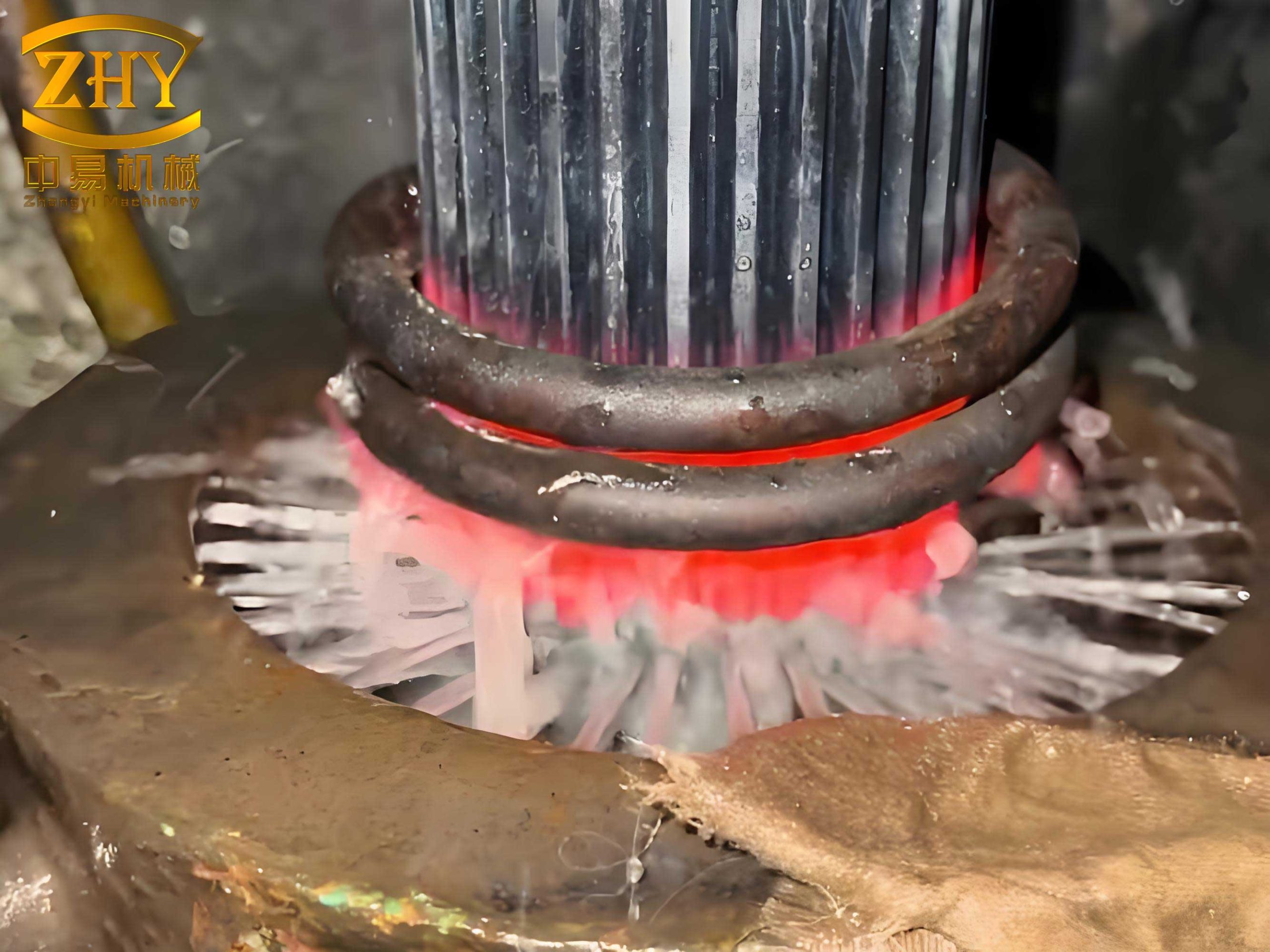
The innovative solution we adopted was Laser Transformation Hardening (LTH). This process represents a paradigm shift in surface engineering. It involves scanning a high-power, focused laser beam across the workpiece surface. The energy density is such that the surface layer is heated to austenitizing temperatures at an extremely rapid rate ($$10^3 – 10^6 \, ^\circ\mathrm{C/s}$$), while the bulk of the material remains cold. When the laser spot moves on, the heated zone is quenched instantly by rapid heat conduction into the cold core, achieving cooling rates often exceeding the critical cooling velocity for martensite formation. This yields several transformative benefits:
- Ultrafine Microstructure: The extreme heating and cooling rates produce a very fine, homogeneous martensitic structure, often with grain sizes an order of magnitude smaller than conventional quenching. This refines microstructure directly enhances strength and toughness according to the Hall-Petch relationship:
$$ \sigma_y = \sigma_0 + k_y d^{-1/2} $$
where $\sigma_y$ is the yield strength, $\sigma_0$ and $k_y$ are material constants, and $d$ is the average grain diameter. - High Residual Compressive Stress: The rapid thermal cycle creates significant volumetric expansion associated with the martensitic transformation in a constrained surface layer, generating high residual compressive stresses (often >750 MPa). This is perhaps the most critical advantage for fatigue resistance, as compressive surface stresses inhibit the initiation and propagation of fatigue cracks. The magnitude of residual stress $\sigma_{res}$ can be influenced by processing parameters:
$$ \sigma_{res} \propto f(P, v, \kappa) $$
where $P$ is laser power, $v$ is scan speed, and $\kappa$ is the material’s thermal diffusivity. - Minimal Distortion: Since the heat input is highly localized and the bulk temperature change is negligible, part distortion is minimal. This is a direct solution to one of the major heat treatment defects of carburizing.
- Precise Process Control: The hardened depth and profile can be accurately controlled by adjusting laser power ($P$), beam spot size ($D$), and traverse speed ($v$). The energy density $E$ is a key parameter:
$$ E = \frac{P}{D \cdot v} $$
By optimizing $E$, we consistently achieved an effective case depth of 1.2–1.4 mm.
| Process | Mechanism | Typical Case Depth | Key Advantages | Common Heat Treatment Defects & Risks |
|---|---|---|---|---|
| Induction Hardening | Electromagnetic induction heating + quench | 1-5 mm | Fast, suitable for high-volume production, selective hardening. | Non-uniform case, overheating at edges, cracking, inadequate root hardening. |
| Case Carburizing | Diffusion of carbon at high T + quench | 0.5-2.0 mm | Deep, hard case with excellent load-bearing capacity; good core properties. | Distortion, internal oxidation, carbide networks, grinding cracks, long cycle time. |
| Laser Transformation Hardening | Rapid surface austenitization with laser + self-quenching | 0.5-2.0 mm | Minimal distortion, high compressive stress, fine microstructure, precise control, clean process. | Overlapping zone softness (if not controlled), requires precise parameter tuning. |
The transition to laser hardening had a profound positive impact on the downstream machining process, further mitigating errors that could compound initial heat treatment defects. Previously, to compensate for the significant distortion from induction or carburizing, large grinding allowances (0.4–0.5 mm per side) were necessary. Finishing a large gear could consume 20 hours of grinding time. With laser hardening’s minimal distortion, the pre-hardening machining strategy could be altered. We switched from using a “pre-grind” hob (which leaves a specific tooth form for grinding) to a standard form hob. The required grinding stock was reduced to a mere 0.10–0.15 mm per side. This drastically reduced grinding time to just a few hours per large gear, slashing manufacturing time, lowering tooling costs, and improving overall dimensional accuracy and surface finish. The relationship between grinding time $T_g$ and stock removal $s$ can be simplified as:
$$ T_g \approx k \cdot s $$
where $k$ is a constant dependent on gear geometry and grinding parameters. Reducing $s$ by a factor of 3-4 directly proportionally reduces $T_g$.
The interplay between hardness, microstructure, and performance is central to understanding the success of the new process. The fine martensite from LTH not only provides high hardness but also better fracture toughness than coarse martensite. Wear resistance, critical for gears, is a function of hardness and microstructure stability. The Archard wear equation provides a foundational model:
$$ V = K \frac{N \cdot L}{H} $$
where $V$ is wear volume, $K$ is a wear coefficient, $N$ is normal load, $L$ is sliding distance, and $H$ is material hardness. While hardness $H$ is in the denominator, a lower wear coefficient $K$—resulting from a finer, more homogeneous microstructure—further reduces wear. Laser-hardened 20CrMnTi exhibits a high $H$ and a favorable $K$.
Fatigue performance, the ultimate test for gear teeth subjected to cyclic bending stress, is dramatically improved by the combination of factors from LTH. The high surface compressive stress $\sigma_{comp}$ effectively superimposes on the applied cyclic tensile stress $\sigma_{applied}$ at the critical tooth root. The net stress $\sigma_{net}$ experienced by the material becomes:
$$ \sigma_{net} = \sigma_{applied} – \sigma_{comp} $$
This can shift $\sigma_{net}$ into compression or significantly lower tension, greatly increasing the number of cycles to crack initiation ($N_i$). This directly addresses the root cause of the original fatigue failures—crack initiation at the tooth root due to tensile stress concentrations exacerbated by pre-existing heat treatment defects like shallow case depth or microcracks.
| Defect Category | Typical Causes (Traditional Processes) | Consequences | Mitigation via New Process (20CrMnTi + LTH) |
|---|---|---|---|
| Cracking (Quench/Grinding) | High thermal stresses, martensite transformation stresses, surface carbide networks, improper cooling. | Catastrophic failure, reduced fatigue life, scrap parts. | Minimized thermal gradient; fine martensite reduces transformation stress; no carbide networks. |
| Excessive Distortion | Non-uniform heating/cooling, phase transformation stresses throughout part. | Difficulty in assembly, increased noise, non-uniform load sharing, high machining cost. | Extremely localized heating; bulk material acts as a heat sink minimizing global distortion. |
| Inconsistent Case Depth/Hardness | Uneven heating (induction), poor furnace atmosphere control (carburizing). | Premature wear, pitting, bending fatigue failure. | Precise, digitally controlled laser energy deposition ensures consistency across tooth profile. |
| Microstructural Deficiencies (Grain growth, Oxidation) | Prolonged high-temperature exposure. | Reduced toughness, “soft layer” under case, spalling. | Extremely short interaction time prevents grain growth and internal oxidation. |
The implementation of the new integrated process—20CrMnTi material, laser transformation hardening, and optimized machining—was validated through extensive trial production. We manufactured nearly forty sets of large and small gears for the plunger pump gearboxes following the new protocol. These were installed in fracturing units deployed in active oilfields. Over a year of rigorous field monitoring and data collection revealed a complete absence of the previous failure modes. No root cracks, tooth fractures, or abnormal wear patterns were reported. The gears performed reliably under the severe cyclic loading conditions of pressure pumping operations. The success was not serendipitous but was rooted in the systematic elimination of the fundamental heat treatment defects that plagued the original production method.
The optimization of the laser process itself involved rigorous parameter studies. The goal was to achieve a martensitic case of specific depth and hardness without surface melting. The key parameters and their interdependencies can be modeled. The peak surface temperature $T_{peak}$ induced by a moving Gaussian laser beam can be approximated for a semi-infinite body:
$$ T_{peak} – T_0 = \frac{A \cdot P}{\sqrt{\pi} \cdot \kappa \cdot r_0} \cdot f(v, r_0, a) $$
where $T_0$ is initial temperature, $A$ is absorptivity, $P$ is power, $\kappa$ is thermal conductivity, $r_0$ is beam radius, $v$ is scan speed, and $a$ is thermal diffusivity. To achieve austenitization without melting, $T_{peak}$ must lie between the Ac3 temperature (for 20CrMnTi, ~850°C) and the solidus temperature (~1500°C). The hardened depth $z_h$ is related to the time above Ac3, which is inversely proportional to scan speed. Through empirical testing and modeling, we established a stable processing window defined by power and speed that consistently produced the desired 1.2-1.4 mm case with surface hardness of 54-58 HRC for pinions and 50-54 HRC for gears.
| Gear Type | Laser Power (kW) | Scan Speed (mm/s) | Beam Diameter (mm) | Energy Density (J/mm²) | Surface Hardness (HRC) | Effective Case Depth (mm) |
|---|---|---|---|---|---|---|
| Pinion (Small Gear) | 3.0 – 3.5 | 20 – 25 | 4 x 6 (Rectangular) | 30 – 35 | 54 – 58 | 1.3 – 1.4 |
| Gear (Large Gear) | 4.0 – 4.5 | 15 – 20 | 5 x 8 (Rectangular) | 40 – 45 | 50 – 54 | 1.2 – 1.3 |
In conclusion, the gear failure problem was a classic case where apparent component failure was a symptom of suboptimal process design. The original heat treatment defects—ranging from quench cracks and distortion to inconsistent case depth and deleterious microstructures—were the fundamental causes of poor field performance. By adopting a systems-engineering approach, we successfully re-engineered the entire manufacturing chain. The strategic selection of 20CrMnTi provided a cost-effective material with excellent grain-refining potential. The revolutionary adoption of laser transformation hardening directly attacked the core weaknesses of traditional heat treatment, delivering a superior hardened surface characterized by minimal distortion, high compressive stress, and an ultrafine microstructure, all while being precisely controllable. This was seamlessly integrated with a revised machining plan that capitalized on the reduced distortion to slash finishing costs and time. The result is a robust, reliable, and economically advantageous manufacturing process that has eradicated the historical failure modes and is now the standard for our critical gear applications. This experience underscores that overcoming persistent heat treatment defects often requires not just incremental adjustments, but a willingness to embrace fundamentally new technologies and holistic process integration.