
In my extensive experience with mining machinery, particularly in the context of underground coal mining operations, the reliability of scraper conveyors is paramount. These systems not only transport coal but also serve as the track for shearers and anchoring points for hydraulic supports. Any downtime can cascade into significant production losses and economic impacts. At the heart of the scraper conveyor’s drive system lies the reducer, a critical component that transmits power from the motor to the conveyor chain. Within these reducers, the gear shaft—a integrated component combining gears and shafts—often proves to be a vulnerability. I have encountered numerous cases where premature failure of these gear shafts led to unscheduled maintenance, operational halts, and safety concerns. This article delves deep into a comprehensive failure analysis of a specific gear shaft from a JS200 reducer used in an SGZ764/400 type scraper conveyor, based on firsthand investigation and technical evaluation. I will systematically explore the root causes, from material selection to manufacturing nuances, and propose robust improvement measures, supported by data tables, engineering formulas, and practical insights. The goal is to furnish a detailed reference that can enhance the design, manufacturing, and maintenance practices for such critical components, thereby boosting overall equipment effectiveness in harsh mining environments.
The problematic gear shaft in question was part of the third-stage transmission in the reducer. After less than six months of service in a high-load, high-cycle underground mining face, multiple reducers exhibited similar failure modes. Upon disassembly and inspection, I observed severe damage to the gear teeth on the gear shaft. The failures manifested as tooth breakage, and in extreme cases, complete stripping of entire teeth, leaving the gear shaft non-functional. This was not an isolated incident but a recurring pattern across several units, indicating a systemic issue rather than a random event. The visual evidence pointed towards a fracture origin at the tooth root or along the tooth flank, suggestive of fatigue failure under cyclic loading. The gear shaft’s design involved a helical gear with a specific tooth count and profile, integrated onto a shaft that accommodated bearings and couplings. The operating conditions included frequent starts and stops, shock loads from coal lumps, and constant torque transmission, creating a demanding environment for any mechanical component. This premature failure warranted a thorough forensic investigation to prevent future occurrences and ensure operational continuity.
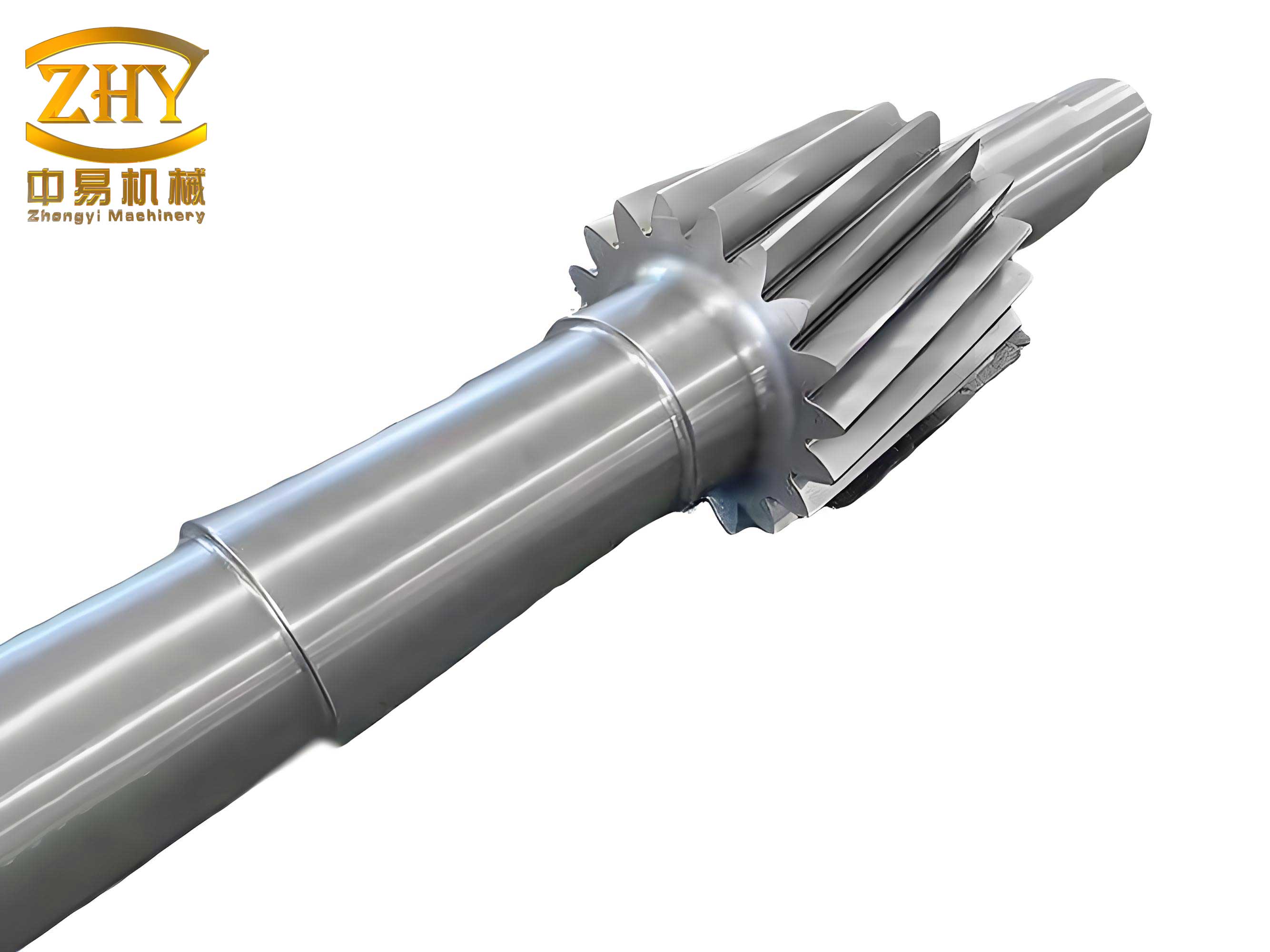
To understand the failure of this gear shaft, I embarked on a multi-faceted analysis covering material properties, heat treatment, manufacturing processes, and design parameters. The gear shaft was specified to be made from 20CrMnTi steel, a common low-alloy carburizing steel for gears. Surface carburizing and quenching were applied to achieve a hard, wear-resistant case (HRC 58-62) with a tough, ductile core (HRC 38-42). Initial hardness checks on the failed parts confirmed surface hardness around HRC 61, which was within specification. However, material compliance alone does not guarantee performance; the inherent material characteristics and their realization through processing are crucial.
First, let’s consider the material’s chemical composition and its implications. 20CrMnTi contains chromium and manganese to improve hardenability and strength, and titanium to refine grain size. However, its toughness, especially under impact, can be a limitation. For comparison, I evaluated an alternative material, 17CrNiMo6, which is often used in high-demand European gear applications. The chemical compositions are summarized below:
| Material | C (%) | Mn (%) | Cr (%) | Ni (%) | Mo (%) | Ti (%) |
|---|---|---|---|---|---|---|
| 20CrMnTi | 0.17–0.23 | 0.80–1.10 | 1.00–1.30 | – | – | 0.04–0.10 |
| 17CrNiMo6 | 0.15–0.20 | 0.40–0.60 | 1.50–1.80 | 1.40–1.70 | 0.25–0.35 | – |
The higher nickel content in 17CrNiMo6 significantly enhances toughness and fatigue resistance. The mechanical properties further highlight the differences:
| Material | Tensile Strength σ_b (MPa) | Yield Strength σ_s (MPa) | Elongation δ_5 (%) | Reduction of Area Ψ (%) |
|---|---|---|---|---|
| 20CrMnTi | ≥1080 | ≥835 | ≥10 | ≥45 |
| 17CrNiMo6 | ≥1180 | ≥835 | ≥7 | ≥45 |
While tensile strength is higher for 17CrNiMo6, the elongation is slightly lower, but the core toughness due to nickel is superior, making it more resistant to shock loads—a critical factor for a gear shaft in a scraper conveyor.
Next, the manufacturing process flow was scrutinized. The typical production sequence for such a gear shaft involves: forging → rough machining → preliminary heat treatment (normalizing or annealing) → semi-finish machining → carburizing → quenching → tempering → finish machining (including gear cutting) → grinding (if specified) → inspection. Deficiencies can creep in at multiple stages. Forging defects, such as incomplete metal flow, internal voids, or improper grain orientation, can create stress concentrators. The gear shaft’s geometry, with a central gear section and extended shaft ends, requires a specific forging technique—upsetting the middle and drawing out the ends—to align the grain flow with the principal stress directions. Inadequate heating during forging can lead to a “cold shut” or internal cracks, severely compromising the gear shaft’s integrity. Moreover, many forging suppliers lack stringent non-destructive testing (NDT), allowing flawed blanks to proceed.
Heat treatment is arguably the most critical phase for a carburized gear shaft. The process must achieve a deep, uniform case depth with a smooth hardness gradient to the core. The standard cycle involves carburizing at 920-930°C to achieve a desired case depth (e.g., 0.8-1.2 mm), followed by quenching in oil and tempering. However, the工艺 card for this gear shaft indicated a potential shortcut: no stress-relief annealing after rough machining, and a tempering time that might be insufficient. Quenching introduces significant residual stresses; if not properly relieved through prolonged tempering, these stresses can act as nucleation sites for fatigue cracks. I recommend a modified heat treatment: reduce the quenching temperature from 860°C to 810°C to minimize distortion and thermal stress, and extend the tempering time from 6 hours to at least 10 hours at 180-200°C. The effective case depth (ECD) and core hardness must be meticulously controlled. The relationship between case depth and tooth module is vital; for a gear tooth, the optimal case depth is approximately 0.2-0.3 times the module to prevent case crushing or core yielding. For this gear shaft with module m_n, the required ECD can be expressed as:
$$ ECD = k \cdot m_n $$
where k is an empirical factor ranging from 0.2 to 0.3. Insufficient case depth leads to subsurface fatigue (pitting), while excessive depth can cause brittleness.
Gear machining quality is another pivotal factor. The tooth flank roughness directly influences contact stress distribution and fatigue life. According to mining gear standards, heavy-duty gears should attain a quality grade of 6 (AGMA or ISO) with a surface roughness Ra ≤ 0.8 μm. Examination of the failed gear shaft teeth revealed visible tool marks from the hobbing process, indicating that final grinding or honing was either omitted or inadequately performed. The presence of these machining marks acts as stress risers, drastically reducing the fatigue limit. The contact stress σ_H and bending stress σ_F at the tooth root are calculated using standard formulas. For helical gears, the contact stress is given by:
$$ \sigma_H = Z_E Z_H Z_\epsilon Z_\beta \sqrt{ \frac{F_t}{b d_1} \cdot \frac{u \pm 1}{u} } $$
where:
– $Z_E$ is the elasticity factor,
– $Z_H$ is the zone factor,
– $Z_\epsilon$ is the contact ratio factor,
– $Z_\beta$ is the helix angle factor,
– $F_t$ is the tangential load,
– $b$ is the face width,
– $d_1$ is the pitch diameter of the pinion,
– $u$ is the gear ratio.
The bending stress at the tooth root is:
$$ \sigma_F = \frac{F_t}{b m_n} Y_F Y_S Y_\beta Y_{DT} $$
where:
– $Y_F$ is the form factor,
– $Y_S$ is the stress correction factor,
– $Y_\beta$ is the helix angle factor,
– $Y_{DT}$ is the dynamic factor,
– $m_n$ is the normal module.
When surface roughness is poor, the effective stress concentration factor increases, effectively amplifying these stresses. For a given roughness profile, the fatigue strength reduction factor K_f can be estimated using empirical relations, such as:
$$ K_f = 1 + q (K_t – 1) $$
where $K_t$ is the theoretical stress concentration factor and $q$ is the notch sensitivity factor, which depends on material and roughness.
Furthermore, the gear shaft design itself warrants scrutiny. The gear had 17 teeth with a relatively high positive profile shift coefficient (x > 0) to avoid undercut and improve root strength. However, in high-shock applications, merely optimizing profile shift may not suffice. Increasing the pressure angle (α) from the standard 20° to 22° or 25° can significantly enhance both bending and contact strength. The bending strength is proportional to the reciprocal of the form factor Y_F, which decreases with larger pressure angles. The contact strength benefits from a larger radius of curvature at the pitch point. Moreover, gear tooth modifications—profile crowning and lead crowning—are essential to compensate for misalignments, deflections, and thermal distortions under load. These modifications prevent edge loading and ensure even stress distribution across the tooth face. For this gear shaft, implementing a combination of a larger pressure angle and micro-geometry optimization could yield substantial durability gains.
To quantify the potential improvement, let’s perform a comparative stress analysis. Assume the original design parameters: module m_n = 6 mm, pressure angle α_n = 20°, helix angle β = 10°, face width b = 80 mm, torque T = 15000 Nm, and application factor K_A = 1.5 for scraper conveyors. The calculated bending stress σ_F and contact stress σ_H can be compared for different pressure angles. Using simplified formulas and typical factor values:
For α = 20°:
$$ \sigma_{F,20} \approx 320 \text{ MPa}, \quad \sigma_{H,20} \approx 1200 \text{ MPa} $$
For α = 25°:
$$ \sigma_{F,25} \approx 280 \text{ MPa}, \quad \sigma_{H,25} \approx 1100 \text{ MPa} $$
This represents a reduction of about 12.5% in bending stress and 8.3% in contact stress, which can dramatically extend the gear shaft’s fatigue life.
Another aspect often overlooked is the shaft’s stiffness and its interaction with the gear mesh. The gear shaft is not infinitely rigid; under load, it deflects, causing misalignment that exacerbates tooth loading. A finite element analysis (FEA) can model this behavior. The total deflection δ_total at the gear section comprises bending and torsional components. For a simplified cantilever model (though the actual support is bearings at both ends), the bending deflection at the gear midspan due to tangential force F_t is:
$$ \delta_b = \frac{F_t L^3}{3 E I} $$
where L is the distance from the bearing to the gear center, E is Young’s modulus, and I is the area moment of inertia of the shaft section. Excessive deflection alters the contact pattern, leading to premature failure. Optimizing the shaft diameter and bearing positions can mitigate this.
Based on the analysis, I propose the following improvement measures for the gear shaft in scraper conveyor reducers:
1. Material Upgrade: Transition from 20CrMnTi to 17CrNiMo6 for critical gear shafts, especially those in the third and fourth stages where loads are highest. The superior hardenability and toughness of 17CrNiMo6 provide better resistance to impact and fatigue. The carburizing response is also excellent, ensuring a deep, hard case with a favorable hardness gradient. Material certification should include spectrochemical analysis, hardness traverse tests, and Charpy impact tests at core temperatures.
2. Enhanced Forging and Heat Treatment Protocols:
– Implement closed-die forging with strict process controls to ensure proper grain flow.
– Mandate ultrasonic testing (UT) or magnetic particle inspection (MPI) on all forged blanks to detect internal flaws.
– Revise the heat treatment cycle: Carburize at 930°C for case depth control, direct quench at 810°C in agitated oil, and temper at 180°C for 10-12 hours. Use atmosphere-controlled furnaces to prevent decarburization.
– Introduce intermediate stress-relief annealing after rough machining to eliminate machining stresses before carburizing.
3. Precision Machining and Finishing:
– Achieve gear tooth quality to ISO 1328 Class 6 standards.
– Incorporate hard finishing processes: after carburizing and quenching, perform gear grinding or skiving to attain a surface roughness Ra ≤ 0.4 μm. This eliminates tool marks and ensures precise tooth geometry.
– Implement 100% gear inspection using coordinate measuring machines (CMM) and gear analyzers to verify profile, lead, and pitch deviations.
4. Design Optimization:
– Increase the normal pressure angle to 22° or 24° for higher strength.
– Apply profile and lead crowning based on FEA and load spectrum analysis. The crown amount can be calculated as:
$$ C_{profile} = k_p \cdot F_t / b, \quad C_{lead} = k_l \cdot \delta_{total} $$
where $k_p$ and $k_l$ are empirical coefficients.
– Consider asymmetric tooth profiles for further bending strength improvement in the dedendum.
– Optimize the shaft geometry to increase bending stiffness, perhaps by using larger diameters or hollow sections with careful weight consideration.
5. Lubrication and Operational Considerations: While not directly a gear shaft manufacturing issue, ensuring proper lubrication with extreme pressure (EP) additives is vital. The lubricant film thickness should be sufficient to separate the tooth surfaces. The minimum film thickness h_min can be estimated using the Dowson-Higginson equation:
$$ h_min = 2.65 \frac{(U \eta_0)^{0.7} R^{0.43}}{\alpha^{0.54} E’^{0.03} W^{0.13}} $$
where U is speed, η_0 is dynamic viscosity, R is effective radius, α is pressure-viscosity coefficient, E’ is effective elastic modulus, and W is load per unit width. Inadequate lubrication accelerates pitting and scuffing on the gear shaft teeth.
To encapsulate the proposed material and design changes, the following table summarizes the key comparisons and recommendations:
| Aspect | Current Practice (20CrMnTi) | Recommended Practice | Expected Benefit |
|---|---|---|---|
| Material | 20CrMnTi steel | 17CrNiMo6 steel | Higher toughness, better fatigue resistance, improved core properties |
| Case Hardness | HRC 58-62 | HRC 60-64 (with precise control) | Enhanced wear resistance |
| Core Hardness | HRC 38-42 | HRC 40-45 | Better support for case, higher bending strength |
| Pressure Angle | 20° | 22° or 24° | Reduced bending and contact stress |
| Tooth Finishing | Hobbing only (Ra ~ 1.6 μm) | Grinding after heat treatment (Ra ≤ 0.4 μm) | Eliminated stress risers, improved fatigue life |
| Heat Treatment Tempering | 6 hours | 10-12 hours | Better relief of quenching stresses |
| Quality Inspection | Sample-based | 100% for critical parameters (case depth, hardness, geometry) | Consistent quality, early defect detection |
In conclusion, the failure of the gear shaft in the scraper conveyor reducer is a multifaceted issue rooted in material limitations and process deviations. Through systematic analysis, I have identified that the combination of material choice (20CrMnTi), potential forging and heat treatment shortcomings, and inadequate gear finishing collectively predisposed the gear shaft to premature fatigue failure. The harsh operating conditions of a coal mine exacerbate these vulnerabilities. By upgrading to a superior material like 17CrNiMo6, refining the heat treatment to ensure complete stress relief, implementing precision grinding, and optimizing the gear geometry with higher pressure angles and crowning, the durability and reliability of the gear shaft can be significantly enhanced. Furthermore, adopting rigorous inspection protocols throughout manufacturing is non-negotiable. This comprehensive approach not only addresses the immediate failure mode but also builds resilience into the component for long-term service. As mining equipment continues to demand higher power densities and longer lifecycles, such detailed attention to critical components like the gear shaft is imperative. The lessons drawn from this analysis are applicable to a wide range of heavy-duty gear applications beyond scraper conveyors, underscoring the importance of integrated design, material science, and manufacturing excellence in mechanical engineering.
To further solidify the understanding, let’s consider the fatigue life estimation using the modified stress values. The gear shaft’s tooth bending fatigue life can be modeled using the S-N curve (stress-life approach) for the material. For carburized steel, the endurance limit for bending σ_fl can be approximated as 0.5 times the ultimate tensile strength for a polished specimen, adjusted for factors like size, surface finish, and reliability. For 17CrNiMo6 with σ_b = 1180 MPa, the ideal endurance limit is about 590 MPa. Applying correction factors for surface roughness (K_f = 1.2 for ground surface), size (K_size = 0.9), and loading (K_load = 1), the effective endurance limit σ_fl’ becomes:
$$ \sigma_{fl}’ = \frac{\sigma_{fl}}{K_f \cdot K_{size} \cdot K_{load}} = \frac{590}{1.2 \times 0.9 \times 1} \approx 546 \text{ MPa} $$
With the reduced bending stress from design optimization (σ_F ≈ 280 MPa), the safety factor for infinite life (N > 10^7 cycles) is:
$$ S_f = \frac{\sigma_{fl}’}{\sigma_F} = \frac{546}{280} \approx 1.95 $$
This indicates a robust design margin. For contact fatigue, the pitting resistance can be evaluated using the ISO 6336 standard, comparing the contact stress to the allowable stress for the material. These calculations demonstrate that the proposed improvements can transform the gear shaft from a failure-prone component to a reliable one.
In practice, continuous monitoring of the gear shaft in service through vibration analysis and oil debris analysis can provide early warning of degradation, allowing for predictive maintenance. However, the foundation lies in getting the design and manufacturing right from the outset. By embracing these measures, manufacturers and end-users can achieve higher availability, lower lifecycle costs, and safer operations for scraper conveyor systems in the demanding mining industry. The gear shaft, though a single component, plays an outsized role in the overall system performance, and investing in its excellence yields substantial returns.