
The manufacturing of large-module gears, particularly helical gears, has long been a challenge in mechanical engineering. Traditional methods such as hobbing, shaping, and grinding often present significant limitations when dealing with large modules, few teeth, or complex geometries like double-helical or curved-tooth gears. The矛盾 between production efficiency, cost, and quality becomes acute. For instance, a small hobbing machine may lack the power, while a large one may not accommodate the workpiece geometry. The advent and widespread application of multi-axis Computer Numerical Control (CNC) technology on machining centers offer a powerful solution to these long-standing challenges. This advanced approach not only enhances processing efficiency by 2-3 times but can also achieve precision levels above Grade 5, enabling flexible, full-process machining for various gear types.
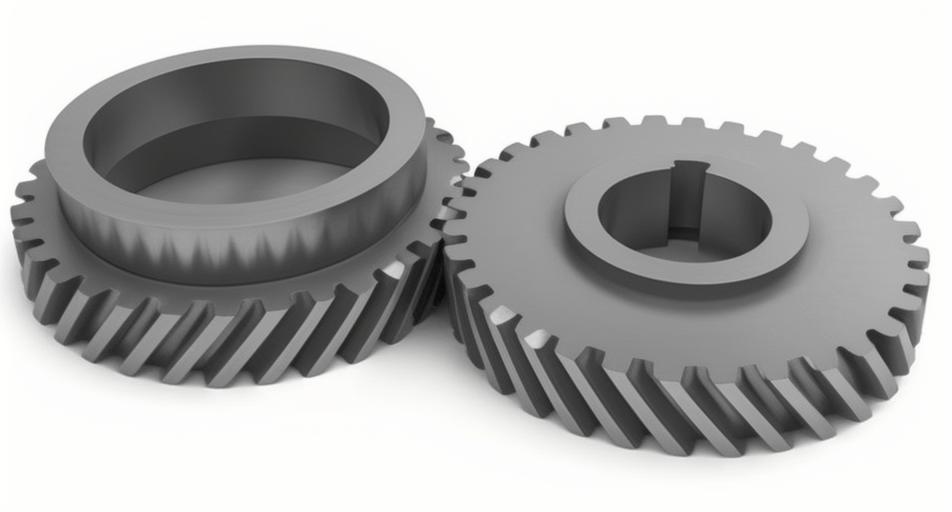
The fundamental geometry of a helical gear originates from an involute helicoid. This surface is generated when a line KK, inclined at an angle $\beta_b$ (the base helix angle) to the generatrix of a base cylinder, rolls without slipping on the base cylinder’s surface. The intersection of this helicoid with a transverse plane (perpendicular to the gear axis) is a standard involute curve. However, its intersection with any coaxial cylindrical surface, including the base cylinder, is a helix. The helix angle at the base circle, $\beta_b$, defines the tooth inclination; $\beta_b = 0^\circ$ results in a spur gear. This geometry is central to understanding the machining requirements for a helical gear.
The conventional process chain for a helical gear typically involves blank preparation, rough turning, heat treatment (if required), and finally, tooth generation. The tooth generation itself has been the bottleneck. Traditional spiral milling is a dedicated but inflexible method. Wire-cut Electrical Discharge Machining (EDM), while accurate, is prohibitively slow for production—a single large helical gear might require over four days of continuous machine operation. Multi-axis CNC machining emerges as the superior third option, offering program-controlled, automatic feed with high efficiency and precision.
Multi-Axis Machining Strategy for Helical Gears
For a helical gear, the machining strategy on a multi-axis center must be meticulously planned to ensure accuracy, surface finish, and tool life. A robust process flow is as follows:
- 3-Axis Roughing: Removal of the bulk material from the tooth spaces using robust tools.
- 4/5-Axis Semi-Finishing: Achieving near-net shape with closer tolerances, preparing for the final cut.
- 4/5-Axis Finishing: Final cut to achieve the required dimensional accuracy and surface quality on the helical gear tooth flanks.
- Rest Machining/Cleanup: Removing remaining material in corners and root fillets that the finishing tool could not access.
The successful implementation of this strategy hinges on several critical factors: machine tool selection, cutting tool technology, workholding, and intelligent toolpath generation.
1. Machine Tool Selection: 4-Axis vs. 5-Axis
The generation of a helical gear tooth profile inherently requires a coordinated linear and rotary motion. Therefore, a minimum of four controlled axes is necessary. In a typical 4-axis horizontal or vertical machining center setup, the gear blank is mounted on a rotary table (the 4th axis, usually the A or B axis). The three linear axes (X, Y, Z) then move the cutter relative to the rotating workpiece to sculpt the helical tooth space.
While a 5-axis machine (with two rotary axes on the tool head, table, or a combination) provides even greater flexibility for tool orientation and potentially better surface finish, its application for standard helical gear machining presents drawbacks:
| Factor | 4-Axis Machining Center | 5-Axis Machining Center (with table rotation) |
|---|---|---|
| Cost | Generally lower capital investment. | Significantly higher cost, especially for models with large tilting/rotary tables. |
| Operational Complexity | Simpler setup and programming; lower error risk. | Complex setup, programming, and verification; higher skill requirement. |
| Interference Risk | Minimal risk between part and machine structure. | High risk of collision between a large gear blank and the lower rotary table or machine column. |
| Application Fit | Ideal for dedicated helical gear milling. | Overqualified for standard helical profiles; better for complex sculpted surfaces. |
Thus, for the focused task of milling helical gear teeth, a 4-axis machining center often represents the optimal balance of capability, cost-effectiveness, and operational simplicity.
2. Cutting Tool Selection: Finger Milling Cutters vs. Disc-Type Milling Cutters
The choice of cutter is paramount for productivity and tool life. The main contenders are finger-type (end mill) and disc-type (slab mill) cutters, each with distinct advantages and constraints.
Finger Milling Cutters: These are similar to long end mills. They are versatile and can reach into deep, narrow tooth spaces of a helical gear. However, their relatively small diameter compromises rigidity, leading to potential deflection, chatter, and lower metal removal rates. They are more susceptible to breakage. Their selection is often governed by the need to machine small-module or small-diameter helical gears where space is limited.
Disc-Type Milling Cutters: These tools offer vastly superior rigidity and higher feed rates, dramatically boosting productivity for large-module helical gears. The primary challenge is diameter selection. A cutter that is too large may not fully generate the tooth profile near the root or may gouge the opposite flank. A cutter that is too small risks shank or holder collision with the tooth tip or adjacent teeth during entry, exit, or side engagement.
The optimal cutter diameter $D_c$ for a disc-type tool machining a helical gear must satisfy geometric constraints related to the gear’s normal module $m_n$, number of teeth $z$, helix angle $\beta$, and pressure angle $\alpha_n$. A simplified check involves the tooth space width at the pitch diameter. The tool must fit within the tooth space while allowing for clearance. The limiting condition often occurs at the gear’s minor diameter. The transverse tooth thickness $s_t$ at a given diameter $d_y$ is:
$$ s_t = d_y \left( \frac{\pi}{2z} + \text{inv}\,\alpha_t – \text{inv}\,\alpha_{yt} \right) $$
Where $\alpha_t$ is the transverse pressure angle and $\alpha_{yt}$ is the pressure angle at diameter $d_y$. The available space is the circular pitch minus this thickness. The cutter diameter must be less than this space, minus a clearance allowance $\delta$:
$$ D_c < \frac{\pi d_y}{z} – s_t(d_y) – \delta $$
Typically, $d_y$ is chosen as the minor diameter for a conservative check.
| Cutter Type | Advantages | Disadvantages | Typical Application |
|---|---|---|---|
| Finger Milling Cutter | Good accessibility; suitable for deep slots; lower initial cost. | Low rigidity; prone to deflection/breakage; lower feed rates. | Small-module helical gears, prototypes, repair work. |
| Disc-Type Milling Cutter | High rigidity and stability; high metal removal rates; excellent surface finish. | Critical diameter selection; risk of gouging or collision; higher cost. | Medium to large-module helical gears, series production. |
3. Workholding and Fixturing
Precise and rigid workholding is non-negotiable for accurate helical gear machining. A dedicated fixture is required to interface the gear blank with the machine’s rotary fourth axis. The fixture must ensure:
- Accurate Centering and Alignment: The gear blank’s axis must be perfectly coaxial with the rotary axis of the machine to avoid eccentricity errors.
- High Rigidity: To withstand intermittent cutting forces without vibration, which degrades surface finish and tool life.
- Proper Support: Using a backing plate or custom support to prevent deflection and to protect the machine table, as shown in process setups.
The machining sequence involves fixing the fixture to the table, mounting the fourth-axis rotary unit on the fixture, and finally clamping the gear blank onto the fourth axis. The CNC program controls the indexing: after machining one tooth space, the fourth axis rotates precisely by the indexing angle $\theta_i = 360^\circ / z$ to present the next slot for machining.
Toolpath Generation, Simulation, and Verification
The core of multi-axis CNC machining for a helical gear lies in the generation of efficient, collision-free toolpaths. This process is typically performed using advanced CAM (Computer-Aided Manufacturing) software.
1. Toolpath Generation Strategy
The strategy follows the staged process of roughing, semi-finishing, finishing, and cleanup.
A) Roughing (3-Axis Volumetric Clearing):
This stage uses a high-strength, large-diameter tool (finger or disc type) to remove 80-90% of the material. A common strategy is “Z-Level Roughing” or “Plunge Milling,” where the tool moves in horizontal layers (XY-plane) at descending Z-heights. The CAM software calculates the stock remaining from a blank model. The key parameter is the maximum stepdown per layer, $\Delta Z_{rough}$, typically 3-5 mm for tough materials to manage cutting forces.
$$ \text{Number of roughing layers} = \frac{\text{Total tooth depth}}{\Delta Z_{rough}} $$
The toolpath for a single tooth space is generated and then transformed via post-processing to repeat for all teeth by synchronizing with the rotary axis motion.
B) Semi-Finishing & Finishing (4-Axis Contour Milling):
This stage uses a smaller, precision-ground tool to achieve the final dimensions and surface finish. The “Contour Drive” or “Swarf Milling” strategy is ideal, where the tool’s side cutting edges engage the helical gear tooth flank, and its axis remains parallel to the gear’s axis (true 4-axis machining). The tool follows the helical path defined by the tooth’s lead $L$:
$$ L = \frac{\pi \cdot d \cdot \cot \beta}{\text{For a single tooth space, the tool moves axially as the part rotates.}} $$
The CAM software calculates this synchronized motion. No depth partitioning is used here to ensure a continuous, high-quality surface.
C) Rest Machining and Cleanup:
A smaller finger-type tool or a lollipop mill is used in a subsequent operation to machine areas (like fillet roots) that the larger finishing tool could not reach. The CAM software’s “Rest Material” function automatically identifies these areas based on the geometry of the previous tool.
2. Toolpath Simulation and Collision Checking
Before generating the final G-code, comprehensive simulation is mandatory. This virtual verification includes:
- Material Removal Simulation: Visualizing the step-by-step removal of stock to confirm the final part geometry matches the designed helical gear.
- Tool Holder/Shank Collision Detection: Checking for collisions not just of the cutting edge, but of the entire tool assembly with the workpiece, fixtures, or machine components. This is critical for disc-type cutters.
- Machine Kinematics Simulation: Using a virtual model of the specific 4-axis machine to detect axis limit violations or structural collisions during the synchronized rotary and linear moves.
Only after a clean simulation is the toolpath post-processed into machine-specific G-code, which incorporates the exact syntax for controlling the fourth-axis rotations (e.g., A-axis commands).
Implementation and Machining Parameters
The practical machining of a helical gear involves careful setup and parameter selection.
Setup: After the blank is faced and the bore machined, it is mounted on the fixture. The tool setting point is often established on the highest point of the outer diameter (OD) or on a pre-machined reference face. Accurate establishment of the workpiece coordinate system (WCS) relative to the rotary axis centerline is crucial.
Cutting Parameters: These depend on the workpiece material (e.g., steel, titanium, hardened alloy), tool material (HSS, carbide, coated carbide), and tool geometry. For a carbide disc mill machining a steel helical gear, typical starting parameters might be:
| Parameter | Roughing | Finishing | Unit | Formula/Note |
|---|---|---|---|---|
| Cutting Speed ($v_c$) | 80 – 120 | 150 – 250 | m/min | $v_c = \pi \cdot D_c \cdot n / 1000$ |
| Spindle Speed ($n$) | Calculated | Calculated | rpm | $n = \frac{1000 \cdot v_c}{\pi \cdot D_c}$ |
| Feed per Tooth ($f_z$) | 0.08 – 0.15 | 0.03 – 0.08 | mm/tooth | Material/tool dependent |
| Axial Depth of Cut ($a_p$) | Full depth (stepwise) | Full depth | mm | Equal to tooth depth |
| Radial Depth of Cut ($a_e$) | 30-70% of $D_c$ | 5-15% of $D_c$ | mm | Lighter cuts for finishing |
The cutting forces, especially for a helical gear, have radial, tangential, and axial components. The axial force component $F_a$ is significant due to the helix angle:
$$ F_a \propto F_t \cdot \tan \beta $$
where $F_t$ is the tangential cutting force. This must be accounted for in fixture design and machine rigidity.
Conclusion: Advantages and Significance
Multi-axis CNC machining, particularly on a 4-axis center, represents a paradigm shift for manufacturing helical gears, especially large-module variants. It transcends the limitations of dedicated gear-cutting machines by offering unparalleled flexibility. The process enables true “flexible manufacturing,” where changing a gear’s design parameters (module, teeth, helix angle) only requires a new CNC program and appropriate tooling, not a new machine.
Key advantages include:
- Overcoming Traditional Limits: It machines gears that are “untouchable” by standard hobbing due to size/power constraints.
- Integrated Process Chain: The same platform can perform facing, boring, and tooth milling, reducing setup errors and handling time.
- Facilitation of Advanced Designs: It readily accommodates profile modifications (tip and root relief, lead crowning) for noise reduction and load distribution simply by modifying the toolpath.
- Foundation for Hard Finishing: The precise CNC toolpath provides an excellent pre-machined geometry for subsequent grinding or hard-skiving processes.
By leveraging synchronized multi-axis interpolation, this method eliminates errors associated with mechanical indexing and the discontinuous generation cuts of some traditional methods. It enhances both gear quality and production efficiency, fully harnessing the potential of modern CNC technology. The development and optimization of this process are therefore of paramount importance for advancing gear manufacturing technology and promoting its adoption across heavy industries, aerospace, and high-performance automotive sectors. The helical gear, a fundamental power transmission component, finds a powerful and precise manufacturing ally in multi-axis CNC machining.