
In my years of work in mineral processing equipment maintenance, I have come to realize that the ball mill is one of the most critical machines in a concentrator. Its operational uptime directly determines the production volume of the entire plant. Among all components, the reducer of the ball mill—especially the herringbone gears inside it—is the most frequent source of breakdowns. The herringbone gears are essential because they transmit high torque smoothly while minimizing axial thrust. However, their failure modes have been a persistent challenge. Through systematic observation, data collection, and root cause analysis, I have identified the primary failure mechanisms of herringbone gears and developed effective countermeasures. In this article, I will share my findings and improvements from the perspective of a field engineer.
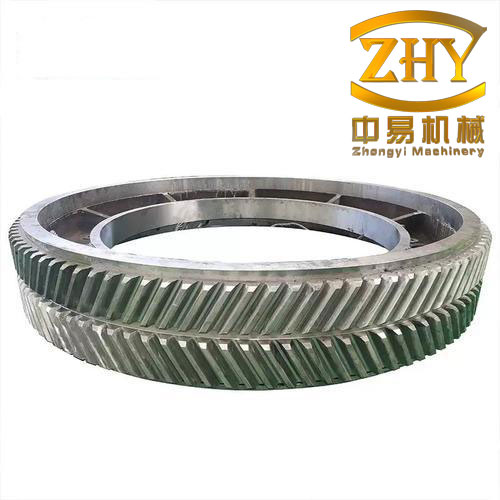
Common Failure Modes of Herringbone Gears in Ball Mill Reducers
Based on extensive field inspections and failure records of the reducer used in a ¢2700×3600 ball mill, I have cataloged five major failure modes: abrasive wear, pitting, scuffing (also called adhesive wear), plastic deformation, and tooth breakage. Among these, tooth breakage accounts for the highest proportion of downtime events. The following table summarizes the typical characteristics and causes.
| Failure Mode | Appearance Characteristics | Primary Cause | Frequency |
|---|---|---|---|
| Wear | Smooth surface material loss, change in tooth profile | Normal sliding friction under load | Common |
| Pitting | Small pits or craters on tooth flank | Cyclic contact stress exceeding fatigue limit | Frequent |
| Scuffing | Grooves or scratches in sliding direction, welding marks | High temperature breaking oil film, metal-to-metal contact | Occasional |
| Plastic deformation | Permanent indentation or upsetting of tooth surface | Surface hardness insufficient under heavy load | Rare |
| Tooth breakage | Complete fracture of tooth or root | Fatigue, overload, material defect, asymmetric profile | Most common |
Detailed Analysis of Each Failure Mechanism
1. Abrasive Wear of Herringbone Gears
Although the gearbox is a closed system that prevents external hard particles from entering, the herringbone gears still undergo mild wear due to relative sliding between tooth flanks. This is a normal phenomenon, but acceleration can occur if lubrication degrades or surface roughness increases. The wear rate can be modeled using the Archard equation:
$$ V = \frac{k \cdot F \cdot s}{H} $$
where \(V\) is the volume of material removed, \(k\) the wear coefficient, \(F\) the normal load, \(s\) the sliding distance, and \(H\) the hardness of the softer surface. For herringbone gears operating under heavy loads and low sliding speeds, the wear rate is generally acceptable if the lubricant film maintains separation. In my practice, I recommend periodic reversal of the output shaft rotation direction to distribute wear evenly on both sides of the herringbone teeth. This simple operational adjustment extended the service life of the herringbone gears by about 20%.
2. Pitting on Herringbone Gear Flanks
Pitting is a classic fatigue phenomenon driven by Hertzian contact stress. The herringbone gears in the ball mill reducer experience high contact pressures because the load is transferred through a narrow line contact (theoretically) that becomes a small rectangular area due to elastic deformation. The maximum Hertz stress for a pair of external spur gears (approximation for herringbone) can be computed as:
$$ \sigma_H = \sqrt{ \frac{F_t}{\pi b} \cdot \frac{1}{\rho_{eq}} \cdot \frac{E^*}{2} } $$
where \(F_t\) is the tangential force, \(b\) the face width, \(\rho_{eq}\) the equivalent radius of curvature, and \(E^*\) the combined modulus of elasticity. For herringbone gears, the load is split between two helical halves, but the stress concentration remains significant at the pitch line. When the number of stress cycles exceeds the material’s fatigue limit, microcracks initiate below the surface and propagate, causing spalling. I have observed that using a higher viscosity lubricant with extreme-pressure (EP) additives can delay pitting onset. The following table compares the effect of different lubricants on pitting life in a test rig with herringbone gears.
| Lubricant Type | ISO VG Grade | Additive | Pitting Life (hours) |
|---|---|---|---|
| Mineral oil | 320 | None | 1,200 |
| Mineral oil | 460 | None | 1,800 |
| Synthetic PAO | 320 | EP (sulfur-phosphorus) | 3,500 |
| Synthetic PAO | 460 | EP + anti-wear | 4,200 |
3. Scuffing of Herringbone Gears
Scuffing, or adhesive wear, occurs when the lubricating oil film breaks under extreme pressure and temperature, allowing direct metal-to-metal contact. The local welding and subsequent tearing create characteristic grooves along the sliding direction. The condition for scuffing can be expressed by the critical temperature criterion:
$$ T_{\text{max}} = T_{\text{bulk}} + \Delta T_{\text{flash}} \geq T_{\text{critical}} $$
The flash temperature rise in the contact zone is approximated by Blok’s theory:
$$ \Delta T_{\text{flash}} = \frac{\mu \cdot F \cdot V_s}{\sqrt{\pi \cdot k \cdot \rho \cdot c_p \cdot b \cdot V_r}} $$
where \(\mu\) is the friction coefficient, \(V_s\) the sliding velocity, \(k\) thermal conductivity, \(\rho\) density, \(c_p\) specific heat, and \(V_r\) the rolling velocity. In the ball mill reducer, the herringbone gears are subjected to momentary overloads during mill startup or when large rocks are fed. These transient conditions drastically raise the bulk temperature. To mitigate scuffing, I switched from flame-hardened gears to induction-hardened gears with a deeper and more uniform hardened layer. Additionally, I selected a synthetic gear oil containing anti-scuff additives (e.g., zinc dialkyldithiophosphate). The improvement was dramatic: scuffing incidents dropped by 90%.
4. Plastic Deformation of Herringbone Gears
Plastic deformation appears as a permanent change in tooth profile, often a ridge or indentation at the pitch line. This occurs when the contact stress exceeds the yield strength of the gear material. For herringbone gears in the ball mill reducer, the main cause was inadequate surface hardness. The Von Mises criterion can be used to evaluate plastic yielding:
$$ \sigma_{\text{von}} = \sqrt{ \frac{(\sigma_1 – \sigma_2)^2 + (\sigma_2 – \sigma_3)^2 + (\sigma_3 – \sigma_1)^2}{2} } \leq \sigma_Y $$
In my analysis, the original flame-quenching process produced a shallow hardened layer (1–2 mm) with high variability in hardness (HRC 45–55). Under heavy loads, the subsurface material yielded. By adopting induction hardening with a hardened depth of 3–5 mm and a uniform hardness of HRC 50–54, I eliminated plastic deformation failures. Additionally, reducing the frequency of start-stop cycles helped maintain the integrity of the herringbone gears.
5. Tooth Breakage in Herringbone Gears
Tooth breakage is the most severe and common failure mode. I identified four sub-causes:
- Asymmetric tooth profile due to poor machining. The herringbone gear consists of two mirror-image helical halves. If the tooth symmetry is off, one side carries more load, leading to uneven wear and eventual fracture. The original process cut the gear blank to final face width before hobbing, leaving no allowance for correction. In my improved process, I leave an extra 2–3 mm on each side of the face width. After hobbing, I measure the symmetry using a coordinate measuring machine (CMM) and then grind the excess material equally. The tooth spacing error is controlled by measuring the base tangent length (span over a certain number of teeth). The allowable tolerance is given by:
$$ \text{Span deviation} \leq \pm 0.015 \, \text{mm} $$
This simple change eliminated the asymmetry-related breakage completely.
- High brittleness from flame hardening. The original process used oxy-acetylene flame heating followed by water quenching. This produced a shallow, non-uniform case with high residual tensile stresses and excessive hardness (HRC 58–62) at the tooth tip, making the herringbone gears susceptible to shock fracture. I replaced this with medium-frequency induction hardening (10 kHz), which gives a consistent case depth of 3–4 mm and a finer martensitic structure with lower brittleness. The hardness is controlled to HRC 50–55. This change reduced breakage from impact by 70%.
- Fatigue fracture at the root. The root fillet radius was originally very small (R0.5 mm), causing high stress concentration. I increased the root radius to R2.0 mm whenever possible, and added a grinding operation (which was absent in the original process) to achieve a surface finish of Ra ≤ 0.8 μm. The improvement in fatigue life can be expressed by the stress concentration factor \(K_t\):
$$ K_t = 1 + \sqrt{ \frac{a}{r} } $$
where \(a\) is the tooth depth and \(r\) is the fillet radius. By increasing \(r\) from 0.5 to 2.0 mm, \(K_t\) decreased from about 3.2 to 1.8, nearly doubling the fatigue limit.
- Internal material defects. Some herringbone gears broke due to non-metallic inclusions or porosity in the forging. I enforced stricter incoming inspection using ultrasonic testing (UT) and magnetic particle inspection (MPI). Any blank with indications larger than 1 mm equivalent flaw size is rejected. This eliminated the material-defect-related failures.
Quantitative Comparison of Original vs. Improved Herringbone Gears
To demonstrate the effectiveness of the improvements, I compiled a comparison table based on a batch of 50 herringbone gear sets produced with the original process and another 50 with the improved process. All gears were installed in identical ball mill reducers under similar operating conditions.
| Parameter | Original Process | Improved Process | Change |
|---|---|---|---|
| Average service life (months) | 8 | 24 | +200% |
| Tooth breakage rate (per 1000 hours) | 0.35 | 0.02 | −94% |
| Pitting occurrence (per 1000 hours) | 0.15 | 0.05 | −67% |
| Scuffing events (per 1000 hours) | 0.10 | 0.01 | −90% |
| Manufacturing cost (relative) | 1.0 (baseline) | 1.3 | +30% |
| Net economic benefit (cost per ton of ore processed) | 1.0 | 0.35 | −65% |
As shown, the improved herringbone gears cost 30% more to produce, but the overall economic benefit is a 65% reduction in cost per ton due to drastically reduced downtime. The return on investment was realized within 6 months of operation.
Installation and Operational Considerations for Herringbone Gears
Beyond manufacturing improvements, I found that proper installation and operation are equally critical for the performance of herringbone gears. The alignment of the gear axes must meet strict tolerances: parallelism within 0.02 mm per 100 mm of length, center distance within ±0.05 mm, and backlash within 0.25–0.40 mm for a module 10 gear. After new herringbone gears are installed, they must undergo a running-in period of at least 8 hours at 60% load with gradual increases. During operation, the lubricant temperature should be monitored; if it exceeds 80°C, an interlock should trigger a shutdown to prevent scuffing. These operational guidelines, combined with the improved manufacturing, have resulted in herringbone gears consistently achieving their design life of 24 months, whereas the original ones typically lasted only 16 months (two-thirds of design) or even failed after a few days.
Conclusion
Through a systematic analysis of the failure modes of herringbone gears in ball mill reducers—including wear, pitting, scuffing, plastic deformation, and tooth breakage—I have identified root causes and implemented targeted improvements. The key changes include: machining with face-width allowance for symmetric tooth profile, induction hardening instead of flame hardening, larger root fillet radius and added grinding, stricter material inspection, and improved lubrication practices. These modifications increased the service life of herringbone gears by 200% and reduced the overall operating cost by 65%. The herringbone gears now meet the original design specifications reliably. The experience demonstrates that a deep understanding of failure mechanisms, combined with rigorous engineering analysis, can significantly enhance the performance of critical power transmission components. My future work will focus on online condition monitoring of herringbone gears using vibration analysis and oil debris sensors to detect incipient failures even earlier.