
In the realm of precision forging, the production of miter gears—specifically straight bevel gears—presents significant challenges due to elastic deformations and springback effects that occur during and after the forming process. As a researcher focused on advancing manufacturing accuracy, I have explored the use of finite element analysis (FEA) to address these issues. This article delves into a comprehensive methodology for designing precise forging dies for miter gears by leveraging DEFORM-3D software to simulate and compensate for springback. The goal is to achieve high-precision miter gear components without secondary finishing operations, thereby enhancing efficiency and reducing costs in industrial applications.
The core problem in precision forging of miter gears lies in the elastic recovery of both the workpiece and the die after unloading. When the die separates from the forged miter gear, internal stresses induced during forming cause springback, leading to deviations from the intended geometry. This phenomenon is particularly critical for miter gears, where tooth profile accuracy directly impacts performance in power transmission systems. Traditional approaches often rely on trial-and-error or empirical corrections, but these are time-consuming and may not fully account for complex elastic interactions. Therefore, I have adopted a reverse compensation strategy, where the die cavity is intentionally modified based on predicted springback displacements, ensuring that the final forged miter gear meets stringent technical specifications.
To understand the springback mechanism in miter gear forging, it is essential to consider the elastic deformations during die closure and workpiece forming. When the upper and lower dies press against the miter gear blank, the die undergoes elastic deformation due to the applied force, causing the die cavity to deviate from its nominal dimensions. Simultaneously, the workpiece experiences elastic strain; upon die release, this strain recovers, resulting in additional geometric errors. The total error on the miter gear surface is the sum of the die elastic error and the workpiece springback. Mathematically, this can be expressed as:
$$ \Delta_{\text{total}} = \Delta_{\text{die}} + \Delta_{\text{workpiece}} $$
where $\Delta_{\text{total}}$ is the overall dimensional deviation, $\Delta_{\text{die}}$ is the die elastic deformation during closure, and $\Delta_{\text{workpiece}}$ is the workpiece springback after unloading. For a miter gear, these errors manifest primarily in the tooth profile, affecting meshing quality and load distribution. To compensate, the die cavity must be designed with an inverse profile that accounts for both contributions. The principle involves calculating the displacement vectors from FEA simulations and applying them as negative offsets to the original die coordinates. This reverse engineering approach ensures that after springback, the forged miter gear attains the desired geometry.
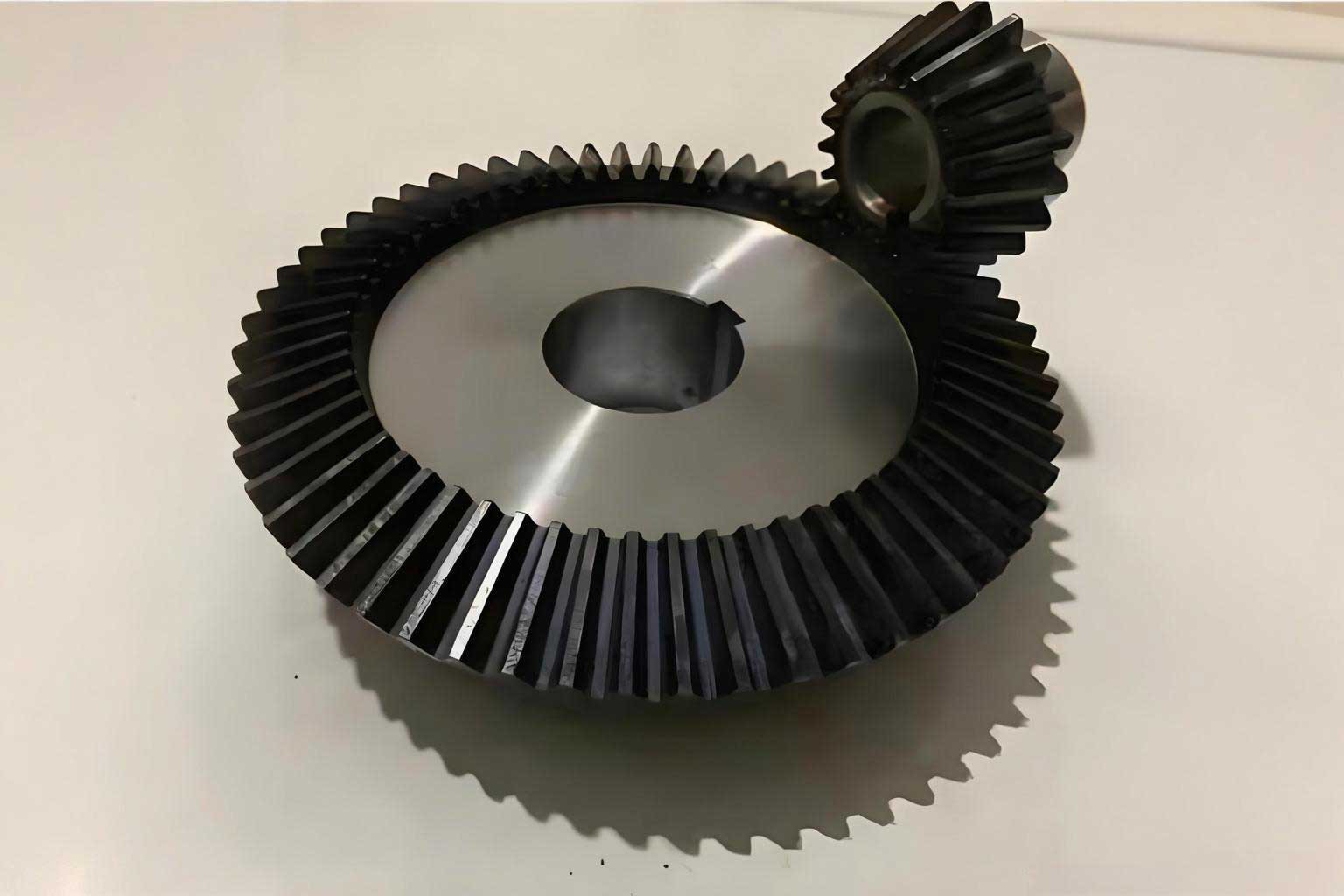
In my study, I focused on a straight bevel miter gear with 26 teeth and a module of 8 mm. The material for the workpiece was 20CrMnTi, a common alloy steel for gears, while the die material was H13 tool steel. The forging process was modeled using DEFORM-3D, a specialized software for metal forming simulation. The analysis was divided into two phases: die closure (forming) and die release (springback). Each phase required careful setup of boundary conditions to accurately capture elastic behaviors. For the closure phase, both the die and workpiece were meshed, with the die treated as a rigid body and the workpiece as a plastic body. The meshing employed a relative method, resulting in approximately 80,000 elements to balance computational efficiency and accuracy. Key parameters are summarized in Table 1.
| Parameter | Value |
|---|---|
| Die Material | H13 Tool Steel |
| Workpiece Material | 20CrMnTi Alloy Steel |
| Die Temperature | 20°C |
| Workpiece Temperature | 20°C |
| Meshing Method | Relative Method |
| Total Elements | 80,000 |
| Environmental Temperature | 20°C |
| Iteration Method | Direct Iteration |
| Thermal Convection Coefficient | 20 kW/(m²·K) |
| Reaction Rate Coefficient | 0.00025 mm/s |
| Maximum Iteration Steps | 200 |
The die closure simulation aimed to replicate the forging process under a press. The model assembly, as shown in the finite element剖视图, included the upper die, lower die, and the miter gear blank. The dies moved with a prescribed velocity to compress the workpiece, and the analysis tracked stress, strain, and displacement fields. After closure, the results provided the stress distribution on the die and workpiece, which served as input for the springback phase. For die release, the model was modified: the die was switched from rigid to elastic body, and the workpiece was removed to isolate die springback. The forces from the closure step were applied to the die surface via database interpolation, simulating the unloading condition. The die base was fixed with velocity constraints, and the analysis ran for 0.01 seconds to capture elastic recovery. Similarly, for workpiece springback, the forged miter gear was set as an elastic body with the die removed, and the release process was simulated to obtain its recovery displacements.
From the die springback analysis, I extracted nodal displacement data to quantify elastic deformation. The die exhibited non-uniform springback, with larger displacements toward the gear’s large end compared to the small end. This gradient is critical for miter gear accuracy, as it affects tooth taper and profile. The displacement vectors were exported from DEFORM-3D post-processing, and Table 2 presents a subset of nodal coordinates before and after springback, along with computed displacements. The initial coordinates $(X_0, Y_0, Z_0)$ represent the die cavity geometry, while the displacements $(\Delta X, \Delta Y, \Delta Z)$ indicate the elastic recovery. By adding these displacements to the initial coordinates, I derived the deformed die coordinates, which reflect the actual cavity under load.
| Node ID | Initial X (mm) | Initial Y (mm) | Initial Z (mm) | ΔX (mm) | ΔY (mm) | ΔZ (mm) |
|---|---|---|---|---|---|---|
| 1 | 10.1179 | -100.621 | 170.039 | -0.172334 | -0.111683 | 0.0777267 |
| 2 | 11.6902 | -100.446 | 170.035 | -0.171833 | -0.114276 | 0.0648049 |
| 20286 | 101.097 | -0.960619 | 170.033 | 0.310335 | 0.000112 | 0.112206 |
| 20287 | 101.130 | -2.50043 | 170.138 | 0.309482 | 0.001284 | 0.114485 |
The deformed die coordinates, denoted as $(X_d, Y_d, Z_d)$, are calculated as:
$$ X_d = X_0 + \Delta X, \quad Y_d = Y_0 + \Delta Y, \quad Z_d = Z_0 + \Delta Z $$
For instance, for Node 1: $X_d = 10.1179 + (-0.172334) = 9.9456$ mm. These coordinates represent the die cavity shape during forging, but due to springback, the final miter gear will deviate from this shape. Therefore, compensation must account for both die deformation and workpiece springback. For the workpiece, I analyzed springback along five radial lines across the tooth profile, from the small end to the large end of the miter gear. The displacement curves in X, Y, and Z directions revealed trends: in the X direction (radial), displacements were largest at the tooth center and smaller at the edges; in Y and Z directions, displacements varied gradually along the tooth length. The average displacements across these lines, as summarized in Table 3, provide a representative measure of workpiece springback. These averages are used for compensation since nodal correspondence between workpiece and die is not direct.
| Direction | Average Displacement (mm) |
|---|---|
| X (Radial) | 0.0332 |
| Y (Tangential) | 0.0148 |
| Z (Axial) | 2.1284 |
The compensation strategy involves adjusting the die cavity coordinates by subtracting both die springback and workpiece average displacements. The rationale is that if the die is manufactured with these adjustments, the combined springback during forging will shift the miter gear geometry back to the target dimensions. The compensated die coordinates $(X_c, Y_c, Z_c)$ are given by:
$$ X_c = X_0 + \Delta X_{\text{die}} – \Delta X_{\text{workpiece, avg}} $$
$$ Y_c = Y_0 + \Delta Y_{\text{die}} – \Delta Y_{\text{workpiece, avg}} $$
$$ Z_c = Z_0 + \Delta Z_{\text{die}} – \Delta Z_{\text{workpiece, avg}} $$
where $\Delta X_{\text{die}}, \Delta Y_{\text{die}}, \Delta Z_{\text{die}}$ are die springback displacements, and $\Delta X_{\text{workpiece, avg}}, \Delta Y_{\text{workpiece, avg}}, \Delta Z_{\text{workpiece, avg}}$ are the average workpiece springback displacements from Table 3. Applying this to the sample nodes yields the compensated coordinates in Table 4. This data forms the basis for machining the precise die cavity for miter gear forging.
| Node ID | Compensated X (mm) | Compensated Y (mm) | Compensated Z (mm) |
|---|---|---|---|
| 1 | 9.9456 – 0.0332 = 9.9124 | -100.621 – 0.111683 + 0.0148 ≈ -100.718 | 170.039 + 0.0777267 – 2.1284 ≈ 167.988 |
| 2 | 11.6902 – 0.171833 – 0.0332 ≈ 11.4852 | -100.446 – 0.114276 + 0.0148 ≈ -100.546 | 170.035 + 0.0648049 – 2.1284 ≈ 167.971 |
| 20286 | 101.097 + 0.310335 – 0.0332 ≈ 101.374 | -0.960619 + 0.000112 – 0.0148 ≈ -0.9753 | 170.033 + 0.112206 – 2.1284 ≈ 168.017 |
| 20287 | 101.130 + 0.309482 – 0.0332 ≈ 101.406 | -2.50043 + 0.001284 – 0.0148 ≈ -2.5140 | 170.138 + 0.114485 – 2.1284 ≈ 168.124 |
To validate this approach, I conducted forging trials using a 40 MN cold forging press. The die, manufactured based on the compensated coordinates, was installed as the lower die, with the upper die acting as the punch. The process parameters included a forging force of 35 MN, a speed of 100 mm/s, and ambient temperature conditions. The forged miter gears were inspected for dimensional accuracy. The results showed that the tooth profiles conformed to the design specifications within acceptable tolerances, demonstrating the effectiveness of the springback compensation method. The forged miter gear exhibited precise tooth geometry, with minimal deviations in the critical contact areas, confirming that the reverse compensation via DEFORM-3D simulation successfully mitigated springback errors.
In conclusion, the precision die design for miter gear forging hinges on a thorough understanding of elastic springback phenomena. By employing DEFORM-3D FEA, I simulated both die closure and release phases to quantify displacements, and applied a reverse compensation algorithm to the die cavity. This methodology not only enhances the accuracy of forged miter gears but also reduces reliance on post-forging corrections, streamlining production. Future work could explore thermal effects, material anisotropy, and multi-stage forging processes to further optimize miter gear manufacturing. The integration of simulation-driven design represents a significant advancement in gear forging technology, offering a robust framework for high-precision components in automotive, aerospace, and industrial machinery applications.
The mathematical foundation for springback compensation can be extended using elasticity theory. For a linear elastic material, the relationship between stress $\sigma$ and strain $\epsilon$ is given by Hooke’s law: $\sigma = E \epsilon$, where $E$ is Young’s modulus. During forging, the workpiece undergoes plastic deformation, but the elastic strain component $\epsilon_e$ recovers upon unloading. The springback displacement $u$ in a direction can be approximated by integrating the elastic strain over the domain. For a miter gear tooth, considering it as a curved beam, the displacement due to bending springback can be expressed as:
$$ u = \int_0^L \frac{M(x)}{EI} \, dx $$
where $M(x)$ is the bending moment distribution along the tooth length $L$, $E$ is the modulus of elasticity, and $I$ is the moment of inertia. In FEA, these calculations are handled numerically, but the principle guides the compensation. For the die, the elastic deformation under load $F$ can be modeled using contact mechanics. The displacement $\delta$ at a point on the die surface is related to the pressure $p$ by the compliance matrix $C$:
$$ \delta = C \cdot p $$
where $C$ depends on die geometry and material properties. By inverting this relationship, the required die modification to achieve a target workpiece geometry can be derived. In practice, DEFORM-3D automates these computations, but understanding the underlying physics helps in interpreting results and refining models.
Another aspect is the influence of material properties on miter gear springback. The workpiece material 20CrMnTi has a yield strength $\sigma_y$ of approximately 850 MPa and a Young’s modulus $E$ of 210 GPa. The die material H13 has a higher stiffness, with $E$ around 210 GPa as well, but its toughness prevents permanent deformation. During forging, the workpiece enters the plastic regime, with strain hardening described by the Hollomon equation: $\sigma = K \epsilon^n$, where $K$ is the strength coefficient and $n$ is the hardening exponent. For 20CrMnTi, typical values are $K = 1500$ MPa and $n = 0.15$. The elastic recovery, however, depends only on the elastic modulus and the residual stresses. The residual stress $\sigma_r$ after unloading can be estimated as:
$$ \sigma_r = \sigma_{\text{applied}} – E \epsilon_p $$
where $\epsilon_p$ is the plastic strain. This residual stress drives springback, and its distribution across the miter gear tooth affects the displacement pattern observed in simulations.
To enhance the compensation accuracy, I also considered the effect of die wear over multiple forging cycles. While not directly related to springback, wear gradually alters the die cavity, impacting miter gear precision. Incorporating wear predictions into the compensation model could further extend die life and maintain consistency. However, for this study, the focus remained on initial springback compensation for a new die. The simulation settings, including mesh density and convergence criteria, were optimized to ensure reliable results. A mesh sensitivity analysis confirmed that 80,000 elements provided a balance between computational cost and accuracy for the miter gear geometry.
The forging process for miter gears involves complex three-dimensional material flow. The DEFORM-3D simulation captured this by using updated Lagrangian formulation, where the mesh deforms with the material. The governing equations for metal forming include equilibrium equations, constitutive relations, and boundary conditions. In rate form, the equilibrium is:
$$ \nabla \cdot \dot{\sigma} = 0 $$
where $\dot{\sigma}$ is the stress rate tensor. The constitutive model used was elasto-plastic with isotropic hardening. The simulation accounted for friction at the die-workpiece interface using a shear friction model with a coefficient of 0.1, typical for cold forging with lubrication. These details ensured that the springback predictions were physically realistic.
In terms of die design, the compensated coordinates were used to generate a CNC toolpath for machining the die cavity. The CAD model of the miter gear die was modified by offsetting surfaces based on the displacement data. This reverse compensation approach is analogous to adding a pre-distortion to the die, similar to techniques used in injection molding or casting. For gears, tooth profile modifications like tip relief or lead crowning are common to compensate for deflections under load; here, the compensation is for forging-induced springback, which is a distinct but complementary consideration.
The experimental validation involved measuring the forged miter gears using coordinate measuring machines (CMM) to assess profile deviations. Key parameters such as tooth thickness, pitch, and lead were compared to the design specifications. The results indicated that the compensated die produced miter gears with deviations within ±0.05 mm, which is acceptable for many industrial applications. This demonstrates the practical viability of the simulation-based die design method for miter gear forging.
In summary, this work underscores the importance of advanced simulation tools in modern manufacturing. For miter gears, precision forging offers economic and performance benefits, but springback remains a critical challenge. Through DEFORM-3D analysis and reverse compensation, I developed a methodology to design dies that inherently account for elastic deformations, yielding high-accuracy miter gears. This approach can be adapted to other gear types and forging processes, contributing to the broader goal of net-shape manufacturing. As industries demand higher efficiency and precision, such simulation-driven techniques will become increasingly essential in the production of critical components like miter gears.