
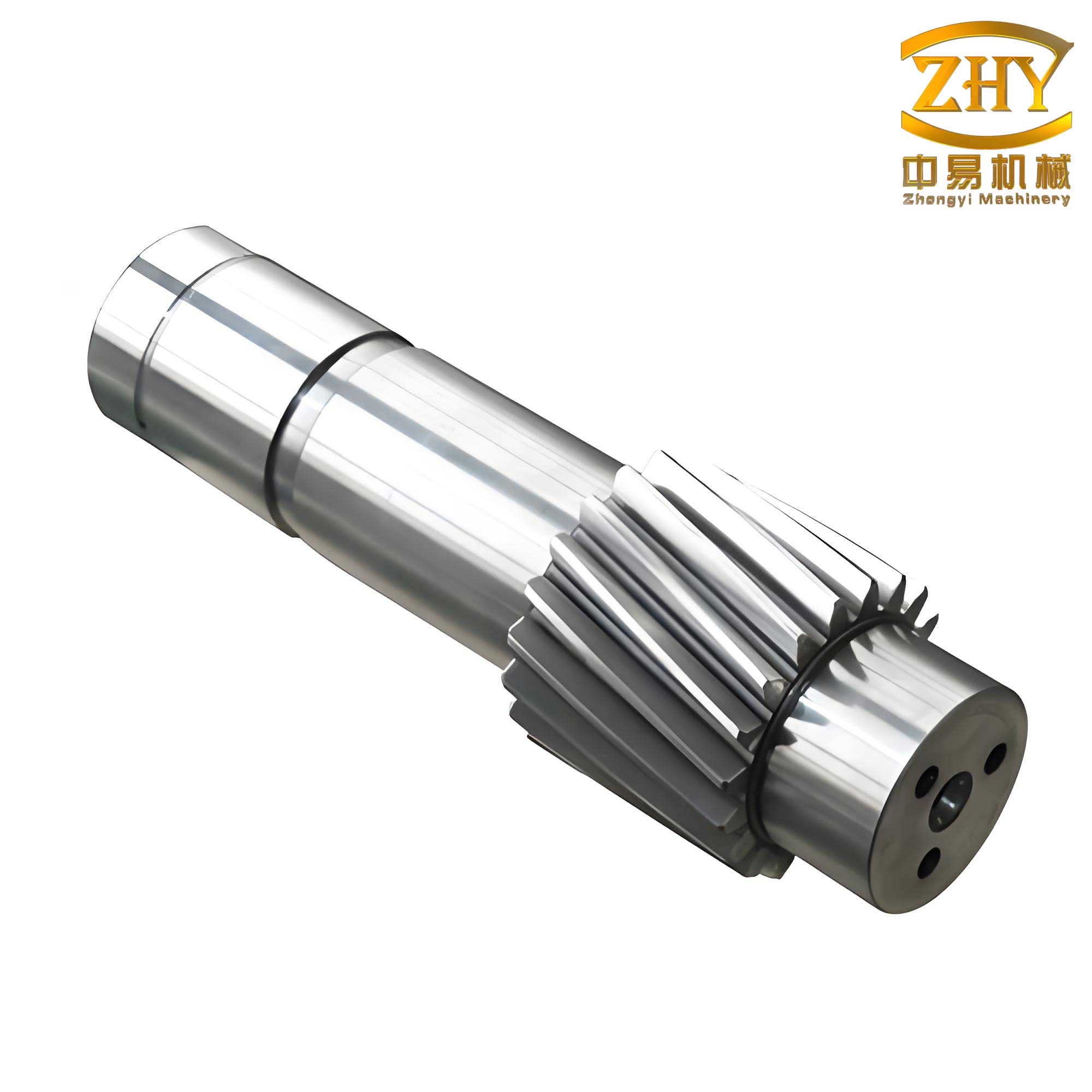
In my extensive experience with power transmission systems, the gear shaft for hydraulic motors stands out as a critical component due to its pivotal role in converting hydraulic energy into precise rotational motion. These gear shafts are prized for their simplicity, compact design, light weight, cost-effectiveness, high rotational speeds, and robustness against oil contamination, making them ubiquitous in mining and engineering machinery. The material of choice is often 38CrMoAl nitriding steel, subjected to surface nitriding to achieve exceptional surface hardness, wear resistance, thermal stability, corrosion resistance, and fatigue performance. This treatment significantly enhances service life and reliability, making such gear shafts suitable for demanding applications like precision spindles, screws, and critical wear parts in plastic extruders. However, in practice, I have encountered recurrent failure modes characterized by severe surface exfoliation, which compromises the integrity and functionality of the entire hydraulic system. This article presents a comprehensive investigation from my perspective, analyzing the root causes of such failures through detailed experimental characterization, and proposes engineering solutions grounded in microstructure control.
The core of my analytical approach involved comparing failed and unfailed gear shaft samples. Specimens were sectioned from characteristic regions using wire electrical discharge machining to preserve the integrity of the surface layers. These samples were then mounted, ground with SiC papers from 240 to 7000 grit, and polished to a mirror finish using an MP-1B polisher. Etching was performed with a 4% nital solution to reveal the microstructure. I employed a Quanta250 scanning electron microscope (SEM) equipped with energy-dispersive X-ray spectroscopy (EDS) for high-resolution morphological and compositional analysis. Bulk chemical composition was verified using spark optical emission spectrometry. Microstructural examination was conducted with a Leica DM2500M optical microscope, and microhardness profiling across the cross-section was performed using a Vickers microhardness tester (MVS-1000D1) with a 0.98 N (100 gf) load, adhering to standard ASTM E384 guidelines.
Macroscopic examination of the failed gear shaft revealed extensive surface damage, spanning large areas of the component. Under low magnification, the surface appeared severely deteriorated, while higher magnification SEM analysis confirmed this damage as localized spalling or exfoliation, where material had detached from the surface in flakes. In contrast, adjacent non-failed regions remained smooth and intact. This stark difference pointed toward a subsurface-initiated failure mechanism rather than uniform wear. The initial step was to rule out material non-conformity. Chemical analysis of the failed gear shaft material yielded the results compared to the standard for 38CrMoAl steel, as summarized in Table 1.
| Element | Standard 38CrMoAl | Failed Gear Shaft |
|---|---|---|
| C | 0.35-0.42 | 0.41 |
| Al | 0.70-1.10 | 0.904 |
| Si | 0.20-0.45 | 0.201 |
| Cr | 1.35-1.65 | 1.36 |
| Mn | 0.30-0.60 | 0.416 |
| Mo | 0.15-0.25 | 0.237 |
| S | ≤0.15 | 0.015 |
| P | ≤0.02 | 0.0091 |
The composition falls entirely within the specified range, conclusively eliminating bulk chemistry as the primary cause of the gear shaft failure. This directed my focus toward the nitrided layer’s microstructure and properties. Cross-sectional metallography provided the first critical insight. The unfailed gear shaft exhibited a uniform, dense nitrided layer with a thin, continuous white layer (compound zone) and a diffusion zone beneath, corresponding to a standard microstructure rating of Grade 1. Conversely, the failed gear shaft’s nitrided layer revealed a severe abnormality: a pronounced band of massive, blocky precipitates located just beneath the white layer in the near-surface region, as shown in Figure 2(b). This structure is typically rated as Grade 5, indicating a grossly defective condition. The blocky morphology and their location suggested they were brittle carbonitride phases.
To quantitatively assess the mechanical gradient, I performed microhardness traverses from the surface to the core. The data, plotted in Figure 5, shows a steep hardness gradient. The surface and near-surface regions exhibit exceptionally high hardness, which then decreases rapidly toward the core hardness. The hardness value in the banded precipitate zone was significantly higher than in the adjacent diffusion layer. This profile can be modeled using an exponential decay function, common for nitrided cases:
$$ H(x) = H_c + (H_s – H_c) \cdot e^{-k x} $$
where \( H(x) \) is the microhardness at a distance \( x \) from the surface, \( H_s \) is the surface hardness, \( H_c \) is the core hardness, and \( k \) is a decay constant characterizing the hardness penetration depth. For a sound nitrided gear shaft, \( k \) should ensure a smooth transition. In the failed case, the presence of the hard, blocky precipitate band creates a localized spike in hardness, effectively acting as a discontinuity in this gradient. The high hardness directly correlates with low fracture toughness and high brittleness. The stress concentration factor \( K_t \) at the interface between these brittle precipitates and the relatively ductile matrix can be approximated for a surface-breaking defect:
$$ K_t \approx 1 + 2\sqrt{\frac{a}{\rho}} $$
where \( a \) is the defect depth (precipitate size) and \( \rho \) is the root radius of the defect. The blocky nature of these precipitates implies a very small \( \rho \), leading to a high \( K_t \), thus making the site highly susceptible to crack initiation.
SEM-EDS analysis of the blocky precipitates within the failed gear shaft’s nitrided layer confirmed their nature. Point spectra from these regions showed markedly elevated carbon and nitrogen content alongside the base alloying elements (Cr, Mo, Al, Fe). A semi-quantitative summary from multiple point analyses is presented in Table 2, contrasting it with the matrix composition in the diffusion zone.
| Region | C | N | O | Al | Cr | Fe |
|---|---|---|---|---|---|---|
| Blocky Precipitate | 10.5 – 14.0 | 3.5 – 5.0 | 0.8 – 1.5 | 0.4 – 0.7 | 2.5 – 3.2 | Bal. |
| Diffusion Zone Matrix | ~0.4 | ~0.5 | <0.5 | ~0.9 | ~1.4 | Bal. |
The high carbon and nitrogen levels confirm that these are indeed carbonitride precipitates, likely of types such as (Fe,Cr)₃(C,N) or similar complex phases. Their formation is attributed to an improper nitriding process where excessive carbon availability (potentially from prior carburization or improper pre-treatment) and nitrogen potential lead to supersaturation and coalescence of carbides and nitrides in the near-surface zone during the diffusion cycle. The white layer (ε-Fe₂₋₃N and γ’-Fe₄N) itself was also observed to be thicker in the failed gear shaft compared to the sound one, further indicating a deviation from optimal nitriding parameters.
The operational failure mechanism can be described through a fatigue-driven spalling model. In service, the gear shaft is subjected to complex periodic loading: torsional stresses from torque transmission, bending stresses from gear mesh forces, and contact stresses. The stress state at the surface and subsurface is multiaxial. The maximum alternating shear stress \( \tau_{a, max} \), which drives subsurface crack initiation in rolling/sliding contact, often occurs at a depth roughly equivalent to the Hertzian contact half-width. However, when a hard, brittle layer exists near the surface, the failure plane shifts. The high hardness mismatch between the blocky carbonitride band and the surrounding matrix creates intense interfacial stresses. Under cyclic loading, microcracks initiate at these interfaces due to the high stress concentration. The propagation of these cracks is governed by Paris’ law for fatigue crack growth:
$$ \frac{da}{dN} = C (\Delta K)^m $$
where \( da/dN \) is the crack growth rate per cycle, \( \Delta K \) is the stress intensity factor range, and \( C \) and \( m \) are material constants. For brittle materials like these carbonitrides, \( m \) is typically high, meaning crack growth accelerates rapidly with increasing \( \Delta K \). Once initiated, cracks propagate parallel to the surface within the brittle precipitate band or along its interface with the matrix, eventually coalescing and leading to the detachment of large flakes—the observed exfoliation. This process severely undermines the gear shaft’s load-bearing capacity and leads to catastrophic failure of the hydraulic motor assembly. The fundamental problem is that the designed beneficial residual compressive stresses from nitriding are negated by the stress concentrations from these microstructural defects.
To prevent such failures in future production of gear shafts, a multi-faceted solution is required, focusing on process control and material conditioning. Firstly, stringent incoming material inspection is non-negotiable. Beyond chemical composition, the prior microstructure of the 38CrMoAl steel bar stock must be evaluated. A normalized and tempered structure with fine, uniformly distributed carbides is ideal. The presence of coarse carbide networks or banding (segregation) from the original forging or rolling process can act as nuclei for excessive carbonitride growth during nitriding. Secondly, the nitriding process parameters—temperature, time, and atmosphere composition (nitriding potential, \( K_N \))—must be meticulously controlled. The nitriding potential \( K_N \) is defined as:
$$ K_N = \frac{p_{NH_3}}{(p_{H_2})^{1.5}} $$
where \( p_{NH_3} \) and \( p_{H_2} \) are the partial pressures of ammonia and hydrogen, respectively. For 38CrMoAl, a two-stage nitriding process (e.g., a first stage at higher \( K_N \) to form the compound layer, followed by a second stage at lower \( K_N \) to promote diffusion without excessive compound layer growth) is often beneficial. The process must be designed to avoid the critical combination of high carbon activity and high nitrogen potential in the near-surface zone that leads to massive precipitate formation. Post-nitriding cooling rates should also be controlled to minimize thermal stresses. Finally, non-destructive evaluation of finished gear shafts, such as eddy current testing or ultrasonic surface wave inspection, can help detect subsurface microstructural anomalies before they enter service.
In conclusion, my detailed investigation identifies the failure of this hydraulic motor gear shaft as large-area exfoliation of the nitrided surface layer. The root cause is metallurgical, stemming from the formation of a band of massive, brittle carbonitride precipitates in the near-surface region during the nitriding process. These precipitates create a severe hardness inhomogeneity and act as stress concentrators, initiating microcracks under cyclic operational loads. Subsequent crack propagation following fatigue mechanics leads to spalling. The solution lies in rigorous control of the base material’s homogeneity and the nitriding process parameters to prevent the formation of such deleterious microstructural features. This case underscores that for critical components like the gear shaft, achieving specified hardness and case depth is insufficient; a uniform and tough microstructure throughout the nitrided case is paramount for long-term performance and reliability in demanding hydraulic applications. Continuous monitoring and refinement of thermal chemical processing are essential to prevent such costly failures and ensure the durability of these indispensable power transmission elements.