
In my research, I focus on the fatigue performance of 40Cr material involute standard straight spur gears, which are widely used in coal mining machinery. The bending fatigue behavior of these gears is critical for the reliability of the entire transmission system. I conducted a systematic experimental study to obtain the fatigue life distribution and the P-S-N curve, providing essential data for anti-fatigue design. Throughout this paper, I emphasize the importance of understanding the fatigue characteristics of straight spur gears to ensure safe operation in mining environments.
I first analyzed the bending fatigue properties of straight spur gears. The tooth root fillet experiences stress concentration under cyclic loading, and the maximum bending stress occurs at the tensile side of the root. The relationship between the applied load and the resulting bending stress can be expressed using the classic Lewis formula modified with stress concentration factors. For a standard spur gear, the nominal bending stress at the root is given by:
$$ \sigma_F = \frac{F_t}{b m} Y_F Y_S Y_\beta Y_B $$
where \(F_t\) is the tangential force, \(b\) is the face width, \(m\) is the module, \(Y_F\) is the form factor, \(Y_S\) is the stress correction factor, \(Y_\beta\) is the helix angle factor (unity for straight spur gears), and \(Y_B\) is the rim thickness factor. In my study, I considered the residual compressive stress induced by surface treatments, which can significantly improve fatigue life. The combined stress at the root tensile side becomes:
$$ \sigma_{total} = \sigma_F – \sigma_{residual} $$
This reduction in tensile stress directly enhances the fatigue endurance of straight spur gears. The inverse power-law relationship between stress and life is well known:
$$ N \propto \sigma^{-n} $$
where \(n\) is typically around 6 for steel gears. Thus, a small decrease in stress can lead to a substantial increase in fatigue life.
I performed bending fatigue tests on 40Cr straight spur gears using a pulse-loading method. The test setup consisted of a high-frequency electromagnetic resonance fatigue testing machine (Model STRON 1603). The fixture, designed according to the standard GB/T 14230-1993, automatically balances the load on two teeth. The loading frequency was 140–150 Hz, and the load was applied in a pulsating cycle (minimum load near zero). The test gear parameters are summarized in the following table:
| Parameter | Value |
|---|---|
| Material | 40Cr |
| Module, m | 4.5 mm |
| Number of teeth, z | 33 |
| Face width, b | 14 mm |
| Average tooth surface hardness | HBS 274 |
| Average root hardness | HBS 282 |
| Root surface roughness, Ra | 30 μm |
| Type | Standard involute straight spur gear |
Before testing, I labeled each tooth on the gear to track fracture locations, as shown in the fixture arrangement. The test involved four stress levels: 293.69 MPa, 275.35 MPa, 256.78 MPa, and 238.24 MPa. These stress levels were determined from preliminary finite element analysis and empirical calculations to cover both low-cycle and high-cycle fatigue regimes. The number of cycles to failure (N) at each stress level was recorded. I then performed statistical analysis on the fatigue life data. The fatigue life of straight spur gears typically follows a three-parameter Weibull distribution. The cumulative distribution function is:
$$ F(N) = 1 – \exp\left[ -\left( \frac{N – N_0}{N_a – N_0} \right)^b \right] $$
where \(N_0\) is the location parameter (minimum life), \(N_a\) is the scale parameter (characteristic life), and \(b\) is the shape parameter. Taking logarithms twice, I obtain a linear form:
$$ \ln\left[ \ln\left( \frac{1}{1 – F(N)} \right) \right] = b \ln(N – N_0) – b \ln(N_a – N_0) $$
Let \(X = \ln(N – N_0)\), \(Y = \ln[\ln(1/(1-F(N)))]\), and \(B = -b \ln(N_a – N_0)\). Then the equation becomes \(Y = b X + B\). Using the least squares method, I estimated the three parameters for each stress level. The results are summarized in Table 2.
| Stress (MPa) | N₀ (cycles) | Nₐ (cycles) | b | Correlation coefficient r |
|---|---|---|---|---|
| 293.69 | 1.52×10⁵ | 3.41×10⁵ | 2.13 | 0.979 |
| 275.35 | 2.84×10⁵ | 6.72×10⁵ | 1.98 | 0.967 |
| 256.78 | 5.66×10⁵ | 1.48×10⁶ | 2.05 | 0.972 |
| 238.24 | 1.05×10⁶ | 3.15×10⁶ | 2.21 | 0.985 |
All correlation coefficients exceeded 0.95, indicating that the three-parameter Weibull distribution adequately describes the fatigue life distribution of these straight spur gears. The linear regression plots of \(Y\) versus \(X\) at each stress level showed excellent linearity, confirming the validity of the model. Based on these parameters, I can construct the P-S-N curve (probability-stress-life) for the 40Cr straight spur gears. The P-S-N curve relates the reliability \(R\) (or survival probability), applied stress, and number of cycles. For a given reliability \(R\), the life at a given stress is:
$$ N_R = N_0 + (N_a – N_0) \left[ -\ln(R) \right]^{1/b} $$
Alternatively, the inverse relationship gives the stress corresponding to a target life at a chosen reliability. This is essential for design purposes.
To reduce the uncertainties in stress estimation before testing, I employed finite element method (FEM) simulations using ANSYS. I created a three-dimensional model of the straight spur gear with detailed root geometry. The load was applied as a distributed force along the tooth contact line (theoretically along the line of action). Since directly applying a uniformly distributed load on the line is impractical in FEM, I placed nodes precisely on the line of action to represent the contact region. This approach ensured that the resultant force was equivalent to a concentrated load at the highest point of single tooth contact (HPSTC). The FEM analysis provided the maximum principal stress at the tooth root, which I used to calibrate the applied load for each target stress level. The results are listed in Table 3.
| Target bending stress (MPa) | Applied load per tooth (kN) | FEM max root stress (MPa) | Error (%) |
|---|---|---|---|
| 293.69 | 8.12 | 294.1 | 0.14 |
| 275.35 | 7.61 | 275.8 | 0.16 |
| 256.78 | 7.09 | 257.2 | 0.16 |
| 238.24 | 6.58 | 238.6 | 0.15 |
The FEM results showed excellent agreement with the target stress values, with errors less than 0.2%. This verified the accuracy of the loading setup. The stress and strain contours from the FEM simulation clearly indicated that the maximum stress occurred at the tooth root fillet on the tensile side, consistent with theoretical expectations. The strain distribution also confirmed that the deformation was primarily bending.
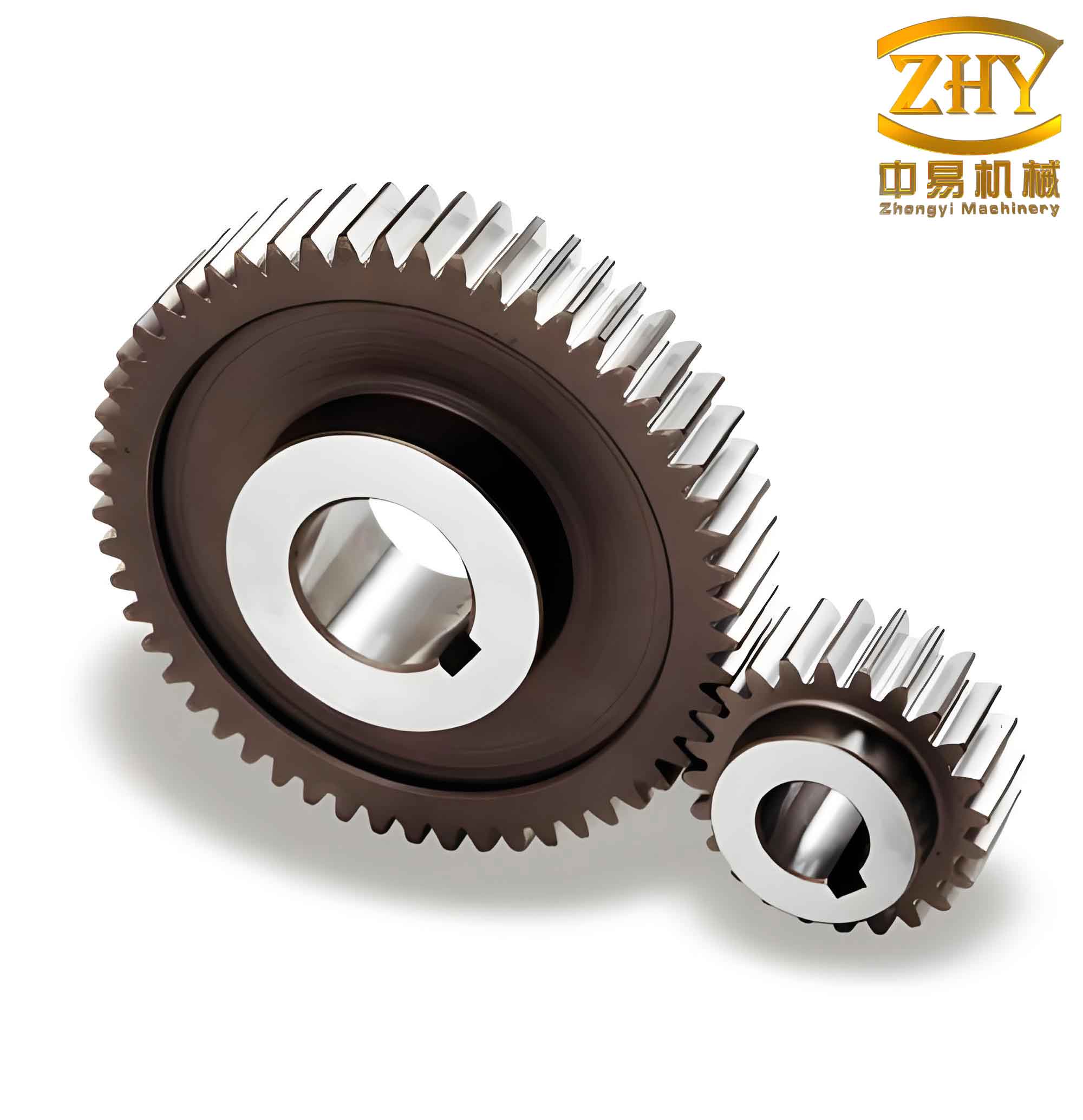
The combination of experimental data, statistical modeling, and numerical simulation provides a comprehensive understanding of the bending fatigue behavior of straight spur gears. The P-S-N curve derived from the Weibull parameters can be used to predict the fatigue life under various reliability levels. For example, at a stress of 256.78 MPa, the median life (R=0.5) is approximately 1.48×10⁶ cycles, while the life at 99% reliability (R=0.99) can be calculated as:
$$ N_{0.99} = N_0 + (N_a – N_0) \left[ -\ln(0.99) \right]^{1/b} = 5.66\times10^5 + (1.48\times10^6 – 5.66\times10^5) \times (0.01005)^{1/2.05} \approx 6.87\times10^5 \text{ cycles} $$
This information is vital for the reliability design of mining gear transmissions, where unexpected failure can lead to costly downtime and safety hazards. Furthermore, the residual compressive stress induced by shot peening or case hardening can be incorporated into the design by reducing the effective tensile stress, thereby extending the fatigue life of straight spur gears.
In summary, my experimental study on 40Cr straight spur gears has yielded reliable fatigue data and a validated statistical distribution model. The use of finite element analysis before testing significantly improved the accuracy of load calibration, reducing trial-and-error efforts. The methods and results presented here can be directly applied to the anti-fatigue optimization of straight spur gears in mining machinery, ensuring safer and more durable operation under harsh conditions.