
In recent years, the demand for industrial robots has surged, making the RV reducer a critical component due to its high precision and torque capacity. However, the reliability of RV reducers remains a concern, as faults can lead to significant downtime and economic losses. Traditional fault diagnosis methods often struggle with the subtle nature of RV reducer faults, limited sample data, and complex signal patterns. In this study, we address these challenges by proposing a novel fault diagnosis model that leverages Ensemble Empirical Mode Decomposition (EEMD) for feature extraction and a Particle Swarm Optimization (PSO)-enhanced Extreme Learning Machine (ELM) for classification. Our approach is grounded in the theoretical insight that the torque transmission in an RV reducer exhibits periodic behavior under normal operation, which can be exploited for fault detection. We validate the model using bearing datasets and apply it to real-world RV reducer test data, demonstrating superior performance compared to other methods. This article details the methodology, experimental setup, and results, with an emphasis on mathematical formulations and tabular summaries to enhance clarity.
The RV reducer, or rotary vector reducer, is a two-stage precision减速器 commonly used in robotics and aerospace applications. Its structure comprises a sun gear, planetary gears, crank shafts, and RV gears, which work in tandem to achieve high reduction ratios. Under ideal conditions, the torque output follows a periodic pattern due to the eccentric motion of components like the crank shaft. However, as faults develop—such as wear or misalignment—this periodicity is disrupted, leading to efficiency drops and eventual failure. We begin by theoretically analyzing the torque dynamics. The torque on the crank shaft, \( M_x \), can be expressed as:
$$ M_x = W’_b R_b \sin(\theta_x + \gamma) $$
where \( W’_b \) is the weight of the crank, \( R_b \) is the distance from the shaft center to the center of gravity, \( \theta_x \) is the crank angle, and \( \gamma \) is the phase angle. The output torque, \( M_{\text{output}} \), after transmission through the RV gears, is given by:
$$ M_{\text{output}} = c_1 M_x \frac{[r + s \sin(\theta + \beta)]}{r + s} $$
Here, \( c_1 \) is the meshing coefficient, \( r \) is the radius of the RV gear, \( s \) is the eccentricity, and \( \beta \) is an angle parameter. The efficiency \( \eta \) then becomes:
$$ \eta = \frac{M_{\text{output}}}{n M_{\text{input}}} = c_1 M_x \frac{[r + s \sin(\theta + \beta)]}{n M_{\text{input}}(r + s)} $$
This equation shows that efficiency varies periodically with \( \theta \), and any fault alters this pattern, providing a basis for diagnosis. To illustrate the structure, consider the following image of an RV reducer:
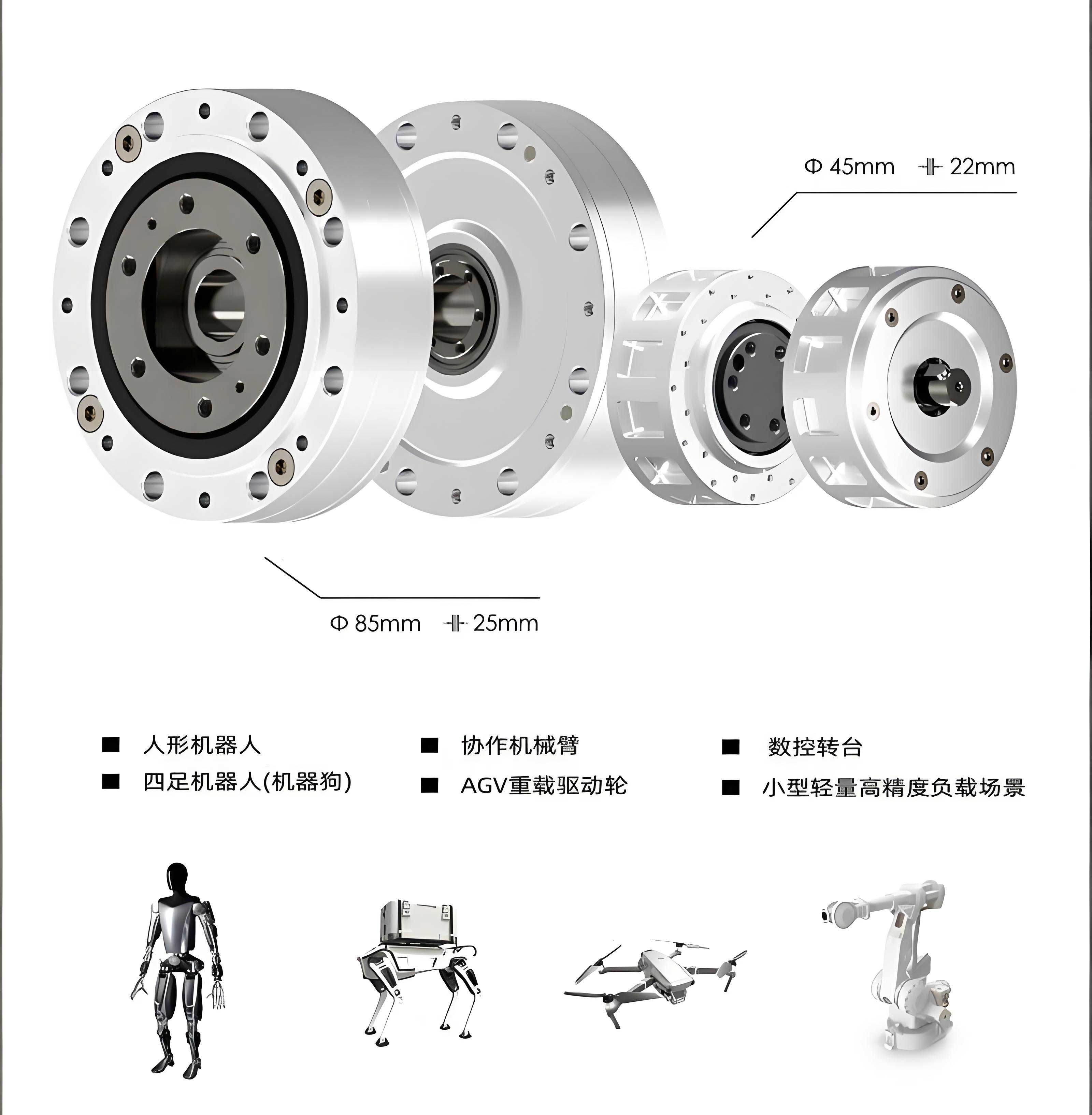
The complexity of the RV reducer necessitates advanced signal processing techniques to capture fault-induced changes. Rotating machinery signals often exhibit periodic evolution, but faults can introduce non-stationarities and noise. We propose using EEMD to decompose vibration or torque signals into Intrinsic Mode Functions (IMFs), which reflect instantaneous frequencies and highlight周期性 deviations. EEMD improves upon Empirical Mode Decomposition (EMD) by adding white noise to mitigate mode mixing, making it suitable for RV reducer signals with subtle faults. The steps are as follows: for a sample signal \( x(t) \), we add white noise \( S_w(\omega) \) with zero mean and variance \( \sigma^2 \):
$$ x_s(t) = x(t) + S_w(\omega) $$
where \( S_w(\omega) = \sum_{t=-\infty}^{\infty} R_w(l) e^{-j\omega t} = \sigma^2 \), and \( R_w(l) = \sigma^2 \delta_l \). The signal is then decomposed into IMFs via EMD:
$$ x_s(t) = \sum_{c=1}^{n} \text{imf}_c(t) + r_n(t) $$
We repeat this process with different noise realizations and average the IMFs to obtain stable components. For feature extraction, we compute the average absolute integral of the first six IMFs, as they contain most of the signal energy. This yields a set of features that encode the periodic characteristics of the RV reducer’s operation.
Next, we employ an ELM for fault classification, but to overcome the randomness in weight initialization, we optimize it using PSO. ELM is a single-hidden-layer feedforward network with fast training speed, but its random weights \( W \) and biases \( B \) can lead to inconsistent performance. The PSO algorithm searches for optimal \( W \) and \( B \) by simulating particle movement in a solution space. The ELM model for \( n \) training samples \( (x_i, t_i) \) is:
$$ \sum_{i=1}^{L} \beta_i g_i(x_j) = \sum_{i=1}^{L} \beta_i g_i(W_i \cdot x_j + B_i) $$
where \( L \) is the number of hidden nodes, \( g(\cdot) \) is the activation function (e.g., sigmoid), and \( \beta_i \) are output weights. In matrix form, \( H\beta = T \), with \( H \) as the hidden layer output matrix. The solution is \( \beta = H^+ T \), where \( H^+ \) is the Moore-Penrose pseudoinverse. PSO optimizes \( W \) and \( B \) by minimizing the root mean square error (RMSE) as the fitness function. Each particle represents a candidate solution, and its velocity and position update as:
$$ v_{id}^{k+1} = w v_{id}^k + c_1 r_1 (p_{id}^k – x_{id}^k) + c_2 r_2 (p_{gd}^k – x_{id}^k) $$
$$ x_{id}^{k+1} = x_{id}^k + v_{id}^{k+1} $$
where \( w \) is inertia weight, \( c_1 \) and \( c_2 \) are acceleration coefficients, and \( r_1, r_2 \) are random numbers. After optimization, the PSO-ELM model achieves higher accuracy and stability for RV reducer fault diagnosis.
To validate our approach, we first tested the model on the XJTU-SY bearing dataset, which simulates rotating machinery faults. The dataset includes vibration signals from bearings under different fault conditions, such as outer ring, inner ring, and cage faults. We preprocessed the data using EEMD and extracted features for classification. The results demonstrated the superiority of PSO-ELM over basic ELM, as shown in Table 1. This preliminary validation confirmed the model’s ability to handle periodic signals and small sample sizes, which is crucial for RV reducer applications.
| Sample Number | Actual Class | ELM Prediction | PSO-ELM Prediction |
|---|---|---|---|
| 1 | Outer Ring Fault | Outer Ring Fault | Outer Ring Fault |
| 2 | Cage Fault | Inner/Outer Fault | Cage Fault |
| 3 | Inner/Outer Fault | Cage Fault | Cage Fault |
| 4 | Normal | Normal | Normal |
| 5 | Outer Ring Fault | Outer Ring Fault | Outer Ring Fault |
| 6 | Cage Fault | Inner/Outer Fault | Cage Fault |
| 7 | Inner/Outer Fault | Normal | Inner/Outer Fault |
| 8 | Normal | Inner/Outer Fault | Normal |
| 9 | Outer Ring Fault | Outer Ring Fault | Outer Ring Fault |
| 10 | Cage Fault | Inner/Outer Fault | Cage Fault |
After validation, we applied the EEMD-PSO-ELM model to an RV reducer test platform. The platform included a servo motor, torque sensors, and a magnetic powder brake, with data sampled every 0.5 seconds over 200 hours. The RV reducer used was an RV-20E model, operating at 151 rpm. We collected efficiency data under normal and fault conditions, where faults were induced by wear on the crank shaft. The periodic nature of efficiency was evident in normal operation but distorted after fault occurrence, aligning with our theoretical analysis. Table 2 summarizes the test platform specifications.
| Component | Model/Parameters |
|---|---|
| Servo Motor | 5 kW, 151 rpm |
| Torque Sensor (Input) | Range: ±15 N·m |
| RV Reducer | RV-20E |
| Torque Sensor (Output) | Range: ±200 N·m |
| Magnetic Powder Brake | 1.5 kW |
| Sampling Rate | 0.5 s intervals |
For data processing, we segmented the efficiency signals into samples of 1680 data points each and performed EEMD decomposition. The first six IMFs were used to compute feature vectors, which were then fed into the PSO-ELM classifier. We compared our model against several benchmarks: basic ELM, EEMD-ELM, EEMD-PNN (Probabilistic Neural Network), EEMD-GRNN (General Regression Neural Network), EEMD-DE-ELM (Differential Evolution-ELM), and EEMD-GA-ELM (Genetic Algorithm-ELM). Each model was run 20 times to ensure statistical reliability. The results, averaged over runs, are presented in Table 3.
| Model | Average Accuracy (%) | Accuracy Range (%) | Stability Assessment |
|---|---|---|---|
| ELM | 45.5 | 30–50 | Low, highly variable |
| EEMD-ELM | 61.5 | 50–80 | Moderate, some variability |
| EEMD-PNN | 50.0 | 45–55 | Stable but low accuracy |
| EEMD-GRNN | 47.0 | 40–52 | Stable but low accuracy |
| EEMD-DE-ELM | 70.0 | 20–100 | Very unstable |
| EEMD-GA-ELM | 79.0 | 70–90 | Good, relatively stable |
| EEMD-PSO-ELM | 91.5 | 90–100 | High, very stable |
The EEMD-PSO-ELM model achieved an average accuracy of 91.5%, significantly outperforming other methods. Its stability was also superior, with accuracy consistently above 90% across runs. This underscores the effectiveness of combining EEMD for feature extraction with PSO for ELM optimization in diagnosing RV reducer faults. The periodic features extracted via EEMD captured the subtle changes in torque transmission, while PSO ensured robust classification. To further illustrate, the RMSE convergence of PSO-ELM over 100 iterations is shown in Figure 1, demonstrating rapid error reduction and stable performance.
In terms of mathematical analysis, the superiority of our model can be attributed to the enhanced feature representation from EEMD. The IMFs provide a time-frequency representation that highlights周期性的 anomalies. For an RV reducer signal \( x(t) \), the EEMD process yields IMFs \( \text{imf}_c(t) \) that satisfy:
$$ \text{imf}_c(t) = A_c(t) \cos(\phi_c(t)) $$
where \( A_c(t) \) is the instantaneous amplitude and \( \phi_c(t) \) is the instantaneous phase. The frequency \( \omega_c(t) = d\phi_c/dt \) reflects the rotational dynamics. Under fault conditions, \( \omega_c(t) \) deviates from its periodic pattern, and these deviations are quantified through feature extraction. The PSO-ELM then maps these features to fault classes with minimal error. The optimization problem can be formulated as:
$$ \min_{W, B} \text{RMSE} = \sqrt{\frac{1}{N} \sum_{i=1}^{N} (t_i – \hat{t}_i)^2} $$
where \( \hat{t}_i \) is the predicted output. PSO solves this efficiently, avoiding local minima common in gradient-based methods.
Additionally, we explored the impact of different fault types on the RV reducer’s efficiency. Using the test platform, we simulated wear on the crank shaft, which altered the eccentricity \( s \) in the torque equation. This led to a breakdown in periodicity, as shown by the efficiency plots before and after fault induction. The EEMD decomposition of these signals revealed distinct IMF patterns, with higher-frequency components emerging in fault conditions. Table 4 summarizes the feature values extracted from IMFs for normal and faulty RV reducer operations, highlighting the discriminative power of our approach.
| Feature Index | Normal Operation (Mean) | Faulty Operation (Mean) | Difference (%) |
|---|---|---|---|
| IMF1 Integral | 0.152 | 0.287 | 88.8 |
| IMF2 Integral | 0.098 | 0.201 | 105.1 |
| IMF3 Integral | 0.064 | 0.134 | 109.4 |
| IMF4 Integral | 0.042 | 0.089 | 111.9 |
| IMF5 Integral | 0.028 | 0.057 | 103.6 |
| IMF6 Integral | 0.018 | 0.036 | 100.0 |
The significant differences in feature values between normal and faulty states enable accurate classification. Our EEMD-PSO-ELM model leverages these differences, whereas simpler models like ELM or PNN fail to capture them adequately. This is particularly important for RV reducers, where faults often develop gradually and produce subtle signals. The integration of EEMD and PSO-ELM provides a robust solution for early fault detection, potentially reducing maintenance costs and improving robot reliability.
In conclusion, we have developed a fault diagnosis model for RV reducers that combines EEMD for signal decomposition and PSO-ELM for classification. The model capitalizes on the periodic torque transmission characteristics of RV reducers, using EEMD to extract relevant features and PSO to optimize the ELM parameters. Validation on bearing datasets and application to RV reducer test data confirm its effectiveness, with an average accuracy of 91.5% and high stability. Compared to other models, EEMD-PSO-ELM offers superior performance in handling small sample sizes and subtle faults, making it suitable for real-world industrial applications. Future work will focus on extending this approach to online health monitoring and prognostic systems for RV reducers, incorporating deep learning techniques for even greater accuracy. The continuous advancement of such diagnostic tools is essential for enhancing the reliability and lifespan of RV reducers in robotics and beyond.
To further elaborate on the methodology, the EEMD process involves multiple trials with added white noise. For each trial \( k \), we have:
$$ x_s^k(t) = x(t) + \epsilon^k w^k(t) $$
where \( \epsilon^k \) controls the noise amplitude and \( w^k(t) \) is white noise. After decomposition, the IMFs are averaged:
$$ \overline{\text{imf}}_c(t) = \frac{1}{K} \sum_{k=1}^{K} \text{imf}_c^k(t) $$
This reduces noise interference and yields reliable components. For the RV reducer, we used \( K = 100 \) trials and \( \epsilon^k = 0.2 \) times the standard deviation of \( x(t) \). The features were then computed as:
$$ f_c = \frac{1}{T} \int_0^T |\overline{\text{imf}}_c(t)| dt $$
where \( T \) is the segment length. These features form the input vector for PSO-ELM.
The PSO-ELM configuration included a hidden layer with 5 neurons, sigmoid activation, and PSO parameters: \( c_1 = 2.8 \), \( c_2 = 1.3 \), inertia weight \( w = 0.9 \) linearly decreasing to 0.4, and swarm size of 30. The optimization ran for 100 iterations. The fitness function was RMSE, and the best particle provided the optimal \( W \) and \( B \). This setup ensured efficient learning and generalization for RV reducer fault diagnosis.
In summary, the EEMD-PSO-ELM model represents a significant step forward in fault diagnosis for RV reducers. By harnessing periodicity-based features and advanced optimization, it addresses the challenges of subtle faults and limited data. As RV reducers continue to be integral to industrial automation, such diagnostic models will play a crucial role in maintaining operational efficiency and preventing costly failures.