
In the realm of precision motion control and power transmission, harmonic drive gear systems have emerged as a pivotal technology due to their exceptional characteristics, such as high positional accuracy, substantial reduction ratios, compact design, and the ability to operate in confined or harsh environments. These systems are widely employed in robotics, aerospace, medical devices, and industrial automation. At the heart of a harmonic drive gear mechanism lies the wave generator, a component that induces controlled elastic deformation in the flexspline to facilitate meshing with the circular spline. Traditional wave generators, such as cam-based or roller-type designs, are inherently rigid and lack adaptability during continuous operation. This limitation motivates the exploration of innovative approaches, including the integration of fluid power technology. In this article, I present a comprehensive investigation into the feasibility of a pure pneumatic wave generator for harmonic drive gear applications. By leveraging pneumatic actuation, this novel design aims to provide a flexible, tunable, and dynamically responsive alternative to conventional wave generators. The core idea involves using an array of pneumatic cylinders to generate the elliptical motion required for harmonic drive gear operation, thereby enabling real-time adjustment of wave parameters and enhanced system performance.
The harmonic drive gear principle relies on three primary components: the wave generator, the flexspline (a thin-walled flexible cup with external teeth), and the circular spline (a rigid ring with internal teeth). The wave generator, typically an elliptical cam or a set of rollers, deforms the flexspline into a non-circular shape, causing its teeth to engage with those of the circular spline at two diametrically opposite regions. As the wave generator rotates, the deformation wave propagates through the flexspline, resulting in relative motion between the flexspline and circular spline. This unique mechanism allows for high reduction ratios (often exceeding 100:1) with minimal backlash and high torque capacity. However, traditional wave generators are constrained by fixed geometries, necessitating manual adjustment during downtime and limiting their ability to compensate for wear or varying loads. To address these challenges, I propose a pure pneumatic wave generator that utilizes pneumatic cylinders to dynamically control the deformation profile of the flexspline. This approach not only offers flexibility but also aligns with the trend toward soft robotics and adaptive mechanisms, where compliant actuation is desirable.
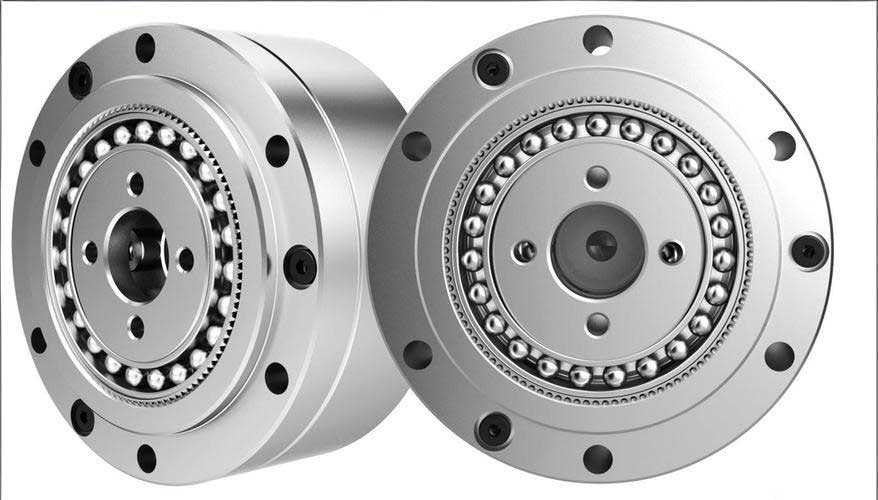
The design of the pure pneumatic wave generator centers on replicating the elliptical deformation pattern essential for harmonic drive gear operation through coordinated pneumatic actuation. The system comprises four groups of single-acting cylinders, each group consisting of two cylinders arranged radially on a circular base plate. The cylinders are positioned at 45-degree intervals around the circumference, with their piston rods oriented toward the center. This configuration ensures that the endpoints of the piston rods form a circular array in the retracted state, mimicking the initial neutral position of the flexspline. To generate the elliptical wave, the cylinders are actuated in a sequential cycle: Group A extends, then retracts; followed by Group B extending and retracting; then Group C; and finally Group D. This sequence, denoted as A+ A- B+ B- C+ C- D+ D- (where “+” indicates extension and “-” indicates retraction), produces a moving elliptical profile as the piston rod endpoints trace a path that deforms the flexspline. By reversing the actuation order, the direction of wave propagation can be inverted, enabling bidirectional operation of the harmonic drive gear. The pneumatic system is governed by a programmable logic controller (PLC) or a microcontroller that regulates the timing and pressure of each cylinder, ensuring synchronized motion and precise control over the wave shape. This design offers several advantages: it allows for online adjustment of the wave amplitude by modulating cylinder stroke, accommodates wear compensation by tuning pressure, and reduces mechanical complexity by eliminating rigid cams or linkages. Moreover, the use of pneumatic power facilitates operation in explosive or high-temperature environments where electrical systems might be unsuitable, further expanding the applicability of harmonic drive gear systems.
To assess the feasibility of this pneumatic wave generator, a thorough analysis of the forces involved in deforming the flexspline is imperative. The flexspline, being a thin cylindrical shell with gear teeth, can be modeled as a smooth cylindrical shell for deformation analysis, assuming small elastic deformations and negligible mid-surface strain. Based on shell theory, the radial displacement \( w \) of the flexspline under load is derived from equilibrium and energy considerations. Let \( u \), \( v \), and \( w \) represent the axial, tangential, and radial displacements, respectively. The strain components at the mid-surface are given by:
$$ \epsilon_z = \frac{\partial u}{\partial z} = 0 $$
$$ \epsilon_\phi = \frac{1}{R} \left( \frac{\partial v}{\partial \phi} + w \right) = 0 $$
$$ \gamma = \frac{\partial v}{\partial z} + \frac{1}{R} \frac{\partial u}{\partial \phi} = 0 $$
where \( \epsilon_z \) and \( \epsilon_\phi \) are the axial and tangential strains, \( \gamma \) is the shear strain, \( R \) is the mean radius of the flexspline, \( \phi \) is the angular coordinate, and \( z \) is the axial coordinate. These conditions imply that the mid-surface is inextensible, a common assumption for thin shells undergoing bending-dominated deformation. The bending moment \( M_\phi \) related to the curvature change is expressed as:
$$ \frac{d^2 w}{d\phi^2} + w = -\frac{M_\phi R^2}{D(1-\nu^2)} $$
where \( D \) is the cylindrical rigidity, defined as \( D = \frac{E \delta^3}{12(1-\nu^2)} \), with \( E \) being the Young’s modulus, \( \delta \) the wall thickness, and \( \nu \) the Poisson’s ratio of the flexspline material. The strain energy \( V \) stored in the flexspline due to bending is:
$$ V = \int_0^{2\pi} \frac{M_\phi^2 R \, d\phi}{2D(1-\nu^2)} $$
Assuming the radial displacement can be expanded as a Fourier series:
$$ w(\phi) = \sum_{n=1}^{\infty} \left( a_n \sin(n\phi) + b_n \cos(n\phi) \right) $$
and considering a point load \( P \) applied at the wave generator contact, the solution for \( w \) simplifies to:
$$ w = \frac{2PR^3}{\pi D(1-\nu^2)} \sum_{n=2,4,6,\ldots} \frac{\cos(n\phi)}{(n^2 – 1)^2} $$
This series converges rapidly, with the dominant term being \( n=2 \) for the elliptical deformation typical in harmonic drive gear systems. The force \( P \) required to produce a given radial deformation \( w_0 \) (the wave amplitude) is obtained by inverting the relation:
$$ P = \frac{\pi w_0 D(1-\nu^2)}{2R^3 \sum_{n=2,4,6,\ldots} \frac{1}{(n^2 – 1)^2}} $$
Substituting the expression for \( D \), we get:
$$ P = \frac{\pi E w_0 \delta^3}{24R^3 \sum_{n=2,4,6,\ldots} \frac{1}{(n^2 – 1)^2}} $$
This formula highlights that the deformation force is proportional to the Young’s modulus, the cube of the wall thickness, and the wave amplitude, and inversely proportional to the cube of the radius. For a typical harmonic drive gear, such as the XB1 series with parameters: tooth number \( Z_1 = 200 \), module \( m = 0.4 \, \text{mm} \), wave amplitude \( w_0 = 0.4 \, \text{mm} \), wall thickness \( \delta = 0.68 \, \text{mm} \), and length \( L = 70 \, \text{mm} \), the force can be computed. Experimental data from similar harmonic drive gear units indicates that a deformation force of approximately 109 N is needed to achieve \( w_0 = 0.4 \, \text{mm} \). However, to account for dynamic effects, friction, and ensuring robust meshing in the harmonic drive gear, a safety factor of 1.3 to 1.5 is applied, yielding a design force \( P’ \) of about 150 N. This force serves as the baseline for sizing the pneumatic cylinders in the wave generator.
The selection of pneumatic cylinders is critical to ensure that the pure pneumatic wave generator can deliver the required force while maintaining precise control over the deformation profile. The primary criteria include the cylinder bore diameter (which determines output force), stroke length (which must accommodate the wave amplitude), operating pressure, and response time. For the harmonic drive gear application, the stroke need only be slightly larger than the wave amplitude; since \( w_0 = 0.4 \, \text{mm} \), a stroke of 2-5 mm is sufficient, allowing for compact cylinder designs. The output force \( F_0 \) of a pneumatic cylinder is given by:
$$ F_0 = \frac{\pi}{4} D_c^2 \cdot p $$
where \( D_c \) is the cylinder bore diameter and \( p \) is the supply pressure. Assuming a standard pneumatic pressure of 0.6 MPa (approximately 6 bar) and accounting for a load factor \( \eta \) (typically 0.5 for dynamic applications) to accommodate losses due to friction and seal resistance, the required theoretical force \( F_0 \) is:
$$ \eta = \frac{P’}{F_0} \Rightarrow F_0 = \frac{P’}{\eta} = \frac{150 \, \text{N}}{0.5} = 300 \, \text{N} $$
Rearranging the force equation, the bore diameter is:
$$ D_c = \sqrt{\frac{4 F_0}{\pi p}} = \sqrt{\frac{4 \times 300}{\pi \times 0.6 \times 10^6}} \, \text{m} \approx 0.025 \, \text{m} = 25 \, \text{mm} $$
Thus, a cylinder with a bore diameter of at least 25 mm and a stroke of around 5 mm is suitable. Consulting manufacturer catalogs, such as SMC’s pneumatic components series, the model RDQB25-5M8—a compact, single-acting cylinder with a 25 mm bore and 5 mm stroke—meets these specifications. Its total length of under 40 mm allows integration into harmonic drive gear assemblies with flexspline diameters above 100 mm. For smaller harmonic drive gear units, custom miniature cylinders can be sourced. The pneumatic system also requires a stable air supply, typically from a compressor with a pressure regulator and reservoir, to maintain consistent pressure and flow. The control system must sequence the cylinders accurately; this can be achieved using solenoid valves operated by a timer or PLC, with feedback from position sensors if closed-loop control is desired. The following table summarizes key parameters for cylinder selection in this harmonic drive gear application:
| Parameter | Value | Description |
|---|---|---|
| Required Force (P’) | 150 N | Design force for flexspline deformation |
| Load Factor (η) | 0.5 | Safety margin for dynamic operation |
| Theoretical Force (F₀) | 300 N | Calculated cylinder output force |
| Supply Pressure (p) | 0.6 MPa | Standard pneumatic pressure |
| Bore Diameter (D_c) | 25 mm | Minimum cylinder bore size |
| Stroke Length | 5 mm | Sufficient for wave amplitude |
| Cylinder Model | RDQB25-5M8 | Example from SMC series |
| Total Length | < 40 mm | Compact design for integration |
Beyond cylinder sizing, the overall pneumatic system design for the harmonic drive gear wave generator must consider factors like air consumption, response speed, and reliability. The air consumption per cycle can be estimated based on cylinder volume and actuation frequency. For a cylinder with bore diameter 25 mm and stroke 5 mm, the volume per stroke is:
$$ V_c = \frac{\pi}{4} D_c^2 \cdot s = \frac{\pi}{4} (0.025)^2 \times 0.005 \, \text{m}^3 \approx 2.45 \times 10^{-6} \, \text{m}^3 = 2.45 \, \text{liters} $$
With eight cylinders actuating sequentially, the total air consumption per full wave cycle (all groups extended and retracted) is approximately 19.6 liters. At a typical wave generator speed of 1000 RPM (16.67 Hz), the required air flow rate would be around 326 L/min, which is manageable with a mid-sized compressor. To enhance efficiency, energy-saving measures such as quick-exhaust valves or pressure regeneration circuits can be incorporated. Additionally, the use of single-acting cylinders with spring return simplifies the pneumatic circuit by reducing the number of control valves, though it may limit force control during retraction. For precise harmonic drive gear operation, a closed-loop system with pressure transducers and positional feedback can be implemented to adjust cylinder pressure in real-time, compensating for load variations and ensuring consistent meshing between the flexspline and circular spline. This adaptability is a key advantage of the pneumatic approach over rigid wave generators in harmonic drive gear systems.
The feasibility of the pure pneumatic wave generator also hinges on its ability to maintain the elliptical deformation profile with minimal distortion. Numerical simulations, such as finite element analysis (FEA), can be employed to model the interaction between the pneumatic actuators and the flexspline. Assuming linear elasticity and small deformations, the radial displacement field can be approximated by the Fourier series mentioned earlier. However, for dynamic analysis, the equation of motion for the flexspline under pneumatic forcing must be considered. Using Hamilton’s principle, the governing equation for the radial displacement \( w(\phi, t) \) as a function of angle and time is:
$$ \rho \delta \frac{\partial^2 w}{\partial t^2} + D \left( \frac{\partial^4 w}{\partial \phi^4} + 2 \frac{\partial^2 w}{\partial \phi^2} + w \right) = q(\phi, t) $$
where \( \rho \) is the material density, \( D \) is the cylindrical rigidity as defined earlier, and \( q(\phi, t) \) is the external pressure distribution from the pneumatic cylinders. For a harmonic drive gear, \( q(\phi, t) \) is periodic and can be modeled as a sum of point forces at the cylinder contact points. Solving this partial differential equation analytically is complex, but approximate solutions using modal analysis can provide insight into the system’s natural frequencies and response. The fundamental frequency \( f_1 \) of the flexspline in elliptical deformation mode (n=2) is:
$$ f_1 = \frac{1}{2\pi} \sqrt{\frac{D}{\rho \delta R^4} (n^2 – 1)^2} \approx \frac{1}{2\pi} \sqrt{\frac{9D}{\rho \delta R^4}} $$
For a steel flexspline with \( E = 200 \, \text{GPa} \), \( \nu = 0.3 \), \( \delta = 0.68 \, \text{mm} \), and \( R = 40 \, \text{mm} \), we compute \( D \approx 0.56 \, \text{N·m} \) and \( f_1 \approx 450 \, \text{Hz} \). This is well above typical operating speeds of harmonic drive gear systems (usually below 100 Hz), indicating that resonance issues are unlikely, and the pneumatic actuators can follow the desired waveform without significant phase lag. Moreover, the damping inherent in pneumatic systems (due to air compressibility and viscous effects) helps suppress vibrations, contributing to stable harmonic drive gear operation.
To further validate the design, experimental data from prototype testing can be compared with theoretical predictions. For instance, measuring the actual force exerted by the pneumatic cylinders on a flexspline instrumented with strain gauges can confirm the deformation force calculations. Additionally, the transmission accuracy and efficiency of the harmonic drive gear equipped with the pneumatic wave generator can be benchmarked against traditional designs. Expected benefits include reduced wear due to compliant contact, adjustable backlash via pressure control, and potential for overload protection by limiting maximum force. However, challenges such as air leakage, slower response compared to electromechanical actuators, and the need for a clean, dry air supply must be addressed in practical implementations. These factors are summarized in the table below, which contrasts traditional and pneumatic wave generators for harmonic drive gear systems:
| Aspect | Traditional Wave Generator | Pure Pneumatic Wave Generator |
|---|---|---|
| Flexibility | Fixed geometry; no real-time adjustment | Adjustable wave amplitude and shape via pressure/stroke control |
| Complexity | Mechanical components (cams, bearings) | Pneumatic components (cylinders, valves, tubing) |
| Response Time | Fast, limited by inertia | Moderate, depends on air flow and valve speed |
| Environmental Suitability | Sensitive to temperature, radiation | Robust in explosive, high-temp, or wet conditions |
| Maintenance | Periodic lubrication, wear adjustment | Check for air leaks, filter maintenance |
| Cost | High precision machining required | Lower cost cylinders, but added control system |
| Integration with Harmonic Drive Gear | Standardized designs | Custom integration needed, but adaptable |
In terms of application, the pure pneumatic wave generator could revolutionize harmonic drive gear usage in fields where adaptability and safety are paramount. For example, in collaborative robots (cobots), the pneumatic system’s inherent compliance can prevent injury during human-robot interaction. In space exploration, where harmonic drive gear systems are used in robotic arms, the absence of electrical components reduces electromagnetic interference and fire risk. Moreover, the ability to tune the wave generator online allows for compensation of thermal expansion or wear in harsh industrial environments, extending the service life of the harmonic drive gear. Future research directions include optimizing the pneumatic circuit for energy efficiency, integrating smart materials like pneumatic artificial muscles for more compact designs, and developing advanced control algorithms that leverage machine learning to predict and adjust for load changes in real-time. These advancements could further enhance the performance and adoption of pneumatic wave generators in harmonic drive gear systems.
From an economic perspective, the initial cost of implementing a pneumatic wave generator may be higher due to the need for compressors, valves, and controllers. However, lifecycle costs could be lower due to reduced maintenance and longer component life. The modular nature of pneumatic cylinders also facilitates repair and replacement, minimizing downtime. For mass production of harmonic drive gear units, standardization of the pneumatic wave generator assembly could lead to cost reductions. Additionally, the growing trend toward Industry 4.0 and IoT-enabled devices allows for remote monitoring and predictive maintenance of the pneumatic system, aligning with smart manufacturing goals. Thus, the pure pneumatic wave generator not only addresses technical challenges but also offers strategic benefits for next-generation harmonic drive gear applications.
In conclusion, the feasibility of a pure pneumatic wave generator for harmonic drive gear systems has been established through theoretical analysis, force calculations, and component selection. By using an array of pneumatic cylinders actuated in a precise sequence, the elliptical deformation required for harmonic drive gear operation can be achieved with sufficient force and control. The deformation force analysis, based on shell theory, indicates that a force of around 150 N is needed for typical harmonic drive gear parameters, which can be delivered by cylinders with a 25 mm bore diameter at standard pneumatic pressures. The proposed design offers flexibility, environmental robustness, and adaptability, addressing limitations of traditional rigid wave generators. While practical challenges such as air supply management and response speed exist, they are manageable with proper engineering. Future work should focus on prototyping and experimental validation to refine the design and control strategies. Overall, the integration of pneumatic technology with harmonic drive gear principles opens new avenues for innovative motion control solutions, enhancing the versatility and performance of these critical transmission systems.