
The analysis of meshing stiffness serves as the foundational pillar for dynamic modeling and performance prediction in precision gear transmissions. In my exploration of strain wave gear systems, this understanding becomes even more critical due to their unique operational principles involving flexible components. Unlike conventional rigid-body gear trains, the strain wave gear relies on the controlled elastic deformation of a flexible spline to transmit motion and torque through a moving wave of engagement. This fundamental difference introduces complex, nonlinear interactions where stiffness characteristics are not static but vary dynamically with the load and position of the harmonic wave generator. The excitation from this time-varying stiffness is a primary source of vibration and dynamic error within the system. Therefore, accurately quantifying the elastic deformation and the resultant meshing stiffness of the strain wave gear teeth is not merely an academic exercise but a practical necessity for advancing their design, improving positional accuracy, and ensuring reliable operation in demanding applications like robotics and aerospace. This article details my approach, based on finite element analysis, to unravel the complexities of single-tooth and composite meshing stiffness in a strain wave gear assembly.
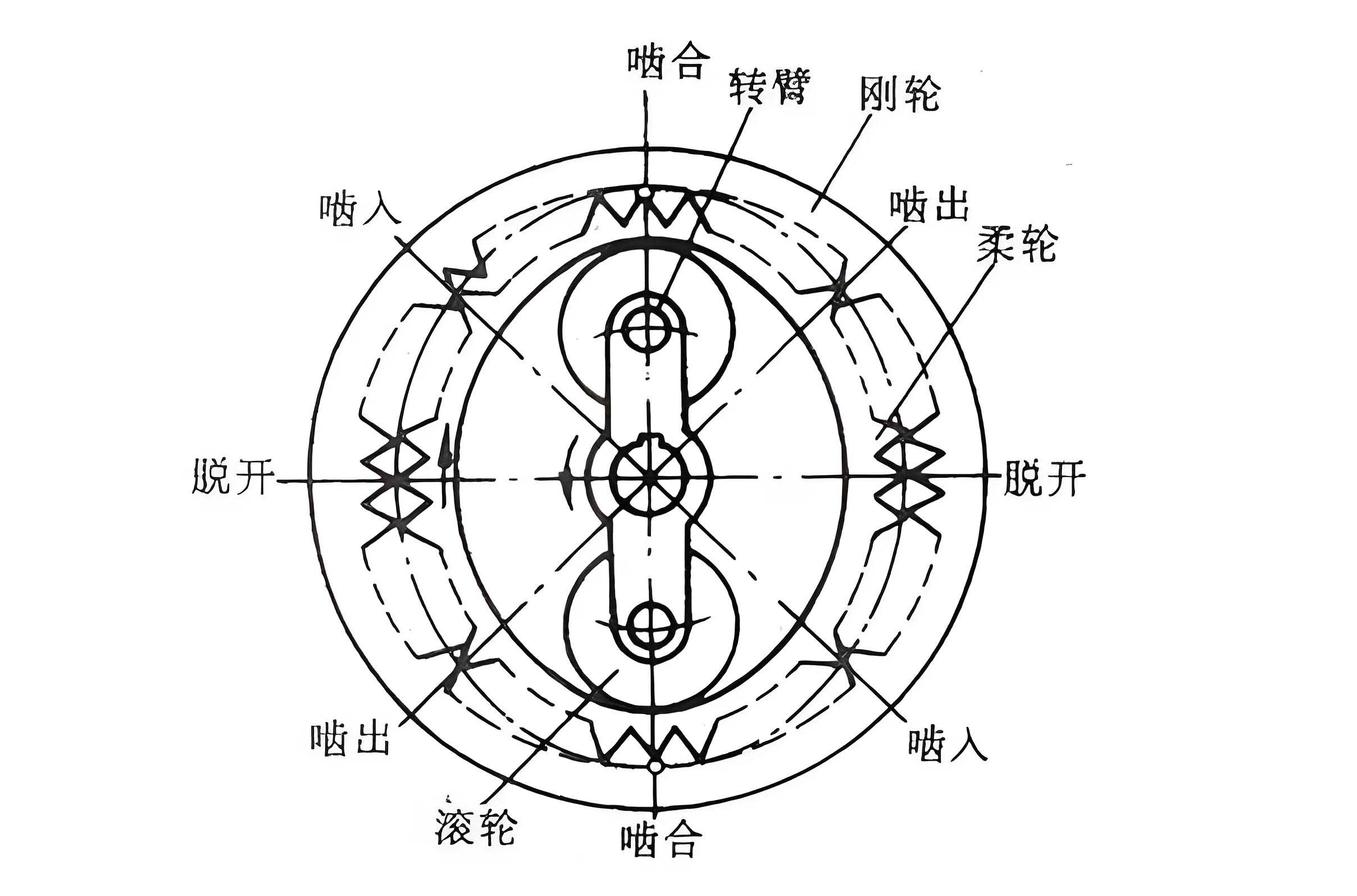
The core components of a strain wave gear include a rigid circular spline, a flexible spline, and a wave generator. The wave generator, typically an elliptical cam, is inserted into the flexible spline, deforming it into an elliptical shape. The flexible spline has slightly fewer teeth (e.g., two teeth fewer for a wave-two configuration) than the rigid circular spline. As the wave generator rotates, the points of engagement between the two splines move, causing a slow relative rotation between the flexible and rigid splines. The kinematic reduction ratio is given by:
$$ i = -\frac{N_f}{N_r – N_f} $$
where $N_f$ is the number of teeth on the flexible spline and $N_r$ is the number of teeth on the rigid circular spline. The negative sign indicates the opposite direction of rotation. The essence of torque transmission in a strain wave gear lies in this moving contact zone, where multiple tooth pairs are simultaneously engaged. However, the stiffness contributed by each tooth pair is not uniform, as the flexible spline undergoes continuous bending and membrane deformation.
Theoretical Foundation of Meshing Stiffness
The meshing stiffness for a single tooth pair, in its most general form, is defined as the ratio of the normal contact force to the total elastic deformation along the line of action. This can be expressed as:
$$ k_n = \frac{F_n}{u_n} $$
where $k_n$ is the single-tooth-pair mesh stiffness, $F_n$ is the normal contact force at the tooth interface, and $u_n$ is the comprehensive elastic deformation in the direction of $F_n$.
For a strain wave gear, the deformation $u_n$ is a composite of several elastic effects:
$$ u_n = u_H + u_b + u_c + u_{sh} + \ldots $$
Here, $u_H$ represents the local Hertzian contact deformation at the tooth flank, $u_b$ is the bending deflection of the tooth itself, $u_c$ accounts for the shear deformation, and $u_{sh}$ signifies the contribution from the deformation of the flexible spline’s cup/shell structure. The last term is particularly significant in strain wave gearing, as the thin-walled cup deforms globally under the action of the wave generator, altering the local contact conditions and effective tooth compliance. This coupling between global shell deformation and local tooth contact is a distinctive feature of strain wave gear stiffness analysis.
Since multiple tooth pairs are engaged simultaneously within the moving wave, they act as parallel springs. The total, or composite, mesh stiffness $K_m$ at any instantaneous position of the wave generator is the sum of the stiffnesses of all $P$ actively engaged tooth pairs:
$$ K_m = \sum_{i=1}^{P} k_{n_i} $$
Previous researchers have attempted to derive analytical expressions for strain wave gear stiffness by simplifying the tooth profile. For instance, approximating the involute profile with a trapezoidal shape and applying Castigliano’s theorem under a load applied at the tooth tip yields a single-tooth stiffness coefficient $K_L$ for the flexible spline:
$$ K_L = \frac{F}{f} = \frac{5Eb}{C_I \cos^2\alpha + C_{II} \sin^2\alpha} $$
where $E$ is the modulus of elasticity, $b$ is the face width, $\alpha$ is the operating pressure angle, and $C_I$, $C_{II}$ are coefficients dependent on the tooth geometry parameters. While insightful, such analytical models often rely on significant simplifications and may not fully capture the complex, load-dependent contact and the intricate coupling with the flexible cup’s deformation. This gap is where the finite element method proves invaluable.
Finite Element Modeling Strategy
To perform a detailed finite element analysis of meshing stiffness, I began by constructing a precise three-dimensional model of a representative strain wave gear set. The key geometric parameters for the flexible spline are summarized in Table 1. These parameters were used to generate accurate involute tooth profiles, which were then imported into solid modeling software to create the detailed geometry of the flexible spline, rigid spline, and an elliptical wave generator.
| Parameter | Symbol | Value | Unit |
|---|---|---|---|
| Diametral Pitch | $P_d$ | 0.3175 | mm⁻¹ |
| Pressure Angle | $\alpha$ | 30 | ° |
| Number of Teeth (Flexible/Rigid) | $N_f$ / $N_r$ | 200 / 202 | – |
| Face Width | $b$ | 11 | mm |
| Cup Inner Diameter | $d_{ci}$ | 61.3 | mm |
Given the wave-two configuration, two diametrically opposed engagement zones exist. Modeling the entire 360-degree assembly with full tooth count is computationally prohibitive. Therefore, based on established contact zone estimation methods, I extracted a sector model containing a sufficient number of tooth pairs from both engagement zones to accurately represent the load-sharing behavior without sacrificing result fidelity. The final assembly included the flexible spline sector, the corresponding rigid spline sector, and the elliptical wave generator. Key small features like fillets and chamfers were suppressed to improve mesh quality without significantly affecting the global stiffness results.
The model was then discretized using a high-order 3D solid element (SOLID185 in the ANSYS environment). A critical step for meshing the flexible spline was to partition the cup body from the tooth ring. This allowed me to apply a finely meshed hexahedral grid to the critical contact regions of the teeth while using a coarser, more efficient mesh for the cup body. The nodes at the interface between the tooth ring and the cup body were merged to ensure perfect connectivity. The material was defined as 40CrNiMoA alloy steel with standard properties, as listed in Table 2.
| Property | Symbol | Value | Unit |
|---|---|---|---|
| Young’s Modulus | $E$ | 2.06 × 10⁵ | MPa |
| Poisson’s Ratio | $\nu$ | 0.3 | – |
| Density | $\rho$ | 7850 | kg/m³ |
Three distinct contact pairs were established: 1) between the elliptical wave generator outer surface and the flexible spline inner bore, 2) between the tooth flanks of the flexible spline and the rigid spline in the first engagement zone, and 3) the corresponding contact in the second zone. Surface-to-surface contact elements (CONTA174 and TARGE170) were used with a standard augmented Lagrange formulation. Boundary conditions were applied to simulate realistic operation: the inner bore of the wave generator and the outer cylindrical surface of the rigid spline were fixed in all degrees of freedom. The output end (cup bottom) of the flexible spline was constrained only in the axial direction, allowing radial and circumferential deformation.
The loading sequence was designed in three steps to ensure robust convergence and simulate the gradual engagement under load:
- Step 1: Establish initial contact with zero load to define the contact status.
- Step 2: Apply a minimal torque (0.1 N·m) to eliminate initial clearances and seat the contacts without causing large deformations.
- Step 3: Apply the full rated output torque of 27 N·m to the flexible spline’s output end, simulating the operating condition.
This multi-step approach mimics the run-in process and prevents numerical instability caused by sudden load application on a free-floating system.
Extraction and Processing of Stiffness Data
Upon solving the nonlinear finite element model, the post-processing phase focused on extracting data relevant to meshing stiffness. The first observation from the stress results confirmed the unique loading state of a strain wave gear. The flexible spline exhibited high stresses from both the global bending induced by the wave generator and the local contact from the gear teeth, while the rigid spline showed stress primarily from tooth contact.
The core of the stiffness calculation lies in determining $F_n$ and $u_n$ for each engaged tooth. I identified the contact elements near the tooth tip where engagement typically initiates in a strain wave gear. For the nodes of these elements, I extracted the reaction force components in the radial and circumferential (tangential) directions in a cylindrical coordinate system. These components were then vectorially summed and projected onto the local tooth surface normal direction to obtain the normal force $F_n$. Similarly, the nodal displacement components were combined and projected to find the normal approach $u_n$ between the contacting tooth surfaces. This process was repeated for all engaged tooth pairs, sequenced from the initial point of engagement to the point of disengagement along one wave. A subset of the processed data is presented in Table 3, where $i$ denotes the sequential position of a tooth pair within the engagement zone.
| Contact Position $i$ | Normal Force per Unit Width $F$ (N/mm) | Normal Displacement $u$ (mm) |
|---|---|---|
| 1 | 0.41 | 6.25E-03 |
| 5 | 13.12 | 4.90E-03 |
| 10 | 33.00 | 3.08E-02 |
| 15 | 9.95 | 6.52E-02 |
| 20 | 0.29 | 1.08E-01 |
The behavior of a single flexible spline tooth as it moves through the entire engagement cycle can be inferred from this static “snapshot” of the multi-tooth contact field. Conceptually, tooth #1 in the static analysis represents a tooth just entering the zone, while tooth #20 represents a tooth about to exit. The data for all teeth in between represent the states a single tooth would pass through. Therefore, the curve of $k_n$ versus position $i$ effectively represents the single-tooth stiffness variation over its meshing cycle. The single-tooth stiffness was calculated for each position using $k_n = F / u$, and the resulting curve is plotted conceptually in Figure 1. The stiffness rises sharply upon engagement as the tooth tip makes contact, peaks near the middle of the engagement zone where contact is more favorable, and then decreases gradually during exit due to the accumulating flexible spline membrane strain, which increases the effective compliance $u_n$ even as the load $F$ decreases.
$$ k_{n}(i) = \frac{F(i)}{u(i)} $$
The composite mesh stiffness $K_m$ at the specific wave generator position captured by the static analysis is simply the sum of all individual $k_n(i)$ values for the engaged teeth (i=1 to P, where P=20 in this model):
$$ K_m = \sum_{i=1}^{20} k_{n}(i) $$
To visualize how $K_m$ would vary as the wave generator rotates and the engagement zone moves, I applied a signal superposition principle. The single-tooth stiffness curve $k_n(i)$ is treated as a periodic stiffness function for one tooth. The total stiffness is the sum of these identical but phase-shifted functions for all teeth in contact. By shifting the $k_n(i)$ curve and summing over the phase-shifted copies, I reconstructed the time-varying composite mesh stiffness $K_m(\theta)$, where $\theta$ is the wave generator angle. The result, shown conceptually in Figure 2, is remarkably flat. This demonstrates a key advantage of the strain wave gear: the large number of simultaneously engaged tooth pairs and the continuous transfer of load between them smooths out the stiffness fluctuations that are prominent in conventional spur gears, leading to inherently smoother torque transmission and lower vibration excitation from stiffness variation.
The peak single-tooth mesh stiffness from my finite element analysis was approximately $4.58 \times 10^3$ N/mm². The corresponding composite mesh stiffness $K_m$ was calculated to be about $2.13 \times 10^4$ N/mm². It is insightful to compare this with the analytical result from the simplified trapezoidal tooth model cited earlier, which predicted a range of $5.8$ to $7.8 \times 10^3$ N/mm². My finite element result for the peak single-tooth stiffness falls within the lower end of this analytical range. The discrepancy can be attributed to the more realistic modeling in the finite element analysis, which includes the coupling with the compliant cup, accurate involute geometry, and distributed contact, all of which contribute to greater overall compliance (lower stiffness) than the highly simplified analytical beam model of an isolated tooth.
| Stiffness Type | Method | Value | Unit |
|---|---|---|---|
| Peak Single-Tooth Stiffness $k_{n}^{max}$ | Finite Element Analysis (This Work) | ~4.58 × 10³ | N/mm² |
| Peak Single-Tooth Stiffness $K_L$ | Analytical (Trapezoidal Model) | 5.8 – 7.8 × 10³ | N/mm² |
| Composite Mesh Stiffness $K_m$ | Finite Element Analysis (This Work) | ~2.13 × 10⁴ | N/mm² |
Discussion and Implications for Strain Wave Gear Dynamics
The methodology I have presented, while powerful, incorporates several assumptions and potential sources of error inherent to the finite element method and the modeling choices. First, the geometric simplification (removing small fillets) can slightly affect local stress concentrations but has a negligible impact on global stiffness calculations. Second, the mesh density, particularly in the contact region, must be sufficiently refined to capture the pressure distribution and deformation accurately; a convergence study would be the next step to quantify this error. Third, the boundary conditions and load application aim to replicate a static, quasi-steady state. In a dynamic scenario with inertial effects and variable input speeds, the load distribution and hence the effective stiffness could vary. Finally, the material was modeled as linear elastic. For very high load conditions or certain materials, nonlinearities from plasticity or hyperelasticity might need consideration, though for standard operating regimes of a strain wave gear, linear elasticity is a valid assumption.
The primary outcome of this analysis is a validated, high-fidelity numerical method for determining the meshing stiffness of a strain wave gear. The resulting stiffness curves—both the varying single-tooth stiffness and the nearly constant composite stiffness—are direct inputs for building lumped-parameter or finite element-based dynamic models of strain wave gear drives. By incorporating this accurate stiffness profile, such models can more reliably predict:
- Torsional Vibration: The composite stiffness $K_m$ acts as a torsional spring in the power path. Its magnitude and any minor fluctuations directly influence the system’s natural frequencies and resonant behavior.
- Transmission Error: Elastic deformations under load cause a deviation from ideal kinematic motion, known as transmission error. The mesh stiffness is a primary determinant of this error, which is a key excitation source for noise and vibration.
- Load Distribution: Understanding how stiffness varies across the engagement zone helps in assessing and optimizing the load sharing between tooth pairs, which is crucial for predicting fatigue life and wear patterns in the strain wave gear.
Furthermore, this finite element-based approach is highly versatile. It can be extended to investigate the effects of key design parameters—such as flexible spline cup thickness, tooth profile modifications, or wave generator shape—on the meshing stiffness and, consequently, on the dynamic performance. It can also be used to study the impact of manufacturing errors or assembly misalignments by introducing corresponding geometric imperfections into the model.
Conclusion
In this comprehensive analysis, I have successfully applied the finite element method to analyze the meshing stiffness of a strain wave gear, a critical parameter governing its dynamic behavior. By constructing a detailed 3D model and performing a nonlinear static contact analysis under rated load, I extracted the normal contact forces and deformations for all simultaneously engaged tooth pairs. From this data, I derived both the single-tooth meshing stiffness variation over a complete engagement cycle and the composite mesh stiffness for the system.
The results highlight the complex interaction within a strain wave gear: the single-tooth stiffness undergoes significant variation, characterized by a sharp rise, a peak, and a gradual decline during disengagement. However, the summation of stiffnesses from the many tooth pairs in parallel produces a composite mesh stiffness that is remarkably constant. This flat stiffness characteristic is a fundamental reason for the smooth operation and low vibration levels associated with high-quality strain wave gear drives. The calculated stiffness values provide quantitative data that aligns reasonably with simplified analytical models while offering greater realism and insight into the coupled tooth-cup deformation.
This finite element methodology establishes a robust foundation for the dynamic analysis of strain wave gearing systems. The accurate meshing stiffness data it generates is essential for developing predictive models of torsional vibration, transmission error, and dynamic response, ultimately enabling the design of more precise, reliable, and quiet strain wave gear drives for advanced robotic and mechatronic applications. The ability to virtually probe and optimize this key parameter before physical prototyping represents a significant advantage in the engineering of these sophisticated mechanical components.