
In modern mechanical design, noise reduction has become a critical factor, especially in transmission systems such as screw gears. These gears, which transmit motion and power between non-parallel and non-intersecting shafts, are widely used in applications like automotive window regulators, machine tools, and lifting equipment due to their compact structure, high transmission ratio, and smooth operation. However, noise generated during operation can lead to discomfort and fatigue, making it essential to address acoustic issues. Noise is primarily characterized by sound intensity and frequency, with intensity directly related to the amplitude of vibration sources. Among the causes of gear noise, design accounts for approximately 35%, highlighting the importance of optimization in this area. While previous studies have explored parameter optimization, experimental testing, and simulation techniques for gear noise reduction, limited research has quantified the application of finite element methods specifically for screw gears. This article presents a comprehensive investigation using finite element analysis (FEA) to study noise reduction in screw gears, validating the approach through theoretical calculations and experimental tests.
The core of this research focuses on screw gears, also known as worm and gear sets, which are pivotal in many mechanical systems. To reduce noise, it is crucial to analyze parameters such as frequency and amplitude during transmission. Finite element methods offer a robust tool for such analyses, enabling transient dynamics simulations that capture the behavior of screw gears under various conditions. This study leverages ANSYS WORKBENCH for transient structural analysis, comparing results with theoretical formulas and experimental data to ensure reliability. The findings demonstrate that FEA can effectively predict frequencies and amplitudes related to noise, thereby guiding parametric design optimizations for quieter screw gears. Throughout this discussion, the term “screw gears” will be emphasized to underscore their significance in transmission systems and noise control efforts.
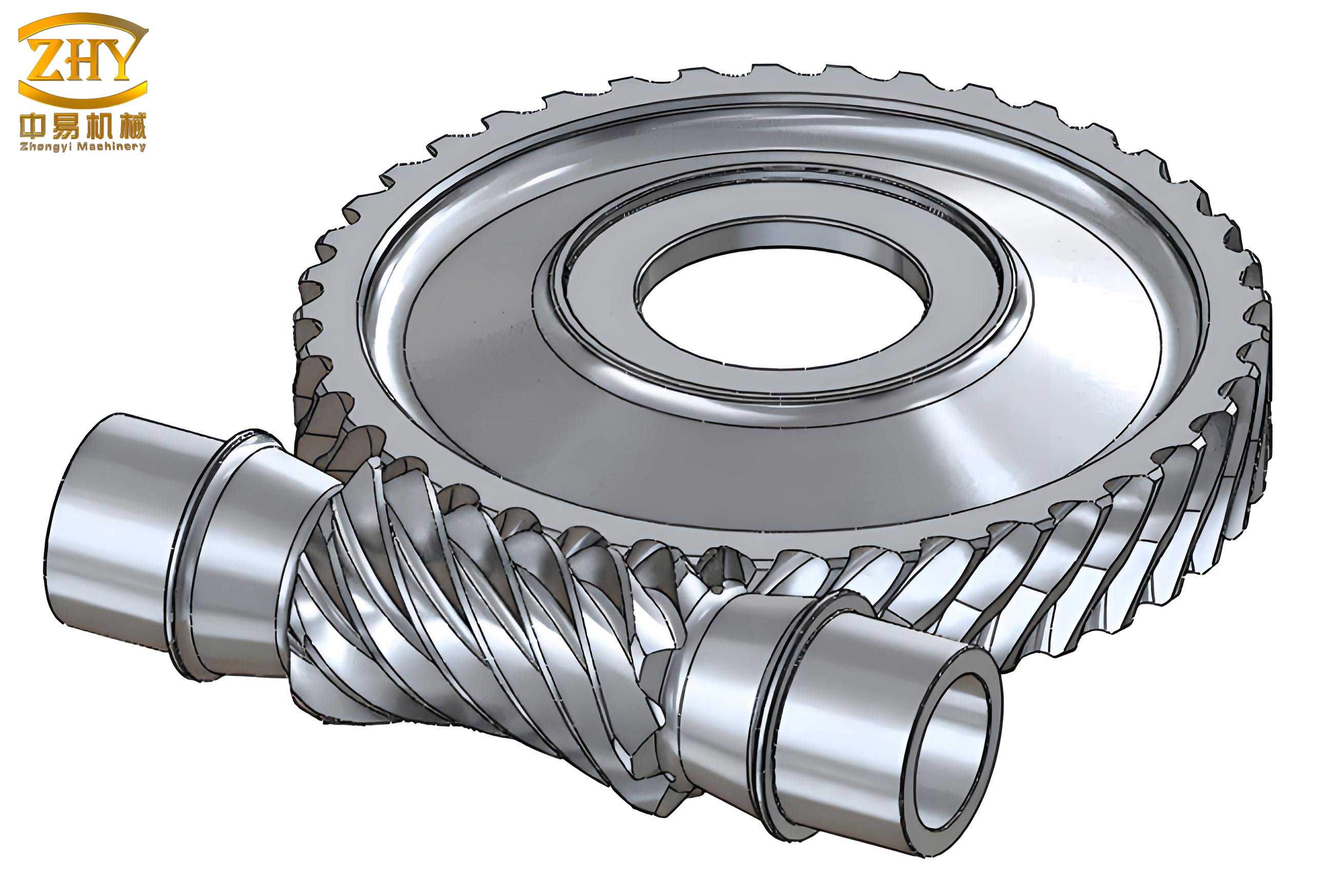
To establish a foundation, theoretical calculations are performed for screw gears based on standard mechanical formulas. The normal force on the worm, a key parameter in transmission dynamics, is derived from the following equation:
$$F_n = \frac{F_{x1}}{\cos \gamma \cos \alpha_n} \approx -\frac{F_{t2}}{\cos \gamma \cos \alpha_x} = -\frac{2000 T_2}{d_2 \cos \gamma \cos \alpha_x}$$
where \(F_n\) is the normal force (N), \(F_{x1}\) is the axial force on the worm (N), \(F_{t2}\) is the circumferential force on the gear (N), \(d_2\) is the pitch diameter of the gear (mm), and \(T_2\) is the nominal torque on the gear (N·m). The relationship between normal pressure angle \(\alpha_n\) and transverse pressure angle \(\alpha_x\) is given by:
$$\tan \alpha_n = \tan \alpha_x \cos \gamma$$
with \(\gamma\) representing the lead angle. These formulas allow for the computation of forces in screw gears, which are later compared with FEA results to validate the simulation approach.
For this study, two distinct screw gear models are considered, with design parameters summarized in Table 1. These parameters include the number of worm threads, gear teeth, normal module, pressure angles, lead angles, and pitch diameters. Such parametric variations are essential for exploring noise reduction potentials in screw gears.
| Parameter | Model 1 | Model 2 |
|---|---|---|
| Worm Threads | 1 | 1 |
| Gear Teeth | 70 | 82 |
| Normal Module (mn, mm) | 0.7875 | 0.775 |
| Normal Pressure Angle (αn) | 10.5° | 10° |
| Lead Angle (γ) | 4.3682° (Right) | 3.3299° (Right) |
| Pitch Diameter (d1, d2, mm) | 11.074, 63.184 | 13.343, 63.657 |
Using these parameters and the theoretical formulas, the normal forces for different torque loads are calculated, as shown in Table 2. This table provides a baseline for comparing with FEA results, ensuring that the finite element method accurately captures the mechanical behavior of screw gears.
| Model | Torque (T2, N·m) | Normal Force (Fn, N) |
|---|---|---|
| Model 1 | 3 | -111.29 |
| Model 1 | 5 | -185.48 |
| Model 2 | 3 | 95.88 |
The finite element analysis is conducted using ANSYS WORKBENCH transient structural module to simulate the dynamic response of screw gears under various operating conditions. Four cases are defined based on different models, torque loads, and worm rotational speeds, as detailed in Table 3. These cases allow for a comprehensive evaluation of how design and operational parameters affect noise-related factors in screw gears.
| Case | Model | Torque (T2, N·m) | Worm Speed (RPM) |
|---|---|---|---|
| Case 1 | Model 1 | 3 | 5300 |
| Case 2 | Model 1 | 3 | 4500 |
| Case 3 | Model 1 | 5 | 5300 |
| Case 4 | Model 2 | 3 | 5300 |
Material properties for the screw gears are specified to ensure accurate simulations. The worm is typically made of stainless steel, while the gear is plastic, with properties outlined in Table 4. These material differences influence the contact behavior and vibrational characteristics of screw gears, which are critical for noise analysis.
| Component | Material | Density (kg/m³) | Elastic Modulus (GPa) | Poisson’s Ratio |
|---|---|---|---|---|
| Worm | Stainless Steel | 7750 | 193 | 0.31 |
| Gear | Plastic | 1420 | 2.4 | 0.39 |
The FEA workflow involves several steps: geometry modeling in SolidWorks based on the parameters from Table 1, exporting as .x_t files, importing into ANSYS WORKBENCH, simplifying geometry, setting up material properties, defining contacts and joints, meshing with refinement at contact areas, applying loads and constraints, and solving for transient responses over specified time intervals. The torque load is applied to the gear’s inner wall, while rotational motion is imposed on the worm’s inner wall, simulating two complete cycles of the worm to capture periodic behavior. This process ensures that the dynamic interactions in screw gears are accurately represented.
Results from the FEA include von-Mises stress distributions and reaction force curves. The stress cloud diagrams reveal that peak stresses occur at contact points and gear tooth roots, but remain within acceptable limits, indicating that structural integrity is maintained for all screw gear designs. More importantly, the reaction force curves on the worm provide insights into noise-related parameters. By analyzing these curves, the average reaction forces can be compared with theoretical values from Table 2. For instance, in Case 1, the FEA-derived average force aligns closely with the calculated -111.29 N, validating the finite element method for screw gears. Additionally, the periodic nature of the force curves allows for frequency estimation using the formula:
$$f = \frac{N}{t}$$
where \(f\) is the frequency (Hz), \(N\) is the number of peaks in the curve, and \(t\) is the total simulation time. The computed frequencies for each case are summarized in Table 5, showing variations due to load and speed changes in screw gears.
| Case | Frequency (Hz) |
|---|---|
| Case 1 | 1819.88 |
| Case 2 | 1762.48 |
| Case 3 | 2119.95 |
| Case 4 | 1813.73 |
The amplitude of the reaction force curves is another critical factor, as it correlates with sound intensity in screw gears. Higher amplitudes indicate greater vibrational energy, leading to increased noise. From the curves, Case 2 exhibits the smallest amplitude, suggesting it may produce the lowest noise among the designs. This highlights how finite element analysis can guide parametric optimizations for noise reduction in screw gears by comparing amplitudes across different configurations.
To further validate the FEA results, experimental tests are conducted on physical screw gear samples matching the simulation parameters. The testing setup involves a B&K Pulse 3560-B system and a power analyzer to measure vibrational responses. The screw gear assembly is operated under conditions corresponding to the FEA cases, with loads applied via weights and rotational speeds controlled. Acceleration signals are captured and processed using Fast Fourier Transform (FFT) to obtain frequency spectra. The experimental frequencies, listed in Table 6, show strong agreement with the FEA-computed values from Table 5. For example, in Case 1, the tested frequency is 1782 Hz, close to the simulated 1819.88 Hz, while trends such as increased frequency with higher load (e.g., Case 3) are consistently observed. This correlation reinforces the reliability of finite element methods for noise analysis in screw gears.
| Case | Frequency (Hz) |
|---|---|
| Case 1 | 1782 |
| Case 2 | 1710 |
| Case 3 | 2082 |
The experimental results also provide insights into the resonance behavior of screw gears. Peaks in the acceleration spectra correspond to structural resonant frequencies, which are influenced by design parameters. By comparing these with FEA predictions, designers can identify optimal configurations for minimizing noise in screw gears. The close match between simulation and experiment demonstrates that finite element analysis serves as an effective tool for pre-testing and optimizing screw gear designs, reducing development time and costs.
In conclusion, this study underscores the efficacy of finite element methods in noise reduction for screw gears. Key findings indicate that both worm rotational speed and load significantly impact the structural frequency, with higher loads leading to increased frequencies due to enhanced contact stiffness. Different screw gear models also exhibit varying noise characteristics, as evidenced by amplitude differences in reaction force curves. The validation through theoretical calculations and experimental tests confirms that FEA can reliably predict frequencies and amplitudes, providing a quantitative basis for parametric optimization. By leveraging transient analysis in ANSYS WORKBENCH, engineers can assess the acoustic performance of screw gears early in the design phase, enabling targeted modifications to reduce noise. Future work could explore advanced material models, nonlinear contact behaviors, and multi-physics simulations to further enhance the accuracy of noise predictions for screw gears. Ultimately, integrating finite element analysis into the design process offers a proactive approach to achieving quieter and more efficient screw gear transmissions, meeting the growing demands for noise control in mechanical systems.
To elaborate on the parametric design aspects, screw gears can be optimized by adjusting geometric parameters such as module, pressure angle, and lead angle. For instance, reducing the normal module might decrease inertial forces, while modifying pressure angles could alter contact patterns and stress distributions. Finite element analysis facilitates these explorations by allowing rapid evaluation of multiple design variants. Equations governing screw gear dynamics, such as the normal force formula mentioned earlier, can be incorporated into optimization algorithms to minimize noise indices. Additionally, the use of response surface methodology or genetic algorithms in conjunction with FEA could further streamline the design process for low-noise screw gears.
Another consideration is the role of damping in screw gears, which affects vibration attenuation and noise emission. Materials with higher damping coefficients, such as certain plastics or composites, may be beneficial for the gear component. FEA can simulate damping effects by including Rayleigh damping parameters in transient analyses, providing insights into how material selection influences noise in screw gears. This aligns with the broader goal of holistic design optimization, where multiple factors—geometric, material, and operational—are tuned to achieve acoustic comfort.
Moreover, the transient analysis approach highlighted in this study captures time-dependent behaviors that are crucial for noise assessment in screw gears. Unlike static analyses, transient simulations account for inertial effects, impact forces during meshing, and dynamic responses to varying loads. This is particularly important for screw gears used in applications like automotive window regulators, where operational conditions change rapidly. By analyzing reaction force curves over time, designers can identify transient peaks that contribute to noise spikes, enabling mitigative measures such as profile modifications or preloading adjustments.
In terms of computational efficiency, modern FEA software like ANSYS WORKBENCH offers parallel processing and cloud computing capabilities, making it feasible to conduct extensive parametric studies on screw gears within reasonable timeframes. This accelerates the iterative design process, allowing for rapid prototyping and validation. As computational power continues to grow, real-time simulations of screw gear noise may become possible, further enhancing design agility.
From an industrial perspective, the adoption of finite element methods for screw gear noise reduction aligns with trends toward digital twin technology and virtual testing. By creating accurate digital models of screw gears, manufacturers can predict acoustic performance before physical production, reducing reliance on costly and time-consuming experimental trials. This not only cuts development expenses but also supports sustainability by minimizing material waste. As noise regulations become stricter globally, such simulation-driven approaches will be invaluable for compliance and competitiveness.
Finally, this research contributes to the broader field of mechanical transmission acoustics by demonstrating a validated framework for screw gears. While prior studies have focused on spur or helical gears, screw gears present unique challenges due to their sliding contact and complex geometry. The methodologies described here—combining theoretical formulas, FEA, and experimental validation—provide a template for extending noise reduction efforts to other types of gear systems. By continuing to refine these techniques, the engineering community can advance toward quieter and more reliable machinery, enhancing user experience across diverse applications where screw gears play a vital role.