
In my years of research and practical experience in gear engineering, I have come to appreciate the intricate and fascinating world of spiral gears. Spiral gear drives, specifically involute helical gears with crossed axes, represent a classic form of spatial meshing. While their application in power transmission within general machinery is limited due to relatively lower load-carrying capacity, their role is absolutely pivotal in precision instrument manufacturing. More profoundly, in gear manufacturing processes such as hobbing, shaving, honing, skiving, and grinding, the interaction between the tool and the workpiece essentially constitutes a meshing pair of spiral gears. By leveraging the unique meshing characteristics of spiral gears to analyze problems in these machining processes, we gain numerous insightful and intriguing revelations.
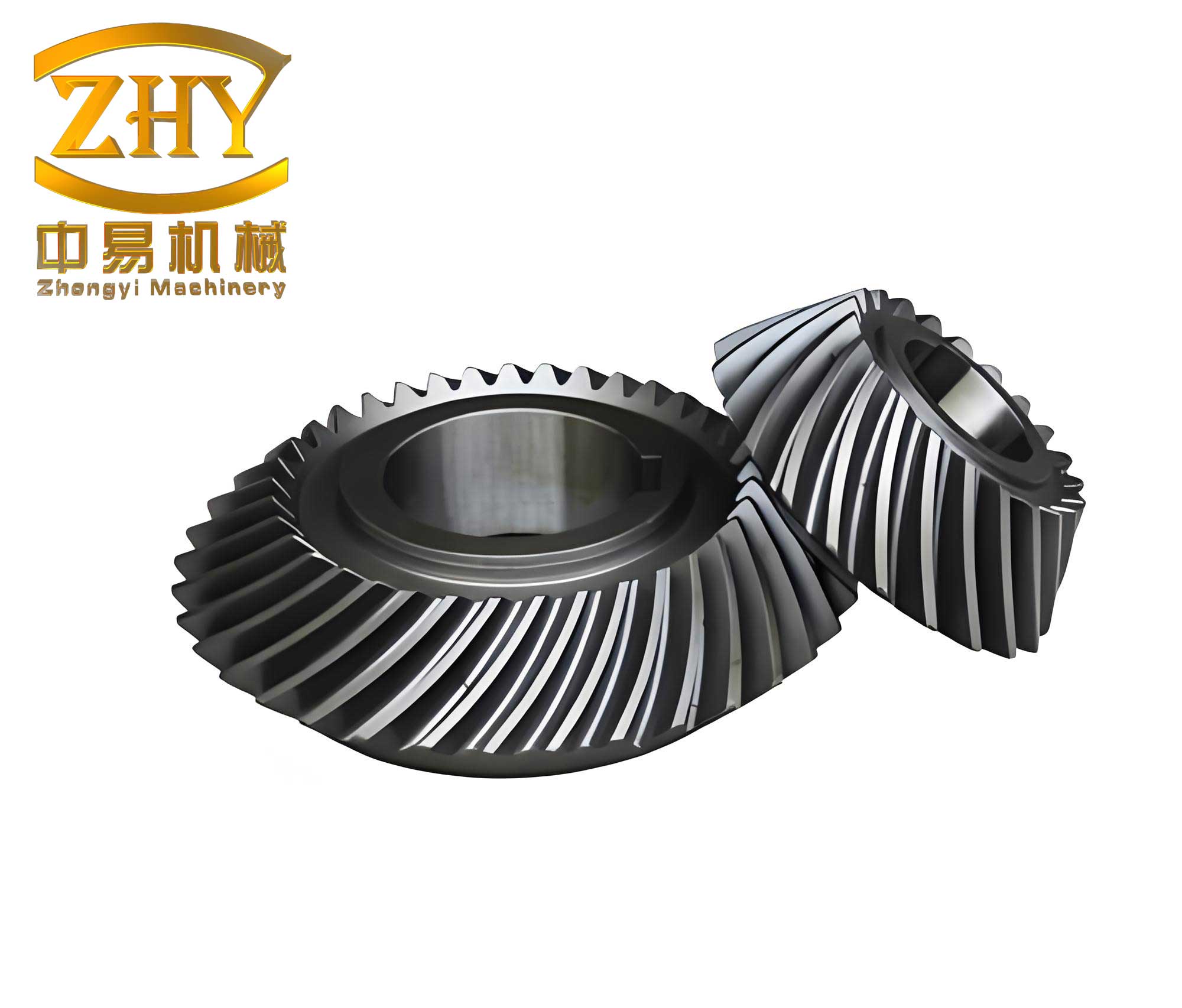
The study of spiral gears opens doors to advanced manufacturing techniques. This article, drawn from my investigations, delves into the core principles, mathematical relationships, and practical applications of spiral gear meshing, with a particular focus on their indispensable role in gear fabrication.
Basic Meshing Characteristics of Spiral Gears
A fundamental theorem for any pair of correctly meshing involute gears, whether with parallel or crossed axes, is the equality of their normal base pitch, normal pressure angle, and normal module. For a pair of involute spiral gears in constant-ratio conjugate motion, the speed ratio is determined solely by their base circle radii and helical leads. It is independent of the center distance and the shaft angle. This is a critical characteristic: in a spatial drive using spiral gears, errors in the center distance or the shaft angle do not affect the normal constant-ratio conjugate action between the gear tooth surfaces.
Based on this fundamental feature of involute spiral gear meshing, we can understand that the hobbing process is essentially the conjugation between a pair of spiral gears—the hob and the workpiece. Their relative conjugate motion will still generate the same type of involute tooth surface (with the same base circle and lead) even if the center distance and shaft angle are altered, although the tooth thickness, addendum, and dedendum will change accordingly.
This property leads to significant practical implications. It suggests a novel method for manufacturing profile-shifted gears. Conventional hobbing for profile-shifted gears relies solely on changing the center distance, based on the concept of a rack-and-gear conjugation. If we adopt the correct concept of a pair of conjugate involute spiral gears and manufacture the hob as an involute spiral gear, then profile-shifted gears can be obtained not only by altering the center distance but also by changing the shaft angle—or, more generally, by adjusting both parameters simultaneously. This new method, having two control parameters (center distance and shaft angle) plus control over the workpiece’s outer diameter, allows for simultaneous control over tooth thickness, addendum, and dedendum to better meet requirements for strength and wear resistance.
Furthermore, it proposes a new method for hobbing stub-tooth gears using standard hobs. Most importantly, it leads to the derivation of the “symmetric” backlash-free meshing equation, providing a more accurate solution for the meshing calculations in processes like shaving and skiving.
Mathematical Relationships for Spiral Gear Meshing Calculation
The analysis of spiral gear meshing relies on a set of precise geometric and kinematic relationships. Typically, the known parameters for a spiral gear pair are the normal module $m_n$, normal pressure angle $\alpha_n$, number of teeth $z_1$ and $z_2$, helix angles at the reference cylinder $\beta_1$ and $\beta_2$, and profile shift coefficients $x_1$ and $x_2$.
Fundamental Parameter Calculations
The basic transforming formulas for related parameters are as follows:
| Parameter Name | Symbol | Formula |
|---|---|---|
| Transverse Module | $m_t$ | $m_t = \dfrac{m_n}{\cos \beta}$ |
| Transverse Pressure Angle | $\alpha_t$ | $\tan \alpha_t = \dfrac{\tan \alpha_n}{\cos \beta}$ |
| Reference Radius | $r$ | $r = \dfrac{m_t \cdot z}{2} = \dfrac{m_n \cdot z}{2 \cos \beta}$ |
| Base Circle Radius | $r_b$ | $r_b = r \cdot \cos \alpha_t$ |
| Normal Pitch | $p_n$ | $p_n = \pi m_n$ |
| Normal Base Pitch | $p_{bn}$ | $p_{bn} = p_n \cos \alpha_n = \pi m_n \cos \alpha_n$ |
| Transverse Pitch | $p_t$ | $p_t = \pi m_t = \dfrac{\pi m_n}{\cos \beta}$ |
| Helix Angle at Base Cylinder | $\beta_b$ | $\sin \beta_b = \sin \beta \cdot \cos \alpha_n$ or $\tan \beta_b = \tan \beta \cdot \cos \alpha_t$ |
| Tooth Thickness at Reference Circle | $s$ | $s = \dfrac{\pi m_t}{2} + 2 x m_t \tan \alpha_t$ or $s = \dfrac{\pi m_n}{2 \cos \beta} + 2 x m_n \tan \alpha_n / \cos \beta$ |
| Tooth Thickness at Base Circle | $s_b$ | $s_b = s \dfrac{r_b}{r} + 2 r_b (\text{inv } \alpha_t – \text{inv } \alpha_{t0})$ where $\alpha_{t0}$ is the transverse pressure angle at the reference circle. |
Relationship Between Mesh Angle and Shaft Angle
In spiral gear meshing, the line of action should be the intersection line of the two tangent planes to the base cylinders, $T_1$ and $T_2$. Let $\Sigma$ be the shaft angle. The angle between the line of action and the common perpendicular to the axes is related to the base helix angles $\beta_{b1}$ and $\beta_{b2}$. For gears with opposite hand of helix (one left-hand, one right-hand), the transverse operating pressure angles $\alpha_{t1}’$ and $\alpha_{t2}’$ on each gear relate to the shaft angle $\Sigma$ by the following meshing angle equation:
$$ \cos \alpha_{t1}’ = \frac{\cos \beta_{b1} \cos (\Sigma – \beta_{b2})}{\cos \beta_{b2}} $$
$$ \cos \alpha_{t2}’ = \frac{\cos \beta_{b2} \cos (\Sigma – \beta_{b1})}{\cos \beta_{b1}} $$
The normal operating pressure angle $\alpha_n’$ is then given by:
$$ \tan \alpha_n’ = \tan \alpha_{t1}’ \cos \beta_{1}’ = \tan \alpha_{t2}’ \cos \beta_{2}’ $$
where $\beta_{1}’$ and $\beta_{2}’$ are the operating pitch cylinder helix angles. If the helix hands are the same, the equation modifies accordingly. A key insight from this equation is that if the shaft angle $\Sigma$ remains constant, the operating pressure angles do not change, and thus the operating pitch radii remain fixed. Changing the center distance alone does not alter the operating pressure angles or pitch radii; it only shifts the relative positions of the pitch cylinders. Therefore, in spiral gear meshing, the pitch cylinders are not necessarily in contact; they can be separate or intersecting—a concept distinctly different from that of profile-shifted spur gears.
Backlash-Free Meshing Equation for Spiral Gears
For generative gear cutting or design based on zero-backlash, establishing the backlash-free meshing equation—the relationship between center distance and shaft angle—is crucial. The center distance $a$ is given by:
$$ a = \sqrt{r_{b1}^2 + r_{b2}^2 + 2 r_{b1} r_{b2} \cos \Sigma_b} $$
where $\Sigma_b$ is the angle between the base cylinder axes projections, related to $\beta_{b1}$ and $\beta_{b2}$. The total length of the path of contact $g_\alpha$ is:
$$ g_\alpha = \sqrt{ r_{a1}^2 – r_{b1}^2 } + \sqrt{ r_{a2}^2 – r_{b2}^2 } – a \sin \alpha_{t}’ $$
Considering the geometric conditions for zero backlash on both tooth flanks, a comprehensive equation can be derived. After substantial trigonometric manipulation, the general backlash-free meshing condition for spiral gears, accounting for profile shift, is obtained:
$$ \pi m_n \cos \alpha_n = \left[ s_{b1} + s_{b2} – 2 r_{b1} (\text{inv } \alpha_{t1} – \text{inv } \alpha_{t1}’) – 2 r_{b2} (\text{inv } \alpha_{t2} – \text{inv } \alpha_{t2}’) \right] \cos \beta_{b1} \cos \beta_{b2} \cos \Sigma_b $$
This equation involves known parameters ($m_n$, $\alpha_n$, $z_1$, $z_2$, $\beta_1$, $\beta_2$, $x_1$, $x_2$) and the unknowns $\alpha_{t1}’$, $\alpha_{t2}’$, and $\Sigma_b$ (which is a function of the shaft angle $\Sigma$). It is a fundamental relationship for solving not only the meshing of profile-shifted spiral gears but also many problems in gear machining and measurement.
Contact Ratio for Spiral Gears
The transverse contact ratio $\epsilon_\alpha$ for spiral gears is calculated from the length of the path of contact in the transverse plane:
$$ \epsilon_\alpha = \frac{g_\alpha}{p_{bt}} = \frac{ \sqrt{ r_{a1}^2 – r_{b1}^2 } + \sqrt{ r_{a2}^2 – r_{b2}^2 } – a \sin \alpha_{t}’ }{ \pi m_t \cos \alpha_t } $$
For a fixed center distance $a$, the contact ratio reaches a maximum when the shaft angle $\Sigma$ satisfies a specific condition related to the operating pitch helix angles. Analysis shows that maximum contact ratio occurs when $\Sigma = \beta_{1}’ + \beta_{2}’$ (for opposite-hand helices). In gear machining, this condition also corresponds to the shortest length of the fillet curve generated.
Length of Contact Lines and Offset of the Line of Action
During meshing, the locus of contact points on the tooth surface forms a spatial curve. The axial length of this contact line $L_c$ is related to the path of contact:
$$ L_c = \frac{g_\alpha}{\sin \beta_b} $$
The offset distance $e$ of the line of action from the common perpendicular (the shortest distance between the axes) is given by:
$$ e = \frac{ r_{b1} \sin \beta_{b2} – r_{b2} \sin \beta_{b1} }{ \sin \Sigma_b } $$
This offset plays a significant role in the alignment and loading conditions in applications like gear shaving.
To illustrate the sensitivity of meshing parameters, consider an example pair of right-hand spiral gears with $m_n=2$, $\alpha_n=20^\circ$, $z_1=20$, $z_2=30$, $\beta_1=15^\circ$, $\beta_2=10^\circ$, $x_1=x_2=0$. The variation of parameters like operating pressure angle, center distance, and contact ratio with changing shaft angle $\Sigma$ is summarized below:
| $\Sigma$ [deg] | $\alpha_{t1}’$ [deg] | $\alpha_{t2}’$ [deg] | $a$ [mm] | $\epsilon_\alpha$ | $e$ [mm] |
|---|---|---|---|---|---|
| 20 | 18.52 | 19.87 | 51.24 | 1.45 | -0.85 |
| 25 | 20.11 | 21.05 | 51.08 | 1.52 | -0.22 |
| 30 | 21.85 | 22.36 | 51.00 | 1.58 | 0.41 |
| 35 | 23.74 | 23.80 | 51.01 | 1.63 | 1.04 |
| 40 | 25.80 | 25.36 | 51.10 | 1.66 | 1.68 |
This table clearly shows how the meshing geometry evolves with the shaft angle, underscoring the flexibility and complexity of spiral gear systems.
“Symmetric” Backlash-Free Meshing and Its Applications
In theory, a pair of spiral gears mates at a point contact, which expands slightly due to wear or elastic deformation. The theoretical line of action is straight and always tangent to both base cylinders. For a backlash-free pair of standard spiral gears installed at their nominal center distance and nominal shaft angle, this line of action passes through the pitch point, which lies on the common perpendicular connecting the two axes. This specific condition is termed “symmetric” meshing. The gear shaving process fundamentally employs this “symmetric” backlash-free meshing configuration.
The “Symmetric” Backlash-Free Meshing Equation
The condition for symmetric meshing is that the offset $e$ of the line of action is zero. From the derivative of the general meshing condition or geometric reasoning, we derive the specific “symmetric” meshing equation:
$$ \frac{s_{b1}}{r_{b1} \cos \beta_{b1}} + \frac{s_{b2}}{r_{b2} \cos \beta_{b2}} = \pi \left( \frac{\tan \alpha_{n1}’}{\cos \beta_{b1}} + \frac{\tan \alpha_{n2}’}{\cos \beta_{b2}} \right) $$
Simultaneously, the relationship between the operating transverse pressure angles and shaft angle for symmetric meshing is:
$$ \tan \alpha_{t1}’ = \tan \alpha_{t2}’ = \frac{\sin \Sigma}{\frac{\cos \beta_{b2}}{\cos \beta_{b1}} + \frac{\cos \beta_{b1}}{\cos \beta_{b2}}} $$
These equations, coupled with the general backlash-free condition, allow for the precise calculation of the operating pressure angles $\alpha_{t1}’$, $\alpha_{t2}’$, and subsequently the shaft angle $\Sigma$ and center distance $a$ for symmetric meshing. They serve as universal formulas for all “symmetric” involute gear pairs, including parallel axes as a special case.
For practical calculation, an approximate method treats the meshing in the normal plane as an equivalent spur gear pair. The equivalent numbers of teeth are $z_{n1} = z_1 / \cos^3 \beta_{b1}$ and $z_{n2} = z_2 / \cos^3 \beta_{b2}$. The normal operating pressure angle $\alpha_n’$ and the equivalent center distance modification coefficient can be found from standard spur gear meshing charts or formulas, and then converted back to the spatial parameters.
Application in Gear Shaving Adjustment
In a shaving process set up for symmetric meshing, if the center distance is altered slightly (e.g., due to a resharpened shaving cutter with a reduced outer diameter) without adjusting the shaft angle, the line of action shifts away from the common perpendicular. This offset generates a significant twisting moment between the cutter and the gear due to cutting forces, adversely affecting the finished gear’s lead accuracy. Therefore, after each resharpening of the shaving cutter, the shaft angle must be readjusted to restore symmetric meshing and ensure high lead precision.
The adjustment calculation is straightforward using the symmetric meshing equations. As an example, consider a shaving cutter with $z_0=53$, $\beta_0=15^\circ$ (right-hand), and a workpiece with $z_1=30$, $\beta_1=10^\circ$ (right-hand), both with $m_n=2$, $\alpha_n=20^\circ$. The nominal shaft angle is $\Sigma_0 = \beta_0 – \beta_1 = 5^\circ$ (for same-hand helices in shaving). After resharpening, the cutter’s addendum is reduced, effectively changing its profile shift coefficient $x_0$. The new symmetric meshing center distance $a’$ and shaft angle $\Sigma’$ can be calculated. The relationship is often tabulated for convenience:
| Cutter Wear/Resharpening $\Delta d_a$ [mm] | Effective Change in $x_0$, $\Delta x_0$ | New Center Distance $a’$ [mm] | New Shaft Angle $\Sigma’$ [deg] |
|---|---|---|---|
| -0.1 | -0.025 | 84.112 | 5.012 |
| -0.2 | -0.050 | 84.098 | 5.024 |
| -0.3 | -0.075 | 84.083 | 5.036 |
| -0.4 | -0.100 | 84.069 | 5.048 |
| -0.5 | -0.125 | 84.054 | 5.060 |
This table guides the machine operator in making precise adjustments to maintain optimal shaving conditions.
Implications for Shaving Cutter Design
The concept of symmetric meshing clarifies several aspects of shaving cutter design. The normal operating pressure angle $\alpha_n’$ for the shaving process can be determined from the equation:
$$ \text{inv } \alpha_n’ = \text{inv } \alpha_n + \frac{2 (x_0 + x_1) \tan \alpha_n}{z_0 + z_1} $$
where $x_0$ includes the initial profile shift and an allowance for regrinding. The distribution of regrinding allowance for a typical shaving cutter is as follows:
| Cutter Structure | Total Allowance per Side $\Delta s$ [mm] | Allowance for Profile $\Delta h_p$ [mm] | Allowance for Lead $\Delta h_l$ [mm] |
|---|---|---|---|
| Ungrooved | 0.15 – 0.20 | 0.10 – 0.15 | 0.05 |
| Grooved | 0.20 – 0.30 | 0.15 – 0.20 | 0.05 – 0.10 |
Furthermore, interference checking is vital. The fillet curve generated by a new shaving cutter is the longest. To avoid undercutting or interference in the subsequent gear mesh, the radius of curvature of the fillet start point on the workpiece $\rho_{F1}$ must be greater than the radius of curvature demanded by the mating gear $\rho_{N2}$ at that point. The condition is:
$$ \rho_{F1} = \sqrt{ a_{12}^2 \sin^2 \alpha_{12}’ + r_{b1}^2 } – \sqrt{ r_{a2}^2 – r_{b2}^2 } > \rho_{N2} $$
where $a_{12}$ and $\alpha_{12}’$ are the center distance and operating pressure angle for the gear pair. Similarly, interference between the shaving cutter and the pre-cut gear tooth (e.g., from hobbing) must be avoided to prevent cutter tooth tip damage. The condition involves comparing the fillet radii generated by the previous cutting tool and the shaving cutter.
In conclusion, the principles governing spiral gear meshing are not merely theoretical curiosities but form the bedrock of critical precision manufacturing processes. From enabling novel methods for generating profile-shifted gears to providing the exact mathematical framework for optimizing gear shaving, the study of spiral gears continues to yield profound practical benefits. My exploration into this domain confirms that a deep understanding of these spatial interactions—embodied in the equations, tables, and concepts discussed—is essential for advancing gear technology and achieving higher levels of precision and efficiency in mechanical systems. The versatility and unique characteristics of spiral gears ensure their enduring relevance in the intricate world of gear design and manufacture.