
The precise and efficient calculation of time-varying mesh stiffness (TVMS) is a cornerstone for evaluating the dynamic performance, vibration characteristics, and durability of gear transmission systems. While substantial research has established reliable methods for cylindrical gears, the analysis of spatial bevel gears, particularly miter gears (equal-tooth, 90-degree shaft angle bevel gears), presents unique challenges due to their complex three-dimensional geometry and spatially varying tooth engagement. Accurate TVMS determination for these components is crucial, given their widespread use in demanding applications like automotive differentials, precision machinery, and aerospace actuators. Traditional approaches, such as the finite element method (FEM), offer high accuracy but are computationally prohibitive for parametric studies or dynamic analyses. Conversely, conventional analytical methods, while fast, often oversimplify the interaction between simultaneously engaged tooth pairs, leading to significant inaccuracies, especially in the double-tooth contact region. This work addresses this critical gap by introducing a novel, high-fidelity analytical model that marries computational efficiency with the accuracy needed for robust miter gear design and analysis.
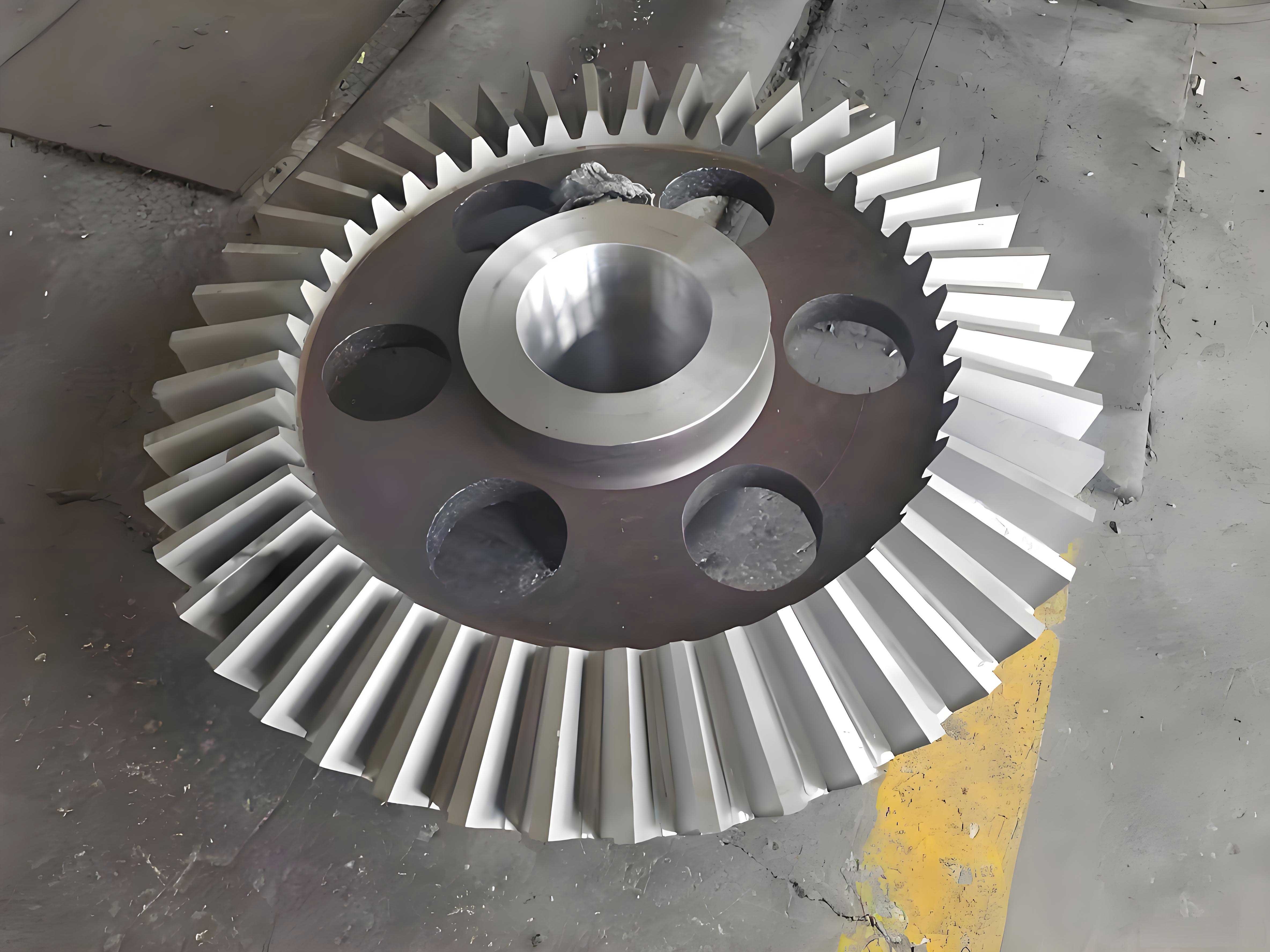
At the heart of the proposed methodology is a slice-based discretization framework. A miter gear pair, with its conical geometry, is decomposed along the face width direction into a finite number of thin, independent slices. Each slice encompasses a segment of the tooth and its corresponding supporting gear body. When the slice width is sufficiently small, the complex geometry of each miter gear slice can be accurately represented on its back-cone development plane. Through the principle of back-cone equivalence, each thin three-dimensional slice is transformed into a two-dimensional spur gear segment with equivalent geometrical properties. Consequently, a spatial miter gear pair is modeled as an assembly of numerous spur gear pairs connected in parallel, each representing a specific location along the face width. This transformation is mathematically expressed by calculating the equivalent gear parameters for the i-th slice. For a gear with tooth count $z$, pitch radius $r$, and pitch angle $\delta$, the equivalent parameters are:
$$ z_{v} = \frac{z}{\cos \delta} $$
$$ r’_{i} = r_i \sin \delta $$
$$ r’_{ai} = r_{ai} \sin \delta_a $$
$$ r’_{fi} = r_{fi} \sin \delta_f $$
where $r_i$, $r_{ai}$, and $r_{fi}$ are the actual pitch, tip, and root radii at the i-th slice location, scaled from the gear’s large end, and $\delta_a$, $\delta_f$ are the tip and root angles. The slice width $d_b$ and the number of slices $n$ are related to the total face width $b$ by $b = n d_b$.
The stiffness of each spur gear slice pair is then computed using a comprehensive energy-based method. The total compliance of a single tooth pair in a slice originates from the elastic deformations of both the driving and driven gear teeth and their supporting bodies, as well as the local contact deformation. For a single-tooth engagement slice, the linear mesh stiffness $k^{d}_{li}$ is given by the summation of compliances:
$$ k^{d}_{li} = \frac{1}{ \frac{1}{k^1_{b}} + \frac{1}{k^1_{s}} + \frac{1}{k^1_{a}} + \frac{1}{k^1_{f}} + \frac{1}{k^2_{b}} + \frac{1}{k^2_{s}} + \frac{1}{k^2_{a}} + \frac{1}{k^2_{f}} + \frac{1}{k_{h}} } $$
Here, $k_b$, $k_s$, $k_a$, $k_f$, and $k_h$ represent the bending, shear, axial compressive, gear body, and Hertzian contact stiffness components, respectively. The superscripts 1 and 2 denote the driver and driven miter gear. The analytical formulas for $k_b$, $k_s$, and $k_a$ are derived from beam theory and integral calculus along the tooth profile. The Hertzian contact stiffness $k_h$ is calculated based on the theory of elastic contact between two cylinders. The gear body stiffness $k_f$, which accounts for the deformation of the gear structure beneath the tooth, is a critical component that is significantly influenced when multiple tooth pairs share the load.
The primary innovation of this model lies in its treatment of the double-tooth engagement phase. In conventional analytical methods, the total double-pair stiffness is simply the sum of two independently calculated single-pair stiffness values. This ignores the coupling effect through the shared gear body—the deformation at the support point of one tooth pair affects the displacement at the support point of the adjacent pair. To accurately capture this coupling, a body stiffness correction factor $\lambda$ is introduced. The linear mesh stiffness for a slice in double-tooth engagement, $k^{s}_{li}$, becomes:
$$ k^{s}_{li} = \sum_{j=1}^{2} \frac{1}{ \frac{1}{k^1_{b_j}} + \frac{1}{k^1_{s_j}} + \frac{1}{k^1_{a_j}} + \frac{1}{\lambda^1_j k^1_{f_j}} + \frac{1}{k^2_{b_j}} + \frac{1}{k^2_{s_j}} + \frac{1}{k^2_{a_j}} + \frac{1}{\lambda^2_j k^2_{f_j}} + \frac{1}{k_{h_j}} } $$
where $j$ indexes the two engaged tooth pairs in the slice. The correction factors $\lambda^1_j$ and $\lambda^2_j$ are determined using a simplified, highly efficient finite element procedure applied to a single slice model. In this procedure, the tooth material is artificially made very stiff to isolate the body-induced deflection. Unit forces are applied at the two potential contact points, and the resulting displacements at both points are calculated. By applying the principle of superposition, the effective body stiffness for each tooth pair in the coupled state ($K_f$) is found and compared to its isolated value ($k_f$). The ratio yields the correction factor: $\lambda = K_f / k_f$. The calculation for a typical slice is summarized below:
| Load Case | Force at Pair 1 ($F_{11}$) | Force at Pair 2 ($F_{21}$) | Displacement at Pair 1 ($\delta_{11}$) | Displacement at Pair 2 ($\delta_{21}$) |
|---|---|---|---|---|
| Case A | 1 N | 0 N | $\delta_{111}$ | $\delta_{211}$ |
| Case B | 0 N | 1 N | $\delta_{121}$ | $\delta_{221}$ |
| Coupled State | 0.5 N | 0.5 N | $\delta_{11}$ | $\delta_{21}$ |
The isolated body stiffness is $k_{f1} = 1 / (\delta_{111} + \delta_{112})$. The load distribution factor is $L_{sf1} = (F_{11}+F_{12}) / (F_{11}+F_{12}+F_{21}+F_{22})$. The coupled body stiffness $K_{f1}$ is derived from superposition, leading to the correction factor:
$$ \lambda_1 = \frac{K_{f1}}{k_{f1}} = \frac{ L_{sf1} (\delta_{111} + \delta_{112}) }{ L_{sf1} (\delta_{111} + \delta_{112}) + (1 – L_{sf1}) (\delta_{211} + \delta_{212}) } $$
This factor, typically less than 1, effectively reduces the contribution of the body stiffness in the double-pair compliance calculation, reflecting the increased flexibility due to load sharing. This process is repeated for all slices, but since the slice FE model is extremely simple (no contact definitions needed), it adds minimal computational overhead while dramatically improving accuracy.
Finally, the linear stiffness $k_{li}$ for each slice is converted to its contribution to the overall torsional mesh stiffness $k_t$ of the miter gear pair:
$$ k_t = \sum_{i=1}^{n} r^2_{b i} \ k_{li} $$
where $r_{b i}$ is the base circle radius at the i-th slice. The total mesh stiffness is the parallel sum of the stiffness contributions from all slices that are in contact at a given meshing position.
Real-world miter gear performance is heavily influenced by assembly errors, primarily shaft angle error ($\theta$) and axial offset error ($\varepsilon$). These errors break the perfect conjugate motion, leading to non-uniform load distribution across the face width. The model elegantly extends to handle these conditions by calculating the effective geometric deviation (or “error”) for each slice. The composite deviation $E_i$ at the pitch point of the i-th slice, combining the effects of both error types, can be expressed as a function of the slice’s position and the instantaneous pressure angle. This geometric deviation is then converted into an equivalent angular displacement error $e_i$ for the slice by dividing by its base radius: $e_i = E_i / r_{bi}$.
Under load, the gear pair will deform to establish contact across multiple slices. The slice with the smallest initial angular error ($e_m$) will contact first and begin to deform. As the driving gear rotates (or under increasing torque), this slice’s elastic angular deflection $\theta_m$ increases. A neighboring slice $k$ will only begin to carry load when the combined deflection and error of the first slice exceed slice $k$’s inherent error: $\theta_m + e_m > e_k$. The load-sharing condition at equilibrium is governed by the force balance between the applied torque $T$ and the sum of torques carried by all loaded slices $Q$:
$$ T = \sum_{i=1}^{Q} H_i \ k_i \ \theta_i $$
where $H_i$ is a contact indicator (1 if in contact, 0 otherwise), $k_i$ is the torsional stiffness of slice $i$, and $\theta_i$ is its net angular deflection. The deflection of any loaded slice relates to the first contacting slice by: $\theta_i = \theta_m + e_m – e_i$. An iterative procedure is used to find the deflection $\theta_m$ that satisfies the torque balance. The effective torsional mesh stiffness under error conditions is then $K = T / \theta_m$. This approach also directly provides the load distribution: the torque carried by slice $i$ is $T_i = k_i \theta_i$.
The proposed model for miter gear stiffness calculation is validated against a detailed 3D nonlinear finite element analysis. The gear parameters used for validation are standard for a miter gear pair. A convergence study on the number of slices confirms that results stabilize above 60 slices, establishing this as the model resolution for subsequent analysis.
| Parameter | Symbol | Value |
|---|---|---|
| Module | $m_n$ | 1.75 mm |
| Number of Teeth (Driver & Driven) | $z_1, z_2$ | 35 |
| Shaft Angle | $\Sigma$ | 90° |
| Face Width | $b$ | 10 mm |
| Pressure Angle | $\alpha$ | 20° |
| Bore Radius | $r_k$ | 15 mm |
| Young’s Modulus | $E$ | 206 GPa |
| Poisson’s Ratio | $\nu$ | 0.3 |
The comparison of TVMS results over one mesh cycle reveals the superiority of the proposed coupled-slice method. The conventional analytical method, which neglects coupling, overestimates the double-tooth mesh stiffness by approximately 40%. In contrast, the proposed method shows excellent agreement with the FEM benchmark, with errors of only about 2% in the double-tooth region and 3% in the single-tooth region. Furthermore, the computational efficiency is remarkable. The coupled-slice method completes the analysis in a fraction of the time required for a full FEM simulation, making it ideal for rapid design iteration and dynamic system simulation.
| Calculation Method | Single-Pair Stiffness Error | Double-Pair Stiffness Error | Typical Computation Time |
|---|---|---|---|
| Proposed Coupled-Slice Method | ~3% | ~2% | ~5 minutes |
| Conventional Analytical Method | ~3% | ~40% | < 1 minute |
| 3D Finite Element Analysis (FEA) | Benchmark | Benchmark | > 24 hours |
The model’s capability to analyze misaligned miter gears is also demonstrated. For an axial offset error of $\varepsilon = 80 \mu m$, the calculated TVMS maintains high accuracy against FEM results. Parametric studies further illustrate the detrimental impact of assembly errors. As either the shaft angle error $\theta$ or the axial offset error $\varepsilon$ increases, the overall mesh stiffness of the miter gear pair decreases. This loss in stiffness directly leads to larger mesh deformations and transmission error, which are primary excitations for vibration and noise, ultimately compromising the gear system’s performance and life.
The model’s output provides deep insight into the internal load sharing. Under ideal conditions, load is symmetrically distributed, with the heel (large end) of the tooth carrying slightly more load during single-pair contact due to its higher local stiffness. However, with a shaft angle error, the initial contact shifts towards the toe (small end). The slice at the toe experiences the largest deflection, and consequently, that region bears the highest load, creating a severe bias. Conversely, with an axial offset error, the bias shifts towards the heel. This analytical prediction of load distribution is critical for identifying potential areas of high stress and premature failure in miter gear applications subject to installation inaccuracies.
In conclusion, this work presents a robust and efficient analytical framework for calculating the time-varying mesh stiffness of straight bevel and miter gears. The key contribution is the synthesis of a high-resolution slice discretization approach with a novel mechanism to account for tooth-pair coupling through gear body flexibility. This method bridges the gap between slow, accurate FEM and fast, inaccurate traditional analytics. It delivers high-fidelity stiffness curves—essential for dynamic modeling—with computational times suitable for design optimization. Furthermore, the model successfully extends to the critical analysis of misaligned gears, providing accurate stiffness evaluation and detailed load distribution data that can inform tolerance design and system alignment procedures. Future enhancements of this model could incorporate the effects of tooth modifications, friction, and lubrication to provide an even more comprehensive tool for the design and analysis of high-performance miter gear transmissions.