
In modern mechanical engineering, spiral bevel gears are widely used in high-speed and heavy-load transmissions due to their smooth operation and high load-carrying capacity. However, traditional design methods, including conventional optimization, often overlook the uncertainties inherent in design parameters, such as fuzziness in boundaries and randomness in operational stresses. These uncertainties can lead to suboptimal or even infeasible designs in practical applications. To address this, I propose a fuzzy optimization design approach that incorporates fuzzy reliability constraints, quantitatively describing the fuzziness and randomness to yield more realistic and efficient outcomes for spiral bevel gears.
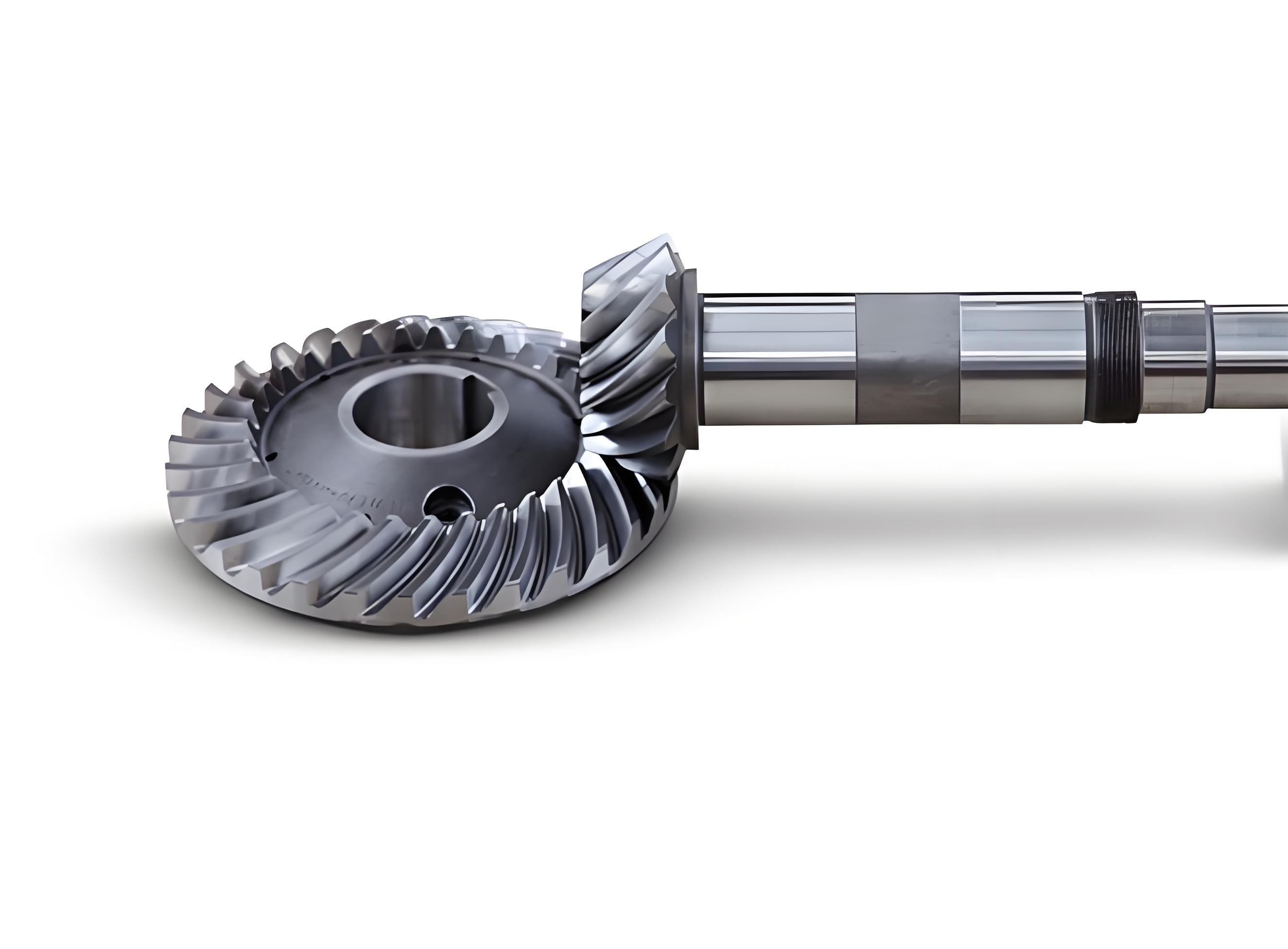
The design of spiral bevel gears involves multiple parameters, including tooth numbers, spiral angle, face width, and module, which exhibit both fuzzy and random characteristics. For instance, the allowable stress limits and manufacturing tolerances are not crisp but have transitional zones. By integrating fuzzy set theory with reliability analysis, I develop a comprehensive fuzzy optimization model that minimizes gear volume while satisfying fuzzy reliability constraints for contact and bending strengths. This approach ensures that the design accounts for real-world variabilities, making spiral bevel gears more robust and economical.
To elaborate, the fuzzy optimization model is built upon several key components. First, the fuzzy reliability is calculated by considering stress distributions as normal and strength as fuzzy, represented by membership functions. The target function aims to minimize the approximate volume of the spiral bevel gears, expressed in terms of design variables. Constraints include fuzzy reliability limits for contact and bending strengths, along with fuzzy boundaries for geometric and variable parameters such as tooth numbers, spiral angle, face width, and module. These constraints reflect the gradual transition from fully allowable to fully unallowable states, captured through linear membership functions.
In the following sections, I detail the mathematical formulation, starting with the fuzzy reliability computation. For contact stress, the mean value $\bar{\sigma}_H$ and standard deviation $S_{\sigma_H}$ are derived from traditional reliability methods, considering factors like torque and gear geometry. Similarly, for bending stress, the mean $\bar{\sigma}_F$ and standard deviation $S_{\sigma_F}$ are computed. The fuzzy reliability $R_i$ for each strength mode (contact, bending for pinion and gear) is then evaluated as an integral over the stress domain weighted by the strength’s membership function $H(x_i)$:
$$ R_i = \int_U f(x_i) H(x_i) \, dx_i \quad (i = H, F1, F2) $$
where $f(x_i)$ is the normal probability density function. This accounts for the fuzziness in strength limits, which is crucial for accurate reliability assessment in spiral bevel gears.
The objective function focuses on minimizing the volume to achieve a lightweight design. The volume of spiral bevel gears is approximated using a cylindrical model based on the mean cone distance and face width. Let $R_m$ be the mean cone distance, $R_e$ the outer cone distance, $d_{a1}$ and $d_{a2}$ the midpoint tip diameters of the pinion and gear, $b$ the face width, and $\beta_m$ the mean spiral angle. The target function $F(x)$ is formulated as:
$$ F(x) = 0.7854 \left( \frac{R_m}{R_e} \right)^2 (d_{a1}^2 + d_{a2}^2) \frac{b}{\cos(0.5 \beta_m)} $$
This expression includes a division by $\cos(0.5 \beta_m)$ to ensure the spiral angle influences the optimization. For spiral bevel gears, reducing volume while maintaining performance is key to efficiency.
The design variables are selected as independent parameters that define the gear geometry. Given a gear ratio $u$, the tooth numbers $z_1$ and $z_2$ are not fully independent; thus, the variable set is:
$$ X = [z_1, \beta_m, b, m_t] $$
where $z_1$ is the pinion tooth number, $\beta_m$ the mean spiral angle, $b$ the face width, and $m_t$ the transverse module. These variables are optimized subject to fuzzy constraints.
The fuzzy constraints encompass strength, geometric, and operational limits. For spiral bevel gears, the strength constraints ensure that the fuzzy reliabilities for contact and bending do not fall below specified levels $\tilde{R}_i$. Additionally, variables have fuzzy boundaries: for example, the pinion tooth number should be at least 12, but this limit is fuzzy with a transition zone. The mean spiral angle typically ranges from 25° to 40°, the module from 1.5 upwards, and the face width between 0.25$R_e$ and 0.3$R_e$, all with fuzzy transitions. The longitudinal contact ratio $\epsilon_\beta$ must exceed 1.25, again in a fuzzy sense. These constraints are represented as:
$$ \tilde{R}_i \leq R_i \quad (i = H, F1, F2) $$
$$ \tilde{x}_k \leq x_k \leq \tilde{x}_k \quad (k = 1, 2) $$
$$ \tilde{x}_j \leq x_j \quad (j = 1, 2) $$
$$ \tilde{H}_0 \leq H_0(x) $$
where tildes denote fuzziness. The fuzzy boundaries are modeled using linear membership functions to capture the gradual acceptance. For instance, a constraint $x \geq \tilde{x}_L$ has a membership function:
$$ H_x = \begin{cases}
1 & \text{if } x \geq x_u \\
\frac{x – x_L}{x_u – x_L} & \text{if } x_L \leq x \leq x_u \\
0 & \text{if } x \leq x_L
\end{cases} $$
Here, $x_L$ and $x_u$ are the lower and upper bounds of the fuzzy transition interval, determined by expansion coefficients—typically 0.80 to 0.95 for upper bounds and 1.05 to 1.30 for lower bounds. This approach quantifies the fuzziness in design parameters for spiral bevel gears.
To solve the fuzzy optimization problem, I apply the optimal level cut-set method, which transforms fuzzy constraints into crisp ones at a specific confidence level $\lambda^*$. According to the decomposition theorem of fuzzy sets, a $\lambda$-level cut set provides a non-fuzzy representation for each constraint. The optimal $\lambda^*$ balances safety and economy, determined via a two-level comprehensive evaluation method. For this study, $\lambda^* = 0.74$ is used, leading to the non-fuzzy optimization model:
$$ \text{Find } X = [z_1, \beta_m, b, m_t] $$
$$ \text{Minimize } F(x) $$
$$ \text{Subject to: } R_i \leq \tilde{R}_i \quad (i = H, F1, F2) $$
$$ x_{Lk} + \lambda^*(x_{uk} – x_{Lk}) \leq x_k \leq x_{uk} – \lambda^*(x_{uk} – x_{Lk}) \quad (k = 1, 2) $$
$$ x_{Lj} + \lambda^*(x_{uj} – x_{Lj}) \leq x_j \quad (j = 1, 2) $$
$$ H_{L0} + \lambda^*(H_{u0} – H_{L0}) \leq H_0(x) \leq H_{u0} – \lambda^*(H_{u0} – H_{L0}) $$
This model handles mixed discrete-continuous variables, such as tooth numbers (discrete) and spiral angles (continuous), using a mixed discrete variable optimization approach. The solution iteratively searches along the relative mixed sub-gradient direction from an initial design point.
To demonstrate the effectiveness of this fuzzy optimization design for spiral bevel gears, I present an example based on a scraper conveyor reducer. The input power is 38 kW, speed is 1440 rpm, gear ratio is 2.5, and design life is 5 years. The initial design serves as the starting point for optimization. The results, comparing conventional and fuzzy reliability-based designs, are summarized in the table below.
| Design Method | z1 | βm (°) | b (mm) | mt (mm) | F(x) (mm³) |
|---|---|---|---|---|---|
| Conventional Design | 12 | 36 | 40 | 7.75 | 1.594 × 10⁶ |
| Fuzzy Reliability Optimization | 12 | 36.75 | 35.12 | 7.15 | 1.272 × 10⁶ |
The optimization results show a significant reduction in volume—approximately 20%—compared to conventional design, highlighting the economic benefits of incorporating fuzzy reliability constraints. The fuzzy optimization method yields a more compact and efficient design for spiral bevel gears, as it accounts for uncertainties in parameters like stress variations and strength limits. This makes it particularly suitable for applications where weight and reliability are critical, such as in aerospace or automotive transmissions.
Further analysis reveals that the fuzzy approach enhances design robustness. For instance, the contact stress $\bar{\sigma}_H$ and bending stress $\bar{\sigma}_F$ are computed with coefficients of variation to model randomness. The contact stress mean is given by:
$$ \bar{\sigma}_H = C_p \sqrt{\frac{2000 T_{\text{max}} l \cdot C_0 \cdot C_m}{C_v d_2^1 b I} \cdot \sqrt[3]{\frac{T_1}{T_{\text{max}} l}}} $$
where $C_p$ is a constant, $T_{\text{max}}$ is maximum torque, and other terms are gear factors. The standard deviation $S_{\sigma_H}$ is derived as $S_{\sigma_H} = C_{\sigma_H} \cdot \bar{\sigma}_H$, with $C_{\sigma_H}$ ranging from 0.02 to 0.09. Similarly, for bending stress:
$$ \bar{\sigma}_{Fi} = \frac{W_t K_0 K_s K_m}{K_v b m_t J_i} \quad (i = 1, 2) $$
and $S_{\sigma_{Fi}} = C_{\sigma_{Fi}} \cdot \bar{\sigma}_{Fi}$, with $C_{\sigma_{Fi}}$ between 0.04 and 0.08. These formulas incorporate statistical variations, ensuring that the fuzzy reliability calculations are grounded in probabilistic models.
The membership functions for strength constraints are defined based on expert knowledge or fuzzy statistics. In this work, I use linear functions for simplicity, but other forms like Gaussian or trapezoidal could be applied depending on the specific behavior of spiral bevel gears. The fuzzy reliability integral becomes:
$$ R_i = \int_{-\infty}^{\infty} \frac{1}{\sqrt{2\pi} S_{\sigma_i}} \exp\left(-\frac{(x – \bar{\sigma}_i)^2}{2 S_{\sigma_i}^2}\right) H(x) \, dx $$
where $H(x)$ might be a linear function representing the degree to which stress $x$ is allowable. This integral evaluates the probability that the gear strength exceeds the fuzzy stress limit, a core aspect of reliability-based design for spiral bevel gears.
To optimize the design variables, I employ numerical methods suitable for mixed discrete problems. The objective function $F(x)$ is minimized subject to the crisp constraints derived from the $\lambda^*$ cut-set. The optimization process involves steps like variable initialization, constraint checking, and iterative refinement. For spiral bevel gears, this ensures that practical manufacturing limits—such as standard module sizes or integer tooth numbers—are respected.
The advantages of this fuzzy optimization design are manifold. First, it provides a systematic way to handle uncertainties that are often ignored in traditional methods. Second, it leads to lighter and more cost-effective gear designs without compromising reliability. Third, it can be extended to other gear types or mechanical components. However, challenges remain, such as determining accurate membership functions and handling complex interactions between variables. Future work could explore nonlinear membership functions or multi-objective optimization for spiral bevel gears.
In conclusion, the fuzzy optimization design with fuzzy reliability constraints offers a robust framework for designing spiral bevel gears. By quantifying fuzziness and randomness, it produces results that align better with real-world conditions, as evidenced by the volume reduction in the case study. This method underscores the importance of integrating advanced mathematical tools into mechanical design to enhance performance and efficiency. For engineers working with spiral bevel gears, adopting such approaches can lead to significant improvements in transmission systems.
Below, I include additional tables and formulas to summarize key aspects of the fuzzy optimization design for spiral bevel gears.
| Parameter | Symbol | Typical Range or Value | Fuzzy Transition |
|---|---|---|---|
| Pinion Tooth Number | z1 | ≥ 12 | Linear membership with bounds [12, 15] |
| Mean Spiral Angle | βm | 25° to 40° | Linear membership with bounds [25°, 40°] |
| Face Width | b | 0.25Re to 0.3Re | Linear membership with expansion coefficients |
| Transverse Module | mt | ≥ 1.5 mm | Linear membership with lower bound fuzzy zone |
| Longitudinal Contact Ratio | εβ | ≥ 1.25 | Fuzzy constraint with transition around 1.25 |
The fuzzy reliability constraints for spiral bevel gears can be expressed in a consolidated form. Let $\tilde{R}_H$ and $\tilde{R}_F$ be the target fuzzy reliabilities for contact and bending, respectively. Then, the constraints are:
$$ R_H = \int \frac{1}{\sqrt{2\pi} S_{\sigma_H}} \exp\left(-\frac{(x – \bar{\sigma}_H)^2}{2 S_{\sigma_H}^2}\right) H_H(x) \, dx \geq \tilde{R}_H $$
$$ R_{F1} = \int \frac{1}{\sqrt{2\pi} S_{\sigma_{F1}}} \exp\left(-\frac{(x – \bar{\sigma}_{F1})^2}{2 S_{\sigma_{F1}}^2}\right) H_{F1}(x) \, dx \geq \tilde{R}_{F1} $$
$$ R_{F2} = \int \frac{1}{\sqrt{2\pi} S_{\sigma_{F2}}} \exp\left(-\frac{(x – \bar{\sigma}_{F2})^2}{2 S_{\sigma_{F2}}^2}\right) H_{F2}(x) \, dx \geq \tilde{R}_{F2} $$
where $H_H(x)$, $H_{F1}(x)$, and $H_{F2}(x)$ are membership functions for contact and bending strengths. These integrals are evaluated numerically during optimization.
For the objective function, the volume calculation can be expanded. The mean cone distance $R_m$ and outer cone distance $R_e$ relate to gear geometry. In terms of design variables, the tip diameters $d_{a1}$ and $d_{a2}$ depend on $z_1$, $m_t$, and the gear ratio. Thus, $F(x)$ is a nonlinear function that the optimizer minimizes. To illustrate, consider a simplified version for spiral bevel gears:
$$ F(x) \propto \frac{b}{\cos(0.5 \beta_m)} (z_1^2 m_t^2 + (u z_1)^2 m_t^2) $$
This shows how variables interact; for instance, increasing $m_t$ raises volume, but optimizing $b$ and $\beta_m$ can counterbalance it.
The optimization algorithm for spiral bevel gears involves discrete choices for $z_1$ and $m_t$, and continuous adjustments for $\beta_m$ and $b$. A mixed-integer programming approach is suitable. The table below outlines the optimization steps.
| Step | Action | Description |
|---|---|---|
| 1 | Initialize Design | Start with conventional design values for spiral bevel gears. |
| 2 | Compute Fuzzy Reliability | Evaluate $R_i$ using stress distributions and membership functions. |
| 3 | Apply Optimal Level Cut-Set | Convert fuzzy constraints to crisp ones with $\lambda^* = 0.74$. |
| 4 | Optimize Variables | Use mixed discrete method to minimize $F(x)$ subject to constraints. |
| 5 | Check Convergence | Iterate until volume reduction plateaus or constraints are satisfied. |
| 6 | Output Results | Final design parameters and volume for spiral bevel gears. |
This methodology ensures that the design of spiral bevel gears is both reliable and efficient. By repeatedly emphasizing spiral bevel gears throughout the analysis, the importance of this component in mechanical systems is underscored. The fuzzy optimization design not only improves individual gear performance but also contributes to broader advancements in transmission technology.
In summary, I have presented a detailed fuzzy optimization design framework for spiral bevel gears with fuzzy reliability constraints. The approach integrates fuzzy set theory, reliability analysis, and traditional optimization to handle uncertainties effectively. The results demonstrate tangible benefits, such as reduced volume and enhanced robustness, making it a valuable tool for engineers designing spiral bevel gears for demanding applications. Future enhancements could involve dynamic loading considerations or environmental factors, further refining the design process for spiral bevel gears.