
In the field of mechanical design, particularly for power transmission systems, hyperboloid gears play a critical role due to their ability to transmit motion between non-parallel and non-intersecting shafts with high efficiency and compactness. However, the design process for hyperboloid gears is inherently complex, involving numerous parameters that exhibit both randomness and fuzziness. Traditional design methods often rely on handbook recommendations and deterministic optimization, which ignore these uncertainties, leading to suboptimal or even infeasible designs. In this article, we explore an optimization design methodology for hyperboloid gears that incorporates fuzzy reliability constraints, addressing the vagueness and variability in design parameters to achieve more robust and practical solutions.
The design of hyperboloid gears involves over 150 calculation formulas, making parameter selection a daunting task. Parameters such as module, face width, spiral angle, number of teeth, and mid-face height coefficient are typically chosen based on empirical charts, but their fuzzy and random nature—stemming from manufacturing tolerances, material inconsistencies, and operational conditions—is often overlooked. This omission can result in designs that are not truly optimal under real-world scenarios. To overcome this limitation, we integrate fuzzy set theory with conventional optimization techniques, establishing a mathematical model that considers fuzzy reliability constraints. This approach allows for multi-parameter optimization while predicting reliability, thereby enhancing design accuracy and performance.
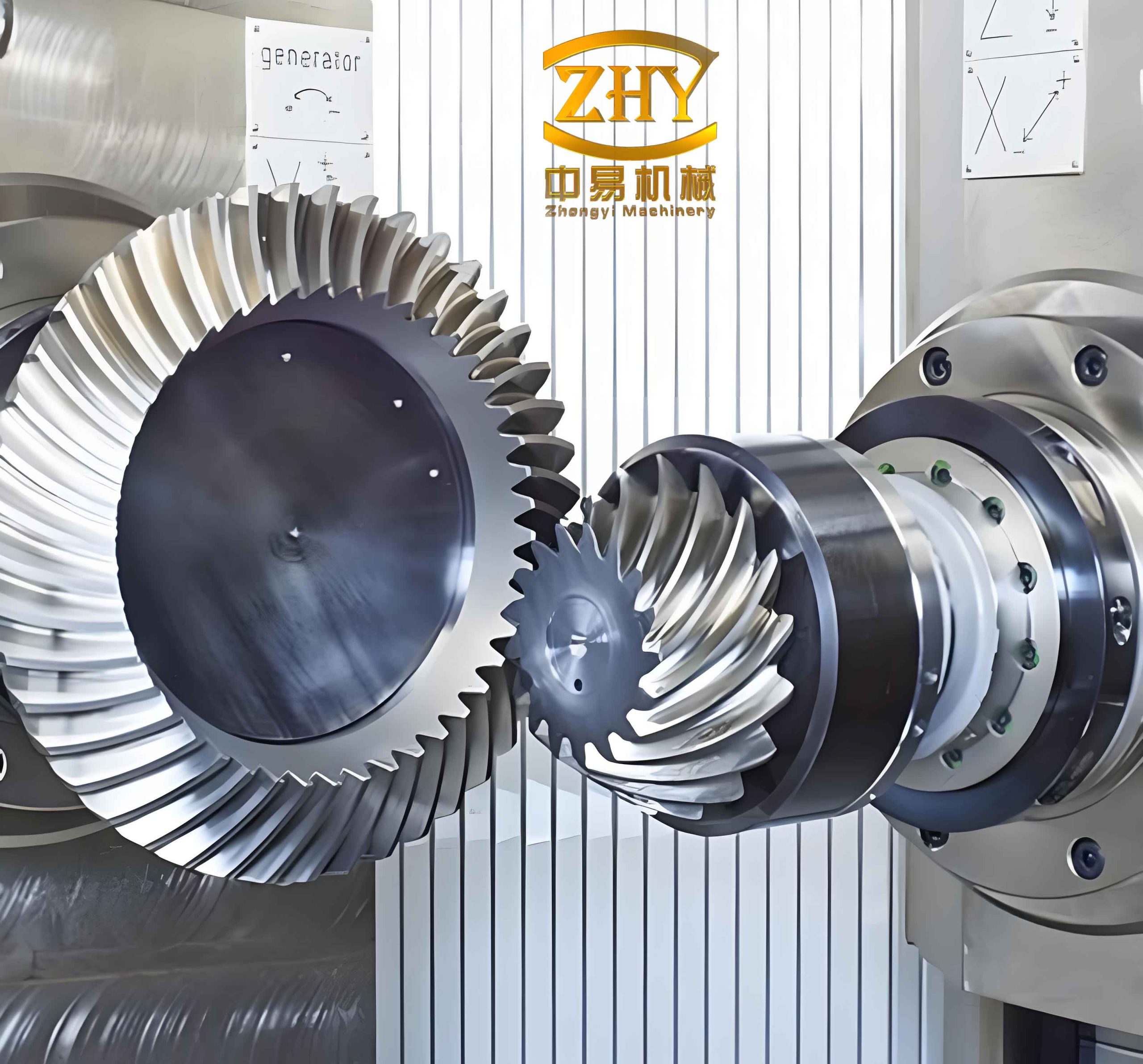
The core of our methodology lies in computing the fuzzy reliability of hyperboloid gears, which accounts for both contact strength and bending strength. We assume that the contact stress \(\sigma_H\) and contact strength \(\sigma_{HS}\), as well as the bending stress \(\sigma_F\) and bending strength \(\sigma_{FS}\), follow normal distributions. This assumption facilitates the calculation of means and coefficients of variation, enabling reliability assessment under fuzzy constraints. For hyperboloid gears, the fuzzy reliability is derived by considering the membership functions of strength parameters, which represent the transition from fully allowable to fully unallowable states.
To compute the contact strength reliability for hyperboloid gears, we define the mean contact stress \(\bar{\sigma}_H\) and mean contact strength \(\bar{\sigma}_{HS}\), along with their coefficients of variation \(C_{\sigma_H}\) and \(C_{\sigma_{HS}}\). The fuzzy reliability for contact strength \(R_H\) is given by:
$$
R_H = \phi \left( \frac{\bar{\sigma}_{HS} – Z_H Z_E Z_\epsilon Z_\beta Z_K \times K_A K_V K_{H\alpha} K_{H\beta} \frac{F_{mt}}{d_{m1} \cdot d_{eH}} \cdot \frac{\sqrt{u^2+1}}{u}}{\sqrt{(C_{\sigma_{HS}} \cdot \bar{\sigma}_{HS})^2 + \left( C_{\sigma_H} Z_H Z_E Z_\epsilon Z_\beta Z_K \times K_A K_V K_{H\alpha} K_{H\beta} \frac{F_{mt}}{d_{m1} \cdot d_{eH}} \cdot \frac{\sqrt{u^2+1}}{u} \right)^2 }} \right)
$$
where \(\phi\) denotes the standard normal distribution function, and other symbols—such as \(Z_H\) for zone factor, \(Z_E\) for elasticity coefficient, \(Z_\epsilon\) for contact ratio factor, \(Z_\beta\) for spiral angle factor, \(Z_K\) for load distribution factor, \(K_A\) for application factor, \(K_V\) for dynamic factor, \(K_{H\alpha}\) and \(K_{H\beta}\) for face load factors, \(F_{mt}\) for transmitted tangential force, \(d_{m1}\) for pinion mean diameter, \(d_{eH}\) for effective diameter, and \(u\) for gear ratio—are defined per standard gear design references. This formula incorporates the fuzziness in stress and strength through their statistical descriptors, providing a reliability measure that reflects real-world uncertainties.
Similarly, the fuzzy reliability for bending strength \(R_F\) of hyperboloid gears is expressed as:
$$
R_F = \phi \left( \frac{\bar{\sigma}_{FS} – \frac{F_{mt}}{d_{eF} \cdot m_{mn}} Y_{Fa} Y_{Sa} Y_\epsilon Y_\beta Y_K K_A K_V K_{F\alpha} K_{F\beta}}{\sqrt{(C_{\sigma_{FS}} \cdot \bar{\sigma}_{FS})^2 + \left( C_{\sigma_F} \cdot \frac{F_{mt}}{d_{eF} \cdot m_{mn}} Y_{Fa} Y_{Sa} Y_\epsilon Y_\beta Y_K K_A K_V K_{F\alpha} K_{F\beta} \right)^2 }} \right)
$$
Here, \(Y_{Fa}\) is the form factor, \(Y_{Sa}\) is the stress correction factor, \(Y_\epsilon\) is the bending contact ratio factor, \(Y_\beta\) is the spiral angle factor, \(Y_K\) is the rim thickness factor, \(K_{F\alpha}\) and \(K_{F\beta}\) are bending load factors, \(d_{eF}\) is the effective diameter for bending, and \(m_{mn}\) is the normal module at the midpoint. These factors account for the geometric and load characteristics unique to hyperboloid gears, ensuring accurate reliability estimation.
The overall fuzzy reliability \(R\) for hyperboloid gears is computed by aggregating reliability values at different cut-set levels \(\lambda_i\) (where \(i=1,2,\ldots,n\)), corresponding to various strength membership grades. Assuming a trapezoidal membership function for strength \(\sigma_S\), the fuzzy reliability is:
$$
R = \frac{\sum_{i=1}^{n} \lambda_i R_i}{\sum_{i=1}^{n} \lambda_i}
$$
This formulation captures the gradual transition in reliability assessment, aligning with the fuzzy nature of design parameters. To illustrate the parameter dependencies, Table 1 summarizes key symbols used in reliability calculations for hyperboloid gears.
| Symbol | Description | Typical Range/Value |
|---|---|---|
| \(\sigma_H\) | Contact stress | Variable (MPa) |
| \(\sigma_{HS}\) | Contact strength | Material-dependent (MPa) |
| \(\sigma_F\) | Bending stress | Variable (MPa) |
| \(\sigma_{FS}\) | Bending strength | Material-dependent (MPa) |
| \(C_{\sigma}\) | Coefficient of variation | 0.05-0.15 |
| \(F_{mt}\) | Transmitted tangential force | Design load (N) |
| \(u\) | Gear ratio | 2-10 for hyperboloid gears |
| \(\beta_m\) | Mean spiral angle | 35°-50° |
Building on fuzzy reliability, we develop an optimization design model for hyperboloid gears. The objective is to minimize the volume of the gear transmission, which reduces material usage and weight while maintaining performance. The volume is approximated as the sum of truncated cone volumes for the pinion and gear, based on their pitch diameters at the large and small ends. The objective function \(F(X)\) is:
$$
F(X) = \frac{\pi}{3} b \cos \delta_1 \left[ \left( \frac{m z_1}{2} \right)^2 + \left( \frac{m z_1}{2} \cdot \frac{R-b}{R} \right)^2 + \frac{m z_1}{2} \cdot \frac{m z_1}{2} \cdot \frac{R-b}{R} \right] + \frac{\pi}{3} b \cos \delta_2 \left[ \left( \frac{m z_2}{2} \right)^2 + \left( \frac{m z_2}{2} \cdot \frac{R-b}{R} \right)^2 + \frac{m z_2}{2} \cdot \frac{m z_2}{2} \cdot \frac{R-b}{R} \right]
$$
where \(X = [m_e, b, \beta_m, z_1, K]\) is the design variable vector, with \(m_e\) as the module at the large end, \(b\) as the face width, \(\beta_m\) as the mean spiral angle, \(z_1\) as the pinion tooth number, and \(K\) as the mid-face height coefficient. Other parameters include \(\delta_1\) and \(\delta_2\) as pitch cone angles, \(R\) as the mean cone distance, and \(z_2\) as the gear tooth number derived from the fixed gear ratio. This volume formulation ensures a compact design for hyperboloid gears, directly linking geometric parameters to overall size.
The design variables are selected because they significantly influence the performance and dimensions of hyperboloid gears, while parameters like torque, speed, and axis offset are treated as fixed inputs. To handle uncertainties, we impose fuzzy constraints on reliability and variable bounds. The fuzzy constraints are:
- Fuzzy reliability constraints: \( \tilde{R}_H \leq 0.995 \) and \( \tilde{R}_{Fi} \leq 0.995 \) for \(i=1,2\) (pinion and gear bending).
- Module constraint: \( m_e \tilde{\geq} 3 \).
- Face width constraints: \( 4 \tilde{-} m_e \tilde{\leq} b \tilde{\leq} 10 \tilde{-} m_e \).
- Spiral angle constraint: \( 35^\circ \tilde{\leq} \beta_m \tilde{\leq} 50^\circ \).
- Tooth number constraint: \( 40 \tilde{\leq} z_1 + z_2 \tilde{\leq} 60 \).
- Mid-face height coefficient constraint: \( 3.5 \tilde{\leq} K \tilde{\leq} 4 \).
The tilde (\(\sim\)) notation indicates fuzziness, meaning these constraints have gradual transitions from fully allowable to fully unallowable states. For instance, a face width near the boundary may be partially acceptable, reflecting practical tolerances in hyperboloid gear manufacturing. To model this, we define linear membership functions for each fuzzy constraint. For a generic variable \(x\) with lower bound \(\underline{x}_L\) and upper bound \(\overline{x}_U\), and transition intervals \(\underline{x}_L\) to \(\underline{x}_U\) (for lower bound) and \(\overline{x}_L\) to \(\overline{x}_U\) (for upper bound), the membership function \(H_x\) is:
$$
H_x =
\begin{cases}
1 & \text{if } \underline{x}_U \leq x \leq \overline{x}_L \\
\frac{\underline{x}_U – x}{\underline{x}_U – \underline{x}_L} & \text{if } \underline{x}_L \leq x \leq \underline{x}_U \\
\frac{x – \overline{x}_L}{\overline{x}_U – \overline{x}_L} & \text{if } \overline{x}_L \leq x \leq \overline{x}_U \\
0 & \text{otherwise}
\end{cases}
$$
Transition intervals are determined using an expansion coefficient method, typically with factors of 0.80-0.95 for upper bounds and 1.05-1.30 for lower bounds. This captures the fuzzy nature of constraints in hyperboloid gear design, such as allowable variations in spiral angle due to assembly adjustments. By applying the cut-set principle, we transform fuzzy constraints into deterministic ones at an optimal cut-set level \(\lambda^*\), which balances safety and economy. The value of \(\lambda^*\) is determined via a two-level evaluation method considering design, manufacturing, material quality, and usage conditions. For hyperboloid gears, \(\lambda^*\) often ranges from 0.7 to 0.9, as in our case study.
The optimization model is thus reformulated as a non-fuzzy problem at the optimal cut-set level:
$$
\begin{aligned}
\text{Minimize} & \quad F(X) \\
\text{Subject to} & \quad R_i \leq 0.995 \quad (i = H, F1, F2) \\
& \quad \underline{x}_{kL} + \lambda^* (\underline{x}_{kU} – \underline{x}_{kL}) \leq x_k \leq \overline{x}_{kU} – \lambda^* (\overline{x}_{kU} – \overline{x}_{kL}) \quad (k = 1,2,\ldots,5)
\end{aligned}
$$
Here, \(x_k\) represents the design variables (e.g., \(m_e, b, \beta_m, z_1, K\)), and the bounds are adjusted based on \(\lambda^*\). This model enables efficient optimization using methods like the complex algorithm, tailored for hyperboloid gear applications.
To validate our approach, we applied it to the hyperboloid gears in a KZ32-19 pneumatic steel bundling machine. The initial design had parameters \(X = [4 \text{ mm}, 30 \text{ mm}, 45^\circ, 12, 3.7]\), and through a two-level evaluation, we found \(\lambda^* = 0.74\). After optimization, the results showed significant improvement. Table 2 compares the original and optimized designs for hyperboloid gears, highlighting reductions in volume and adjustments in key parameters.
| Parameter | Original Design | Fuzzy Reliability Optimization | Units |
|---|---|---|---|
| Module \(m_e\) | 4.0 | 3.8 | mm |
| Face Width \(b\) | 30.0 | 31.9 | mm |
| Mean Spiral Angle \(\beta_m\) | 45.0 | 41.0 | degrees |
| Pinion Tooth Number \(z_1\) | 12 | 11 | – |
| Mid-face Height Coefficient \(K\) | 3.7 | 3.9 | – |
| Volume \(F(X)\) | 107,187 | 85,842 | mm³ |
| Volume Reduction | – | ~25% | – |
The optimized hyperboloid gear design achieved approximately 25% reduction in volume compared to the original, demonstrating the effectiveness of our fuzzy reliability-based approach. This reduction not only saves material but also contributes to lighter and more efficient transmissions. In practical tests, two units of the pneumatic steel bundling machine equipped with optimized hyperboloid gears operated without failure, confirming the design’s feasibility and robustness. This success underscores the importance of accounting for fuzzy and random factors in hyperboloid gear design, as it leads to more reliable and economical outcomes.
The mathematical formulation for hyperboloid gear optimization can be extended by incorporating additional constraints, such as thermal limits or noise criteria. For example, the contact stress formula for hyperboloid gears can be refined to include temperature effects:
$$
\sigma_H = Z_H Z_E Z_\epsilon Z_\beta Z_K \sqrt{\frac{F_{mt}}{d_{m1} \cdot d_{eH}} \cdot \frac{u^2+1}{u} \cdot \frac{1}{\cos^2 \beta_m}}
$$
This emphasizes the role of spiral angle \(\beta_m\) in stress distribution for hyperboloid gears. Similarly, bending stress can be expressed in terms of geometry factors specific to hyperboloid gears:
$$
\sigma_F = \frac{F_{mt}}{b m_{mn}} Y_{Fa} Y_{Sa} Y_\epsilon Y_\beta \left(1 + \frac{0.25}{\sqrt{K}}\right)
$$
where the mid-face height coefficient \(K\) influences tooth root stress. These formulas highlight the interplay between design variables and performance metrics in hyperboloid gears.
In terms of fuzzy reliability, the membership functions for constraints can be tailored based on application requirements. For hyperboloid gears used in high-load scenarios, such as industrial machinery, stricter transition intervals may be adopted. Table 3 provides example transition intervals for common fuzzy constraints in hyperboloid gear design, derived from empirical data.
| Constraint | Lower Transition Interval | Upper Transition Interval | Typical \(\lambda^*\) Range |
|---|---|---|---|
| Module \(m_e \geq 3\) | 2.5-3.0 mm | 3.0-3.5 mm | 0.70-0.85 |
| Face Width \(4m_e \leq b \leq 10m_e\) | 3.5m_e-4.0m_e | 9.5m_e-10.0m_e | 0.65-0.80 |
| Spiral Angle \(35^\circ \leq \beta_m \leq 50^\circ\) | 30°-35° | 45°-50° | 0.75-0.90 |
| Tooth Number Sum \(40 \leq z_1+z_2 \leq 60\) | 35-40 | 55-60 | 0.70-0.85 |
These intervals reflect the gradual acceptance of parameter values, ensuring that the optimization for hyperboloid gears remains practical under manufacturing variances. The optimal cut-set level \(\lambda^*\) is critical; too high a value may lead to overly conservative designs, while too low may compromise reliability. For hyperboloid gears, we recommend iterative evaluation to determine \(\lambda^*\), considering factors like lubrication conditions and expected lifespan.
From a computational perspective, the optimization of hyperboloid gears involves nonlinear programming due to the complex objective function and constraints. We utilized the complex method, which is suitable for constrained optimization with multiple variables. The algorithm iteratively adjusts the design variables to minimize volume while satisfying fuzzy reliability constraints. The convergence criteria include tolerance on function value changes and constraint violations, typically set at \(10^{-6}\) for hyperboloid gear applications.
To further illustrate the reliability calculations, consider the statistical parameters for a typical hyperboloid gear material. Assuming normalized steel, the mean contact strength \(\bar{\sigma}_{HS}\) might be 1500 MPa with a coefficient of variation \(C_{\sigma_{HS}} = 0.10\), while the mean bending strength \(\bar{\sigma}_{FS}\) is 500 MPa with \(C_{\sigma_{FS}} = 0.12\). For a design load \(F_{mt} = 5000 \text{ N}\) and gear ratio \(u = 5\), the reliability indices can be computed using the formulas above. This process underscores the need for accurate statistical data in hyperboloid gear design, which can be gathered from historical failure analyses or testing.
In conclusion, our fuzzy reliability-based optimization method for hyperboloid gears offers a comprehensive framework that addresses both random and fuzzy uncertainties. By integrating fuzzy set theory with traditional optimization, we achieve designs that are not only volume-efficient but also reliable under real-world conditions. The case study demonstrates a 25% volume reduction, validating the approach’s effectiveness. Future work could explore dynamic fuzzy reliability models for hyperboloid gears under varying loads or incorporate multi-objective optimization to balance volume, cost, and performance. This methodology paves the way for more resilient and sustainable hyperboloid gear systems in applications ranging from automotive to industrial machinery.
The principles discussed here are broadly applicable to other gear types, but the unique geometry of hyperboloid gears necessitates special attention to parameters like spiral angle and mid-face height coefficient. As manufacturing technologies advance, such as additive manufacturing for hyperboloid gears, the fuzzy constraints may evolve to reflect new tolerance capabilities. Ultimately, embracing uncertainty in design leads to hyperboloid gears that perform better and last longer, contributing to overall system reliability and efficiency.