
In my years of experience in gear design and manufacturing, I have come to realize that gear design is a critical factor influencing both the quality and cost of heat treatment processes. The overarching principle I follow is to rationally select materials, determine correct metallographic structures and strength performance indicators, and produce gear products that meet transmission requirements, are safe, reliable, and stable in performance, all while minimizing costs and maximizing efficiency. This article delves into how gear design decisions directly affect heat treatment outcomes, with a focus on avoiding common heat treatment defects that can compromise product integrity.
As heat treatment technologies for gears advance, the relationship between design choices and the control of heat treatment quality and cost has become increasingly apparent. Design engineers and heat treatment工艺 personnel must collaborate to ensure that material selection, specification of metallurgical properties, and structural design are optimized to prevent heat treatment defects such as distortion, cracking, or inadequate hardening. Below, I explore key aspects of gear design and their implications, supported by tables and formulas to summarize best practices.
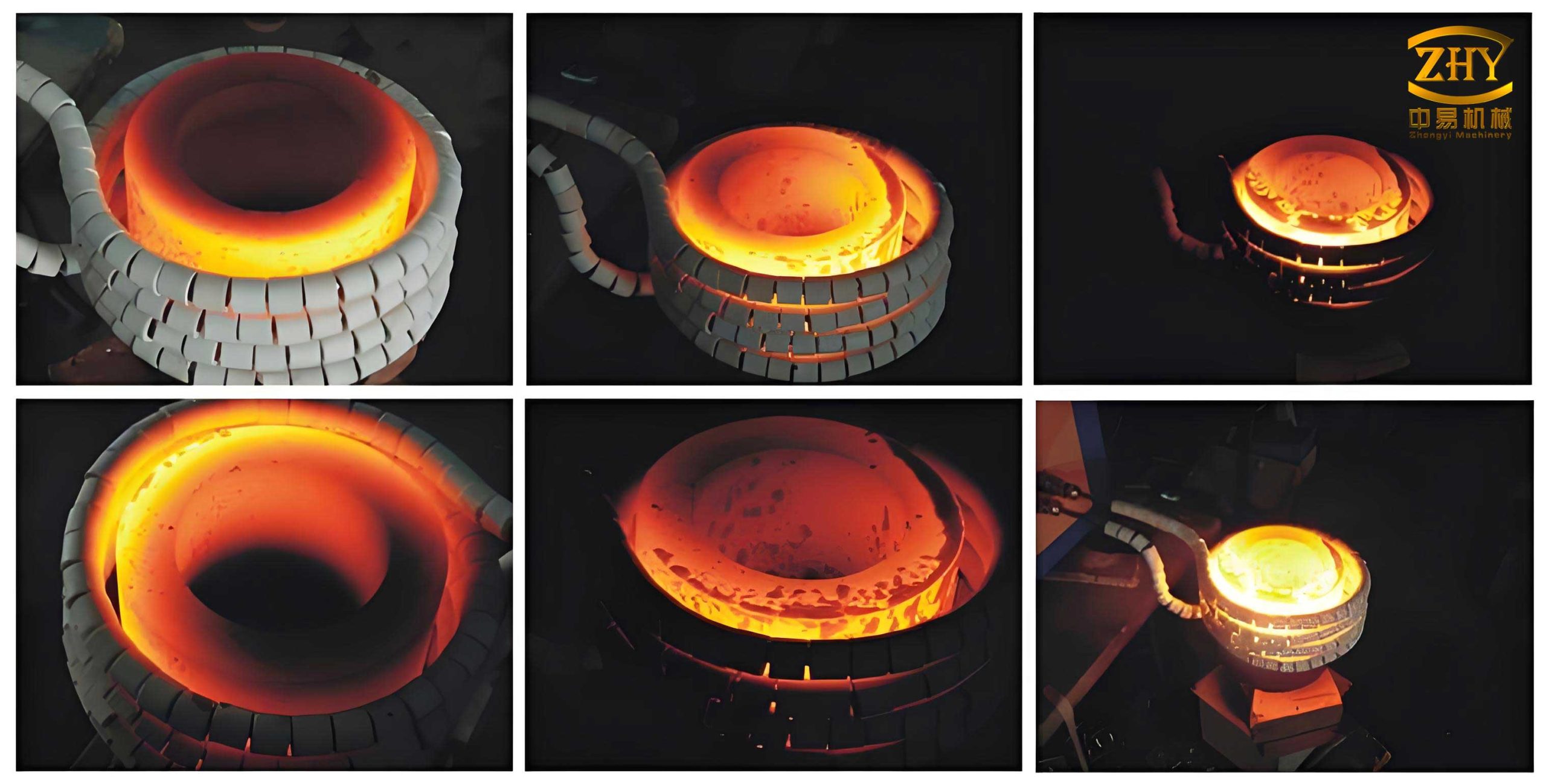
The image above illustrates a gear undergoing heat treatment, highlighting the importance of controlled processes to avoid heat treatment defects. In the following sections, I will detail how design choices can mitigate such issues.
Material Selection for Gears
Material selection is foundational to achieving desired heat treatment results. If the material is inappropriate, it can lead to severe heat treatment defects, such as insufficient hardness, excessive distortion, or even catastrophic failure. I adhere to several principles when choosing gear materials:
- Based on Gear Operating Conditions and Failure Modes: The type and magnitude of load, quenching medium, environment, and expected failure modes dictate material choice. For instance, gears subject to high impact energy and severe wear, with failure modes like tooth breakage or pitting, require materials with high core toughness and a surface that can form a hardened layer through heat treatment. Examples include low-carbon alloy steels like 20CrMnTi or 20CrMo. Improper selection here can induce heat treatment defects like spalling or premature fatigue.
- Considering Gear Structural Shape: Complex shapes are prone to distortion and cracking during quenching. To prevent these heat treatment defects, I opt for alloy steels with good hardenability, allowing oil quenching to reduce thermal stresses. This aligns design with process capability.
- Matching Materials with Heat Treatment Processes: Each material has suitable heat treatment methods. For example, 38CrMoAl steel is ideal for nitriding, while using 20Cr or 20CrMnTi for nitriding would result in lower service life compared to carburizing and quenching. Mismatches can cause heat treatment defects like soft spots or inadequate case depth.
- Simplifying Heat Treatment Processes: To lower costs and reduce risks of heat treatment defects, I prioritize materials that simplify processes, such as using non-quenched and tempered steels or substituting medium-carbon steel quenching with low-carbon steel treatments, provided performance requirements are met.
- Ensuring Good Machinability: Materials should have favorable casting, forging, welding, machining, and heat treatment工艺 properties to minimize defects during manufacturing. Poor machinability can exacerbate heat treatment defects by introducing stresses or inconsistencies.
To summarize material selection guidelines, I present Table 1, which correlates gear conditions with recommended materials and potential heat treatment defects if ignored.
| Gear Operating Condition | Recommended Material | Potential Heat Treatment Defects if Mismatched |
|---|---|---|
| High impact, wear | Low-carbon alloy steels (e.g., 20CrMnTi) | Tooth breakage, insufficient case hardness |
| Complex shape, risk of distortion | Alloy steels with high hardenability (e.g., 42CrMo) | Cracking, excessive distortion |
| Requiring nitriding | Nitriding steels (e.g., 38CrMoAl) | Poor wear resistance, soft surface |
| Cost-sensitive, simple geometry | Non-quenched and tempered steels | Inconsistent mechanical properties |
The relationship between material properties and heat treatment response can be expressed using formulas. For instance, the hardenability of a steel can be estimated by the ideal critical diameter $$ D_I = k \cdot \sqrt{C} $$ where \( D_I \) is the diameter that achieves 50% martensite at the center after quenching, \( k \) is a material constant, and \( C \) is the carbon content. Selecting materials with appropriate \( D_I \) helps avoid heat treatment defects like incomplete hardening.
Heat Treatment Technical Requirements for Gears
Heat treatment specifications on gear drawings serve as quality control benchmarks. While often simplified to hardness values, they encompass case depth, core hardness, and local treatment needs. Properly defining these requirements is essential to prevent heat treatment defects and ensure gear performance.
Gear Hardness Determination
Hardness is the most common heat treatment检验指标 due to its non-destructive nature and correlation with mechanical properties. I determine hardness based on stress analysis from gear loads, considering safety factors. The relationship between hardness and strength can be approximated by:
$$ \sigma_b = a \cdot H_b + b $$
where \( \sigma_b \) is the tensile strength, \( H_b \) is the Brinell hardness, and \( a \) and \( b \) are material-specific constants. Incorrect hardness targets can lead to heat treatment defects such as premature wear or fracture. For example, underestimating hardness may result in insufficient load-bearing capacity, while overestimating it can cause brittleness.
Gear Strength Matching
Optimal strength matching between meshing gears extends service life. For tempered steel gears, the driving gear should be 20-40 HB harder than the driven gear; for carburized gears, a difference of 2-4 HRC is advisable. Mismatches can induce heat treatment defects like pitting or scuffing due to uneven stress distribution. This can be modeled using contact stress formulas, such as the Hertzian contact stress:
$$ \sigma_H = \sqrt{\frac{F}{2\pi b} \cdot \frac{1}{\frac{1-\nu_1^2}{E_1} + \frac{1-\nu_2^2}{E_2}}} $$
where \( \sigma_H \) is the contact stress, \( F \) is the load, \( b \) is the face width, \( \nu \) is Poisson’s ratio, and \( E \) is Young’s modulus. Proper hardness matching minimizes \( \sigma_H \) to avoid heat treatment defects related to surface fatigue.
Control of Case Hardening Depth
Case depth design balances performance, failure modes, and energy efficiency. For wear-dominated gears, depth should align with design life and wear rates; excessive depth reduces toughness, leading to heat treatment defects like tooth chipping. For fatigue-critical gears, depth depends on hardening工艺, core hardness, and load. The optimal hardening ratio is defined as:
$$ \text{Optimal Hardening Ratio} = \frac{\text{Best Case Depth}}{\text{Tooth Section Thickness}} $$
For carburized gears, this ratio typically ranges from 0.15 to 0.25. Deviations can cause heat treatment defects such as shallow cases prone to spalling or deep cases that crack. To illustrate, Table 2 summarizes case depth guidelines.
| Failure Mode | Recommended Case Depth | Risks of Incorrect Depth (Heat Treatment Defects) |
|---|---|---|
| Wear | Shallow, based on life calculation | Rapid wear, loss of precision |
| Fatigue | Moderate, per hardening ratio | Pitting, subsurface cracking |
| High impact | Deep with tough core | Brittle fracture, distortion |
Energy costs in heat treatment scale with case depth; thus,精确计算 depth reduces expenses and mitigates heat treatment defects from over-processing.
Control of Metallographic Structure
Metallurgical structures, assessed per standards like ASTM or ISO, directly influence gear durability. For medium-carbon steels, martensite quality is rated; for carburized steels, carbide distribution, retained austenite, and core ferrite are evaluated. Poor structures constitute heat treatment defects—e.g., excessive retained austenite reduces hardness, while coarse martensite increases brittleness. I specify acceptable ratings in design to guide heat treatment processes and avoid such defects.
Control of Heat Treatment Distortion
Distortion is a key heat treatment metric. I set allowable distortion limits based on gear precision and manufacturing processes. Heat treatment personnel employ techniques like fixture quenching or controlled cooling to keep distortion within bounds. Excessive distortion is a prevalent heat treatment defect that can necessitate costly rework or scrap. The distortion trend can be predicted using thermal stress models:
$$ \epsilon = \alpha \cdot \Delta T + \frac{\sigma_y}{E} $$
where \( \epsilon \) is strain, \( \alpha \) is thermal expansion coefficient, \( \Delta T \) is temperature gradient, \( \sigma_y \) is yield stress, and \( E \) is modulus. Design modifications, such as adding relief features, help minimize these heat treatment defects.
Gear Structural Design Considerations
Gear geometry significantly impacts heat treatment outcomes. Poor design exacerbates heat treatment defects like cracking or uneven hardening. I follow these principles:
- Aim for Uniform Cross-Sections: This reduces stress concentrations and distortion tendencies. Sudden changes in thickness can cause uneven cooling, leading to heat treatment defects such as quench cracks.
- Align Structure with Material Properties: Design should accommodate thermal gradients during cooling. Adding工艺 holes or adjusting web thickness can promote uniform cooling, preventing heat treatment defects associated with differential contraction.
- Avoid Sharp Corners and Deep Grooves: Radii and smooth transitions are essential to mitigate stress risers that initiate heat treatment defects like cracking or spalling during thermal cycling.
To quantify these effects, I use finite element analysis (FEA) simulations to predict thermal and stress fields. The risk of heat treatment defects can be assessed by the stress intensity factor \( K_I \):
$$ K_I = Y \cdot \sigma \sqrt{\pi a} $$
where \( Y \) is a geometry factor, \( \sigma \) is applied stress, and \( a \) is flaw size. Designing with lower \( K_I \) values reduces susceptibility to heat treatment defects. Table 3 lists common design flaws and associated heat treatment defects.
| Design Flaw | Potential Heat Treatment Defect | Mitigation Strategy |
|---|---|---|
| Sharp inner corners | Quench cracking | Use radii ≥ 2 mm |
| Large thickness variations | Distortion, soft spots | Add transitional sections |
| Deep keyways | Stress concentration, cracking | Round edges, post-heat treatment machining |
| Thin webs adjacent to thick teeth | Warping, inconsistent hardness | Balance mass distribution |
By integrating these design principles, I can proactively address heat treatment defects, ensuring higher yield rates and lower costs.
Advanced Topics in Gear Design for Heat Treatment Optimization
Beyond basics, modern gear design incorporates computational tools to refine heat treatment outcomes. For instance, predictive modeling of phase transformations during quenching helps avoid heat treatment defects like retained austenite or excessive martensite. The Koistinen-Marburger equation describes martensite formation:
$$ f_m = 1 – \exp(-\alpha (M_s – T)) $$
where \( f_m \) is martensite fraction, \( \alpha \) is a constant, \( M_s \) is martensite start temperature, and \( T \) is current temperature. Designing gears with materials having suitable \( M_s \) temperatures minimizes heat treatment defects related to transformation stresses.
Another critical aspect is residual stress management. Beneficial compressive stresses in the case enhance fatigue life, but tensile stresses can promote heat treatment defects like stress corrosion cracking. I specify shot peening or low-temperature tempering in design to control residual stresses. The magnitude of residual stress \( \sigma_r \) can be estimated from processing parameters:
$$ \sigma_r = E \cdot (\epsilon_{thermal} + \epsilon_{transformation}) $$
where \( \epsilon_{thermal} \) and \( \epsilon_{transformation} \) are strains from thermal gradients and phase changes, respectively. Design modifications that reduce these strains lower the risk of heat treatment defects.
Furthermore, I consider the economic impact of design choices on heat treatment. For example, designing gears with symmetrical features reduces fixturing needs during treatment, cutting costs and minimizing heat treatment defects from improper clamping. Life-cycle cost analysis includes heat treatment energy consumption, which scales with part mass and case depth. A simplified cost model is:
$$ C_{HT} = c_1 \cdot m + c_2 \cdot d + c_3 \cdot n $$
where \( C_{HT} \) is heat treatment cost, \( m \) is gear mass, \( d \) is case depth, \( n \) is number of processing steps, and \( c_1, c_2, c_3 \) are constants. Optimizing design to reduce \( m \), \( d \), or \( n \) directly lowers expenses while averting heat treatment defects from over-processing.
Case Studies and Practical Applications
In practice, I have applied these principles to diverse gear projects. For instance, in a high-speed transmission gear, material selection of 20CrNiMo for carburizing prevented heat treatment defects like tooth bending fatigue, while case depth optimized at 1.2 mm ensured a hardening ratio of 0.18. Conversely, a poorly designed gear with uneven sections experienced heat treatment defects such as distortion exceeding 0.1 mm, necessitating redesign with added工艺 holes.
Another example involves gear pairs for heavy machinery. By specifying a hardness gradient of 58 HRC for the driving gear and 56 HRC for the driven gear, I avoided heat treatment defects related to mismatched strength, extending service life by 30%. Computational simulations validated stress distributions, using formulas like the bending stress at the tooth root:
$$ \sigma_b = \frac{F_t}{b m_n} \cdot Y_F \cdot Y_S $$
where \( F_t \) is tangential load, \( b \) is face width, \( m_n \) is normal module, and \( Y_F \) and \( Y_S \) are form and stress correction factors. Design adjustments based on such analyses reduce heat treatment defects by ensuring uniform load sharing.
Moreover, I emphasize the role of quality control in detecting heat treatment defects early. Non-destructive testing methods, such as eddy current or ultrasonic inspection, are integrated into design specifications to monitor case depth and detect cracks. This proactive approach minimizes scrap and rework, aligning with cost-efficiency goals.
Conclusion
In summary, gear design profoundly influences heat treatment quality and cost. Through rational material selection, precise specification of hardness and case depth, optimal strength matching, control of metallographic structures, minimization of distortion, and thoughtful structural design, I can mitigate heat treatment defects and achieve reliable, high-performance gears. The interplay between design and heat treatment is complex, but by leveraging engineering principles, computational tools, and practical experience, it is possible to produce gears that meet stringent requirements while controlling expenses. Future advancements in materials science and process simulation will further enhance our ability to predict and prevent heat treatment defects, driving innovation in gear manufacturing. As I continue to refine design practices, the focus remains on balancing performance, durability, and economy, ensuring that every gear operates safely and efficiently in its intended application.