
In my experience in manufacturing, processing large-modulus and large-diameter gears has consistently presented challenges such as low accuracy, short service life, high noise, and limited load capacity. While some factories have adopted hard or medium-hard tooth surface rolling or shaving processes, the resulting surface roughness often remains unsatisfactory. To address this, I embarked on research and experimentation into gear honing techniques for large gears, achieving notable improvements. This article details a method for performing gear honing on a vertical lathe—a solution born out of the scarcity of dedicated large-scale gear honing equipment. I will share insights from my trials, focusing on the principles, setup, parameters, and outcomes, all from a first-person perspective.
Gear honing, in essence, simulates the free meshing and rolling of a pair of tightly engaged helical gears to generate a finishing cut. The honing wheel, a tool formed by casting epoxy resin mixed with abrasives, gradually removes a thin metal layer from the gear tooth surface under controlled speed and honing pressure. This process progressively achieves the desired dimensional and geometric accuracy along with superior surface roughness. My approach leverages a vertical lathe as the host machine, utilizing its inherent functions: the worktable rotation for primary motion, the slide radial feed, and the slide axial feed. By attaching a custom gear honing device to the lathe’s ram, with the workpiece mounted on the worktable as the driver and the honing wheel as the follower, effective gear honing for large gears becomes feasible. The schematic below illustrates this honing motion principle and setup.
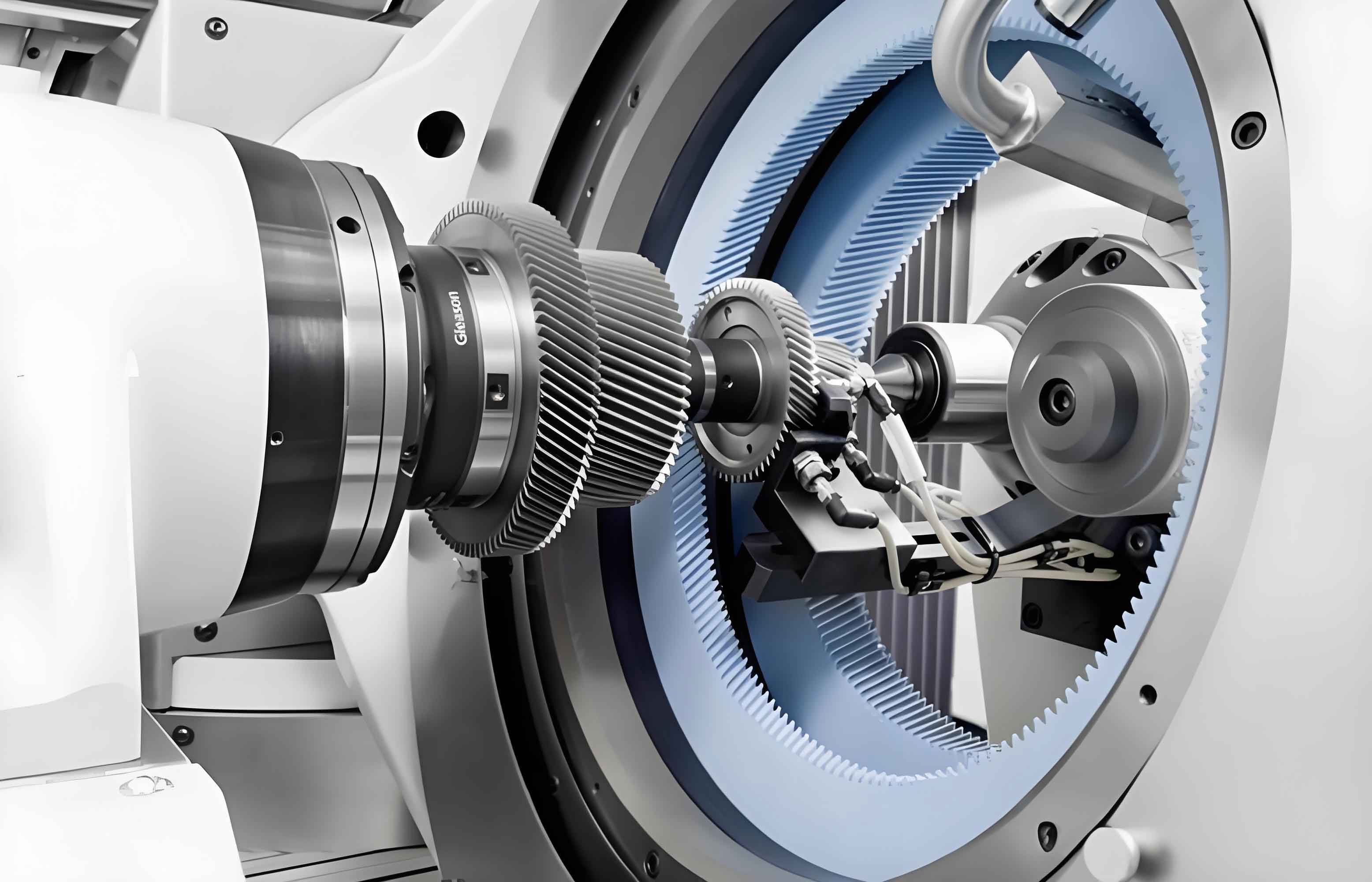
The core of gear honing lies in the relative sliding velocity at the mesh point between the honing wheel and the workpiece. This velocity, critical for material removal, is given by:
$$v = v_w \pm v_h$$
where $v_w$ is the relative sliding velocity of the workpiece at the mesh point, and $v_h$ is that of the honing wheel. More specifically, for practical calculation:
$$v = \frac{\pi d_w n_w}{1000} \cdot \sin \Sigma$$
Here, $d_w$ is the pitch diameter of the workpiece (in mm), $n_w$ is the worktable rotational speed (in rpm), and $\Sigma$ is the shaft crossing angle between the honing wheel and the workpiece. The shaft crossing angle depends on the helix directions: if the honing wheel and workpiece have the same helix direction, $\Sigma = \beta_h – \beta_w$; if opposite, $\Sigma = \beta_h + \beta_w$, where $\beta_h$ is the honing wheel helix angle and $\beta_w$ is the workpiece helix angle. In gear honing, typical honing speeds range from 0.5 to 2 m/s, with lower speeds preferred for heavy workpieces to ensure stability.
Designing the gear honing attachment for the vertical lathe prioritized simplicity, ease of installation and adjustment, and reliable honing action. The attachment connects securely to the lathe ram, accommodates the honing wheel, allows for shaft angle adjustment, and supports both double-sided and single-sided honing modes. Below is a table summarizing the key components and their functions based on my design.
| Component | Description | Function |
|---|---|---|
| Cone Body | Firmly connects to the lathe ram | Provides rigid mounting for the attachment |
| Main Spindle | Supported by fixed and movable brackets | Holds the honing wheel and allows easy wheel change |
| Honing Wheel | Epoxy-abrasive cast tool | Performs the actual gear honing by abrasive action |
| Worm-Helical Gear Pair | Manual adjustment mechanism | Sets the shaft crossing angle $\Sigma$ via a scale |
| Rubber Pad | Elastic element under the rotary table | Compensates automatically during double-sided honing |
| Bevel Gear Pair & Magnetic Powder Brake | Damping system | Applies controllable braking torque for single-sided honing |
For double-sided gear honing, the radial feed drives both flanks simultaneously. However, due to uncertainties in actual cut depth per stroke, the rubber pad offers elastic compensation, enhancing honing efficiency, wheel life, and stability. In single-sided gear honing, the magnetic powder brake (adjustable from 0 to 50 N·m) provides necessary damping, granting the honing wheel better cutting and corrective ability. This flexibility in honing modes is crucial for optimizing the gear honing process.
The effectiveness of gear honing heavily depends on the selection of process parameters. Through experimentation, I’ve identified key factors and their optimal ranges, as detailed below with formulas and tables.
Honing Speed ($v$): As derived, $v = \frac{\pi d_w n_w}{1000} \cdot \sin \Sigma$. For large gears, I recommend $v$ between 0.8 and 1.2 m/s. The honing wheel helix angle $\beta_h$ is typically around 10–15°, and the shaft crossing angle $\Sigma$ should be kept under 10° to avoid instability, tooth flank distortion at ends, and wheel damage.
Stroke Count ($N$): The number of double strokes relates to material, wheel cutting ability, pre-honing roughness, and required precision. My trials show that using double-sided honing for bulk removal followed by single-sided honing for refinement yields good efficiency and results. Ideally, $N$ ranges from 20 to 40 double strokes.
Honing Allowance ($a$): Given the limited cutting capacity of gear honing, and since large gears often have generous tolerance bands, I typically do not allocate additional allowance on the pre-honed tooth thickness. As long as the pre-hone tooth thickness is near the upper limit of its deviation, sufficient material exists for honing.
Radial Feed ($f_r$): Used in double-sided gear honing, usually $f_r = 0.01–0.03$ mm per double stroke. However, due to operational inaccuracies and system rigidity, it’s safer to feed incrementally: after a few strokes, apply $f_r$, then continue. This prevents excessive accumulation that could crush the honing wheel.
Axial Feed ($f_a$): This affects surface roughness, productivity, and cutting ability. Generally, $f_a = 0.5–2$ mm per worktable revolution. A finer feed improves roughness but increases time; a coarser feed boosts efficiency but may compromise finish.
Cooling: Heat from friction and chips can degrade accuracy, roughness, and wheel sharpness. Cooling is essential. On the vertical lathe, without built-in splash guards, I applied a mixture of kerosene and machine oil intermittently via an oil can to the mesh zone. This provided adequate cooling and lubrication for the gear honing process.
To encapsulate these parameters, here is a comprehensive table summarizing their typical values and effects:
| Parameter | Symbol | Typical Range | Influence on Gear Honing |
|---|---|---|---|
| Honing Speed | $v$ | 0.8–1.2 m/s | Affects cutting rate and surface finish; too high causes instability |
| Shaft Crossing Angle | $\Sigma$ | < 10° | Impacts honing stability and tooth profile accuracy |
| Stroke Count | $N$ | 20–40 double strokes | Determines material removal and final precision |
| Radial Feed | $f_r$ | 0.01–0.03 mm/stroke | Controls depth of cut in double-sided honing |
| Axial Feed | $f_a$ | 0.5–2 mm/rev | Influences surface roughness and cycle time |
| Cooling Fluid | — | Kerosene-oil blend | Reduces heat and removes debris, enhancing wheel life |
My gear honing trials involved multiple large gears, and the results consistently demonstrated the viability and effectiveness of this vertical lathe-based method. The table below presents a subset of these trials, highlighting key parameters and outcomes. Each case underscores the adaptability of gear honing across different gear specifications.
| Workpiece Parameters | Pre-Honing Condition | Honing Parameters | Post-Honing Results |
|---|---|---|---|
| Module: 10 mm, Teeth: 100, Pitch diameter: 1000 mm, Face width: 200 mm, Helix angle: 15° right, Material: 42CrMo, Hardness: 280 HB | Tooth thickness at upper limit, roughness Ra 3.2 µm, accuracy Grade 9 | Speed: 1 m/s, Σ: 8°, Strokes: 30 double, $f_r$: 0.02 mm/stroke, $f_a$: 1 mm/rev, Cooling: kerosene-oil | Roughness improved to Ra 0.8 µm, accuracy to Grade 7, no tooth form distortion |
| Module: 12 mm, Teeth: 80, Pitch diameter: 960 mm, Face width: 180 mm, Helix angle: 10° left, Material: 20MnCr5, Hardness: 260 HB | Roughness Ra 6.3 µm, accuracy Grade 10, slight taper on flanks | Speed: 0.9 m/s, Σ: 5°, Strokes: 25 double + 10 single-sided, $f_r$: 0.015 mm/stroke, $f_a$: 1.5 mm/rev, Cooling: kerosene-oil | Roughness Ra 1.0 µm, accuracy Grade 8, taper corrected, noise reduction in test runs |
| Module: 8 mm, Teeth: 120, Pitch diameter: 960 mm, Face width: 150 mm, Helix angle: 0° (spur), Material: GG30 cast iron, Hardness: 220 HB | Roughness Ra 3.2 µm, accuracy Grade 9, burrs at tooth edges | Speed: 1.1 m/s, Σ: 10° (via honing wheel helix), Strokes: 35 double, $f_r$: 0.025 mm/stroke, $f_a$: 0.8 mm/rev, Cooling: kerosene-oil | Roughness Ra 0.6 µm, accuracy Grade 7, burrs removed, surface gloss improved |
| Module: 14 mm, Teeth: 70, Pitch diameter: 980 mm, Face width: 220 mm, Helix angle: 12° right, Material: 34CrNiMo6, Hardness: 320 HB | Hard tooth surface after heat treat, roughness Ra 4.0 µm, accuracy Grade 8 | Speed: 0.8 m/s, Σ: 6°, Strokes: 40 double + 5 single-sided, $f_r$: 0.01 mm/stroke, $f_a$: 1.2 mm/rev, Cooling: kerosene-oil | Roughness Ra 0.9 µm, accuracy maintained at Grade 8, micro-cracks from grinding eliminated |
These examples confirm that gear honing on a vertical lathe is not only feasible but also highly effective for enhancing surface finish and geometric accuracy. The process consistently reduced roughness to Ra 1.0 µm or better and often improved gear accuracy by one or two grades. Moreover, the simple attachment proved cost-effective and easy to install, solving the pressing issue of limited dedicated gear honing machines for large diameters.
However, successful implementation of gear honing requires attention to several practical aspects. Based on my experience, here are key considerations:
- The vertical lathe worktable must possess bidirectional rotation capability to facilitate honing strokes.
- When installing the gear honing attachment, only the tool post on the ram needs removal; all other lathe functions remain unchanged. The magnetic powder brake requires a power connection for torque control.
- Between the rotary table and the rubber pad in the attachment, inserting a 0.5–1 mm thick steel shim ensures smoother rotation and prevents sticking.
- Pre-honing tooth surface roughness should not exceed Ra 3.2 µm, and gear accuracy should meet drawing specifications to ensure effective honing. Poor pre-conditions can overwhelm the honing wheel or yield subpar results.
- Regular inspection of the honing wheel for wear or clogging is essential. Since the wheel is epoxy-based, excessive pressure or heat can degrade it; thus, parameter control is critical.
- For cooling, though intermittent manual application works, designing a simple drip or mist system could further enhance consistency and efficiency in gear honing operations.
In conclusion, my research and trials affirm that gear honing on a vertical lathe is a robust solution for large-modulus, large-diameter gears. The method addresses common shortcomings like poor surface finish and low precision, while bypassing the need for expensive dedicated honing machines. The attachment is straightforward, adjustable, and reliable, enabling both double-sided and single-sided honing modes. By optimizing parameters such as honing speed, stroke count, and feeds, significant improvements in roughness and accuracy are achievable, as evidenced by the trial results. Gear honing, thus, emerges as a versatile and economical finishing process, particularly valuable in settings where conventional grinding or shaving falls short. Future work could explore automated cooling systems or advanced honing wheel formulations to push the boundaries of this technique further. Ultimately, this approach underscores the adaptability of existing machine tools through innovative attachments, expanding the horizons of gear honing in heavy industry.