
As an engineer specializing in mechanical design and manufacturing, I have always been fascinated by the critical role gears play in transmission systems. Gears are subjected to complex stresses during operation, including cyclic bending stresses at the tooth roots, contact stresses on the tooth surfaces, and frictional forces from meshing, along with occasional impact loads. To prevent failures such as tooth breakage, fatigue pitting, and excessive wear, it is essential to select appropriate materials and apply suitable heat treatment processes. Heat treatment enhances gear properties like wear resistance, load-bearing capacity, and service life by improving bending fatigue strength, contact fatigue strength, surface hardness, and core toughness. However, improper heat treatment can lead to various heat treatment defects, which compromise gear performance and reliability. In this article, I will explore common gear materials, their associated heat treatment processes, and delve into the identification, causes, and prevention of heat treatment defects, using tables and formulas for clarity.
Gear materials range from forged steels and cast irons to non-metallic substances, each chosen based on application requirements like load, speed, and environmental conditions. The heat treatment processes, such as carburizing, quenching, tempering, and nitriding, are tailored to achieve desired mechanical properties. Yet, these processes are prone to heat treatment defects like distortion, cracking, soft spots, and residual stresses, which can arise from factors like improper heating rates, inadequate cooling, or material inconsistencies. Understanding these defects is crucial for optimizing gear manufacturing. For instance, in high-speed automotive gears, heat treatment defects such as decarburization or incomplete hardening can lead to premature failure. Thus, a comprehensive analysis of materials and processes, with a focus on defect mitigation, is vital for ensuring gear durability and efficiency.
Common Gear Materials and Their Selection Principles
Gear materials are selected based on factors like load capacity, wear resistance, cost, and manufacturability. The primary categories include forged steels, cast irons, cast steels, non-ferrous metals, and non-metallic materials. Each material has unique properties that influence the choice of heat treatment and the potential for heat treatment defects. Below, I summarize these materials in a table to highlight their characteristics and typical applications.
| Material Type | Common Examples | Key Properties | Typical Applications | Associated Heat Treatment Processes |
|---|---|---|---|---|
| Forged Steel | 45# steel, 40Cr, 20CrMnTi | High strength, toughness, and wear resistance | Automotive transmissions, machine tools | Quenching, tempering, carburizing |
| Cast Iron | HT250, QT600-3 | Good machinability, damping capacity, but brittle | Open gears, low-speed drives | Stress relief annealing, normalizing |
| Cast Steel | ZG270-500, ZG310-570 | Moderate strength, suitable for large sizes | Heavy machinery, agricultural equipment | Normalizing, surface hardening |
| Non-Ferrous Metals | Bronze, aluminum alloys | Corrosion resistance, lightweight | Marine gears, aerospace components | Solution treatment, aging |
| Non-Metallic Materials | Nylon, plastics | Low noise, self-lubricating | High-speed light-load gears | Minimal heat treatment required |
The selection principles for gear materials emphasize matching material properties to operational demands. For example, gears under high impact loads require high toughness, often achieved through carburizing of low-carbon steels. Conversely, gears subjected to high contact stresses need high surface hardness, typically via induction hardening of medium-carbon steels. However, each heat treatment process carries the risk of heat treatment defects. For instance, in forged steels, rapid quenching can cause cracking, a common heat treatment defect that reduces fatigue life. Thus, material choice must consider not only performance but also the susceptibility to defects during heat treatment.
Heat Treatment Processes for Gears: An Overview
Heat treatment processes transform gear microstructure to enhance mechanical properties. Key processes include normalizing, annealing, quenching, tempering, carburizing, nitriding, and induction hardening. Each process involves controlled heating and cooling cycles, but deviations can lead to heat treatment defects. For example, improper tempering temperatures may result in excessive brittleness, a defect that compromises gear toughness. I will describe these processes and their associated defects in detail.
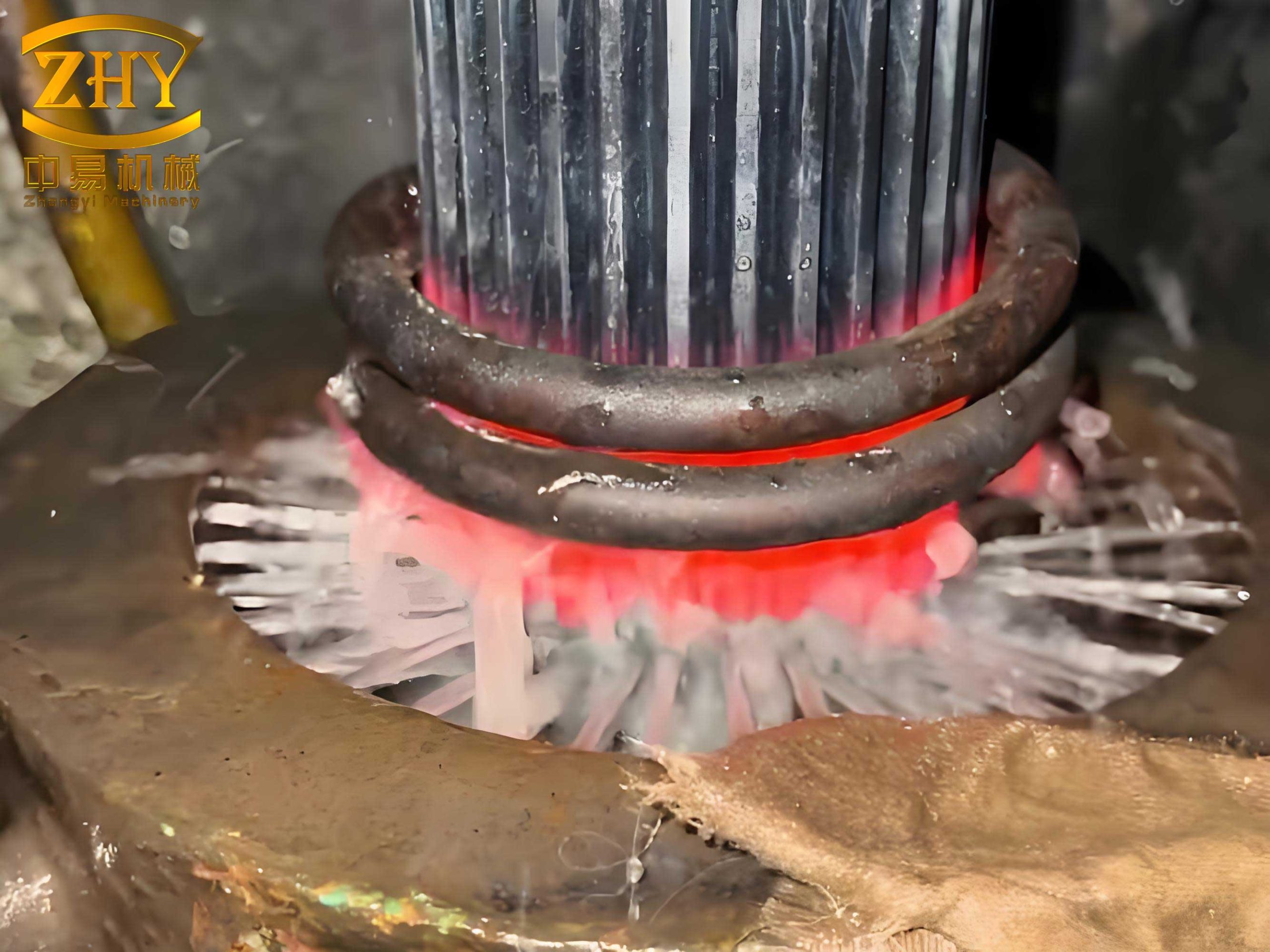
Normalizing and annealing are often used as preparatory treatments to homogenize microstructure and relieve stresses. However, if done incorrectly, they can cause grain growth or uneven hardness, which are forms of heat treatment defects. Quenching involves rapid cooling to achieve high hardness, but it can introduce distortion and residual stresses, common heat treatment defects that affect gear accuracy. Tempering reduces brittleness after quenching, but inadequate tempering can leave the gear prone to cracking. Case hardening processes like carburizing and nitriding create hard surface layers, but defects such as shallow case depth or porosity can occur, leading to reduced wear resistance. Induction hardening offers localized hardening, but non-uniform heating may cause soft spots, another type of heat treatment defect.
To quantify the effects of heat treatment, we can use formulas related to hardness and stress. For instance, the relationship between cooling rate and hardness in steel can be expressed using the Jominy end-quench test, where hardness (H) varies with distance (d) from the quenched end:
$$ H = H_0 – k \cdot d $$
Here, \( H_0 \) is the initial hardness, and \( k \) is a material constant. Deviations from expected hardness profiles indicate heat treatment defects like incomplete transformation. Similarly, residual stress (\(\sigma_r\)) after quenching can be modeled as:
$$ \sigma_r = E \cdot \alpha \cdot \Delta T $$
where \( E \) is Young’s modulus, \( \alpha \) is the coefficient of thermal expansion, and \( \Delta T \) is the temperature gradient. Excessive residual stress is a critical heat treatment defect that promotes fatigue failure.
Common Heat Treatment Defects in Gears: Causes and Prevention
Heat treatment defects are imperfections that arise during thermal processing, adversely affecting gear performance. These defects can be categorized into dimensional changes, microstructural anomalies, and property deficiencies. In my experience, addressing these defects requires a deep understanding of process parameters and material behavior. Below, I present a table summarizing common heat treatment defects, their causes, effects, and preventive measures.
| Defect Type | Primary Causes | Effects on Gears | Preventive Measures |
|---|---|---|---|
| Distortion and Warping | Uneven heating or cooling, residual stresses | Loss of dimensional accuracy, misalignment | Use of fixtures, controlled cooling rates |
| Cracking | Rapid quenching, high carbon content | Reduced fatigue strength, catastrophic failure | Preheating, use of milder quenchants |
| Soft Spots | Inadequate heating, scale formation | Localized wear, reduced load capacity | Proper furnace atmosphere, uniform heating |
| Decarburization | Exposure to oxidizing atmospheres | Loss of surface hardness, poor wear resistance | Controlled atmospheres, protective coatings |
| Overheating | Excessive temperature or time | Grain growth, brittleness | Precise temperature control, monitoring |
| Incomplete Hardening | Insufficient cooling rate, low alloy content | Low hardness, poor fatigue resistance | Optimized quenching media, alloy selection |
Distortion is a prevalent heat treatment defect in gears due to asymmetric geometry, which leads to uneven thermal expansion and contraction. Mathematically, distortion (\(\delta\)) can be related to temperature gradient (\(\nabla T\)) and material properties:
$$ \delta = \int \alpha \cdot \nabla T \, dx $$
To minimize this defect, stress-relief annealing before final machining is often employed. Cracking, another severe heat treatment defect, occurs when thermal stresses exceed the material’s fracture toughness. The risk of cracking increases with higher carbon equivalents, as described by the formula:
$$ CE = C + \frac{Mn}{6} + \frac{Cr + Mo + V}{5} + \frac{Ni + Cu}{15} $$
where CE is the carbon equivalent, and elements are in weight percent. Gears with high CE values require careful quenching to avoid this defect.
Soft spots result from localized inadequate transformation to martensite, often due to poor heat transfer during quenching. This heat treatment defect reduces surface hardness and can be detected through hardness testing. Preventive measures include agitation of quenchant and ensuring clean gear surfaces. Decarburization, a surface heat treatment defect, involves loss of carbon, leading to a soft surface layer. It can be quantified by measuring carbon concentration profiles, and prevention involves using neutral atmospheres during heating. Overheating causes excessive grain growth, weakening the gear; monitoring furnace temperatures with thermocouples is crucial to avoid this defect. Incomplete hardening, a common heat treatment defect in thick sections, results from insufficient cooling rates, and can be mitigated by using alloy steels with higher hardenability.
In practice, heat treatment defects are often interrelated. For example, distortion can lead to cracking if stresses are not relieved. Therefore, a holistic approach to process design is essential. Statistical process control (SPC) methods can help monitor parameters and reduce defect occurrence. For instance, control charts for quenching temperature can detect deviations that might cause heat treatment defects. Additionally, computational modeling using finite element analysis (FEA) can predict temperature distributions and stress fields, aiding in defect prevention.
Case Studies: Gear Heat Treatment and Defect Analysis
To illustrate the impact of heat treatment and heat treatment defects, I will discuss two typical gear applications: machine tool gears and automotive gears. These cases highlight how material selection and process control influence defect formation.
Machine tool gears, such as those in lathes or milling machines, often operate at moderate speeds and loads. They are commonly made from medium-carbon steels like 45# steel or 40Cr. The standard heat treatment process involves normalizing, rough machining, quenching and tempering, followed by finish machining. However, heat treatment defects like distortion can occur during quenching due to uneven cooling. For example, if the gear teeth cool faster than the web, residual stresses cause warping, affecting gear meshing accuracy. To prevent this, fixtures are used during quenching, and tempering is done at controlled temperatures to relieve stresses. Another defect, soft spots, may arise if the quenching oil is contaminated, leading to uneven hardness. Regular maintenance of quenching systems is vital to avoid such heat treatment defects.
Automotive gears, such as those in transmissions, endure high loads and impacts. They are typically made from low-carbon alloy steels like 20CrMnTi, subjected to carburizing, quenching, and low-temperature tempering. Carburizing creates a hard case, but defects like shallow case depth or carbon porosity can occur. Shallow case depth, a heat treatment defect, reduces wear resistance and is caused by insufficient carburizing time or temperature. It can be detected through microhardness testing, where case depth (d) should meet specifications:
$$ d = \sqrt{D \cdot t} $$
where \( D \) is the diffusion coefficient and \( t \) is time. Carbon porosity, another heat treatment defect, forms due to excessive carbon potential, leading to brittle surfaces that crack under load. Controlling atmosphere composition during carburizing minimizes this defect. Additionally, distortion in automotive gears is critical due to tight tolerances; shot peening after heat treatment is often used to induce compressive stresses and counteract distortion-related heat treatment defects.
In both cases, non-destructive testing (NDT) methods like ultrasonic testing or magnetic particle inspection are employed to detect heat treatment defects such as cracks or inclusions. Early detection allows for rework or rejection, ensuring gear reliability.
Advanced Heat Treatment Techniques and Defect Mitigation
Recent advancements in heat treatment technology aim to reduce heat treatment defects and improve gear performance. Processes like vacuum heat treatment, laser hardening, and cryogenic treatment offer better control over parameters. Vacuum heat treatment minimizes oxidation and decarburization, common heat treatment defects, by heating in a low-pressure environment. Laser hardening provides precise surface hardening with minimal distortion, reducing the risk of heat treatment defects like warping. Cryogenic treatment, involving cooling to very low temperatures, stabilizes microstructure and enhances wear resistance, but improper cooling rates can cause thermal shock, a potential heat treatment defect.
Modeling and simulation play a key role in defect prediction. For instance, using phase transformation kinetics, the formation of martensite during quenching can be described by the Koistinen-Marburger equation:
$$ f_m = 1 – \exp(-k(M_s – T)) $$
where \( f_m \) is the martensite fraction, \( k \) is a constant, \( M_s \) is the martensite start temperature, and \( T \) is the temperature. Deviations from expected transformation can indicate heat treatment defects like retained austenite, which softens the gear. Process optimization through design of experiments (DoE) helps identify parameter settings that minimize defects. For example, response surface methodology can model the effect of quenching temperature and time on hardness and distortion, guiding defect-free production.
Conclusion
In summary, the selection of gear materials and heat treatment processes is pivotal for achieving desired mechanical properties and longevity. However, heat treatment defects pose significant challenges, affecting gear accuracy, strength, and reliability. Through this analysis, I have highlighted common defects such as distortion, cracking, and soft spots, along with their causes and preventive strategies. By leveraging tables for material comparison and formulas for quantitative analysis, engineers can better understand and mitigate these defects. Emphasizing process control, advanced techniques, and continuous monitoring is essential to minimize heat treatment defects and enhance gear performance. As technology evolves, a proactive approach to defect prevention will remain central to manufacturing high-quality gears for diverse applications.
Ultimately, the interplay between material science and heat treatment engineering determines gear success. Whether dealing with forged steels in automotive systems or cast irons in industrial machinery, awareness of heat treatment defects ensures that gears meet stringent demands. I encourage practitioners to integrate defect analysis into their workflow, using tools like FEA and SPC to drive innovation and reliability in gear manufacturing.