
Traditionally, the study of meshing characteristics in mismatched screw gear drives relies heavily on physical trial-and-error methods. This involves coating the worm with marking compound, assembling the gear set, and running it to observe the contact pattern transferred onto the worm wheel. If the contact is unsatisfactory, the worm wheel is re-machined with adjusted parameters, and the process is repeated until an acceptable pattern is achieved. This approach is notoriously resource-intensive, consuming significant time, material, and labor while offering limited insight into the underlying contact mechanics.
The advent of virtual simulation technology provides a powerful alternative for investigating the meshing of non-conjugate screw gears. This methodology allows researchers to observe, evaluate, and modify the entire manufacturing and assembly process within a digital environment. By validating machining schemes computationally, the need for costly and time-consuming physical prototypes is drastically reduced, enabling rapid and informed development.
The core principle of the virtual transmission simulation system discussed here is based on leveraging the robust parametric modeling and motion simulation capabilities of a 3D CAD platform, specifically Pro/ENGINEER, combined with secondary development using VC++. This system digitally replicates the entire factory process—from gear design and virtual machining to assembly and dynamic meshing analysis. It effectively creates a virtual testbed for screw gear analysis. Through computer-simulated contact marking and cross-sectional analysis, the meshing condition between tooth surfaces becomes visually clear. This visibility allows for the systematic adjustment of design and manufacturing parameters to optimize the contact pattern, providing crucial guidance for real-world production.
Fundamental Principles of Mismatched Screw Gear Meshing
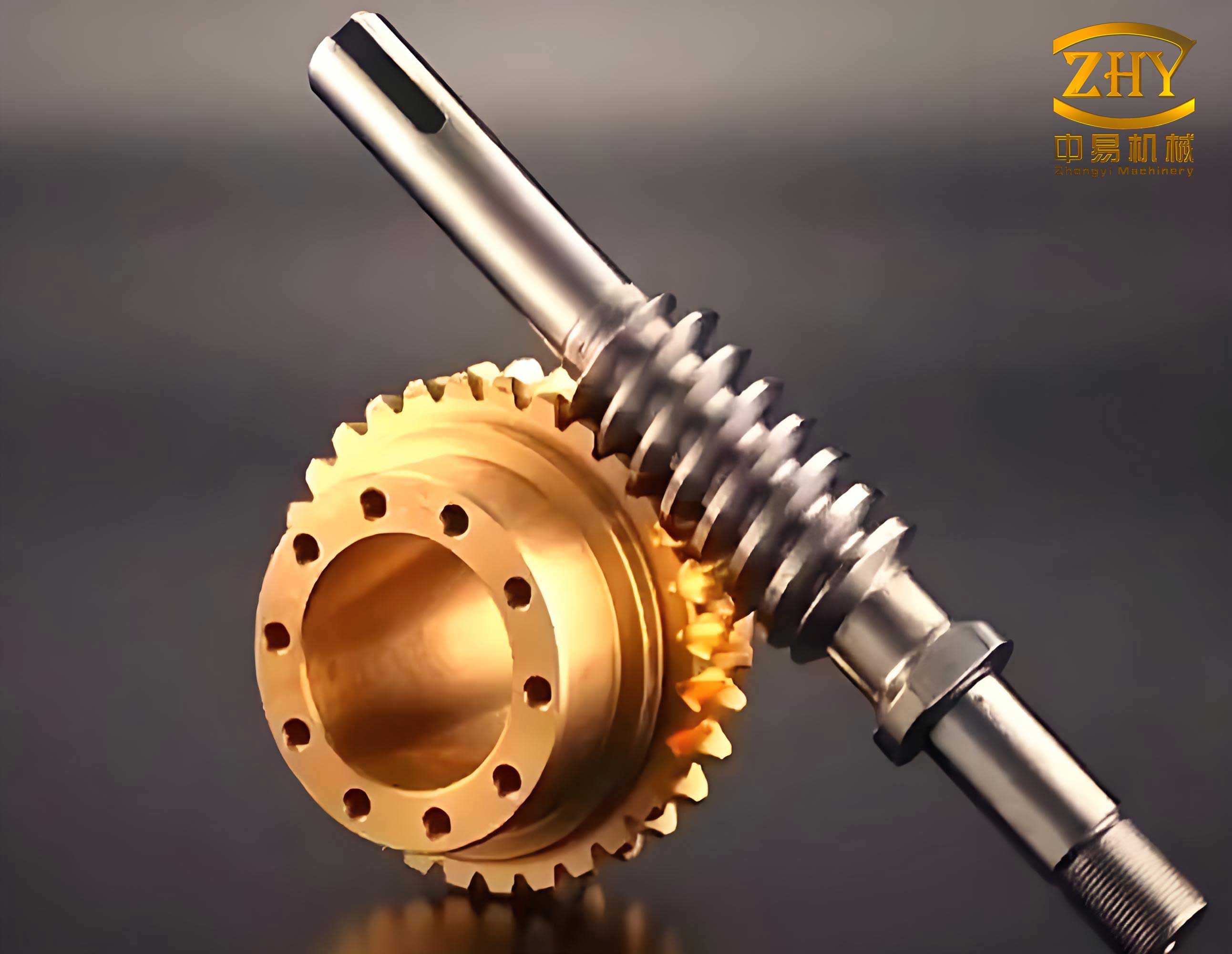
This analysis is grounded in a practical industrial case involving a mismatched screw gear pair. The worm is a three-start conical enveloping worm, and the worm wheel is generated by a single-start normal straight-sided hob. The primary parameters for the driving worm are as follows: it is left-handed, with a pitch diameter $d_1 = 13.5 \text{ mm}$, an axial module $m = 1.25 \text{ mm}$, a lead angle at the pitch cylinder $\lambda_1 = 15^\circ 31′ 27”$, and a number of starts $N_1 = 3$. The hob for generating the worm wheel has a pitch diameter $d_0 = 20 \text{ mm}$.
According to the fundamental principles of gear generation and meshing, the key parameters for the hob must be derived from the target worm geometry to ensure proper conjugation in the generation process. The hob’s lead angle $\lambda_0$ is calculated based on the worm’s lead and the hob’s pitch diameter:
$$ \lambda_0 = \arcsin\left(\frac{m N_1}{d_0 \cos \lambda_1}\right) $$
The axial module of the hob, $m_{0a}$, is then:
$$ m_{0a} = \frac{d_0 \tan \lambda_0}{N_0} $$
where $N_0 = 1$ is the number of starts of the hob.
The relationship between the axial pressure angles of the worm ($\alpha_{1a}$) and the hob ($\alpha_{0a}$) is governed by the normal pressure angle, which should ideally be consistent. This gives:
$$ \tan \alpha_{0a} \cos \lambda_0 = \tan \alpha_{1a} \cos \lambda_1 $$
Using these equations, the essential parameters for the mismatched pair are calculated and summarized in the table below. Note the distinction between the hob’s *theoretical* axial parameters (derived directly from conjugate theory) and its *actual* manufactured parameters (slightly adjusted for practical cutting). The theoretical machining tilt angle, which is the angle between the hob axis and the worm wheel blank axis during virtual generation, is given by $(\lambda_1 – \lambda_0)$.
| Component | Type | No. of Starts/Teeth | Axial Module (mm) | Pitch Diameter (mm) | Pressure Angle (°) | Lead Angle |
|---|---|---|---|---|---|---|
| Worm | Conical Enveloping | 3 | 1.25 | 13.5 | 20 (Axial) | 15° 31′ 27” |
| Other Data: Tip Diameter: 16 mm, Root Diameter: 10.375 mm | ||||||
| Hob | Normal Straight-Sided | 1 | 1.219 (Actual Axial) | 20.0 | 19.34 (Actual Axial) | 3° 29′ 19” |
| Theoretical | 1 | 1.207 | 20.0 | 19.36 | 3° 27′ 9” | |
| Other Data: Tip Diameter: 23.2 mm, Root Diameter: 16.4 mm | ||||||
| Worm Wheel | Generated | 36 | 1.25 | 45.0 | — | — |
For a high-performance mismatched screw gear drive, the contact condition is paramount. The optimal meshing form is not a perfect line contact (as in conjugate pairs) but a favorable area contact that promotes lubrication. Specifically, the tooth profiles of both the worm and the worm wheel in the direction normal to the relative velocity vector at the contact point should be conducive to the formation of a hydrodynamic oil wedge. This requires that the normal curvatures of both surfaces in that specific direction be as high as possible, creating an elliptical contact patch with controlled size and orientation. Achieving this through parameter adjustment is the central goal of the virtual simulation.
Virtual Simulation Research Methodology
The simulation process involves three core steps: the parametric modeling of the worm, the parametric modeling and virtual generation of the worm wheel, and the dynamic meshing simulation with contact analysis.
1. Parametric Modeling of the Three-Start Conical Enveloping Worm
Within the Pro/ENGINEER environment, a fully parametric model of the worm is created. Fundamental parameters such as the number of starts, axial module, pressure angle, lead angle, grinding wheel radius, and pitch diameter are defined as input variables. The worm blank is created via extrusion. The axial tooth profile and root transition curves are defined using equation-driven curves. A single thread is then constructed by sweeping this profile along a helical path defined by the worm’s lead. The complete worm thread form is generated by patterning this single thread around the axis. Finally, a Toolkit application developed in VC++ provides a user-friendly dialog box for inputting these parameters, instantly regenerating the 3D model of the screw gear component.
2. Virtual Generation of the Three-Start Worm Wheel Using a Single-Start Hob
A similar parametric approach is used for the normal straight-sided hob. Its key parameters—normal module, normal pressure angle, lead angle, and pitch diameter—are parameterized. After modeling the hob body, its helical tooth form is created. This virtual hob is then used in a simulated gear generation process. The computer mimics the hobbing machine: the hob rotates and feeds relative to the worm wheel blank at the calculated theoretical center distance and tilt angle. Through Boolean subtraction operations, the hob’s form digitally cuts the gear teeth into the blank, resulting in the precise geometry of the mismatched worm wheel. This virtual manufacturing step is critical as it replicates the actual errors and adjustments (like modified hob pressure angle) present in real production.
3. Meshing Contact Simulation and Parametric Adjustment
The assembled virtual models of the worm and the generated worm wheel are imported into the Mechanism module of Pro/ENGINEER for dynamic simulation. Rotational motors are applied to the worm, and the system solves the constrained motion of the gear set. To analyze contact, a simulated “marking compound” method is used: a visualization technique that highlights regions on the worm wheel tooth surface that come within a very small distance (representing an oil film thickness) of the worm thread surface during motion.
More importantly, cross-sectional analysis is performed. At selected contact points during the mesh cycle, a plane is constructed normal to the relative velocity vector. The intersection of this plane with both tooth surfaces reveals the local profile geometry—the actual “gap” or “conformity” between the screw gear surfaces in the most critical direction for lubrication. The shape and size of this gap directly indicate the quality of the oil wedge formation.
The simulation is run iteratively for worm wheels generated under different manufacturing parameters, primarily the actual machining tilt angle and center distance. For each set of parameters, the contact pattern and the normal cross-sectional profiles are examined and compared.
Simulation Results and Contact Analysis
The following analysis presents the virtual contact patterns and corresponding normal section profiles for three different machining tilt angles, with a fixed working center distance of 32.5 mm. The worm wheel rotation direction is counter-clockwise when viewed along its axis.
| Case | Machining Tilt Angle | Contact Pattern Observation | Normal Section Profile Analysis | Meshing Quality Assessment |
|---|---|---|---|---|
| Case A | Theoretical Angle: $12.07^\circ$ $(\lambda_1 – \lambda_0)$ | The contact band is located centrally on the tooth flank, slightly towards the leaving side. It has a regular, somewhat elliptical shape. | The profiles of the worm and wheel in the normal section show a pronounced and well-centered concave-convex conformity. The gap between the surfaces is narrow and uniform in the central region, flaring open at the edges. | Optimal. The contact is positioned in the root-to-middle region of the wheel tooth, ideal for carrying lubricant into the mesh. The profile conformity is excellent, promoting the formation of a stable elastohydrodynamic lubrication (EHL) film. This leads to low wear, smooth running, and high efficiency for the screw gear drive. |
| Case B | Reduced Angle: $9.3^\circ$ | The contact patch shifts towards the tooth root and the entering edge. It becomes more concentrated and may show a sharper, less regular boundary. | The normal section reveals a misalignment of the profile curvatures. The contact occurs near the edge of the active profile, resulting in a highly asymmetrical gap shape. One side of the gap is extremely tight (edge contact), while the other is wide open. | Poor. This condition leads to edge loading or point contact near the root/edge. Stress concentrations are very high, lubrication is severely compromised as oil is squeezed out, and wear will be accelerated. This is detrimental to the lifespan and noise performance of the screw gears. |
| Case C | Increased Angle: $12.5^\circ$ | The contact patch moves towards the tooth tip and the leaving edge. Similar to Case B, it becomes concentrated and irregular, potentially touching the tip corner. | The profile misalignment is opposite to Case B. The contact occurs near the tip edge of the wheel tooth. The normal section gap is again highly asymmetrical, indicative of localized edge contact. | Poor. Tip or edge contact near the leaving side is equally harmful. It risks scuffing, high friction, and possible interference. The lubrication wedge cannot form effectively under such concentrated loading, leading to high operating temperatures and potential failure of the screw gear set. |
The simulation results conclusively demonstrate that the meshing quality of these mismatched screw gears is extremely sensitive to the manufacturing setup parameters. Deviation from the theoretically calculated tilt angle, even by a small amount, causes a significant migration of the contact zone towards the edges of the worm wheel tooth. This edge contact phenomenon is clearly visualized through both the contact patterns and, more definitively, through the cross-sectional profile analysis in the direction of relative sliding.
The optimal condition (Case A) achieves a centered contact on the flank, which is the hallmark of a well-adjusted mismatched screw gear pair. The virtual simulation system successfully identifies this optimum without the need for physical part iteration. Furthermore, it provides a deep mechanical explanation: the optimal condition corresponds to the best alignment of the principal curvatures of the two surfaces in the critical direction, maximizing the normal curvature difference and creating a favorable elliptical contact patch for EHL.
The general relationship between tilt angle adjustment and contact zone movement can be summarized for this class of screw gears:
$$ \text{Contact Zone Shift} \propto (\beta_{\text{actual}} – \beta_{\text{theoretical}}) $$
where a positive deviation ($\beta_{\text{actual}} > \beta_{\text{theoretical}}$) shifts contact towards the tip/leaving side, and a negative deviation shifts it towards the root/entering side.
Conclusion
This research establishes a comprehensive virtual simulation framework for the analysis and optimization of mismatched screw gear drives. By integrating parametric modeling, virtual gear generation, and dynamic contact simulation, the system faithfully replicates the entire physical manufacturing and testing cycle within a digital environment.
The key outcomes are:
- The system enables clear visualization of the screw gear tooth contact patterns under dynamic conditions.
- It provides a powerful diagnostic tool through normal cross-sectional analysis at the contact point, revealing the fundamental geometry of the interface critical for lubrication.
- It allows for the rapid, cost-free exploration of manufacturing parameter space (tilt angle, center distance, hob profile modification) to systematically drive the contact condition towards an optimal state characterized by centered flank contact.
The application of this virtual simulation technology to screw gear development offers tremendous advantages. It virtually eliminates the wasteful cycle of physical trial-and-error involving repeated machining, assembly, and testing. This leads to dramatic savings in time, materials, and labor costs. Moreover, it provides engineers with profound insight into the meshing mechanics of non-conjugate screw gear pairs, enabling the design of more reliable, efficient, and durable power transmission systems. Future work can extend this methodology to include thermal analysis, elastodynamic simulation, and the study of other complex gear geometries, further solidifying virtual prototyping as an indispensable tool in advanced gear engineering.