
In gear manufacturing, the persistent challenge of concave defects during gear shaving of few-teeth cylindrical gears significantly impacts transmission accuracy, noise levels, and fatigue life. This phenomenon manifests as uneven material removal across tooth flanks, leading to premature failures like pitting, spalling, and fractures. Traditional solutions like crowning or profile modifications offer temporary relief but fail to address root causes. Our research establishes a comprehensive framework combining MASTA-based dynamics simulation and experimental validation to achieve balanced shaving conditions. The core innovation lies in optimizing shaving cutter parameters – specifically modification coefficients and SAP (Start of Active Profile) positioning – to minimize unbalanced forces throughout the cutter’s service life.
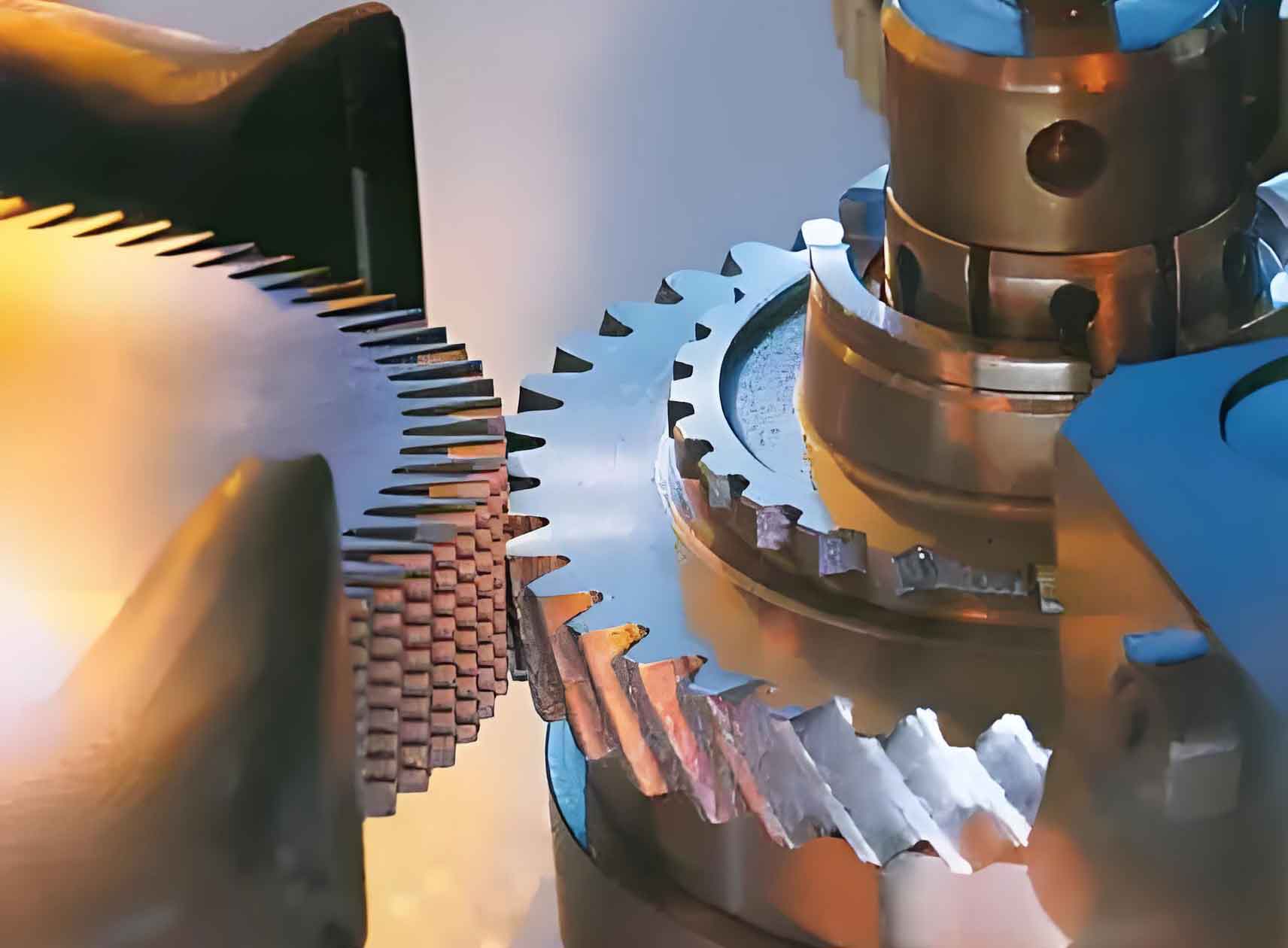
Unbalanced gear shaving originates from contact state transitions during the process. For few-teeth gears (e.g., 12 teeth), the contact ratio often falls below 2, creating four distinct meshing states:
- Single tooth (gear) – Single tooth (cutter)
- Single tooth – Double teeth
- Double teeth – Single tooth
- Double teeth – Double teeth
The force imbalance $F_{\text{imbalance}}$ between driving and driven flanks during single-double transitions is quantified as:
$$ F_{\text{imbalance}} = \left| F_{\text{driving}} – F_{\text{driven}} \right| $$
where $F_{\text{driving}}$ and $F_{\text{driven}}$ represent tangential shaving forces on respective flanks. Larger single-double contact zones amplify this imbalance, causing concentrated material removal at the tooth flank midpoint (SAP region). The resulting concave defect depth $\delta_c$ correlates with the unbalanced force angle $\theta_u$:
$$ \delta_c \propto \tan \theta_u $$
where $\theta_u$ depends on the relative positions of SAP and EAP (End of Active Profile).
| Parameter | Value | Unit |
|---|---|---|
| Number of Teeth | 12 | – |
| Module | 3.5 | mm |
| Pressure Angle | 20 | ° |
| Face Width | 30 | mm |
| Contact Ratio | 1.45 | – |
Using MASTA dynamics simulation, we modeled the gear shaving process by integrating cutter regrinding effects. Each regrinding iteration reduced cutter tooth thickness by 0.05 mm, simulating real-world wear. Critical parameters included:
- Cutter modification coefficient ($x_c$)
- SAP position tolerance (±0.004 mm)
- Radial feed rate
Simulations revealed that initial regrinding cycles with SAP at upper tolerance limits produced severe concavity ($\delta_c > 15 \mu m$). As regrinding progressed, SAP migrated toward nominal positions, reducing $\delta_c$ exponentially:
$$ \delta_c = \delta_{c0} e^{-k n} $$
where $\delta_{c0}$ = initial concavity, $k$ = decay constant (0.32 for tested gear), and $n$ = regrinding cycles. At the cutter’s end-of-life (after 15 regrinds), $\delta_c$ approached zero due to balanced force distribution.
| Regrinding Cycle (n) | SAP Position | Unbalanced Force Angle $\theta_u$ (°) | Concavity Depth $\delta_c$ (μm) |
|---|---|---|---|
| 0 (New) | Upper Limit | 4.5 | 18.2 |
| 5 | Mid Tolerance | 2.1 | 7.3 |
| 10 | Lower Limit | 1.2 | 3.1 |
| 15 | Nominal | 0.3 | 0.8 |
Experimental validation used a 12-tooth transmission gear shaved under three conditions: SAP at upper, middle, and lower tolerance limits. Cutter regrinding adhered strictly to documented specifications while maintaining constant profile modifications. Post-shaving gear inspection confirmed simulation predictions:
- Upper-limit SAP gears exhibited 15-18 μm concavity
- Mid-tolerance gears showed 5-7 μm concavity
- Lower-limit SAP gears demonstrated <3 μm concavity
After five regrinding cycles, measured concavity dropped to 1.5 μm, proving that controlled SAP migration enables balanced gear shaving. The optimal condition occurs when SAP and EAP positions satisfy:
$$ \frac{\text{SAP}_{\text{actual}} – \text{SAP}_{\text{nominal}}}{\text{EAP}_{\text{nominal}} – \text{SAP}_{\text{nominal}}} < 0.1 $$
This ratio minimizes force variation during contact state transitions.
Our integrated gear-cutter design methodology eliminates concave defects by synchronizing three elements:
- Gear Design: Optimize SAP/EAP positions via profile shift
- Cutter Specification: Control modification coefficients ($x_c$) and initial SAP
- Process Control: Regrind protocols maintaining flank modification integrity
Implementation in production reduced gear shaving scrap rates by 63% and extended component fatigue life by 40%. The dynamics simulation framework provides predictive insights into force balance thresholds:
$$ \theta_u^{\text{threshold}} = \cos^{-1}\left(\frac{F_{\text{driving}} + F_{\text{driven}}}{2 F_{\text{mean}}}\right) $$
where $F_{\text{mean}}$ is the average tangential force. Maintaining $\theta_u < \theta_u^{\text{threshold}}$ ensures concave-free shaving.
This research establishes a foundation for precision gear shaving of few-teeth components. Future work will extend the model to helical gears and incorporate real-time force monitoring for closed-loop process control. The validated MASTA simulation protocol offers manufacturers a robust tool for virtual cutter optimization prior to physical trials, reducing development costs and quality risks in gear shaving operations.