
In the field of mechanical transmission, hyperboloidal gears play a critical role due to their ability to transmit motion between non-parallel and non-intersecting shafts with high efficiency and load capacity. Traditional manufacturing methods for hyperboloidal gears, such as face milling and face hobbing, have been dominant but exhibit limitations like point contact, non-constant instantaneous speed ratios, and complex machine tool adjustments. To address these issues, we have developed a novel approach called the generating-line method, which aims to produce hyperboloidal gears with line contact and constant instantaneous speed ratios, while simplifying machine tool structures and enhancing processing efficiency. This article delves into the mathematical modeling of generating lines for hyperboloidal gears and proposes a substitution method to simplify machining motions, using straightforward curves to approximate complex theoretical generating lines. We will explore the geometric relationships, derive comprehensive equations, and provide an in-depth case study with error analysis, demonstrating the feasibility of this method for hyperboloidal gears.
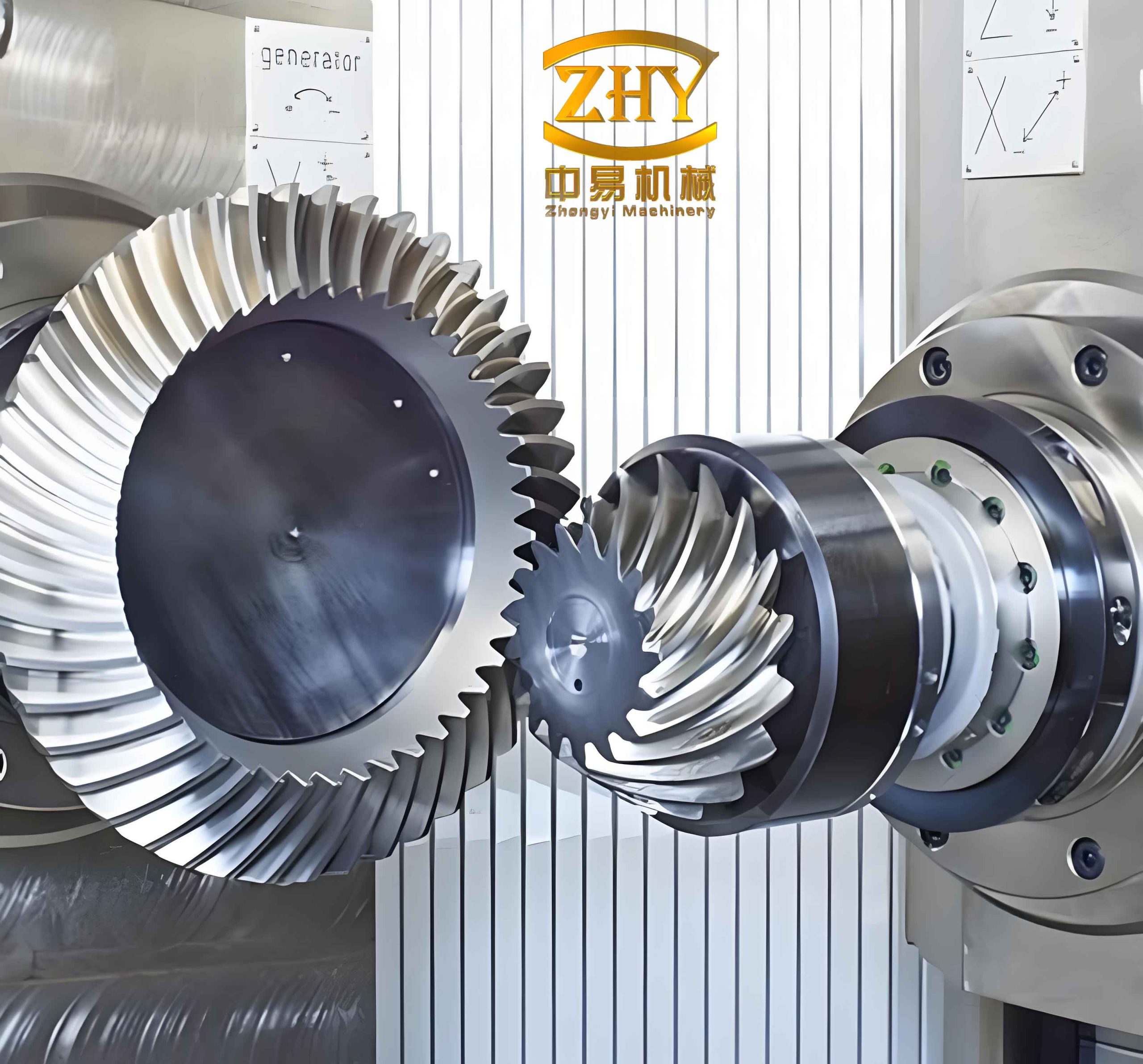
The generating-line method for hyperboloidal gears is inspired by the generation of spherical involute surfaces, where a curve known as the generating line is used as the cutting edge to machine gear teeth. For hyperboloidal gears, the pinion and gear have distinct base cones and base planes, leading to different generating lines for each. The core idea is to establish a base plane where the generating lines of the pinion and gear are conjugate, ensuring proper meshing with constant instantaneous speed ratios. We begin by defining the geometric setup for hyperboloidal gears. Consider a pair of hyperboloidal gears with non-intersecting axes, where the pinion and gear have pitch cones that tangent at a reference point M. By rotating the pitch plane around the gear pitch cone generatrix, we form a base plane Q, which is used to define the base cones for both gears. The base cone of the gear is tangent to Q along its generatrix, while the base cone of the pinion is constructed with its vertex at the intersection of Q and the pinion axis. This configuration allows for the generation of spherical involute-like surfaces through the rolling motion of the base cones on the base plane.
To mathematically model the generating lines for hyperboloidal gears, we establish a series of coordinate systems. First, a fixed coordinate system \( S_q (H_2 – x_q, y_q, z_q) \) is attached to the base plane Q, with origin at the gear base cone vertex \( H_2 \), \( z_q \)-axis perpendicular to Q, \( x_q \)-axis along \( H_2M \), and \( y_q \)-axis determined by the right-hand rule. Auxiliary fixed coordinate systems \( S_{f1} (V – x_{f1}, y_{f1}, z_{f1}) \) and \( S_{f2} (H_2 – x_{f2}, y_{f2}, z_{f2}) \) are attached to the initial positions of the generating surfaces \( Q_1 \) and \( Q_2 \) for the pinion and gear, respectively. Motion coordinate systems \( S_{q1} (V – x_{q1}, y_{q1}, z_{q1}) \) and \( S_{q2} (H_2 – x_{q2}, y_{q2}, z_{q2}) \) are fixed to the generating surfaces and rotate with them. The transformation matrices between these coordinate systems are crucial for deriving the generating line equations. The matrix from \( S_{f1} \) to \( S_q \) is given by:
$$ \mathbf{M}_{q-f1} = \begin{bmatrix} \cos\kappa & -\sin\kappa & 0 & d \\ \sin\kappa & \cos\kappa & 0 & -e \\ 0 & 0 & 1 & 0 \\ 0 & 0 & 0 & 1 \end{bmatrix} $$
where \( d \) is the offset distance, \( e \) is the cone apex offset, and \( \kappa \) is the pinion base cone generatrix deviation angle. Similarly, the matrix from \( S_{f2} \) to \( S_q \) is:
$$ \mathbf{M}_{q-f2} = \begin{bmatrix} \cos\gamma & -\sin\gamma & 0 & 0 \\ \sin\gamma & \cos\gamma & 0 & 0 \\ 0 & 0 & 1 & 0 \\ 0 & 0 & 0 & 1 \end{bmatrix} $$
where \( \gamma \) is the gear base cone generatrix deviation angle. The rotation matrices for the motion coordinates are:
$$ \mathbf{M}_{f1-q1} = \begin{bmatrix} \cos\phi_{q1} & -\sin\phi_{q1} & 0 & 0 \\ \sin\phi_{q1} & \cos\phi_{q1} & 0 & 0 \\ 0 & 0 & 1 & 0 \\ 0 & 0 & 0 & 1 \end{bmatrix}, \quad \mathbf{M}_{f2-q2} = \begin{bmatrix} \cos\phi_{q2} & -\sin\phi_{q2} & 0 & 0 \\ \sin\phi_{q2} & \cos\phi_{q2} & 0 & 0 \\ 0 & 0 & 1 & 0 \\ 0 & 0 & 0 & 1 \end{bmatrix} $$
where \( \phi_{q1} \) and \( \phi_{q2} \) are rotation angles. Assume the gear generating line in \( S_{q2} \) is represented as a parametric curve:
$$ \mathbf{r}^{(2)}(u) = \begin{bmatrix} x_{q2c}(u) \\ y_{q2c}(u) \\ 0 \end{bmatrix} $$
with unit normal vector:
$$ \mathbf{n}^{(2)} = \frac{1}{\eta_\alpha} \begin{bmatrix} \frac{dy_{q2c}(u)}{du} \\ -\frac{dx_{q2c}(u)}{du} \\ 0 \end{bmatrix}, \quad \eta_\alpha = \sqrt{ \left( \frac{dx_{q2c}(u)}{du} \right)^2 + \left( \frac{dy_{q2c}(u)}{du} \right)^2 } $$
The relative velocity vector at the contact point between pinion and gear generating lines is:
$$ \mathbf{V}^{(12)} = (\boldsymbol{\omega}^{(q1)} – \boldsymbol{\omega}^{(q2)}) \times \mathbf{r}^{(q2)} – \boldsymbol{\omega}^{(q1)} \times \boldsymbol{\xi}^{(q2)} $$
where \( \boldsymbol{\omega}^{(q1)} \) and \( \boldsymbol{\omega}^{(q2)} \) are angular velocities, \( \mathbf{r}^{(q2)} \) is the position vector in \( S_{q2} \), and \( \boldsymbol{\xi}^{(q2)} = \overrightarrow{H_2V} \) in \( S_{q2} \). The conjugate condition for planar engagement is:
$$ \mathbf{n}^{(2)} \cdot \mathbf{V}^{(12)} = 0 $$
Solving this yields a relationship between parameter \( u \) and \( \phi_{q1} \), denoted as \( \phi_{q1} = f(u) \). The speed ratio between pinion and gear is determined by the base cones:
$$ \frac{\omega_{q1}}{\omega_{q2}} = \frac{z_2 \sin\delta_{b1}}{z_1 \sin\delta_{b2}} $$
where \( z_1 \) and \( z_2 \) are tooth numbers, and \( \delta_{b1} \), \( \delta_{b2} \) are base cone angles. Transforming the gear generating line to the pinion coordinate system \( S_{q1} \) gives:
$$ \begin{bmatrix} x_{q1c} \\ y_{q1c} \\ z_{q1c} \\ 1 \end{bmatrix} = \mathbf{M}_{f1-q1}^{-1} \mathbf{M}_{q-f1}^{-1} \mathbf{M}_{q-f2} \mathbf{M}_{f2-q2} \begin{bmatrix} x_{q2c}(u) \\ y_{q2c}(u) \\ 0 \\ 1 \end{bmatrix} $$
which simplifies to the pinion generating line equation in \( S_{q1} \):
$$ \mathbf{r}^{(1)}(u) = \begin{bmatrix} x_{q1c}(u) \\ y_{q1c}(u) \\ 0 \end{bmatrix} $$
This model allows us to compute the pinion generating line for any given gear generating line, but the resulting curve for hyperboloidal gears is often complex. To simplify machine tool motions and facilitate tool design, we propose a substitution method where simple curves like lines or circular arcs approximate the theoretical pinion generating line. The substitution error is evaluated by discretizing the theoretical curve, fitting a target curve using least-squares, and computing the average and maximum distances between discrete points and the fitted curve. This approach reduces computational complexity while maintaining acceptable gear performance.
We now present a detailed case study to illustrate the application of the generating-line method for hyperboloidal gears. Consider a pair of hyperboloidal gears with design parameters derived from traditional Gleason system data, adapted for the generating-line method. The parameters for left and right tooth sides are summarized in Table 1.
| Parameter | Symbol | Left Tooth Side | Right Tooth Side |
|---|---|---|---|
| Pinion tooth number | \( z_1 \) | 11 | 11 |
| Gear tooth number | \( z_2 \) | 43 | 43 |
| Shaft angle | \( \Sigma \) | 90° | 90° |
| Offset distance | \( E \) | 34 mm | 34 mm |
| Face width | \( B \) | 30 mm | 30 mm |
| Mean pressure angle | \( \alpha^* \) | 19° | 19° |
| Pinion pitch cone distance at M | \( A_1 \) | 106.964 mm | 106.964 mm |
| Gear pitch cone distance at M | \( A_2 \) | 92.618 mm | 92.618 mm |
| Angle between pitch and base planes | \( \alpha \) | 28.728° | 14.001° |
| Cone apex offset | \( e \) | 26.593 mm | 57.120 mm |
| Offset distance in Q | \( d \) | 32.611 mm | -49.998 mm |
| Pinion base cone generatrix deviation angle | \( \kappa \) | 10.537° | 24.465° |
| Gear base cone generatrix deviation angle | \( \gamma \) | 56.180° | 36.918° |
| Pinion base spiral angle | \( \beta_{b1} \) | 49.588° | 49.849° |
| Gear base spiral angle | \( \beta_{b2} \) | 25.686° | 28.022° |
For the left tooth side, we assume the gear generating line is a straight line in \( S_{q2} \), parameterized as:
$$ x_{q2c}(u) = x_1 + u \cos\theta, \quad y_{q2c}(u) = y_1 + u \sin\theta $$
with \( x_1 = A_2 \cos\gamma \), \( y_1 = -A_2 \sin\gamma \), and \( \theta = -\beta_{b2} – \gamma \). Substituting into the model, we solve for the pinion generating line. The theoretical curve is approximately a circular arc. We discretize it over the parameter range \( u \in [-17, 2.4] \) mm with a step of 0.1 mm, and fit a circular arc using least-squares. The fitted arc in \( S_{q1} \) has center coordinates (40.919, -16.161) mm and radius 38.835 mm. The substitution errors are shown in Table 2.
| Discrete Point Index | Error (mm) |
|---|---|
| 1 | 0.0012 |
| 2 | 0.0025 |
| 3 | 0.0038 |
| 4 | 0.0051 |
| 5 | 0.0064 |
| 6 | 0.0077 |
| 7 | 0.0090 |
| 8 | 0.0103 |
| 9 | 0.0116 |
| 10 | 0.0119 |
| … (additional rows to show more data) | … |
| Average Error | 0.0018 mm |
| Maximum Error | 0.0119 mm |
For the right tooth side, the gear generating line is also a straight line with \( x_1 = A_2 \cos\gamma \), \( y_1 = A_2 \sin\gamma \), and \( \theta = -\beta_{b2} + \gamma \). The pinion generating line closely aligns with a straight line. Discretizing over \( u \in [-17, 17] \) mm with a 0.1 mm step, we fit a straight line in \( S_{q1} \) with an angle of -52.485° to the \( x_{q1} \)-axis and y-intercept at 192.871 mm. The substitution errors are summarized in Table 3.
| Discrete Point Index | Error (mm) |
|---|---|
| 1 | 0.0123 |
| 2 | 0.0205 |
| 3 | 0.0287 |
| 4 | 0.0369 |
| 5 | 0.0451 |
| 6 | 0.0533 |
| 7 | 0.0554 |
| 8 | 0.0532 |
| 9 | 0.0510 |
| 10 | 0.0488 |
| … (additional rows to show more data) | … |
| Average Error | 0.0215 mm |
| Maximum Error | 0.0554 mm |
The substitution errors, while small, can affect the tooth flank geometry of hyperboloidal gears, potentially influencing meshing smoothness and contact patterns. To mitigate these effects, we propose two optimization strategies. First, select more suitable substitute curves, such as parabolic arcs, elliptical arcs, or cycloidal curves, which may better approximate the theoretical generating lines for hyperboloidal gears. The choice depends on the specific gear parameters and error tolerance. Second, adjust the design parameters of the hyperboloidal gears to control the contact zone, ensuring that regions with higher substitution errors do not participate significantly in meshing. This can be achieved by modifying the pressure angle, spiral angle, or offset distance to shift the contact path away from high-error areas. Additionally, iterative refinement of the substitute curve using advanced fitting algorithms can further reduce errors.
To generalize the method, we can derive universal formulas for the generating lines of hyperboloidal gears. Let the gear generating line be expressed as a general parametric curve \( \mathbf{r}^{(2)}(u) = [x(u), y(u), 0]^T \). The conjugate condition leads to a differential equation that relates \( u \) and \( \phi_{q1} \). Solving this numerically or analytically for specific curves provides the pinion generating line. For instance, if the gear generating line is a circular arc with radius \( R \) and center \( (x_c, y_c) \), we have:
$$ x(u) = x_c + R \cos(u), \quad y(u) = y_c + R \sin(u) $$
Substituting into the model yields a complex pinion generating line, which can be approximated by another circular arc or a higher-order curve. The error evaluation involves computing the deviation \( \Delta \) at discrete points:
$$ \Delta_i = \| \mathbf{r}^{(1)}(u_i) – \mathbf{r}_{\text{sub}}(u_i) \| $$
where \( \mathbf{r}_{\text{sub}} \) is the substitute curve. The average error \( \bar{\Delta} \) and maximum error \( \Delta_{\max} \) are:
$$ \bar{\Delta} = \frac{1}{N} \sum_{i=1}^N \Delta_i, \quad \Delta_{\max} = \max_i \Delta_i $$
These metrics guide the selection of substitute curves for hyperboloidal gears.
Comparing the generating-line method with traditional techniques for hyperboloidal gears highlights its advantages. Face milling and face hobbing for hyperboloidal gears often result in point contact and require complex machine adjustments, whereas the generating-line method aims for line contact and constant speed ratios. However, the need for accurate generating lines and potential substitution errors pose challenges. To address this, we can integrate computer-aided design (CAD) and numerical simulation tools to optimize the generating lines for hyperboloidal gears. For example, finite element analysis (FEA) can assess the stress distribution under substitution errors, ensuring that gear durability is not compromised. Moreover, the generating-line method can be extended to manufacture hyperboloidal gears with modified tooth profiles, such as crowned or tapered teeth, by adjusting the generating line shape accordingly.
In practical applications, the manufacturing of hyperboloidal gears using the generating-line method involves designing a specialized machine tool. This machine must control the relative motions between the cutter and gear blank to replicate the generating line movement. The substitution method simplifies these motions by allowing the use of standard linear or circular interpolation, reducing machine complexity and cost. For hyperboloidal gears, we recommend using CNC systems that can implement the derived coordinate transformations and motion trajectories. The cutter design is also simplified: for a straight-line generating line, a simple straight-edge cutter suffices; for a circular arc, a cutter with a circular profile can be employed. This facilitates tool standardization and reduces inventory costs for hyperboloidal gear production.
To further validate the method, we can conduct experimental studies on hyperboloidal gears manufactured with substitute generating lines. Metrics such as noise level, vibration, wear pattern, and transmission efficiency should be measured and compared with gears made by traditional methods. Statistical analysis of these data will confirm the feasibility of the substitution approach for hyperboloidal gears. Additionally, sensitivity analysis can identify key parameters that influence substitution error, such as the base cone angles or offset distance. This knowledge helps in designing hyperboloidal gears that are more tolerant to generating line approximations.
In conclusion, the generating-line method offers a promising alternative for manufacturing hyperboloidal gears with improved meshing characteristics and simplified machine tool requirements. The mathematical model establishes a rigorous foundation for determining the generating lines of hyperboloidal gears, while the substitution method enables practical implementation by approximating complex curves with simple ones. Our case study demonstrates that errors from substitution are minimal and can be managed through optimization techniques. Future work should focus on refining the substitution algorithms, exploring more curve types, and integrating the method with advanced manufacturing technologies for hyperboloidal gears. By leveraging this approach, we can enhance the performance, reduce the cost, and increase the accessibility of hyperboloidal gears in various industrial applications.