
Spiral gears are critical components in precision mechanical transmissions due to their advantages of low vibration, reduced noise, and high energy efficiency. The surface quality and geometric accuracy of spiral gears directly influence transmission performance, necessitating ultra-precision finishing processes. Conventional machining methods often fall short of achieving the required tolerances, making abrasive flow machining (AFM) a viable post-processing technique. This study focuses on the numerical simulation of solid-liquid two-phase abrasive flow polishing for spiral gears, aiming to elucidate the flow behavior and its impact on surface quality. By analyzing parameters such as pressure, turbulent kinetic energy, and wall shear stress, insights are gained into optimizing the polishing process for spiral gears.
Abrasive flow machining utilizes a mixture of abrasive particles suspended in a viscous fluid medium, which is forced through constrained passages formed by the workpiece and fixture. The relative motion between the abrasive-laden fluid and the workpiece surface results in micro-cutting and material removal, thereby improving surface finish. For complex geometries like spiral gears, the flow dynamics are intricate due to the curved and helical nature of the tooth surfaces. Numerical simulation using computational fluid dynamics (CFD) provides a cost-effective means to investigate these dynamics without physical experimentation. This research employs a two-phase model to simulate the polishing of spiral gears, considering factors such as inlet velocity, particle concentration, and geometric effects.
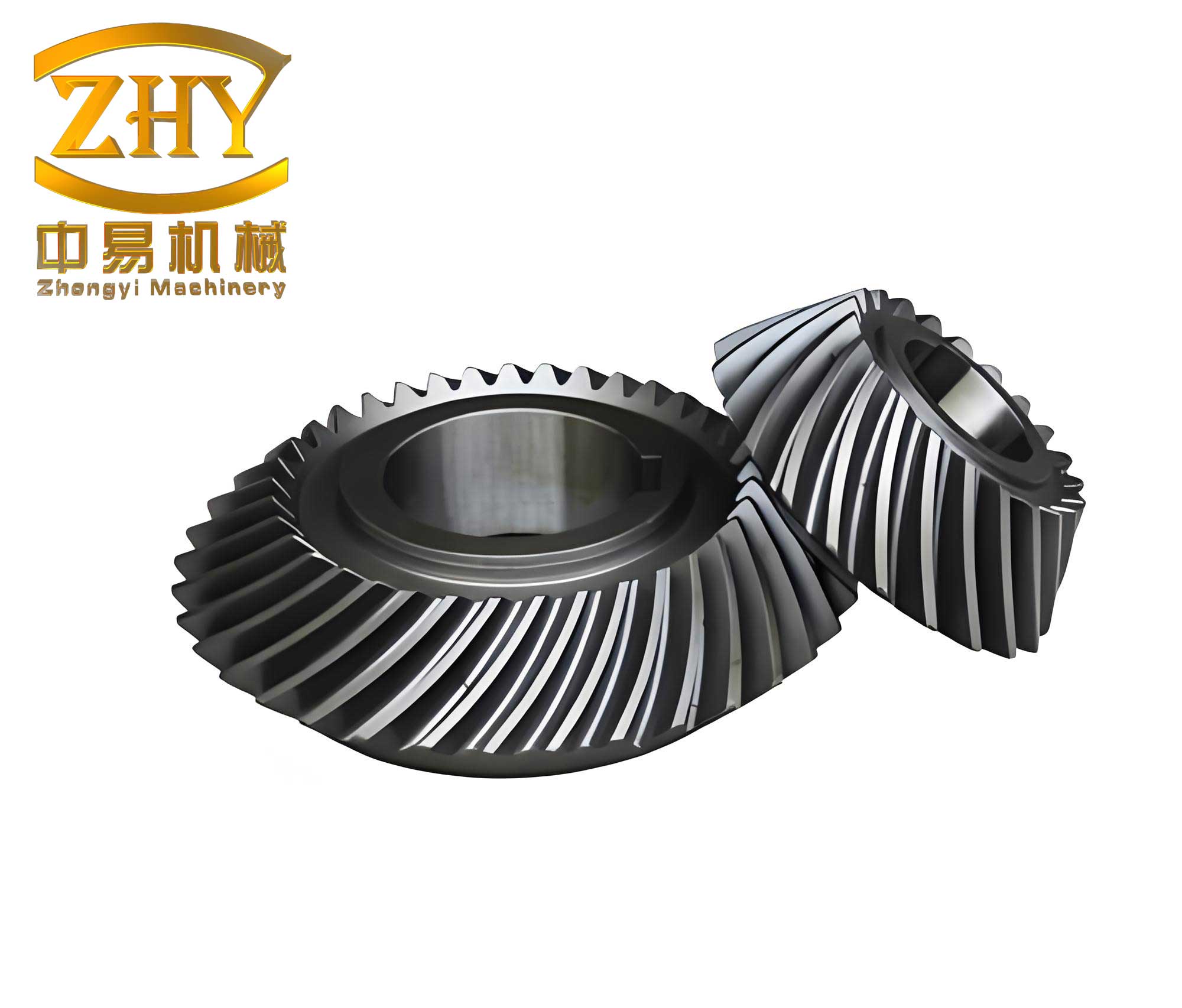
The geometry of the spiral gear is defined with key parameters: module of 1 mm, 16 teeth, pressure angle of 20°, and helix angle of 45°. These spiral gears are commonly used in precision instruments, where high surface integrity is paramount. The three-dimensional model is created using CAD software, and the fluid domain is constructed by enveloping the gear with an external confinement to form a closed flow channel. This approach allows for the simulation of abrasive flow through the inter-tooth spaces and along the helical surfaces of the spiral gears.
Mesh generation is performed with a focus on capturing the boundary layer effects near the gear surfaces. A tetrahedral mesh is applied, with refinement in regions of high curvature, such as the tooth flanks and roots of the spiral gears. The mesh independence test ensures that results are not affected by grid resolution. The fluid is modeled as a two-phase mixture, with the continuous phase being hydraulic oil and the dispersed phase consisting of silicon carbide (SiC) abrasive particles. The mixture model is employed to account for the interaction between phases, while the turbulence is described by the standard k-ε model. The governing equations for the mixture model include continuity, momentum, and energy equations. For turbulence, the transport equations for turbulent kinetic energy k and dissipation rate ε are solved.
The continuity equation for the mixture is:
$$ \frac{\partial \rho_m}{\partial t} + \nabla \cdot (\rho_m \mathbf{v}_m) = 0 $$
where $\rho_m$ is the mixture density and $\mathbf{v}_m$ is the mass-averaged velocity. The momentum equation is:
$$ \frac{\partial (\rho_m \mathbf{v}_m)}{\partial t} + \nabla \cdot (\rho_m \mathbf{v}_m \mathbf{v}_m) = -\nabla p + \nabla \cdot \left[ \mu_m (\nabla \mathbf{v}_m + \nabla \mathbf{v}_m^T) \right] + \rho_m \mathbf{g} + \mathbf{F} $$
where $p$ is pressure, $\mu_m$ is the mixture viscosity, $\mathbf{g}$ is gravity, and $\mathbf{F}$ represents external body forces. The turbulent kinetic energy k and dissipation rate ε are given by:
$$ \frac{\partial (\rho_m k)}{\partial t} + \nabla \cdot (\rho_m \mathbf{v}_m k) = \nabla \cdot \left[ \left( \mu_m + \frac{\mu_t}{\sigma_k} \right) \nabla k \right] + G_k – \rho_m \epsilon $$
$$ \frac{\partial (\rho_m \epsilon)}{\partial t} + \nabla \cdot (\rho_m \mathbf{v}_m \epsilon) = \nabla \cdot \left[ \left( \mu_m + \frac{\mu_t}{\sigma_\epsilon} \right) \nabla \epsilon \right] + C_{1\epsilon} \frac{\epsilon}{k} G_k – C_{2\epsilon} \rho_m \frac{\epsilon^2}{k} $$
where $\mu_t = \rho_m C_\mu \frac{k^2}{\epsilon}$ is the turbulent viscosity, and the empirical constants are $C_{1\epsilon}=1.44$, $C_{2\epsilon}=1.92$, $C_\mu=0.09$, $\sigma_k=1.0$, $\sigma_\epsilon=1.3$. The generation term $G_k$ is derived from the mean velocity gradients. For the dispersed phase, the particle volume fraction is set to 0.2, representing a balance between polishing efficiency and flowability. The particle diameter is assumed uniform at 10 μm, typical for fine finishing processes.
Boundary conditions are critical for accurate simulation. The inlet is defined as a velocity inlet, with velocities ranging from 30 m/s to 60 m/s to study the effect of flow rate. Both phases enter at the same velocity, with a turbulent intensity of 5% and hydraulic diameter based on the flow channel. The outlet is set as a pressure outlet with zero gauge pressure, assuming fully developed flow. The walls of the spiral gears are treated as no-slip boundaries, while the external confinement walls are adiabatic and stationary. The interaction between abrasive particles and gear surfaces is modeled using a discrete phase model (DPM) with rebound conditions, accounting for momentum transfer and energy dissipation during collisions.
The simulations are conducted using a transient approach, with convergence achieved after approximately 125 iterations. Results are post-processed to extract contour plots and quantitative data for parameters such as static pressure, dynamic pressure, turbulent kinetic energy, turbulent intensity, and wall shear stress. These parameters are indicative of the polishing effectiveness on the surfaces of spiral gears. The analysis is performed both axially (along the gear axis) and radially (across the tooth profile) to understand spatial variations.
Static pressure distributions on the spiral gears at different inlet velocities are shown in contour plots. At a given inlet velocity, the static pressure is highest at the upper regions of the teeth, where the fluid first impinges. As the flow progresses axially, the pressure decreases due to energy losses from the curved geometry of the spiral gears. The helical shape causes continuous changes in flow direction and cross-sectional area, leading to pressure drops. With increasing inlet velocity, the static pressure rises proportionally, enhancing the normal force on the gear surfaces. This is summarized in the table below for specific locations on the spiral gears.
| Inlet Velocity (m/s) | Upper Tooth Static Pressure (MPa) | Middle Tooth Static Pressure (MPa) | Lower Tooth Static Pressure (MPa) |
|---|---|---|---|
| 30 | 4.25 | 3.19 | 2.12 |
| 40 | 7.76 | 5.82 | 3.88 |
| 50 | 12.2 | 7.65 | 6.12 |
| 60 | 17.8 | 11.1 | 8.91 |
Dynamic pressure, representing the kinetic energy of the flow, also exhibits similar trends. The dynamic pressure is highest at the tooth tips of the spiral gears, where the flow channel is narrowest. Radially, the dynamic pressure decreases from the tip to the root due to the increasing cross-sectional area. The following table compares dynamic pressure at different radial positions.
| Inlet Velocity (m/s) | Tooth Tip Dynamic Pressure (MPa) | Tooth Root Dynamic Pressure (MPa) |
|---|---|---|
| 30 | 3.72 | 0.531 |
| 40 | 6.79 | 0.970 |
| 50 | 10.7 | 1.53 |
| 60 | 15.6 | 2.23 |
Turbulent kinetic energy (TKE) is a measure of the fluctuating velocity components, which promote mixing and enhance particle-wall interactions. For spiral gears, TKE is maximum near the inlet regions and gradually diminishes along the flow path. The helical teeth induce secondary flows and vortices, increasing turbulence in certain areas. At higher inlet velocities, TKE increases, but the gradient reduces at extreme velocities, suggesting a saturation effect. The turbulent intensity, defined as the ratio of turbulent velocity fluctuations to mean velocity, follows a comparable pattern. It is elevated at the tips of the spiral gears due to flow constriction and shear. The table below lists turbulent intensity values.
| Inlet Velocity (m/s) | Tooth Tip Turbulent Intensity (%) | Tooth Flank Turbulent Intensity (%) | Tooth Root Turbulent Intensity (%) |
|---|---|---|---|
| 30 | 16.6 | 9.78 | 4.29 |
| 40 | 21.3 | 12.5 | 5.50 |
| 50 | 25.9 | 15.2 | 6.68 |
| 60 | 30.3 | 17.8 | 7.83 |
Wall shear stress is directly related to the material removal rate in abrasive flow polishing. Higher shear stress implies greater frictional forces between abrasive particles and the gear surface. For spiral gears, the wall shear stress is most significant at the upper tooth regions and decreases axially. Radially, the shear stress is higher at the tips compared to the roots, aligning with the dynamic pressure distribution. The data is consolidated in the following table.
| Inlet Velocity (m/s) | Upper Tooth Wall Shear Stress (kPa) | Middle Tooth Wall Shear Stress (kPa) | Lower Tooth Wall Shear Stress (kPa) |
|---|---|---|---|
| 30 | 11.9 | 6.80 | 1.70 |
| 40 | 16.3 | 9.30 | 2.33 |
| 50 | 20.5 | 11.7 | 2.92 |
| 60 | 24.6 | 14.1 | 3.52 |
The material removal mechanism can be approximated using the Preston equation, which relates removal rate to pressure and velocity:
$$ R = K \cdot P \cdot v $$
where $R$ is the removal rate, $K$ is a constant, $P$ is pressure, and $v$ is velocity. For spiral gears, the effective velocity is influenced by the helical flow, and the pressure varies spatially. Integrating this over the gear surface, the overall polishing uniformity can be assessed. The non-uniformity in pressure and shear stress distributions leads to uneven material removal, which is a challenge for spiral gears. Optimization strategies may include adjusting the fixture design to equalize flow cross-sections or using multi-pass polishing with varying orientations.
From an axial perspective, the polishing efficacy on spiral gears diminishes along the flow direction due to energy dissipation. The initial sections experience vigorous polishing, but as the fluid navigates the helical passages, its momentum decays. Radially, regions with smaller flow gaps, such as tooth tips, undergo more intense polishing than roots. This is attributed to higher velocities and turbulent mixing in constricted areas. The geometry of spiral gears inherently creates varying flow conditions, which must be accounted for in process planning. To improve uniformity, one could modulate the inlet velocity profile or employ adaptive confinement geometries that compensate for cross-sectional changes.
The simulations also reveal that particle concentration plays a crucial role. While a volume fraction of 0.2 is used here, higher concentrations may increase collisions but risk clogging, especially in tight spaces of spiral gears. Conversely, lower concentrations reduce efficiency. Future studies could explore optimal particle size distributions and non-Newtonian fluid carriers to enhance performance. Additionally, the effect of helix angle on flow dynamics warrants investigation; steeper helix angles may exacerbate pressure losses but also increase tangential polishing actions.
In conclusion, the numerical simulation of solid-liquid two-phase abrasive flow polishing for spiral gears provides valuable insights into the complex flow interactions. Key findings indicate that inlet velocity positively correlates with polishing parameters, but spatial non-uniformity exists due to the helical geometry. Axially, polishing effectiveness declines along the flow path, while radially, tooth tips receive more attention than roots. To achieve high-quality finishing on spiral gears, process parameters such as velocity and particle concentration should be optimized, and fixture designs should aim to homogenize flow cross-sections. This research underscores the potential of CFD in advancing abrasive flow machining for complex components like spiral gears, paving the way for more precise and efficient manufacturing processes.
Further work could involve experimental validation of these simulations, possibly using 3D printed spiral gears and abrasive flow setups. Real-time monitoring of surface roughness and material removal could refine the models. Moreover, multi-phase simulations incorporating heat transfer and wear models would offer a more comprehensive understanding. The continuous evolution of ultra-precision machining technologies will benefit from such detailed analyses, ensuring that spiral gears meet the escalating demands of modern mechanical systems.