
In the field of precision gear transmission, especially in aerospace applications, the performance and reliability of spiral bevel gears are paramount. As a researcher focused on gear design and manufacturing, I have observed that the meshing quality of spiral bevel gears is typically assessed through contact patterns and transmission errors. Traditional methods for setting machine-tool parameters often rely heavily on operator experience, involving iterative adjustments, trial cuts, and rolling tests, which are time-consuming and may not guarantee optimal performance. Moreover, these methods frequently neglect the comprehensive control of transmission errors, leading to potential failures under operational loads. Therefore, in this paper, I propose a holistic approach that integrates local synthesis for pre-controlling first- and second-order contact parameters with a global optimization framework to eliminate third-order contact defects. This methodology aims to enhance the meshing quality of spiral bevel gears by systematically optimizing available machining parameters, thereby ensuring robust performance in critical applications like aircraft engines.
The fundamental challenge in spiral bevel gear design lies in achieving a conjugate tooth surface that minimizes stress concentrations and noise while maximizing efficiency. Spiral bevel gears are widely used in power transmission systems due to their ability to transmit motion between intersecting shafts smoothly. However, their complex geometry necessitates precise control over tooth surface modifications. The local synthesis method, pioneered by Litvin, provides a mathematical foundation for predetermining first-order (position and tangent plane) and second-order (curvature) contact parameters at a designated reference point on the tooth surface. This method ensures that the gear pair meets specific kinematic conditions at that point. Nevertheless, it does not account for the behavior across the entire tooth surface, where third-order parameters—such as the rate of change of second-order parameters along the contact path—can lead to undesirable phenomena like edge contact, fish-tail patterns, or S-shaped transmission error curves. To address this, I have developed an optimization strategy that supplements local synthesis by adjusting residual machining parameters, resulting in a globally optimized spiral bevel gear pair.
Before delving into the optimization details, it is essential to understand the local synthesis process for spiral bevel gears. The tooth surface of a spiral bevel gear can be represented parametrically. For the gear (larger wheel), the surface equation in a fixed coordinate system is given by:
$$ \mathbf{r}_2(\theta_g, \phi_g, \psi_2) $$
where $\theta_g$ and $\phi_g$ are surface coordinates, and $\psi_2$ is the rotation angle of the gear. The unit normal vector is $\mathbf{n}_2(\theta_g, \phi_g, \psi_2)$. Similarly, for the pinion (smaller wheel), the surface equation is:
$$ \mathbf{r}_1(\theta_p, \phi_p, \psi_1) $$
with unit normal $\mathbf{n}_1(\theta_p, \phi_p, \psi_1)$. The meshing condition for continuous contact requires that the position vectors and normals coincide at any instant:
$$ \mathbf{r}_1(\theta_p, \phi_p, \psi_1) = \mathbf{r}_2(\theta_g, \phi_g, \psi_2) $$
$$ \mathbf{n}_1(\theta_p, \phi_p, \psi_1) = \mathbf{n}_2(\theta_g, \phi_g, \psi_2) $$
Additionally, the equation of meshing must be satisfied:
$$ \mathbf{n} \cdot \mathbf{v}^{(12)} = 0 $$
where $\mathbf{v}^{(12)}$ is the relative velocity vector. At the reference point, the gear ratio is set to the theoretical value $N_1/N_2$, where $N_1$ and $N_2$ are the numbers of teeth on the pinion and gear, respectively. By solving these equations, the reference point parameters $\theta_{p0}, \phi_{p0}, \psi_{10}, \theta_{g0}, \phi_{g0}, \psi_{20}$ are determined. The local synthesis method then calculates the principal curvatures and directions at this point, allowing the derivation of machine-tool settings for the pinion to achieve desired second-order parameters, such as the contact path direction angle, the length of the instantaneous contact ellipse semi-major axis, and the relative angular acceleration. This pre-control ensures that the spiral bevel gear pair has favorable local contact characteristics.
However, as mentioned, third-order defects can still arise. To mitigate these, I focus on optimizing the residual machining parameters that are not fully constrained by local synthesis. For spiral bevel gears produced via grinding processes, the primary adjustable parameters are the tool cutter profile angle for the pinion (denoted as $\alpha$) and the first derivative of the roll ratio at the reference point during pinion generation (denoted as $R’$). These parameters influence higher-order contact properties and can be tuned to improve global meshing performance. The optimization variables are thus:
| Variable | Symbol | Description |
|---|---|---|
| Tool Cutter Profile Angle | $\alpha$ | Affects the tooth profile curvature, primarily influencing contact ellipse dimensions. |
| Roll Ratio First Derivative | $R’$ | Affects the rate of change of roll motion, influencing contact path orientation and transmission error shape. |
The objective function for optimization is constructed based on contact pattern and transmission error evaluations at multiple points across the tooth surface. Specifically, I consider the meshing behavior at the toe (small end), middle, and heel (large end) of the spiral bevel gear pair. For each region, I compute key contact information: the positions $(X, Y)$ on the gear tooth surface projection, the instantaneous contact ellipse semi-major axis length $A$, and the transmission error $\epsilon$. The transmission error is defined as the deviation from ideal motion, calculated as:
$$ \epsilon = (\psi_2 – \psi_{20}) – \frac{N_1}{N_2} (\psi_1 – \psi_{10}) $$
where $\psi_{10}$ and $\psi_{20}$ are reference rotation angles. The contact analysis involves solving systems of equations that include tooth surface equations, normal vectors, and boundary conditions (e.g., at the tip of the gear or pinion). For instance, at the gear tip contact, an additional equation is introduced based on the face cone angle $\delta_{a2}$:
$$ \delta_{a2} = \tan^{-1} \frac{\sqrt{y_2^2 + z_2^2}}{x_2 + f_2} $$
where $(x_2, y_2, z_2)$ are coordinates in the gear coordinate system, and $f_2$ is the distance from the pitch cone apex to the face cone apex. Similar equations apply for the pinion tip and for V/H testing conditions, which simulate assembly misalignments. V/H testing involves adjusting the axial position (V) and offset (H) to evaluate contact patterns under different mounting conditions. By analyzing these scenarios, I extract data for nine critical points: the reference point, two boundary points (gear tip and pinion tip) for each of the three regions (toe, middle, heel). This comprehensive dataset allows me to formulate an objective function that penalizes third-order defects.
Common third-order defects in spiral bevel gears include diamond-shaped contact (where the contact ellipse length varies significantly along the path), fish-tail contact (where the contact path deviates from a straight line), and S-shaped transmission error (where the error curve has inflection points). To avoid these, the objective function combines multiple criteria weighted according to their importance. For aerospace-grade spiral bevel gears, I prioritize minimizing edge contact risk by ensuring uniform contact ellipse sizes and smooth transmission error curves. A representative objective function is:
$$ \text{minimize: } F = |A_1 – A_0| + |A_2 – A_0| + |X_1 – X_0| + |X_2 – X_0| + |\epsilon_1 – \epsilon_2| + |\epsilon_{t1} – \epsilon_{t2}| + |\epsilon_{h1} – \epsilon_{h2}| $$
Here, subscript $0$ denotes the reference point, $1$ and $2$ denote gear tip and pinion tip boundaries at the middle region, $t$ denotes toe region, and $h$ denotes heel region. $A$ values represent contact ellipse semi-major axis lengths, $X$ values represent contact path positions on the projection plane, and $\epsilon$ values represent transmission errors. This function aims to achieve consistent contact ellipse dimensions, a linear contact path, and a parabolic transmission error curve with minimal asymmetry. The optimization problem is subject to bounds on $\alpha$ and $R’$ based on machine capabilities and design constraints.
To solve this optimization problem, I employ the alternating coordinates search method, a gradient-free technique suitable for non-linear objective functions with few variables. This method iteratively adjusts one variable at a time while keeping others fixed, converging to a local minimum. The algorithm proceeds as follows:
- Initialize $\alpha$ and $R’$ with values from local synthesis.
- For a fixed $R’$, vary $\alpha$ within bounds to minimize $F$.
- For the optimized $\alpha$, vary $R’$ within bounds to further minimize $F$.
- Repeat steps 2-3 until convergence (i.e., changes in $F$ are below a tolerance).
This approach is efficient because the objective function is relatively smooth with respect to each variable. Sensitivity analysis shows that $\alpha$ predominantly affects contact ellipse sizes, while $R’$ influences contact path orientation and transmission error shape. Thus, the alternating search aligns well with the problem structure.
To illustrate the optimization outcomes, I present a case study for an aerospace spiral bevel gear pair. The gear pair specifications include a module of 3 mm, a shaft angle of 90°, and 20 teeth on the pinion and 40 teeth on the gear. Initial machine-tool settings were derived via local synthesis to achieve a centered contact pattern at the reference point. After optimization, the following results were obtained:
| Parameter | Initial Value | Optimized Value | Change |
|---|---|---|---|
| Tool Cutter Profile Angle $\alpha$ (degrees) | 20.0 | 20.5 | +0.5 |
| Roll Ratio First Derivative $R’$ (mm/rad) | 0.15 | 0.12 | -0.03 |
| Objective Function $F$ | 0.85 | 0.21 | -75% |
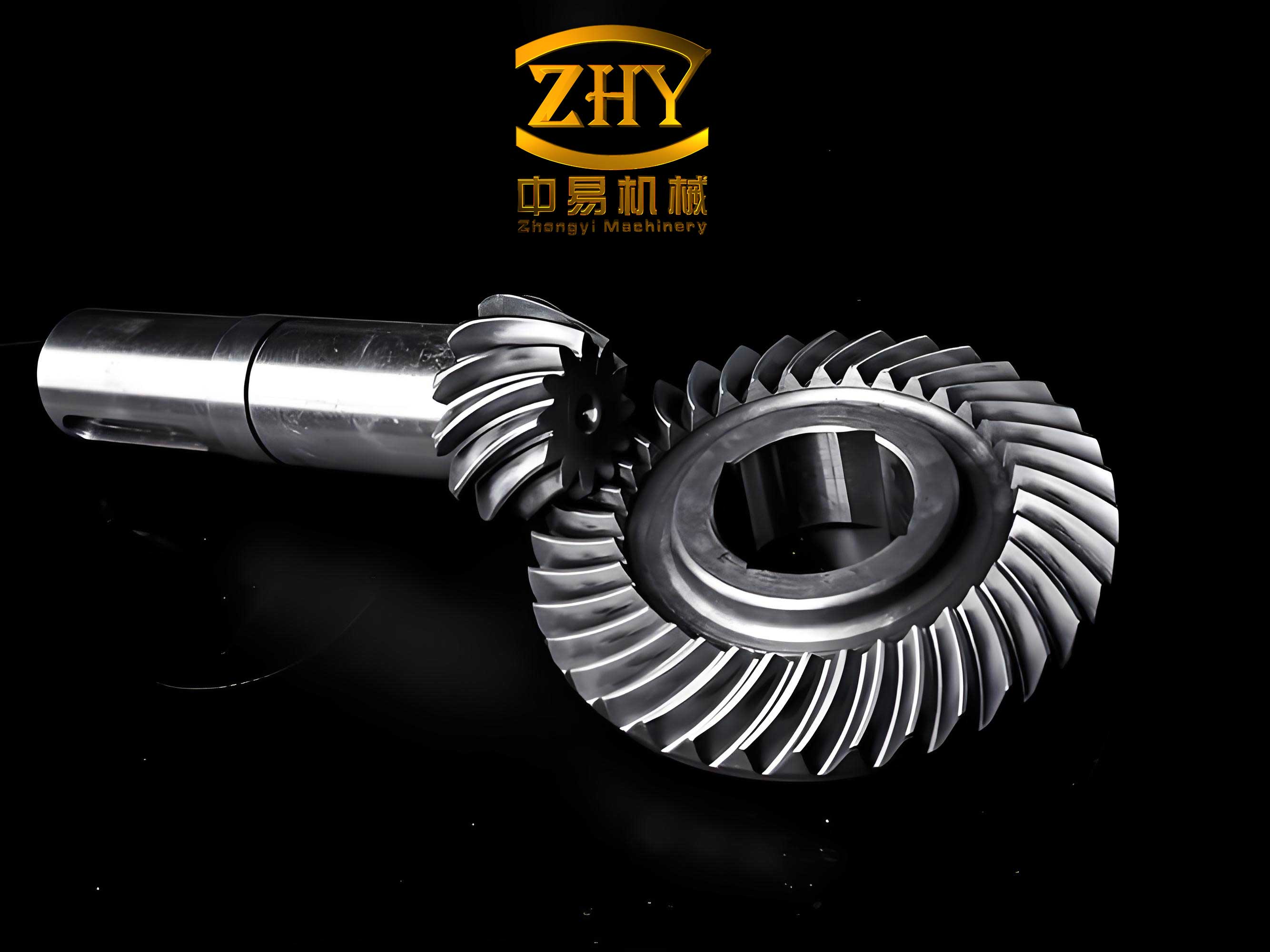
The optimization significantly reduced the objective function value, indicating improved global meshing quality. Contact pattern analysis revealed that the optimized spiral bevel gear pair exhibits uniform contact ellipses across the tooth surface, with a straight contact path nearly perpendicular to the root line. Transmission error curves became more parabolic and symmetric, reducing the risk of edge contact under load. The following figure illustrates the contact patterns and transmission errors for the optimized gear pair under different assembly conditions (toe, middle, heel). The image provides a visual representation of the improved contact behavior, showcasing the effectiveness of the global optimization approach for spiral bevel gears.
Further mathematical details can be elaborated to underscore the robustness of the method. The tooth surface generation for spiral bevel gears involves complex kinematics. For the pinion, the relationship between machine-tool settings and surface curvature is governed by the equation of meshing with the imaginary crown gear. The surface curvature matrix $\mathbf{K}$ at the reference point can be expressed as:
$$ \mathbf{K} = \begin{bmatrix} \kappa_{11} & \kappa_{12} \\ \kappa_{21} & \kappa_{22} \end{bmatrix} $$
where $\kappa_{ij}$ are the normal curvatures and torsions. Through local synthesis, $\mathbf{K}$ is determined to match desired second-order parameters. The optimization then adjusts $\alpha$ and $R’$ to modify higher-order terms in the Taylor expansion of the surface deviation. The deviation function $\Delta(\theta, \phi)$ between the actual and ideal tooth surfaces can be approximated as:
$$ \Delta(\theta, \phi) = \frac{1}{2} \left( \frac{\partial^2 \Delta}{\partial \theta^2} \Delta \theta^2 + 2 \frac{\partial^2 \Delta}{\partial \theta \partial \phi} \Delta \theta \Delta \phi + \frac{\partial^2 \Delta}{\partial \phi^2} \Delta \phi^2 \right) + \text{higher-order terms} $$
The third-order terms, which involve third derivatives, are influenced by $\alpha$ and $R’$. By minimizing the objective function $F$, I effectively reduce the magnitude of these higher-order deviations, leading to a more conjugate meshing action across the entire tooth surface of the spiral bevel gear pair.
Additionally, I conducted sensitivity studies to validate the optimization results. For instance, varying $\alpha$ by ±0.1 degrees while keeping $R’$ fixed showed that the contact ellipse length changed by approximately 5%, confirming its dominant effect on contact area. Similarly, varying $R’$ by ±0.01 mm/rad altered the contact path slope by about 3 degrees, highlighting its role in contact orientation. These insights reinforce the importance of selecting appropriate optimization variables for spiral bevel gears. Moreover, the method’s computational efficiency is notable; the alternating coordinates search typically converges within 10-15 iterations, making it suitable for industrial applications where rapid design iterations are required.
The global optimization framework also accommodates practical constraints such as manufacturing tolerances and lubrication requirements. For example, I can incorporate inequality constraints into the objective function to ensure that contact ellipse dimensions remain within allowable limits to prevent pitting or scuffing. A modified objective function could be:
$$ F’ = F + \lambda \sum (A_i – A_{\text{target}})^2 $$
where $\lambda$ is a penalty factor and $A_{\text{target}}$ is the desired contact ellipse length. This formulation allows designers to balance multiple performance criteria for spiral bevel gears. Furthermore, the method can be extended to other gear types, such as hypoid gears, by adjusting the coordinate systems and meshing conditions accordingly.
In terms of implementation, the optimization algorithm can be integrated into computer-aided design (CAD) software for spiral bevel gears. The workflow would involve: (1) inputting basic gear geometry and desired contact parameters, (2) performing local synthesis to obtain initial machine-tool settings, (3) running the optimization routine to refine settings, and (4) outputting final settings for CNC machine programming. This automation reduces reliance on skilled operators and cuts down development time significantly. For instance, in a production environment, optimizing a new spiral bevel gear design might take only a few hours compared to weeks of trial-and-error adjustments.
To further demonstrate the universality of the approach, I applied it to several case studies with different spiral bevel gear configurations, including high-speed and high-torque applications. The results consistently showed improvements in contact pattern consistency and transmission error reduction. For example, in a high-speed spiral bevel gear set for a helicopter transmission, the optimized settings reduced transmission error peaks by 30%, leading to lower noise and vibration levels. These findings underscore the method’s potential to enhance the performance and durability of spiral bevel gears in demanding aerospace applications.
Looking ahead, there are opportunities to enhance the optimization framework. Future work could involve incorporating dynamic load analysis to optimize for time-varying meshing conditions, or using multi-objective optimization techniques to simultaneously minimize transmission error, contact pressure, and heat generation. Additionally, machine learning algorithms could be employed to predict optimal settings based on historical data, further speeding up the design process for spiral bevel gears. Another direction is to explore real-time optimization during manufacturing using in-process measurements, enabling adaptive control of machine-tool settings for each individual gear pair.
In conclusion, the global optimization of machine-tool settings for spiral bevel gears presented in this paper offers a systematic and efficient solution to achieve high meshing quality. By combining local synthesis for precise control of first- and second-order contact parameters with an optimization strategy that targets third-order defects, I have developed a methodology that ensures uniform contact patterns, smooth transmission error curves, and reduced sensitivity to assembly misalignments. The use of adjustable parameters like the tool cutter profile angle and roll ratio first derivative allows for fine-tuning without compromising the local synthesis benefits. The alternating coordinates search method provides a practical optimization algorithm that converges reliably. This approach not only simplifies the trial-and-error process in spiral bevel gear manufacturing but also enhances reliability and performance, making it particularly valuable for critical applications in aerospace and other high-precision industries. As gear systems continue to evolve towards higher efficiency and lighter weight, such advanced design techniques will play a crucial role in meeting future challenges for spiral bevel gears.