
In industrial applications, screw gear reducers, commonly known as worm gear reducers, are pivotal for transmitting power in low-speed, high-torque scenarios. Their ability to provide large reduction ratios and smooth operation makes them indispensable in sectors like chemical processing, mechanical manufacturing, and automated production lines. However, these reducers are prone to various faults that can disrupt production and pose safety risks. Based on my experience and technical knowledge, this article delves into the characteristics, structure, and common failures of screw gear reducers, with a focus on the RV series, and proposes comprehensive maintenance strategies. Throughout, the term “screw gears” will be emphasized to highlight the core components involved in these systems.
Screw gear reducers function as power transmission mechanisms, converting high-speed motor rotation into lower speeds while amplifying torque. They are widely adopted due to their compact design and high efficiency. The RV series, in particular, features a lightweight cast aluminum housing that enhances heat dissipation. Key components include the screw gear (worm), gear wheel (worm wheel), seals, bearings, and housing. The screw gear, typically made of hardened steel, engages with a gear wheel often composed of bronze or advanced alloys, ensuring durability under heavy loads. Understanding these elements is crucial for fault diagnosis and prevention.
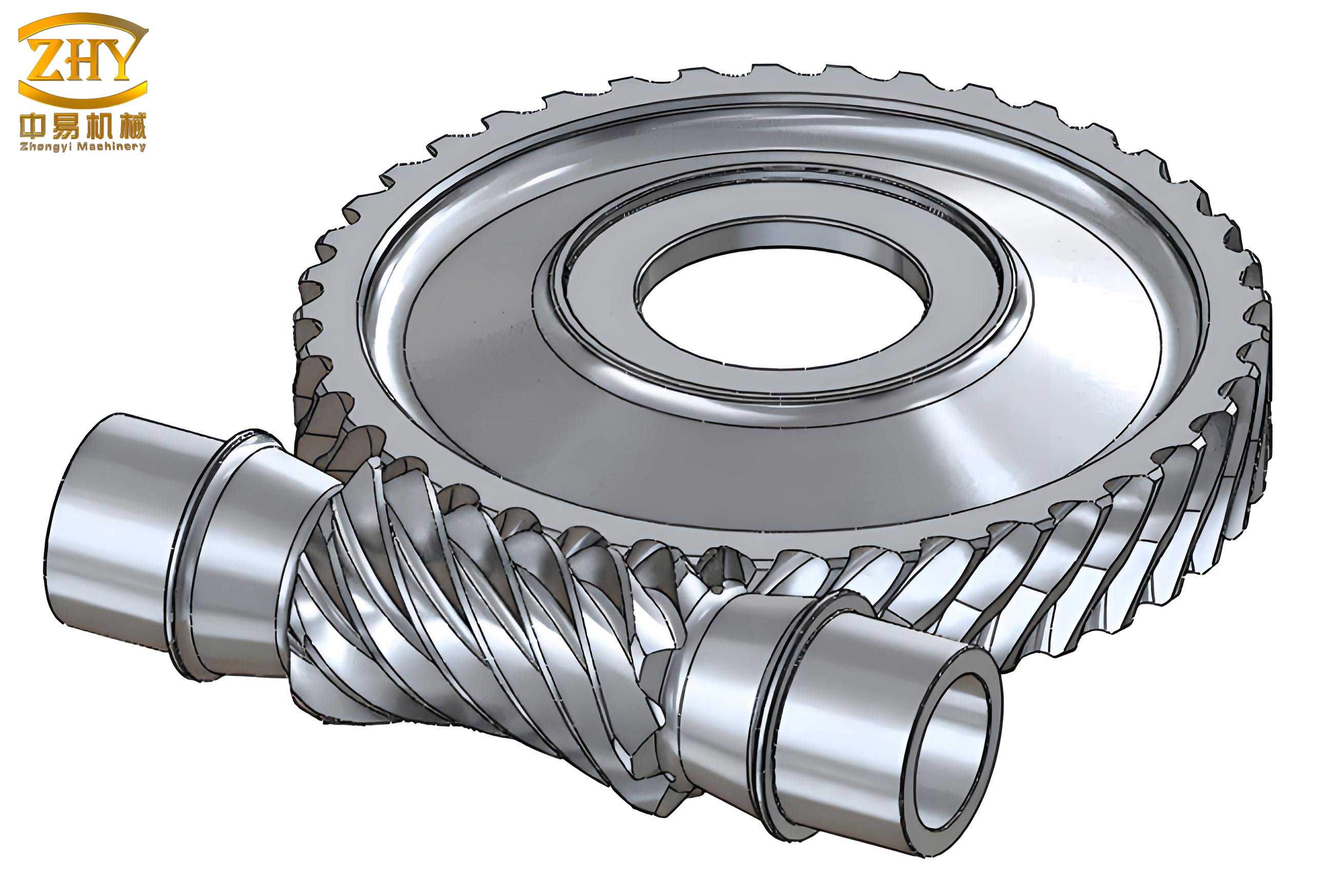
The mechanical structure of screw gear reducers, as illustrated in the RV series, comprises several critical parts. The screw gear transmits motion to the gear wheel, with bearings supporting rotation and seals preventing oil leakage. Proper alignment and lubrication are essential to minimize wear. The design often incorporates oil seals made of nitrile or fluorocarbon rubber for high-temperature resistance, and oil plugs for easy lubricant changes. This compact arrangement allows for efficient power transmission in confined spaces, but it also makes the system susceptible to issues if not maintained correctly.
Screw gears can be classified into three main transmission types, each with distinct advantages. Cylindrical screw gears, including Archimedes, involute, and normal straight-sided variants, offer high efficiency and precision. Enveloping screw gears provide superior load capacity and smoother operation due to better oil film formation. Cone screw gears enable multiple tooth engagement, enhancing durability and torque handling. The selection of screw gear type depends on application requirements, such as speed, load, and environmental conditions. For instance, involute screw gears are preferred for high-speed applications, while enveloping screw gears excel in heavy-duty scenarios.
The materials used for screw gears and gear wheels significantly impact performance and lifespan. Screw gears are commonly fabricated from carbon or alloy steels, such as 40Cr or 20CrMnTi, hardened to resist wear. Gear wheels often employ bronze (e.g., ZCuSn10P1) or cast iron for its耐磨性. Recent advancements include zinc-aluminum alloys (e.g., ZA27), which offer comparable friction properties to bronze at lower cost and extended service life. The material pairing must consider factors like sliding velocity and load to prevent premature failure. For example, at sliding speeds above 3 m/s, bronze is recommended, while cast iron suits speeds below 2 m/s.
To quantify the performance of screw gear reducers, mathematical models are essential. The reduction ratio (i) is given by: $$i = \frac{N_1}{N_2}$$ where $N_1$ is the rotational speed of the screw gear and $N_2$ is the speed of the gear wheel. The efficiency (η) can be approximated using: $$\eta = \frac{\tan(\lambda)}{\tan(\lambda + \phi)}$$ where $\lambda$ is the lead angle of the screw gear and $\phi$ is the friction angle. Wear rate (W) may be modeled as: $$W = k \cdot P \cdot v$$ with $k$ as a material constant, $P$ as contact pressure, and $v$ as sliding velocity. These formulas help in designing and troubleshooting screw gear systems.
Common faults in screw gear reducers can be categorized into five types: overheating, oil leakage, vibration, wear, and noise. Each fault stems from specific causes and requires tailored solutions. Below, a table summarizes these faults, causes, and corrective actions to aid quick reference.
| Fault Type | Common Causes | Recommended Solutions |
|---|---|---|
| Overheating | Misalignment with driven equipment, overload, excessive or insufficient lubricant, poor lubricant quality, seal friction. | Realign axes, reduce load, adjust lubricant level, replace with suitable oil, lubricate seal lip. |
| Oil Leakage | Worn seal lip, damaged shaft neck, loose drain plug, broken oil gauge. | Replace seal, repair or replace shaft, tighten plug with sealant, install new oil gauge. |
| Vibration | Loose mounting, worn screw gears or gear wheels, bearing wear, loose bolts. | Secure reducer and driven machine, replace gear set, install new bearings, tighten all bolts. |
| Wear | Overload, improper lubricant, low lubricant level, infrequent oil changes, high ambient temperature. | Adjust load, use correct lubricant, refill oil, follow oil change schedule, improve cooling. |
| Noise | Misalignment, damaged bearings, poor gear meshing, insufficient lubrication. | Realign connections, replace bearings, repair or replace gears, add lubricant as per manual. |
Overheating in screw gear reducers often results from operational or maintenance lapses. Misalignment between the reducer and driven machine induces additional friction, raising temperatures. Overload exceeds the design capacity, while lubricant issues—either in quantity or quality—hinder heat dissipation. For instance, using a lubricant with high viscosity can increase churning losses. To address this, regular alignment checks and load monitoring are vital. The thermal balance can be expressed as: $$Q_{generated} = Q_{dissipated}$$ where $Q_{generated}$ is heat from friction and $Q_{dissipated}$ is heat lost through housing and oil. Maintaining this equilibrium prevents thermal damage.
Oil leakage is a frequent issue that compromises lubrication and contaminates environments. Seal degradation due to aging or abrasive wear is a primary cause. Shaft wear at seal contact points exacerbates leakage. Preventive measures include using high-quality seals and inspecting shaft surfaces. The leakage rate (L) can be estimated by: $$L = C \cdot \Delta P \cdot d^3 / \mu$$ where $C$ is a constant, $\Delta P$ is pressure difference, $d$ is seal gap, and $\mu$ is oil viscosity. Ensuring tight seals and proper installation minimizes this fault.
Vibration in screw gear systems signals mechanical instability. Loose fasteners or worn components, such as bearings or screw gears, generate harmonic oscillations. This not only reduces efficiency but also accelerates failure. Dynamic analysis tools, like vibration spectrums, help identify fault frequencies. For example, bearing defect frequency (f_b) is given by: $$f_b = \frac{N}{60} \cdot k$$ with $N$ as shaft speed in RPM and $k$ as a bearing constant. Regular vibration monitoring and tightening of mounts can mitigate this issue.
Wear of screw gears and gear wheels is inevitable but manageable. Abrasive wear occurs due to contaminant ingress, while adhesive wear results from inadequate lubrication. The wear volume (V) over time (t) can be modeled with Archard’s equation: $$V = K \cdot W \cdot s / H$$ where $K$ is a wear coefficient, $W$ is load, $s$ is sliding distance, and $H$ is material hardness. Using advanced materials like zinc-aluminum alloys for gear wheels reduces wear rates. Additionally, maintaining clean lubricant and optimal operating conditions extends component life.
Noise generation in screw gear reducers often indicates misalignment or component wear. Poor meshing between screw gears and gear wheels creates irregular sound patterns. Bearing defects produce characteristic squeals or rumbles. Acoustic analysis can pinpoint these issues. The sound pressure level (SPL) relates to vibration amplitude: $$SPL = 20 \log_{10}(p / p_0)$$ where $p$ is sound pressure and $p_0$ is reference pressure. Proper lubrication and alignment reduce noise, ensuring smoother operation.
Maintenance of screw gear reducers is critical for longevity. Key practices include operating within an ambient temperature range of -10°C to +40°C, regular oil checks using level indicators, and timely oil changes every 4-6 months. If a reducer is stored, seals should be inspected for hardening or adhesion. Lubricant selection must match manufacturer specifications—typically ISO VG 220 or similar for screw gears. A maintenance schedule table can streamline these tasks:
| Maintenance Activity | Frequency | Action |
|---|---|---|
| Oil level inspection | Weekly | Check via oil gauge and top up if needed. |
| Alignment check | Monthly | Verify reducer and driven machine alignment. |
| Vibration analysis | Quarterly | Use sensors to detect abnormal vibrations. |
| Oil change | Every 6 months | Drain old oil, flush, and refill with fresh lubricant. |
| Seal inspection | Annually | Replace seals if signs of wear or leakage appear. |
Material advancements continue to enhance screw gear reducer reliability. Zinc-aluminum alloys, for instance, offer a cost-effective alternative to traditional bronze, with wear rates up to five times lower. The yield strength (σ_y) of ZA27 is approximately 400 MPa, compared to 250 MPa for tin bronze, making it suitable for high-load applications. Material selection formulas consider factors like pv value (pressure × velocity): $$pv = P \cdot v$$ where exceeding limits leads to rapid wear. By optimizing materials, screw gear systems achieve longer service intervals and reduced downtime.
In conclusion, screw gear reducers are vital for industrial machinery, but their performance hinges on proper operation and maintenance. By understanding common faults—overheating, leakage, vibration, wear, and noise—and implementing proactive measures, such as regular inspections and material upgrades, users can extend equipment life and ensure safety. Emphasizing the role of screw gears in transmission systems underscores their importance. Continuous improvement in design and maintenance protocols will further solidify their position as a reliable solution for high-torque, low-speed applications across diverse industries.