
The pursuit of high-performance power transmission in heavy industries such as mining, metallurgy, cement, oil, and shipping has driven an increasing demand for large-module, large-diameter spiral bevel gears. Compared to straight bevel gears, spiral bevel gears offer significant advantages, including a larger contact ratio, higher load-carrying capacity, longer service life, and the ability to achieve higher transmission ratios. However, the final heat treatment processes like carburizing, quenching, and induction hardening inevitably introduce distortions in the gear tooth geometry. To achieve the required precision for these critical components, a finishing operation is essential.
Traditionally, grinding is the preferred method for finishing hardened gears. However, for gears exceeding 1200 mm in diameter, capable grinding machines are extremely scarce and prohibitively expensive. In the absence of such large-scale grinding equipment, our company has successfully implemented a hard skiving process on a YH6016 type CNC spiral bevel gear milling machine. This process involves removing a thin layer of metal from the hardened tooth flanks using carbide tools to correct heat treatment distortions. This method offers a compelling combination of relatively low cost and high efficiency for finishing large-scale hardened spiral bevel gears.
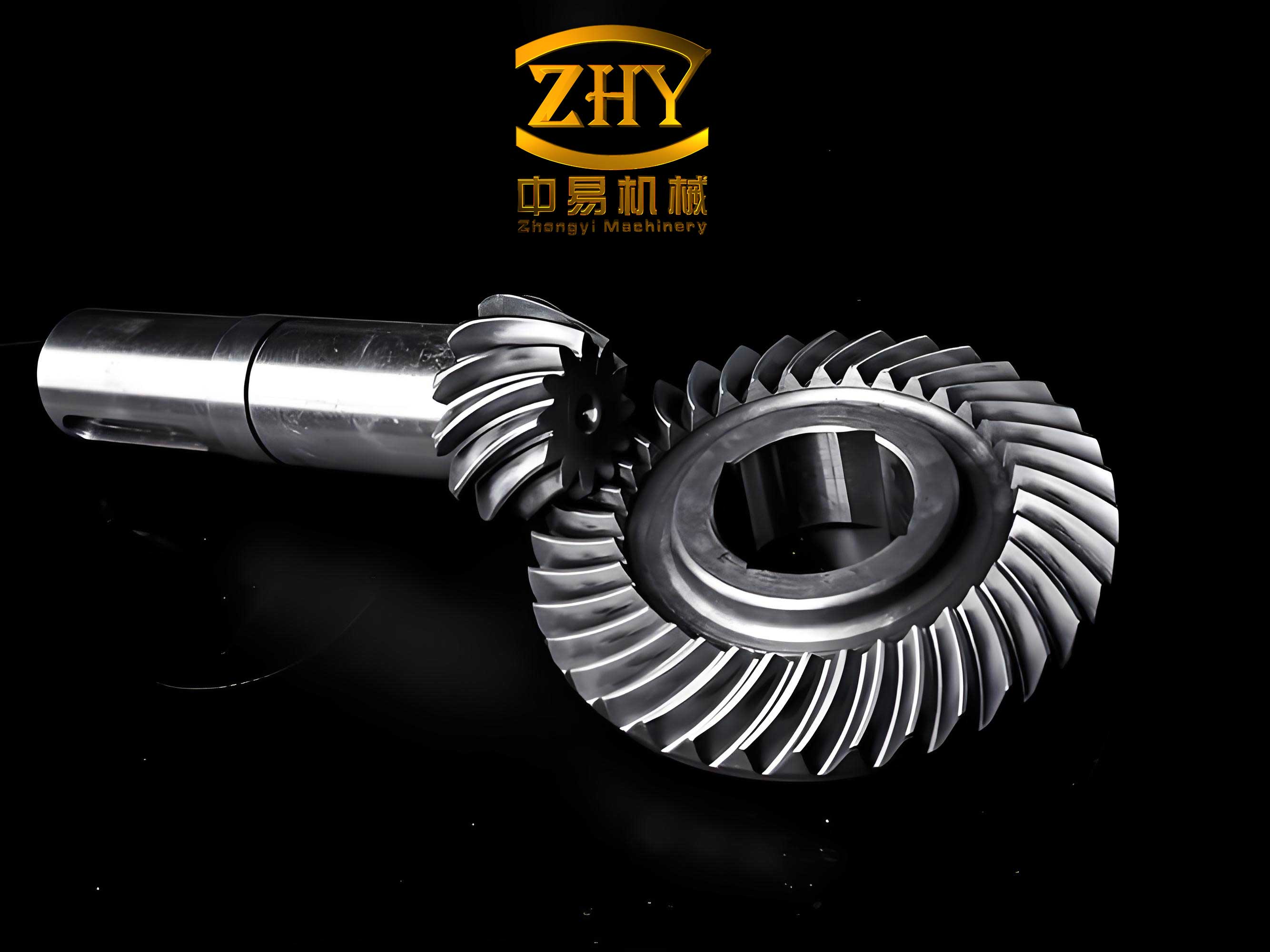
1. Technical Requirements for Machine, Fixture, and Tooling
The successful implementation of hard skiving for spiral bevel gears hinges on the stability and precision of the machining system. The process places high demands on the machine tool, workpiece fixturing, and the cutting tools themselves.
1.1 Machine Tool Capability
The domestic YH6016 CNC spiral bevel gear milling machine forms the backbone of this process. It is a four-axis CNC machine directly controlled by a numerical system. For hard skiving, the machine must possess high static and dynamic stiffness to resist cutting forces, a short and non-compliant drive train, high spindle power, and sufficient vibration damping capacity. The YH6016 meets these criteria, enabling it to handle the rigors of cutting into hardened surfaces.
1.2 Fixture and Workpiece Installation
The final accuracy of the machined spiral bevel gear is not solely dependent on the machine’s innate precision. The fixture and the installation of the gear play an equally critical role. A meticulous setup procedure is mandatory:
- Runout Control: The radial and axial runout of both the machine spindle and the workpiece mandrel must be checked and adjusted to be ≤ 0.015 mm.
- Parallelism of Spacers: The parallelism of the clamping spacer faces must be ≤ 0.008 mm.
- Secure Mounting: The gear must be mounted steadily and securely on the machine. The installed setup must be verified after clamping. Excessive installation error will not only compromise the final gear quality but also pose a significant risk of catastrophic tool failure.
The following table summarizes the key installation accuracy requirements:
| Component | Parameter | Tolerance (mm) |
|---|---|---|
| Machine Spindle | Radial Runout | ≤ 0.015 |
| Machine Spindle | Face Runout | ≤ 0.015 |
| Workpiece Mandrel | Radial Runout | ≤ 0.015 |
| Workpiece Mandrel | Face Runout | ≤ 0.015 |
| Clamping Spacers | Face Parallelism | ≤ 0.008 |
1.3 Cutting Tool Requirements
The principle of hard skiving for spiral bevel gears is analogous to soft cutting, typically employing the Single Side (Single Indexing) method with a single cutter head. The key difference lies in the cutting edges.
- Toolholder: A standard single-sided finishing cutter head (blade group) is used.
- Inserts: The standard HSS blades for soft cutting are replaced with dedicated carbide insert tips for spiral bevel gear skiving. A typical setup uses 6 inside blade tips and 6 outside blade tips.
- Carbide Properties: Carbide inserts are chosen for their excellent combination of bending strength, thermal conductivity, heat resistance, and wear resistance—properties essential for maintaining accuracy and tool life during the hard finishing operation.
- Toolholder Runout: After mounting the assembled cutter head on the machine spindle, its radial runout must be checked and corrected to within 0.015 mm to ensure uniform cutting load across all inserts.
2. Analysis of Target Spiral Bevel Gear Parameters
The development and refinement of the skiving process were conducted on a large spiral bevel gear set intended for heavy-duty mining equipment. A detailed analysis of the gear pair’s parameters is fundamental to defining the correct manufacturing and skiving strategy. The gear system follows the Gleason design methodology.
| Parameter | Pinion (Small Gear) | Gear (Large Ring) |
|---|---|---|
| Tooth System | Gleason | |
| Module (at large end), m | 26.5 mm | |
| Number of Teeth, z | 15 | 55 |
| Pressure Angle, α | 20° | |
| Mean Spiral Angle, β | 35° | |
| Shaft Angle, Σ | 90° | |
| Outer Cone Distance, Le | 755.36 mm | |
| Whole Depth, H | 50.032 mm | |
| Face Width, B | 130 mm | |
| Normal Clearance, j | 1.1 – 1.3 mm | |
| Cutter Diameter, Do | 40″ (1016 mm) | |
| Hand of Spiral | Right Hand | Left Hand |
| Target Accuracy Grade | GB11365 – Grade 6 | |
The geometry of a spiral bevel gear is complex. Key formulas governing the basic geometry include the calculation of the pitch cone angle (δ) for the gear and pinion. For a 90° shaft angle (Σ=90°), the pitch cone angles are determined by the tooth ratio:
$$ \delta_{\text{gear}} = \arctan\left(\frac{z_{\text{gear}}}{z_{\text{pinion}}}\right) = \arctan\left(\frac{55}{15}\right) $$
$$ \delta_{\text{pinion}} = 90^\circ – \delta_{\text{gear}} $$
The outer cone distance (Le) is a critical starting dimension for all subsequent gear calculations, relating the pitch diameter at the large end (de) to the pitch cone angle:
$$ L_e = \frac{d_{e,\text{gear}}}{2 \sin(\delta_{\text{gear}})} = \frac{d_{e,\text{pinion}}}{2 \sin(\delta_{\text{pinion}})} $$
where $d_e = m \cdot z$.
3. Defining the Gear Manufacturing and Skiving Process
A comprehensive process plan is essential, encompassing material selection, heat treatment, soft machining (pre-skiving), and the final hard skiving operation for the spiral bevel gears.
3.1 Material and Heat Treatment Strategy
The two members of the spiral bevel gear pair are manufactured from different alloys suited to their operational stresses and required hardness profiles.
| Component | Material | Core Properties | Heat Treatment | Tooth Flank Hardness | Hardened Case Depth |
|---|---|---|---|---|---|
| Large Gear | 42CrMo (Medium Carbon Alloy Steel) | High Strength & Toughness | Single-tooth Laser Hardening | 50 – 55 HRC | 2.0 – 2.5 mm |
| Small Pinion | 20CrNi2Mo (Low Carbon Alloy Steel) | Good Hardenability, Low Distortion Tendency | Carburizing & Quenching | 58 – 62 HRC | Specified per design |
Process Route for the Large Spiral Bevel Gear Ring: Forging → Rough Machining → UT Inspection → Rough Turning → Pre-skimming → Tooth Milling (Soft Cutting) → Laser Hardening → Shot Blasting → Finish Turning → Hard Skiving → PT Inspection.
Process Route for the Small Spiral Bevel Pinion: Forging → Rough Machining → UT Inspection → Normalizing → Turning Blank → Tooth Milling (Soft Cutting) → Carburizing → Quenching → Shot Blasting → Internal Grinding (Bore) → Hard Skiving → PT Inspection → Keyway Cutting.
3.2 Pre-Skiving (Soft Cutting) Strategy
The geometry produced during the soft cutting operation directly influences the success of the subsequent hard skiving of the spiral bevel gear.
- Cutting Depth: During soft cutting, the actual whole depth is intentionally cut slightly deeper than the nominal whole depth. An empirical rule is to add an increment of (0.02m) mm. For a module (m) of 26.5 mm, this increment is 0.53 mm. Therefore, the soft cutting depth would be approximately 50.032 + 0.53 = 50.562 mm. This creates slight undercut (root relief) at the fillet, ensuring that during hard skiving, the carbide insert’s tip (corner radius) and its side cutting edge do not engage simultaneously. This strategy significantly reduces the risk of chipping and accelerated flank wear on the expensive carbide tools.
- Flank Stock Allowance for Skiving: The amount of material left on each tooth flank after heat treatment for the skiving operation is critical. General guidance suggests a unilateral allowance of 0.25 mm. Given the significant case depths of both gears (2.0+ mm), the risk of exposing the softer core material is minimal. Based on experimental analysis, the optimal unilateral skiving allowance was determined:
Component Optimal Unilateral Skiving Allowance Rationale Large Spiral Bevel Gear 0.3 – 0.4 mm Accommodates larger distortion from single-tooth hardening; ensures complete flank clean-up. Small Spiral Bevel Pinion 0.2 – 0.3 mm Lower distortion from carburizing; sufficient for correction and achieving ideal contact pattern. This controlled allowance ensures the hard skiving process cleans up the entire active flank profile and achieves the desired tooth contact bearing under load.
4. Hard Skiving Parameters and Methodology for Spiral Bevel Gears
Selecting optimal cutting parameters—cutting speed, feed rate, and depth of cut—is paramount for achieving good surface finish, dimensional accuracy, and maximizing tool life when skiving spiral bevel gears.
4.1 Cutting Speed (vs)
Cutting speed is the most influential parameter on insert life and surface quality. An improper speed can lead to multiple failure modes:
$$ v_s = \pi \cdot D_o \cdot n_s $$
where $v_s$ is the cutting speed (m/min), $D_o$ is the cutter diameter (m), and $n_s$ is the spindle speed (rpm).
– Excessively High Speed: Can cause thermo-mechanical fatigue and brittle fracture of the carbide inserts.
– Excessively Low Speed: Promotes the formation of comb cracks (thermal cracks) on the insert rake and flank faces. These cracks can intersect at the cutting edge, leading to thermal cracking and chipping.
For hard skiving spiral bevel gears, the speed is typically set slightly lower than that used for soft cutting. For a 40-inch (1016 mm) diameter cutter head, the practical range is $v_s = 30-60$ m/min. Through iterative testing, the following optimal speeds were established for this specific large-module spiral bevel gear pair:
– Large Spiral Bevel Gear Ring (50-55 HRC): $v_s = 30$ m/min
– Small Spiral Bevel Pinion (58-62 HRC): $v_s = 40$ m/min
4.2 Feed Rate
Carbide inserts for hard skiving typically feature negative rake angles, resulting in significant radial and tangential cutting forces. While a high-speed, light-feed strategy might seem appealing, it can accelerate abrasive wear. Therefore, a moderate feed rate is selected. Given the large module (26.5) and face width (130 mm) of these spiral bevel gears, a feed rate of approximately 3 minutes per tooth (for the single-side method) was found effective. This minimizes the dynamic impact forces on the workpiece and the machine structure, promoting stability.
4.3 Skiving Methodology and Sequence
The process follows a logical sequence: the mating gear (large ring) is skived first, and then the pinion is skived to match it, with adjustments made to optimize the contact pattern.
- Skiving the Large Spiral Bevel Gear: The concave and convex flanks are finished separately using dedicated inside and outside blade groups (single-sided cutter heads). The machine settings (e.g., eccentric angle, sliding base setting) are adjusted based on the measured heat treatment distortion. The goal is to skive one complete flank surface across all teeth, then repeat the process for the opposite flank.
- Skiving the Small Spiral Bevel Pinion: Using the skived large gear as the master, the pinion’s convex and concave flanks are finished with their respective inside/outside cutter heads. The machine settings for the pinion are actively adjusted during trial cuts to develop the correct tooth contact pattern (location, size, and shape) in conjunction with the master gear.
- Depth of Cut Strategy: During skiving, the final stock is removed in multiple light passes. Using the machine’s feed divider, each pass removes about 0.05 mm of stock. The first one or two passes remove the irregular distortion, while the final pass, with minimal stock removal, is responsible for achieving the final surface finish and geometric accuracy.
- Coolant Application: Hard skiving is performed with coolant (wet cutting). Carbide is susceptible to thermal shock and brittle fracture if subjected to rapid heating and cooling cycles. Continuous coolant application helps maintain a stable insert temperature, reduces wear, and minimizes thermal expansion of the workpiece, which is crucial for large spiral bevel gears.
4.4 CNC Program Example for Large Spiral Bevel Gear Skiving
The following is an illustrative excerpt of a CNC program structure for skiving the large spiral bevel gear on the YH6016 machine. Key parameters are assigned to variables (R-codes).
N10  R150=50.032      ; Whole Depth
N20  R151=17          ; Skip Teeth Count
N30  R152=55          ; Number of Teeth
N40  R105=267+2       ; Actual Mounting Distance
...
N50  R106=207.3       ; Arbor Length
N60  R114=-2.5        ; Machine Center to Back (Horizontal) Correction
N70  R108=71.56       ; Root Angle (°)
...
N100 R110=80.964      ; Eccentric Angle
N110 R94=0            ; Workpiece Hand: 0=Left, 1=Right
N120 R92=1            ; Cutter Rotation: 0=Normal, 1=Reverse
N130 R112=30          ; Cutter Spindle Speed (rpm) - for v_s=30 m/min
...
N150 R95=140          ; Cutter Point Width
N160 R90=0            ; Cycle Type: 0=Generating, 1=Test Cut
N170 R70=10           ; Slide Advance Time (s)
N180 R72=10           ; Slide Retract Time (s)
N190 R73=15           ; Indexing Time (s)
...
N230 R153=1.03652     ; Generating Ratio (Roll)
N240 R23=180          ; Generating Time (s)
N250 R29=86.68708     ; Cradle Angle
...
N310 R93=0            ; 0=Production Cut, 1=Test Cut
For the small spiral bevel pinion, the corresponding parameters (number of teeth, root angle, eccentric angle, generating ratio, etc.) are changed accordingly. The contact pattern is then fine-tuned by making minor adjustments to relevant machine settings (like the machine center to back or the eccentric angle) during test cuts, a process that is relatively straightforward on the CNC platform.
5. Conclusion
The application of hard skiving technology on a CNC spiral bevel gear milling machine presents a highly viable and economical solution for finishing large-scale, hardened spiral bevel gears. This process effectively corrects heat treatment distortions, achieving high meshing accuracy (such as GB11365 Grade 6) and excellent surface finish on the tooth flanks. By leveraging existing milling platforms, manufacturers can avoid the enormous capital investment required for large-diameter grinding machines. The successful implementation for modules greater than 22 mm and diameters exceeding 1000 mm demonstrates the practical significance and broad potential of this technique for heavy industry sectors reliant on robust and precise spiral bevel gear drives.