
In the field of industrial robotics, the rotary vector reducer plays a crucial role due to its high precision, high reduction ratio, compact structure, and stable transmission characteristics. As a closed-type combined planetary transmission mechanism, the rotary vector reducer integrates a two-stage reduction system, making it indispensable for applications requiring precise motion control. In this article, I will delve into a comprehensive analysis of the transmission performance of the rotary vector reducer, focusing on transient dynamics and modal analysis to evaluate contact stresses and vibrational characteristics. The goal is to provide insights that can aid in the design and optimization of rotary vector reducers, ensuring reliability and efficiency in real-world operations.
The rotary vector reducer consists of a primary planetary gear stage and a secondary cycloidal pinwheel stage. Key components include a sun gear, planetary gears, crankshafts, cycloid gears, pin teeth, a pin gear housing, and an output plate. The transmission principle relies on the engagement between these elements to achieve significant speed reduction. The total reduction ratio is derived from the combination of both stages, expressed as:
$$ i_{E}^{AB} = 1 + \frac{z_2}{z_1} \times z_p $$
where $z_1$ represents the number of teeth on the sun gear, $z_2$ denotes the number of teeth on the planetary gear, and $z_p$ is the number of pin teeth. This formula highlights the high reduction capability of the rotary vector reducer, which is essential for robotic joints requiring precise torque output. Understanding this fundamental principle is critical for analyzing its performance under dynamic loads.
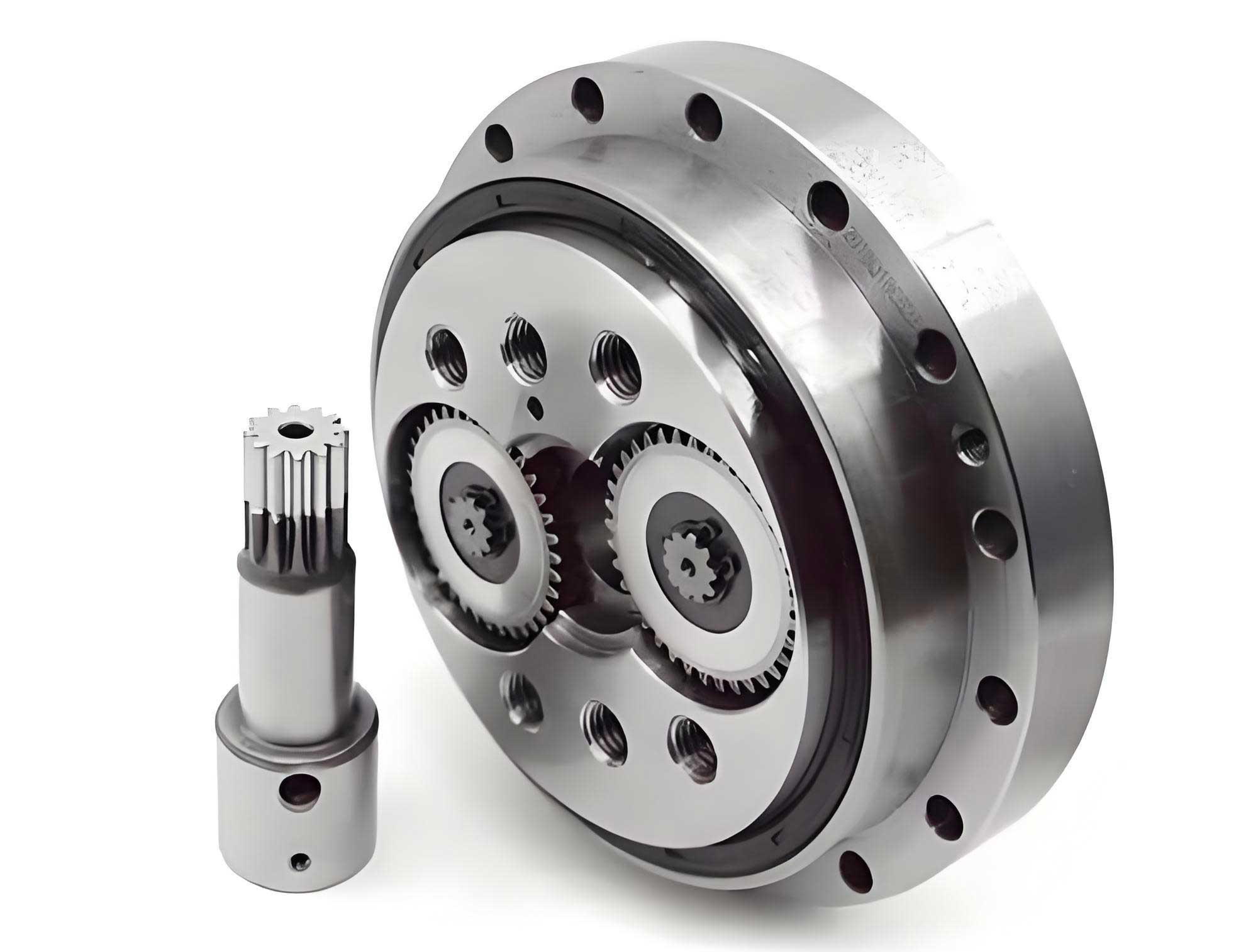
To facilitate a detailed analysis, a three-dimensional model of the rotary vector reducer was developed using UG software. Special attention was given to the cycloid gear, as its complex tooth profile requires parametric modeling. This process involved defining the tooth profile equations through UG’s expression tools. First, I input parameters such as the cycloid radius, pin radius, and eccentricity into the expression editor. Then, using the law curve function based on these equations, the cycloid tooth profile was automatically generated. Finally, extrusion and Boolean operations were applied to create the solid model, including bearing holes for the crankshafts. This accurate modeling is vital for subsequent finite element analysis, as it ensures that the geometric integrity of the rotary vector reducer is maintained.
The transient dynamics analysis focuses on evaluating the contact stresses during meshing of critical components: the sun gear with planetary gears, and the cycloid gear with pin teeth. I employed ANSYS Workbench for this purpose, importing the UG models in .x_t format. The analysis involves material assignment, meshing, contact pair setup, load application, and solution. For the sun gear and planetary gears, materials were selected based on common engineering alloys to reflect realistic conditions. The properties are summarized in Table 1.
| Component | Material | Density $\rho$ (kg/m³) | Young’s Modulus $E$ (GPa) | Poisson’s Ratio $\mu$ |
|---|---|---|---|---|
| Sun Gear | 20CrMnTi | $7.86 \times 10^3$ | 212 | 0.289 |
| Planetary Gear | 40Cr | $7.87 \times 10^3$ | 206 | 0.277 |
Mesh generation is a critical step in finite element analysis. For the sun gear and planetary gears, I refined the mesh at the contact surfaces to capture stress concentrations accurately. The sun gear’s meshing teeth were divided into 12 segments, while the planetary gear’s teeth were divided into 9 segments. This resulted in an average element quality of 0.91957, with 162,491 nodes and 35,391 elements, ensuring computational precision. Contact pairs were defined with the sun gear as the contact body and the planetary gears as the target bodies, using a friction coefficient of 0.15. Joint revolute pairs were applied to the inner holes of both gears, with a rotational speed of 140.25 rad/s on the sun gear and a torque of 4.8775 N·m on the planetary gears.
The solution revealed that the maximum contact stress occurs at the meshing point between the sun gear and planetary gears, with a value of 91.53 MPa. Stress distribution shows secondary stresses at the tooth roots, indicating minor deformation that remains within safe limits. No stress concentration was observed on the tooth surfaces, confirming that the first-stage reduction in the rotary vector reducer operates safely under the given loads. This analysis underscores the robustness of the planetary gear system in the rotary vector reducer.
Next, I examined the cycloid gear and pin teeth engagement, which constitutes the second reduction stage of the rotary vector reducer. Material properties for these components are listed in Table 2. The pin gear housing was treated as a rigid body to simplify the analysis, as its deformation is negligible compared to the cycloid gear and pin teeth.
| Component | Material | Density $\rho$ (kg/m³) | Young’s Modulus $E$ (GPa) | Poisson’s Ratio $\mu$ |
|---|---|---|---|---|
| Cycloid Gear | G20CrMo | $7.8 \times 10^3$ | 208 | 0.292 |
| Pin Teeth | GCr15 | $7.8 \times 10^3$ | 219 | 0.300 |
Meshing for this stage involved controlling element sizes: 0.006 mm for the cycloid gear and 0.004 mm for the pin teeth. The grid quality achieved an average element quality of 0.75251, with 448,801 nodes and 117,218 elements. Contact pairs were established with the cycloid gear’s tooth surfaces as contact bodies and the pin teeth cylindrical surfaces as target bodies, using a friction coefficient of 0.13. The pin gear housing was fully constrained, and a joint revolute pair with a torque of 774 N·m was applied to the cycloid gear’s center hole.
The results indicate that the maximum contact stress of 420.44 MPa occurs near the planetary carrier hole on the side where the cycloid gear meshes with the pin teeth. Stress is primarily distributed around the planetary carrier and bearing holes, with pin teeth support mitigating some stress. This finding suggests that design enhancements should focus on strengthening the cycloid gear at these high-stress regions to improve the durability of the rotary vector reducer. The contact stress analysis for both stages demonstrates that the rotary vector reducer can withstand operational loads without failure, but optimization is needed for critical areas.
Beyond transient dynamics, modal analysis is essential to assess the vibrational behavior of the rotary vector reducer. Resonance can lead to premature failure or noise, so I conducted modal analyses for both the entire assembly and the cycloid gear separately. The full assembly model included all components, with materials assigned as per Table 3. The coordinate system origin was set at the sun gear’s central axis to standardize the analysis.
| Component | Material | Density $\rho$ (kg/m³) | Young’s Modulus $E$ (GPa) | Poisson’s Ratio $\mu$ |
|---|---|---|---|---|
| Cycloid Gear | G20CrMo | $7.80 \times 10^3$ | 208 | 0.292 |
| Pin Teeth | GCr15 | $7.80 \times 10^3$ | 219 | 0.300 |
| Sun Gear | 20CrMnTi | $7.86 \times 10^3$ | 212 | 0.289 |
| Planetary Gear | 40Cr | $7.87 \times 10^3$ | 206 | 0.277 |
| Pin Gear Housing | GCr15 | $7.80 \times 10^3$ | 219 | 0.300 |
| Output Plate | 45 Steel | $7.89 \times 10^3$ | 209 | 0.269 |
Mesh generation for the full assembly focused on uniformity, with controlled sizes of 0.005 mm for the front and rear covers and pin gear housing. Using relevance settings of 100 and fine center, the mesh comprised 809,296 nodes and 236,991 elements. Constrained modal analysis was performed by fixing the pin gear housing’s bottom to simulate installation conditions. All contacts, such as those between the sun gear and planetary gears, were defined as bonded. A cylindrical support constrained the sun gear’s center hole, allowing only rotational freedom. The analysis computed 16 mode shapes, with the first six natural frequencies listed in Table 4.
| Mode | 1 | 2 | 3 | 4 | 5 | 6 |
|---|---|---|---|---|---|---|
| Frequency (Hz) | 2291 | 2372 | 2381.9 | 2912.9 | 2919.5 | 2989.7 |
The mode shapes reveal various vibrational patterns: in the first mode, the front and rear covers along with the cycloid gear move along the Y-direction in the XZ plane, while the planetary gears bend forward and backward. The second mode involves swinging along the Z-direction, and the third mode along the Y-direction. Higher modes show overall swinging and rotational motions. These frequencies are relatively high, indicating stiff structural behavior of the rotary vector reducer.
For the cycloid gear alone, a separate modal analysis was conducted. The gear was constrained with a cylindrical support at its center hole, and 16 mode shapes were extracted. The first 16 natural frequencies are presented in Table 5. The first mode is nearly zero, representing rigid body motion, while subsequent modes show bending and torsional vibrations.
| Mode | 1 | 2 | 3 | 4 | 5 | 6 | 7 | 8 |
|---|---|---|---|---|---|---|---|---|
| Frequency (Hz) | $2.4785 \times 10^{-4}$ | 1553.7 | 1553.7 | 1717.8 | 2202.0 | 2202.1 | 4419.0 | 4552.7 |
| Mode | 9 | 10 | 11 | 12 | 13 | 14 | 15 | 16 |
|---|---|---|---|---|---|---|---|---|
| Frequency (Hz) | 5390.8 | 5391.3 | 7681.2 | 7865 | 7866.7 | 7930.2 | 7930.4 | 10874.0 |
To assess resonance risks, the meshing frequency must be compared with these natural frequencies. The meshing frequency $f$ for gear systems is calculated as:
$$ f = \frac{n z}{60} $$
where $n$ is the rotational speed in rpm and $z$ is the number of teeth. For the rotary vector reducer, the input speed is 1815 rpm, and after reduction, the cycloid gear rotates at 15 rpm. With 39 pin teeth (assuming a typical design), the meshing frequency for the cycloid stage is approximately 9.75 Hz. This value is significantly lower than all natural frequencies of both the full assembly and the cycloid gear, indicating no resonance risk under normal operating conditions. Thus, the rotary vector reducer is safe from vibrational excitations that could compromise performance.
The contact stress analysis and modal analysis collectively provide a thorough evaluation of the rotary vector reducer’s transmission performance. The maximum contact stress in the sun gear-planetary gear engagement is 91.53 MPa, located at the meshing point, while for the cycloid gear-pin teeth engagement, it reaches 420.44 MPa near the planetary carrier hole. Both values are within allowable limits for the selected materials, ensuring structural integrity. However, the higher stress in the cycloid gear suggests that design optimizations, such as material upgrades or geometric reinforcements, could enhance durability. The modal analysis confirms that the rotary vector reducer’s natural frequencies are well-separated from operational meshing frequencies, eliminating resonance concerns.
In conclusion, this study underscores the importance of finite element analysis in understanding the complex dynamics of the rotary vector reducer. By leveraging tools like UG and ANSYS Workbench, I was able to model, simulate, and analyze key aspects of transmission performance. The results validate the reliability of the rotary vector reducer for industrial applications while highlighting areas for potential improvement. Future work could explore parametric optimizations, fatigue analysis, or experimental validation to further advance the design of rotary vector reducers. As robotics technology evolves, such analyses will remain critical for developing high-performance, durable reduction systems.