
In my extensive experience with precision machinery, particularly in the printing industry, I have encountered various mechanical transmission systems. Among these, the harmonic drive gear stands out as a remarkable innovation. This unique form of gearing, often referred to as a strain wave gear, has proven invaluable in applications demanding high accuracy, compact design, and reliable performance. My firsthand involvement in troubleshooting and maintaining equipment utilizing harmonic drive gears, such as certain gravure printing presses, has provided me with profound insights into their operation, advantages, and occasional frailties. This article aims to delve deeply into the world of harmonic drive gears, examining their structure, fundamental principles, characteristics, and applications, while incorporating technical details through formulas and tables to offer a comprehensive understanding.
The concept of the harmonic drive gear emerged in the mid-20th century, with its development initially driven by military and aerospace technologies requiring precise motion control in confined spaces. Over the decades, its use has permeated numerous industrial sectors, including robotics, semiconductor manufacturing, medical devices, and indeed, printing machinery. The core appeal lies in its ability to provide exceptionally high reduction ratios within a single stage, alongside near-zero backlash and high torque capacity. The terminology “harmonic drive gear” itself stems from the harmonic wave-like deformation of a critical component during operation. Throughout this discussion, I will consistently use the term harmonic drive gear to emphasize this specific technology.
To fully appreciate the harmonic drive gear, one must start with its fundamental architecture. A standard harmonic drive gear assembly comprises three primary components: the circular spline, the flexspline, and the wave generator. This configuration is elegantly simple yet ingeniously effective.
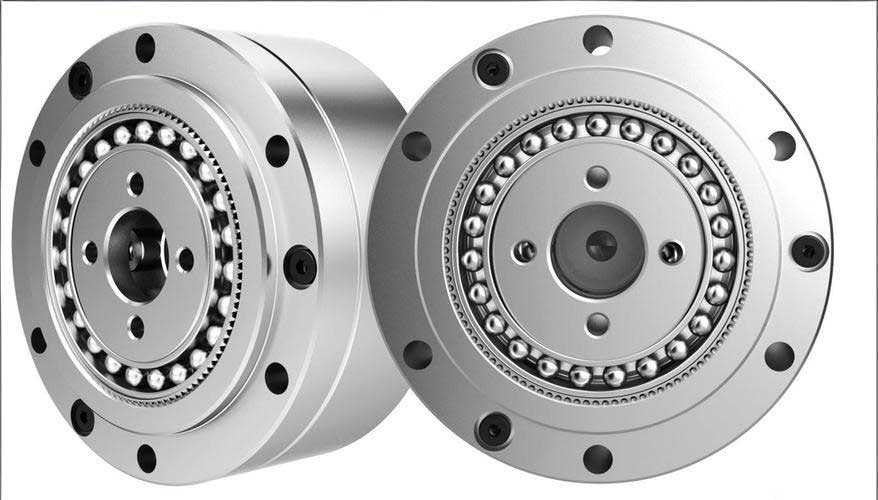
The circular spline is a rigid, ring-shaped component with internal teeth. It typically serves as the stationary member or the output, depending on the configuration. The flexspline is a thin-walled, flexible cup or ring with external teeth. Its material and geometry allow it to undergo controlled elastic deformation. The wave generator is an assembly that includes an elliptical cam or a four-point contact ball bearing, which is inserted into the bore of the flexspline. When assembled, the wave generator forces the flexspline into an elliptical shape, causing its teeth to engage with those of the circular spline at two diametrically opposite regions along the major axis of the ellipse. The following table summarizes the key attributes of these components:
| Component | Primary Function | Key Characteristics |
|---|---|---|
| Circular Spline (CS) | Provides the fixed or output gear ring with internal teeth. | Rigid structure, high hardness, precise internal gear profile. |
| Flexspline (FS) | Undergoes elastic deformation to create the wave motion; has external teeth. | Thin-walled, high-strength alloy (e.g., stainless steel), designed for fatigue resistance. |
| Wave Generator (WG) | Induces elliptical deformation in the flexspline. | Contains an elliptical cam or bearing; often the input element. |
The magic of the harmonic drive gear unfolds in the relative motion of these three elements. The fundamental principle is based on the kinematic phenomenon known as “differential tooth engagement” or “error averaging.” The number of teeth on the flexspline (N_fs) is slightly less than the number of teeth on the circular spline (N_cs), usually by a difference of 2 for a standard double-wave generator (or 4 for a triple-wave, etc.). This tooth difference is central to the operation. When the wave generator rotates, it propagates a traveling wave of deformation around the flexspline. The teeth of the flexspline engage with those of the circular spline progressively. For each full revolution of the wave generator, the flexspline experiences a net angular displacement relative to the circular spline equal to the angular pitch corresponding to the tooth difference.
The transmission ratio (i) of a harmonic drive gear can be derived from this tooth difference. For the common configuration where the circular spline is fixed, the wave generator is the input, and the flexspline is the output, the reduction ratio is given by:
$$ i = -\frac{N_{fs}}{N_{cs} – N_{fs}} $$
The negative sign indicates that the output rotation direction is opposite to the input. Conversely, if the flexspline is fixed and the wave generator is the input, the circular spline becomes the output, rotating in the same direction as the input with a ratio:
$$ i = +\frac{N_{cs}}{N_{cs} – N_{fs}} $$
Given that N_cs – N_fs is typically a small integer (e.g., 2), the denominator is small, leading to very high reduction ratios from a compact assembly. For instance, if N_fs = 200 and N_cs = 202, the first configuration yields i = -100. This elegant formula is the cornerstone of harmonic drive gear design.
The motion transfer is not a simple rigid-body rotation but involves the elastic strain of the flexspline. The radial deflection (δ) of the flexspline at any angular position (θ) relative to the wave generator’s major axis can be approximated by a cosine function, justifying the “harmonic” name:
$$ \delta(\theta) = \delta_m \cos(2\theta) $$
for a double-wave generator, where δ_m is the maximum radial deflection at the major axis. This wave-like deformation ensures that at any given time, a significant portion of the teeth are in contact. The engagement zone spans approximately 180 degrees for a double-wave generator, meaning that a large percentage of the total teeth (often around 20-30%) are simultaneously engaged in load sharing. This distributed contact is a key factor behind the high torque capacity and stiffness of the harmonic drive gear.
To further elucidate the kinematics, consider the angular velocities. Let ω_wg, ω_fs, and ω_cs represent the angular velocities of the wave generator, flexspline, and circular spline, respectively. The fundamental kinematic relation, based on the gear mesh, is:
$$ (N_{cs} – N_{fs}) \cdot \omega_{wg} = N_{cs} \cdot \omega_{fs} – N_{fs} \cdot \omega_{cs} $$
By setting one component’s velocity to zero (fixed), we can solve for the transmission ratio between the other two. This equation encapsulates the differential nature of the system. The harmonic drive gear essentially functions as a planetary differential with a flexible element, offering unique advantages over traditional gear trains.
The characteristics of the harmonic drive gear are what make it indispensable in precision engineering. I have compiled a detailed table comparing these features against conventional gear systems like spur, planetary, or cycloidal drives.
| Characteristic | Harmonic Drive Gear | Conventional Gear Trains | Remarks |
|---|---|---|---|
| Single-Stage Reduction Ratio | Very High (50 to 320 typical) | Moderate (typically < 10 per stage) | Harmonic drive gear achieves in one stage what requires multiple stages in others. |
| Backlash | Extremely Low, often near-zero | Present, requires careful design to minimize | Critical for precision positioning; harmonic drive gear excels due to preloaded tooth engagement. |
| Torque-to-Weight Ratio | High | Moderate | Compact and lightweight design of harmonic drive gear offers high power density. |
| Positioning Accuracy & Repeatability | Excellent | Good to Very Good | Error averaging effect in harmonic drive gear enhances accuracy. |
| Torsional Stiffness | High | High (depends on design) | Harmonic drive gear provides good stiffness, though hysteresis can be a factor. |
| Efficiency | High (typically 80-90% per stage) | High (spur gears can exceed 95%) | Efficiency of harmonic drive gear is slightly lower due to flexing losses but remains competitive. |
| Noise & Vibration | Low | Varies (can be high at high speeds) | Smooth, continuous tooth engagement in harmonic drive gear reduces noise. |
| Ability for Sealed Design | Excellent (hollow shaft option) | Possible but more complex | Harmonic drive gear can be fully sealed, ideal for harsh environments. |
| Life & Reliability | High (limited by flexspline fatigue) | High (limited by wear/pitting) | Properly applied, harmonic drive gear offers long service life; flexspline is the life-determining component. |
From my practical involvement, the advantages of the harmonic drive gear are palpable. In a printing press tension control system, the requirement for smooth, precise, and responsive adjustment of web tension is paramount. The harmonic drive gear, with its near-zero backlash, ensures that the tension roller responds instantaneously to control signals without any lost motion. This directly translates to stable print registration and consistent quality. The compact size of the harmonic drive gear reducer allows it to be integrated into the machine’s frame without occupying excessive space, a crucial consideration in modern manufacturing lines where real estate is at a premium.
However, the harmonic drive gear is not without its limitations. The flexspline, being a cyclically loaded elastic element, is susceptible to fatigue failure. I recall an instance where a printing press exhibited unstable rear tension. Upon disassembly, the root cause was identified as a cracked flexspline in the harmonic drive gear unit responsible for driving the tension roller. The failure occurred due to a combination of material fatigue and perhaps unforeseen overload conditions. The replacement of the flexspline restored proper function, highlighting that while robust, the harmonic drive gear requires attention to its operational limits and proper maintenance. The stress within the flexspline can be analyzed using elasticity theory. For a thin-walled cylinder under elliptical deformation, the maximum bending stress (σ_max) can be estimated by:
$$ \sigma_{max} \approx \frac{E \cdot t \cdot \delta_m}{R^2} $$
where E is the Young’s modulus of the flexspline material, t is its wall thickness, δ_m is the maximum radial deflection, and R is the mean radius. This stress must be kept well below the endurance limit of the material to ensure infinite fatigue life, a critical design criterion for any harmonic drive gear application.
Designing a harmonic drive gear involves a multi-parameter optimization. Key design variables include the module (or diametral pitch) of the teeth, the number of teeth on both splines, the wave generator profile (ellipticity), the flexspline geometry (cup length, wall profile), and material selection. Tooth profiles are often based on involute geometry but may be modified to accommodate the large deflection and ensure proper meshing throughout the engagement cycle. The contact stress between teeth, governed by Hertzian contact theory, must also be checked:
$$ \sigma_H = \sqrt{\frac{F_n}{\pi L} \cdot \frac{\frac{1}{R_1} + \frac{1}{R_2}}{\frac{1-\nu_1^2}{E_1} + \frac{1-\nu_2^2}{E_2}}} $$
where F_n is the normal tooth load, L is the face width, R_1 and R_2 are the effective radii of curvature, and ν and E are Poisson’s ratio and Young’s modulus for the two materials (flexspline and circular spline). Keeping this stress within allowable limits prevents surface pitting and ensures longevity of the harmonic drive gear.
The manufacturing of harmonic drive gear components demands high precision. The teeth on both the flexspline and circular spline are typically ground to achieve the necessary accuracy and surface finish. The flexspline undergoes heat treatment to achieve a high strength-to-weight ratio and good fatigue resistance. The wave generator bearing is a precision component, often a specially designed cam follower bearing. Assembly requires careful alignment to prevent binding and ensure smooth operation. Modern computer-aided design (CAD) and finite element analysis (FEA) software are invaluable tools for simulating the deformation, stress, and thermal behavior of a harmonic drive gear before physical prototyping.
Beyond the standard reduction configuration, harmonic drive gears can be arranged in various ways to achieve different functions. A “geared” harmonic drive gear can provide speed increase. Differential configurations, where none of the three members is fixed, allow for precise angular adjustment or torque summing, useful in servo systems and robotics. Compound harmonic drive gears, formed by connecting multiple stages in series or using planetary arrangements, can achieve astronomical reduction ratios exceeding 1,000,000:1 for applications like telescope positioning or satellite antenna control. The versatility of the harmonic drive gear principle continues to inspire new mechanical solutions.
In terms of applications, the harmonic drive gear has found a home in countless high-tech fields. In industrial robotics, it is the actuator of choice for robot wrist joints and articulated arms, providing the compactness, high torque, and precision needed for complex maneuvers. In aerospace, harmonic drive gears are used in satellite solar array drives, antenna pointing mechanisms, and aircraft control surfaces. Medical robotics, such as surgical assist devices, leverage their smooth motion and accuracy. Semiconductor manufacturing equipment uses them for precise wafer handling and stage positioning. And as I’ve experienced, in printing machinery, they control tension, registration, and other critical motions. The harmonic drive gear is truly a cross-industry enabler of precision motion.
Maintenance of a harmonic drive gear system primarily involves monitoring for signs of wear or degradation. Regular inspection for unusual noise, increased backlash, or overheating is advised. Lubrication is critical; most units are grease-lubricated for life, but in severe operating conditions, relubrication might be necessary. The flexspline should be checked for cracks or permanent deformation during major overhauls. Proper handling during installation is crucial to avoid damaging the thin-walled flexspline. Understanding the failure modes, such as flexspline fatigue fracture, tooth wear, or wave generator bearing failure, helps in proactive maintenance planning for any system employing a harmonic drive gear.
Looking forward, the evolution of the harmonic drive gear continues. Research focuses on new materials for the flexspline, such as advanced composites or shape memory alloys, to reduce weight and increase fatigue life. Improvements in lubrication technology aim to extend service intervals and efficiency. Integrated design, where the harmonic drive gear is combined with motors and sensors into a single “smart” actuator module, is becoming more prevalent. Furthermore, the principles of the harmonic drive gear are being explored in microscale and nanoscale devices for precision engineering at smaller dimensions. The fundamental elegance of the harmonic drive gear concept ensures its relevance in the future of mechanical design.
In conclusion, my journey with harmonic drive gears, from troubleshooting a faulty tension system to studying their theoretical foundations, has been immensely rewarding. This transmission technology embodies a beautiful synergy between elastic body mechanics and gear kinematics. Its ability to provide high reduction ratios, exceptional precision, and compact design in a single package is unmatched by many traditional systems. While it demands careful design and an understanding of its unique failure modes, the benefits it brings to precision machinery are substantial. Whether in the demanding environment of a high-speed printing press or the vacuum of space, the harmonic drive gear performs its task with quiet efficiency. I hope this detailed exposition, enriched with formulas and comparative analysis, provides a thorough resource for anyone seeking to understand or work with this fascinating component. The harmonic drive gear is more than just a gearbox; it is a testament to human ingenuity in solving complex motion control challenges.