
As a precision motion control component, the harmonic drive gear represents a fascinating synthesis of mechanics and materials science. My exploration into this field reveals a technology that fundamentally differs from conventional gearing systems by harnessing controlled elastic deformation to transmit motion and torque. The elegance of its operation lies in its simplicity and the remarkable performance characteristics that emerge from the interaction of just three primary components.
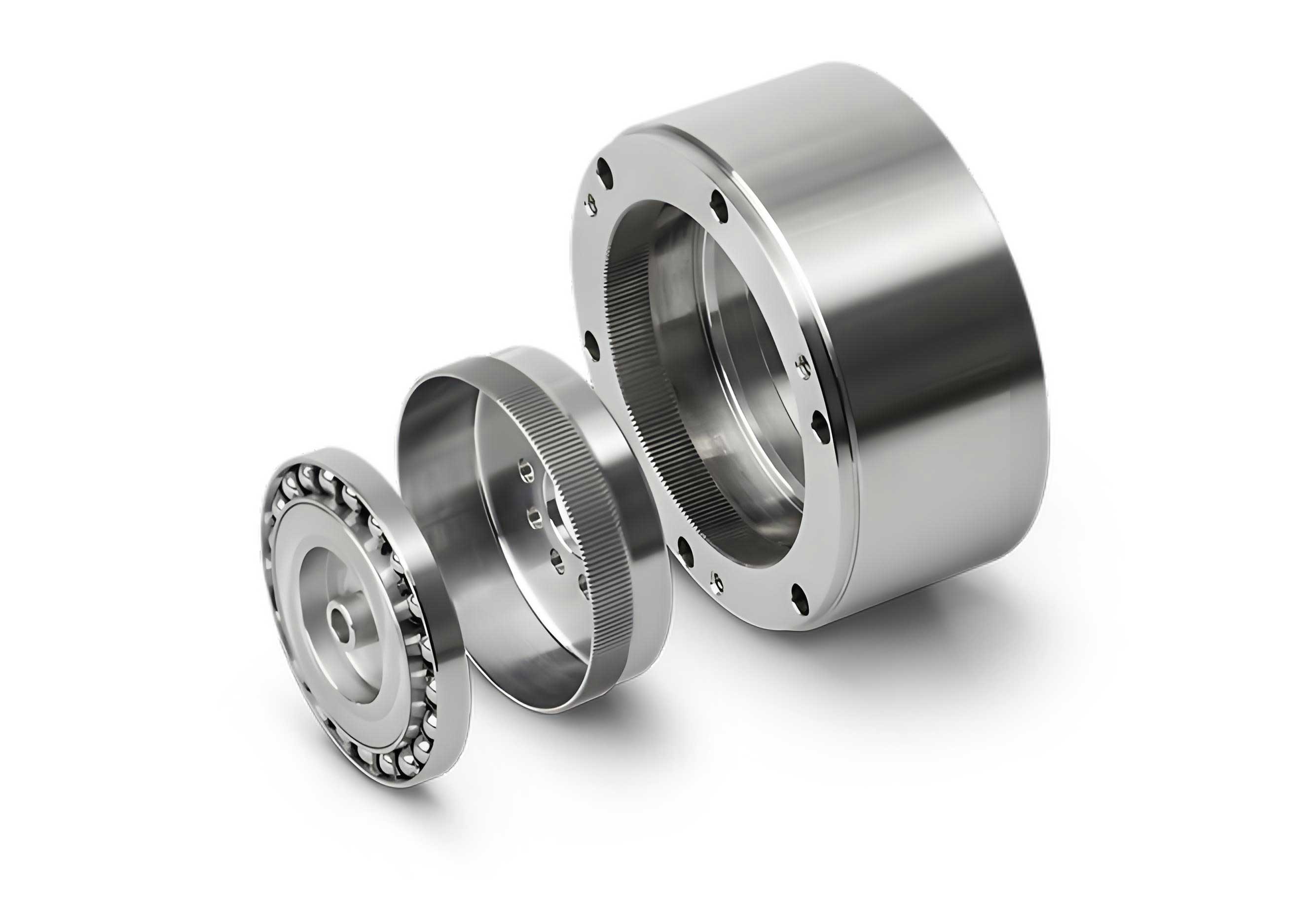
The core of a harmonic drive gear system consists of three fundamental elements: the Wave Generator (H), the Flexspline (1), and the Circular Spline (2). In its unassembled state, the Flexspline is a thin-walled, flexible cylindrical cup or ring with external teeth. The Circular Spline is a rigid, non-deformable ring with internal teeth. Critically, the number of teeth on the Flexspline (\(Z_1\)) is slightly less than that on the Circular Spline (\(Z_2\)), typically by two teeth for the most common configuration. The Wave Generator is an assembly, often comprising an elliptical bearing mounted on a shaft, whose purpose is to induce a controlled, wave-like deformation in the Flexspline.
The operational principle is initiated upon assembly. The Wave Generator is inserted into the bore of the Flexspline, forcing its circular cross-section into a predictable, elliptical shape. This deformation causes the teeth of the Flexspline to engage with those of the Circular Spline at two diametrically opposite regions (the major axis of the ellipse). At the minor axis, the teeth are completely disengaged. The regions between the major and minor axes are in a state of partial mesh, either coming into engagement or disengaging. When the Wave Generator rotates, the location of these engagement zones propagates around the circumference of the Flexspline. This traveling wave of deformation is the source of the “harmonic” motion and the basis for speed reduction or increase.
The number of complete waves, or lobes, generated on the Flexspline per revolution of the Wave Generator defines the “wave number” (n). The most prevalent configuration is the dual-wave (n=2) system, where the deformation profile approximates a cosine curve with two complete cycles per revolution. The contour of the deformed Flexspline’s neutral surface can be modeled mathematically. For an idealized elliptical Wave Generator, the radial displacement \( \Delta r(\theta) \) of a point on the Flexspline’s neutral line from its original circular position can be described as:
$$ r(\theta) = r_0 + \Delta r \cos(n\theta – \phi_H) $$
where \( r_0 \) is the original radius, \( \Delta r \) is the deformation amplitude, \( \theta \) is the angular position, \( n \) is the wave number, and \( \phi_H \) is the angular position of the Wave Generator. This equation highlights the traveling wave nature of the deformation, a key to understanding the kinematic behavior of harmonic drive gears.
The motion is transmitted due to the difference in tooth counts. As the Wave Generator completes one full revolution, the traveling wave causes the Flexspline teeth to walk relative to the Circular Spline teeth. Since there are fewer teeth on the Flexspline, for each revolution of the Wave Generator, the Flexspline rotates backwards (or forwards, depending on the fixed component) by a number of teeth equal to the difference (\(Z_2 – Z_1\)). The kinematic relationship follows a formula analogous to planetary gear systems. For the common case where the Circular Spline is fixed, the Wave Generator is the input, and the Flexspline is the output, the reduction ratio \(i\) is given by:
$$ i_{H1} = \frac{\omega_H}{\omega_1} = -\frac{Z_1}{Z_2 – Z_1} $$
The negative sign indicates that the Flexspline rotates in the opposite direction to the Wave Generator. If the Flexspline is fixed and the Circular Spline is the output, the ratio and direction change:
$$ i_{H2} = \frac{\omega_H}{\omega_2} = +\frac{Z_2}{Z_2 – Z_1} $$
These high-ratio formulas, derived from the fundamental tooth difference, enable the exceptional reduction capabilities of a single-stage harmonic drive gear.
| Fixed Component | Input | Output | Reduction Ratio (i) | Direction |
|---|---|---|---|---|
| Circular Spline | Wave Generator (H) | Flexspline (1) | \( i = -\frac{Z_1}{Z_2 – Z_1} \) | Output opposite to input |
| Flexspline | Wave Generator (H) | Circular Spline (2) | \( i = +\frac{Z_2}{Z_2 – Z_1} \) | Output same as input |
| Wave Generator | Flexspline (1) | Circular Spline (2) | \( i = +\frac{Z_2}{Z_1} \) | Output same as input (low ratio) |
The unique operating principle of the harmonic drive gear bestows upon it a suite of distinctive advantages that make it indispensable in high-performance applications. These characteristics stem directly from the mechanics of elastic deformation and multi-tooth simultaneous engagement.
| Characteristic | Description & Implication | Typical Value/Feature |
|---|---|---|
| High Reduction Ratio in Single Stage | The ratio is determined by the tooth difference (\(Z_2 – Z_1\)), which can be made very small (e.g., 2), yielding high ratios from 50:1 to over 300:1 in a compact package. | Single-stage ratios: 50 to 320. Dual-stage can exceed 10,000:1. |
| Exceptional Compactness & Light Weight | The coaxial, nested design eliminates offset shafts and bulky gear trains, leading to very high torque-to-weight and torque-to-volume ratios. | Up to 1/3 the volume and 1/2 the weight of equivalent conventional gearboxes. |
| High Positional Accuracy & Low Backlash | Simultaneous engagement of a large percentage of teeth (up to 30% for dual-wave) averages out individual tooth errors. Preload can be applied to achieve near-zero backlash. | Backlash can be <1 arcmin. High torsional stiffness. |
| High Torque Capacity | The load is distributed over many teeth in contact simultaneously, significantly reducing stress per tooth compared to conventional gears where only 1-2 teeth carry the full load. | Suitable for applications from fractional watt servos to industrial robots handling tens of kW. |
| Excellent Coaxiality | Input and output shafts are concentrically aligned, simplifying mechanical design and mounting. | Inherent in the cup- or pancake-shaped design. |
| Smooth & Quiet Operation | Teeth engage with a pure rolling motion in the direction of wave travel, and the high number of contacting teeth dampens vibration. | Superior to planetary and spur gear systems at similar precision levels. |
The superiority of a harmonic drive gear in terms of load distribution is mathematically evident. In a conventional spur gear pair, the theoretical maximum number of teeth in contact is around 2, and the load is shared between them. In a dual-wave harmonic drive, the number of teeth in simultaneous contact \(N_c\) can be estimated as a significant fraction of the total:
$$ N_c \approx \frac{2 \alpha}{\pi} Z_1 $$
where \(\alpha\) is the engagement angle (often 30-45° per wave). For \(Z_1 = 200\) and \(\alpha = 40^\circ\), \(N_c \approx 44\) teeth share the load. This fundamental difference is why harmonic drive gears offer such high torque density and smooth operation.
The journey of harmonic drive gear technology from a conceptual novelty to a mainstream engineering solution spans decades of intensive research and development. The foundational principle was first patented in the late 1950s, sparking global interest, particularly in aerospace and defense sectors where its unique advantages were immediately recognized.
Early research focused on understanding the complex stress state within the cyclically deforming Flexspline, which is the life-limiting component. Analytical models using thin-shell theory were developed to predict stress concentrations, particularly at the critical flexspline cup rim and tooth root. Finite Element Analysis (FEA) later became the primary tool for detailed stress and strain analysis, enabling optimization of tooth profile, cup geometry, and wall thickness to maximize fatigue life. The stress at the critical inner wall of the flexspline cup can be approximated by:
$$ \sigma_\theta \approx E \frac{\Delta r}{r_0} $$
where \(E\) is the Young’s modulus of the flexspline material, \(\Delta r\) is the radial deformation amplitude, and \(r_0\) is the mean radius. This highlights the importance of high-strength, high-endurance limit materials like specialized alloy steels (e.g., 40CrNiMoA) and advanced processes like vacuum heat treatment and shot peening.
Tooth geometry has been another major area of investigation. While the initial Involute profile was used, specialized profiles like the S-shaped or “conjugate” tooth form were developed to improve contact conditions, reduce sliding friction, and increase torque capacity. The optimal profile ensures near-pure rolling engagement along the direction of wave propagation while accommodating the slight sliding in the lateral direction.
The applications of harmonic drive gears have proliferated far beyond their initial niches. Their role is now critical in fields demanding compact, precise, and reliable motion control.
| Sector | Application Examples | Key Reason for Using Harmonic Drive Gears |
|---|---|---|
| Aerospace & Satellites | Solar array drives, antenna pointing mechanisms, gimbal controls, rover wheel drives. | High ratio in single stage, light weight, reliability in vacuum, zero backlash for precise positioning. |
| Industrial Robotics | Articulated robot arm joints (from waist to wrist), SCARA robots, collaborative robot (cobot) actuators. | Compact design allows slim arm sections, high torque, high stiffness, and precision for repeatable positioning. |
| Semiconductor Manufacturing | Wafer handling robots, precision stages, photolithography equipment. | Ultra-clean operation (can be sealed), minimal particle generation, exceptional smoothness and accuracy. |
| Medical & Laboratory Automation | Surgical robot joints, MRI-compatible manipulators, automated liquid handling systems. | Compactness, precision, smooth motion, and ability to provide high torque in confined spaces. |
| Optical & Instrumentation | Pan-tilt units for cameras and sensors, telescope drives, precision rotary stages. | Low backlash, high torsional stiffness for accurate pointing, and smooth motion for tracking. |
| Defense Systems | Turret drives, periscope mechanisms, radar and lidar scanner drives. | High shock load capacity, reliability, and precision under demanding conditions. |
Contemporary research and development in harmonic drive gear technology continues to push the boundaries of performance. Key areas of focus include:
Advanced Materials: Exploration of carbon fiber composite Flexsplines and high-performance polymers aims to reduce inertia further and eliminate metal fatigue. Ceramic coatings on teeth are investigated to reduce wear and increase efficiency.
Dynamic Modeling & Vibration Control: As applications demand higher speeds and accelerations, understanding the nonlinear dynamics—including the interaction between the variable mesh stiffness of the harmonic drive gear and system resonances—becomes crucial. Advanced models incorporate time-varying stiffness \(k_m(t)\):
$$ J\ddot{\theta} + c\dot{\theta} + k_m(t)\theta = T_{in} – T_{load} $$
where \(J\) is inertia, \(c\) is damping, and \(\theta\) is angular displacement. Research aims to design control algorithms that mitigate vibration induced by this parametric excitation.
Integrated Design & Miniaturization: The trend towards “harmonically-driven actuators” integrates the harmonic drive gear directly with a brushless DC motor and feedback sensor into a single sealed unit. This is paramount for robotics. Furthermore, micro-harmonic drives for millimeter-scale medical devices are an emerging frontier.
Efficiency Optimization: While highly precise, harmonic drives have inherent losses from elastic hysteresis in the Flexspline and friction in the Wave Generator bearing and tooth contacts. Research into advanced lubrication, low-friction tooth profiles, and optimized bearing designs aims to push efficiency above 80-90% for certain ratios and sizes.
Digital Twin & Prognostics: Using sensor data (torque, temperature, vibration) and high-fidelity physics-based models to create a digital twin of a harmonic drive gear enables predictive maintenance, estimating remaining useful life based on actual operating conditions rather than fixed intervals.
The development path for harmonic drive gear systems is increasingly intertwined with smart manufacturing and the demands of Industry 4.0. The drive for greater precision, reliability, and intelligence in motion systems ensures that this remarkable technology will remain at the forefront of mechanical engineering innovation. From enabling the dexterous movements of a surgical robot to pointing a communications satellite with arc-second accuracy, the harmonic drive gear continues to be a critical enabler of advanced technology, transforming simple rotational input into highly refined and controlled mechanical output.