
As a researcher and practitioner in the field of advanced manufacturing, I have dedicated significant effort to understanding and refining the process of precision forging for critical automotive components. Among these, the helical bevel gear stands out due to its complex geometry and demanding performance requirements in power transmission systems, particularly in automotive final drives. This article consolidates my perspective and findings on the numerical simulation and experimental investigation of the precision forging process for this crucial component. The transition from traditional machining to net-shape forging represents a paradigm shift, offering profound benefits in material savings, mechanical properties, and production efficiency. Here, I will delve into the underlying theories, process design intricacies, simulation methodologies, experimental validations, and practical formulas that govern the successful forging of a helical bevel gear.
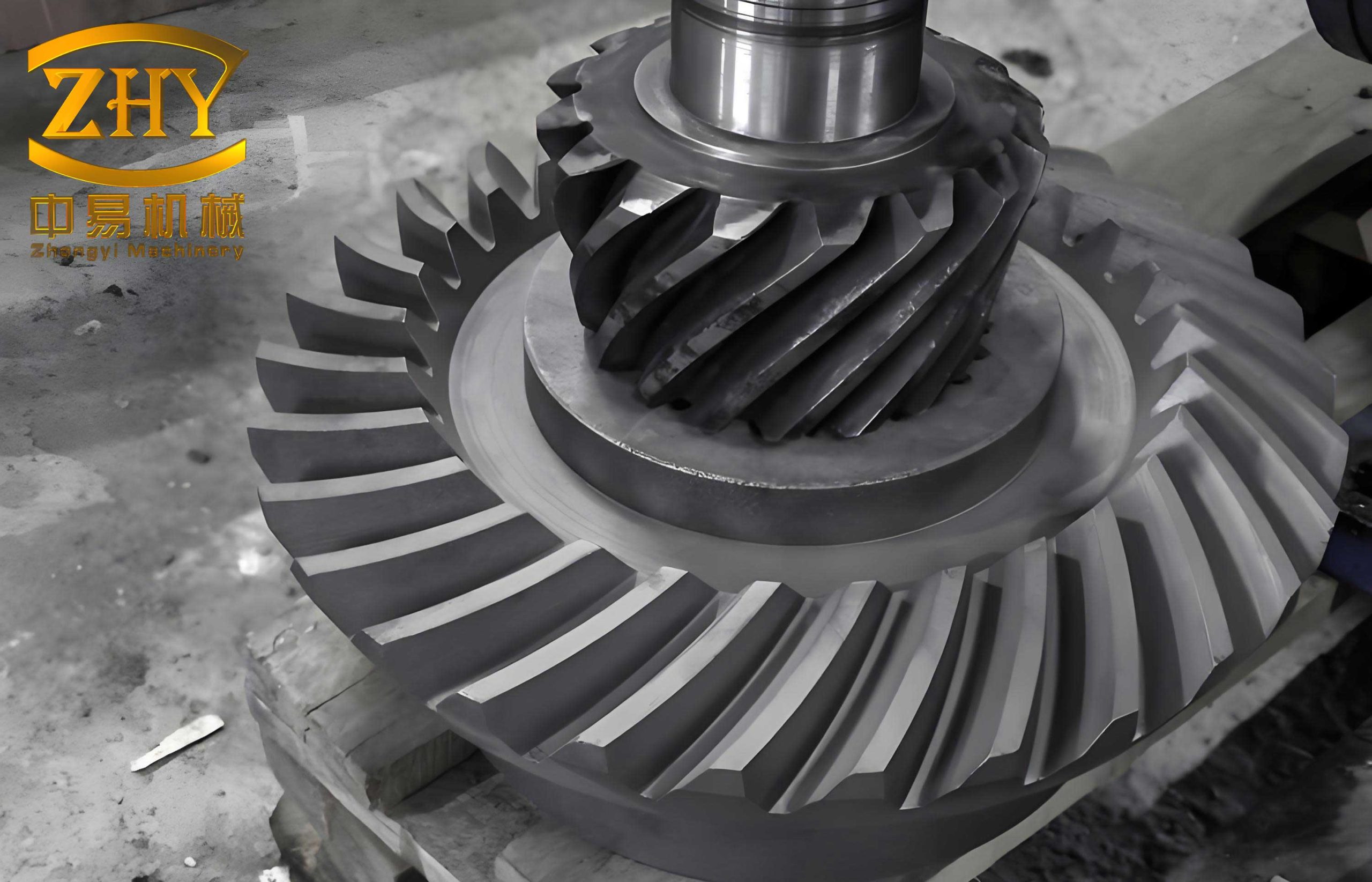
The fundamental driving force behind adopting precision forging for helical bevel gears is the superior integrity of the final product. Machining operations inevitably cut through the continuous grain flow lines established during the initial billet forging, creating stress concentrators and potential fatigue initiation sites. In contrast, a precision forged helical bevel gear maintains a contiguous fiber orientation that follows the contour of the teeth, significantly enhancing fatigue life, wear resistance, and overall load-bearing capacity. The challenge, however, lies in the three-dimensional, non-axisymmetric nature of the helical tooth form, which creates complex, non-uniform metal flow during forming. Understanding and controlling this flow is paramount to achieving complete die fill without defects and within acceptable forming load limits.
Theoretical Foundations and Material Behavior
The analysis of metal forming processes, especially for complex parts like the helical bevel gear, rests on the principles of plasticity theory. For the high-strain-rate deformation involved in forging, the material is often modeled as a rigid-plastic or rigid-viscoplastic body. This simplification ignores elastic deformation, which is negligible compared to the large plastic strains, making the finite element analysis computationally efficient. The core of this model is the constitutive equation relating flow stress to strain, strain rate, and temperature. For many steels, a commonly used model is the Hensel-Spittel equation or a simple power-law relation. The flow stress (\(\sigma_f\)) is critical for accurate simulation and load prediction.
For a medium-carbon steel like AISI 1045 (a common choice for gears), the flow stress at room temperature and elevated temperatures can be described by data from compression tests. A representative set of data for forging simulation is presented below, showing the strain-hardening behavior.
| True Strain (\(\varepsilon\)) | Flow Stress at 1.5 s\(^{-1}\) (MPa) | Flow Stress at 100 s\(^{-1}\) (MPa) |
|---|---|---|
| 0.0 | 640 | 641 |
| 0.1 | 689 | 691 |
| 0.7 | 905 | 907 |
| 1.2 | 908 | 910 |
This data can be fitted to a constitutive model. A frequently used form is:
$$\sigma_f = K \varepsilon^n \dot{\varepsilon}^m$$
where \(K\) is the strength coefficient, \(n\) is the strain-hardening exponent, and \(m\) is the strain-rate sensitivity exponent. For the precision forging of a helical bevel gear, the interface friction condition is another critical theoretical aspect. The shear friction model, given by \(\tau = m_k \cdot k\), where \(\tau\) is the frictional shear stress, \(m_k\) is the friction factor (ranging from 0 for perfect lubrication to 1 for perfect sticking), and \(k\) is the shear yield strength of the material (\(k = \sigma_f / \sqrt{3}\)), is often employed in simulations.
Process Design and Finite Element Modeling Strategy
Designing a precision forging process for a helical bevel gear requires careful consideration of the preform geometry, die design, and forming sequence. The goal is to ensure complete filling of the intricate tooth cavities while minimizing forming load, material waste, and die wear. The initial billet is typically a machined preform that approximates the final gear’s back-face contour and volume. The die assembly consists of a lower die (or gear die) containing the negative impression of the helical bevel gear teeth, an upper punch (or pressure die), and often a central mandrel to control the bore dimensions.
To virtually analyze this process, a three-dimensional finite element model is indispensable. The setup involves defining the rigid tooling components and the deformable billet. The material properties, as previously discussed, are assigned to the billet. The friction conditions at the die-workpiece interfaces are applied using the shear model. The simulation is run as a displacement-controlled process, with the upper punch moving at a constant speed (e.g., 10 mm/s) to compress the billet into the lower die cavity. The incremental analysis requires small step sizes (e.g., 0.03 mm per step) to accurately capture the severe geometry changes and contact conditions. The following table summarizes a typical simulation setup for analyzing a helical bevel gear.
| Modeling Aspect | Parameter / Assumption |
|---|---|
| Workpiece Material | AISI 1045 Steel (45# Steel) |
| Material Model | Rigid-Plastic |
| Flow Stress Data | See table above (Room Temperature) |
| Friction Model | Shear Friction, Factor \(m_k = 0.2\) |
| Tooling | Rigid Bodies (Punch, Gear Die, Mandrel) |
| Punch Speed | 10 mm/s |
| Initial Billet Temperature | 20°C (Cold Forging) |
| Simulation Type | 3D, Transient, Lagrangian Incremental |
Insights from Numerical Simulation
The finite element simulation provides a powerful visual and quantitative window into the forging process of the helical bevel gear. Tracking the deformation step-by-step reveals the metal flow patterns. Initially, the billet makes contact with the tips of the teeth in the gear die. As the punch advances, the material in these contact zones is compressed and begins to flow laterally and radially into the adjacent tooth cavities. This is not a simple extrusion but a complex three-dimensional flow guided by the helical angle of the teeth. The simulation clearly shows that the tooth formation is a transfer process: metal from the region under the die’s tooth tip is displaced into the space corresponding to the gear’s tooth root and flank.
The effective strain distribution is highly non-uniform. The highest strains are concentrated in the tooth regions, particularly in the root filllet areas where metal undergoes severe shearing and bending to conform to the die geometry. The core of the gear body experiences relatively lower deformation. The simulation also tracks the evolving contact pressure on the die surfaces, which is crucial for predicting die stress and potential failure. The formation of the helical bevel gear can be quantitatively divided into distinct stages based on the load-stroke curve:
- Initial Contact and Upsetting Stage: The load increases relatively slowly as the billet undergoes initial yielding and begins to spread, making broader contact with the die surfaces.
- Tooth Cavity Filling Stage: This is the longest stage. The load increases more steadily as metal flows into the increasingly restrictive tooth cavities. The slope of the load curve is governed by the growing contact area and the strain-hardening of the material.
- Final Filling and Corner Radii Completion Stage: In the final moments of the stroke, the last few corners and the finest details of the helical bevel gear teeth are filled. The load increases very sharply because the remaining free space is minimal, and the material is highly work-hardened, requiring extremely high pressure to effect small amounts of plastic flow.
The final simulated load can be extraordinarily high for cold forging. For a typical automotive-sized helical bevel gear, the simulation may predict a maximum load (P_sim) exceeding 45,000 kN. This enormous requirement is a primary reason why cold precision forging is often impractical for large gears, pointing directly to the need for warm or hot forging processes to reduce flow stress.
Experimental Validation and Scaling Laws
To validate the numerical findings and gain practical insights, physical modeling experiments are essential. Due to the prohibitive cost and force requirements of full-scale steel trials, similarity theory is employed using a model material. Lead, at room temperature, is an excellent analog because it has a low yield stress, is strain-rate sensitive, and exhibits plasticity similar to hot steel. The key to a valid model experiment is maintaining geometric similarity (scale factor \(\lambda\)) and ensuring that the dimensionless numbers governing plastic flow are similar. The most important scaling relationship is for force, derived from equating the stresses in the model and the prototype:
$$\frac{\sigma_{p}}{\sigma_{m}} = \frac{F_{p} / A_{p}}{F_{m} / A_{m}} = \frac{F_{p}}{F_{m}} \cdot \frac{1}{\lambda^{2}}$$
where subscript \(p\) denotes prototype (steel gear), \(m\) denotes model (lead gear), \(F\) is forming force, and \(A\) is area. Since we maintain geometric similarity (\(\lambda = L_p / L_m\)), the area scales with \(\lambda^2\). Rearranging gives the force scaling law:
$$F_{p} = F_{m} \cdot \left( \frac{\sigma_{p}}{\sigma_{m}} \right) \cdot \lambda^{2}$$
In a 1:1 scale experiment (\(\lambda = 1\)), this simplifies to:
$$F_{p} = F_{m} \cdot \left( \frac{\sigma_{p}}{\sigma_{m}} \right)$$
In my experimental work, a lead billet with gridded surfaces is forged into the helical bevel gear shape. The deformation of the grid provides a direct visual map of metal flow, confirming the simulation predictions: the flow is primarily localized to the tooth region, with material being displaced from the tip-contact zones into the cavities. The experimental load-stroke curve for lead exhibits the same three-stage characteristic. A typical maximum load for the lead model (\(F_m\)) might be around 1,650 kN. With a flow stress ratio \(\sigma_p / \sigma_m\) of approximately 905 MPa / 29.5 MPa ≈ 30.7 for cold steel versus lead, the predicted prototype force is:
$$F_{p}^{cold} = 1650 \text{ kN} \times 30.7 \approx 50,655 \text{ kN}$$
This aligns closely with the simulation result, validating the model. For a warm forging process at, say, 850°C where the flow stress of steel \(\sigma_p^{warm}\) drops to about 240 MPa, the required force becomes:
$$F_{p}^{warm} = 1650 \text{ kN} \times \left( \frac{240}{29.5} \right) \approx 13,425 \text{ kN}$$
This dramatic reduction in force, by a factor of nearly 4, makes the process feasible on large-capacity but commercially available forging presses.
| Parameter | Model (Lead) | Prototype – Cold (AISI 1045) | Prototype – Warm (AISI 1045 @ 850°C) |
|---|---|---|---|
| Flow Stress (\(\sigma\)) | 29.5 MPa | ~905 MPa | ~240 MPa |
| Experimental Force (\(F_m\)) | 1,650 kN | N/A | N/A |
| Predicted Force (\(F_p\)) | N/A | ~50,655 kN | ~13,425 kN |
| Process Feasibility | High | Very Low (Requires >50,000 kN press) | High (Feasible on ~15,000 kN press) |
Development of a Practical Forging Load Formula
Based on the consistent relationship observed in both simulation and experiment, a generalized empirical formula for estimating the forging load of a helical bevel gear can be derived. The basic form is:
$$P = C \cdot A \cdot \sigma_f^{*}$$
Where:
- \(P\) is the total forging load (in kN or MN).
- \(A\) is the projected area of the forging on a plane perpendicular to the punch motion (in mm²). For a gear, this is essentially the area of the back face: \(A = \pi D^2 / 4\), where \(D\) is the outer diameter.
- \(\sigma_f^{*}\) is the mean flow stress of the material under the forging conditions (in MPa). This accounts for strain-hardening and can be approximated as the flow stress at an effective strain representative of the process.
- \(C\) is a dimensionless coefficient that encapsulates the complexity of the shape, friction conditions, and the efficiency of metal flow. It is significantly greater than 1 for complex parts like a helical bevel gear due to the extra work required to fill thin, intricate sections against frictional resistance.
From the experimental data with lead, we can calibrate \(C\). For a specific helical bevel gear with a diameter of 172 mm:
$$A = \frac{\pi \times (172)^2}{4} \approx 23,235 \text{ mm}^2$$
$$\sigma_f^{*} \approx 29.5 \text{ MPa (for lead)}$$
$$P_{exp} \approx 1,650 \text{ kN} = 1,650,000 \text{ N}$$
Solving for \(C\):
$$C = \frac{P}{A \cdot \sigma_f^{*}} = \frac{1,650,000}{23,235 \times 29.5} \approx 2.4$$
Therefore, the practical forging load formula for a helical bevel gear is:
$$P = (2.3 \text{ to } 2.5) \times A \times \sigma_f^{*}$$
The range accounts for variations in gear geometry (spiral angle, module, pressure angle) and lubrication. This formula provides a quick, first-order estimate for process engineers to select appropriate forging equipment during the initial design phase for a helical bevel gear.
Process Optimization and Industrial Considerations
The journey from a validated simulation to a robust industrial process for forging a helical bevel gear involves several optimization steps. First, the forging temperature is the most critical parameter. As demonstrated, warm forging (in the range of 700-900°C) offers an optimal balance: it sufficiently lowers the flow stress and required load while maintaining dimensional accuracy and surface finish superior to hot forging. It also avoids the extreme die wear and oxidation associated with higher temperatures.
Second, die design optimization is crucial. This includes not only the accuracy of the tooth profile but also the design of flash lands and gutters. For a helical bevel gear, a flash land is often necessary to ensure complete filling by creating a back-pressure that forces material into the tooth cavities. The geometry of this flash must be carefully designed to minimize material waste without compromising fill quality. Furthermore, die stress analysis using FEA is mandatory to determine potential failure points and to specify appropriate die materials (e.g., hot-work tool steels like H13) and hardening treatments.
Third, the design of the preform is an art in itself. An optimally designed preform can reduce forming load, improve material utilization, promote uniform die filling, and minimize internal defects. The goal is to distribute the material in the preform such that during forging, the metal flows smoothly into all cavities with minimal shearing and redundant work. The use of topology optimization or backward simulation techniques can aid in generating an ideal preform shape for the helical bevel gear.
| Optimization Parameter | Goal | Typical Range / Method |
|---|---|---|
| Forging Temperature | Minimize flow stress & load, maximize accuracy | Warm Forging: 700°C – 900°C |
| Preform Geometry | Promote uniform fill, reduce load & waste | FEM-based backward simulation or trial-and-error |
| Die Stress Management | Prevent die fracture, fatigue, and wear | Use H13 steel, proper heat treatment, stress analysis via FEA |
| Friction / Lubrication | Reduce forming load, improve surface finish | Graphite-based lubricants or coatings for warm forging |
| Flash Design | Ensure complete filling with minimal waste | Narrow land width with adequate gutter volume |
Conclusion
In conclusion, the precision forging of a helical bevel gear is a sophisticated manufacturing process where advanced numerical simulation and physical modeling converge to provide a deep understanding and control over the forming operation. The three-dimensional finite element analysis successfully reveals the complex metal transfer mechanism involved in tooth formation and accurately predicts the high forming loads, explaining the industrial preference for warm forging over cold forging for this component. Experimental validation using model materials and similarity laws confirms the numerical predictions and allows for the safe and cost-effective exploration of process parameters. The derived empirical load formula, \(P = C \cdot A \cdot \sigma_f^{*}\), with \(C\) between 2.3 and 2.5, serves as a valuable practical tool for initial press selection. Ultimately, the successful implementation of this technology for producing a high-performance helical bevel gear hinges on the integrated optimization of temperature, preform design, die engineering, and lubrication—a task made profoundly more efficient and reliable through the methodologies detailed in this analysis.