
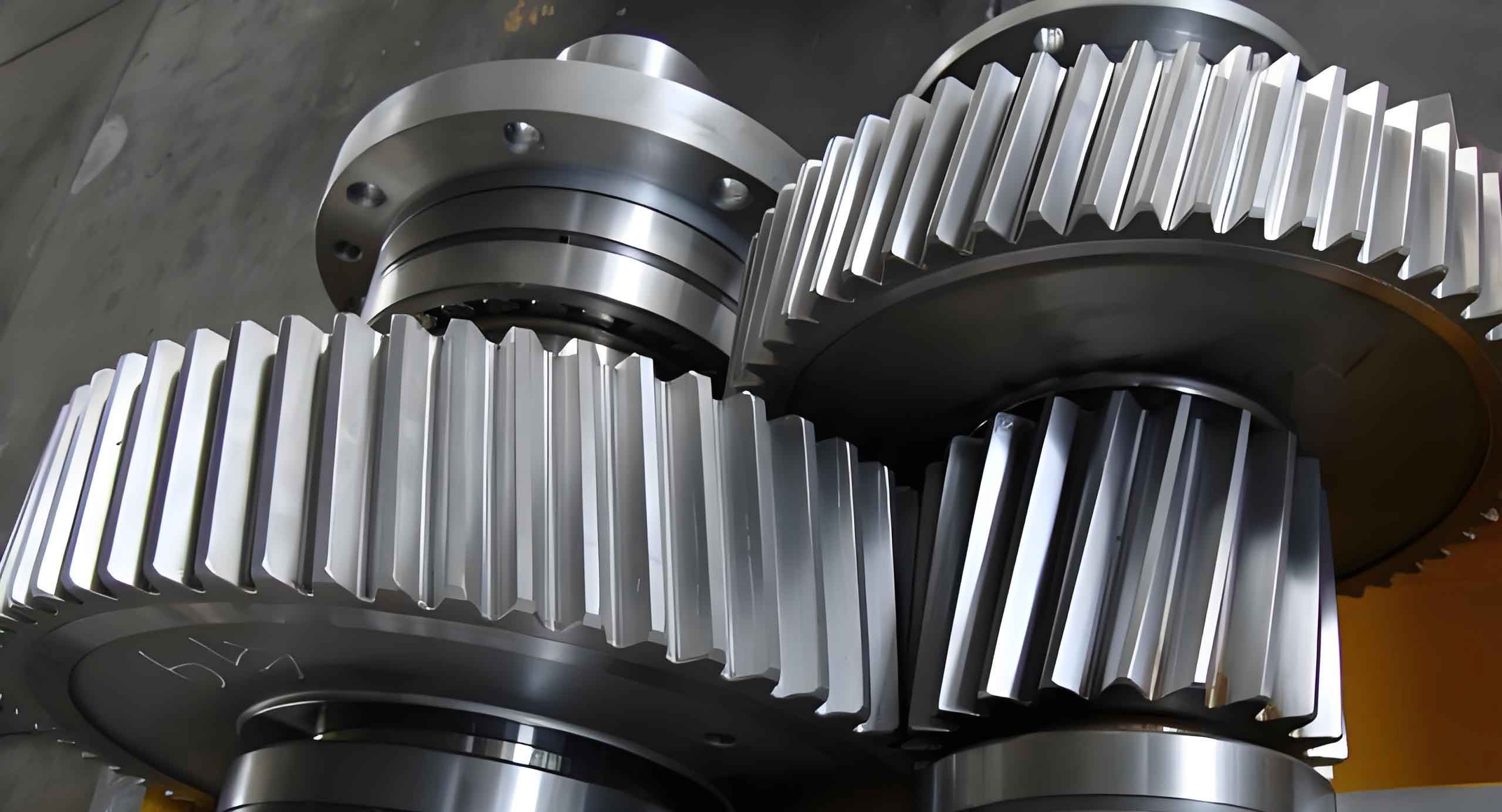
In my research on industrial machinery, I have encountered numerous cases where helical gears play a critical role in power transmission systems, particularly in heavy-duty applications like mining hoists. Helical gears are favored for their smooth operation and high load-carrying capacity, but their shafts are often subjected to complex stress states that can lead to fatigue failure. One such incident involved the fracture of a high-speed helical gear shaft in a large hoist reducer at a coal mine. The fracture occurred at the transition region between a thread run-out groove and a shaft shoulder, exhibiting clear signs of fatigue, such as smooth and rough zones on the fracture surface. This prompted me to conduct a detailed investigation using computational tools to analyze the static strength and fatigue life of the helical gear shaft, followed by structural optimization to prevent future failures. In this article, I will share my methodology and findings, emphasizing the importance of helical gears in such systems and how their design can be improved for enhanced durability.
The helical gear shaft in question was part of a reducer that transmits power from an electric motor to the hoist drum. Helical gears, with their angled teeth, generate both radial and axial forces, which must be carefully considered in shaft design. The shaft material was 20CrNiMo alloy steel, with key properties listed in Table 1. To begin the analysis, I developed a three-dimensional solid model of the helical gear shaft using CAD software, simplifying features like threads and sharp corners to focus on critical stress regions. This model was then imported into ANSYS for finite element analysis (FEA). I chose the SOLID45 element type for meshing, with finer mesh in high-stress areas such as the gear section and keyway, resulting in 151,036 elements and 29,915 nodes. The mesh quality was ensured to capture stress gradients accurately, especially around the fracture site.
| Property | Value | Unit |
|---|---|---|
| Elastic Modulus (E) | 208 | GPa |
| Poisson’s Ratio (ν) | 0.295 | – |
| Ultimate Tensile Strength (σu) | 980 | MPa |
| Yield Strength (σy) | 785 | MPa |
| Fatigue Strength Coefficient (σf‘) | Estimated from S-N curve | MPa |
For static strength analysis, I applied loads and boundary conditions based on the operational context of the helical gears. The shaft was modeled as a continuous beam, with torque input at the motor coupling end converted into a distributed normal force on the keyway surface. The helical gear output forces were simplified as a distributed normal force on the tooth surface, accounting for the helical angle. Bearing reactions were determined through equilibrium equations, and constraints included restricting five degrees of freedom (UX, UY, UZ, MX, MY) at bearing supports, with an axial constraint (UZ) at one shoulder to prevent Z-axis movement. The static analysis revealed a maximum von Mises stress of 431.457 MPa at the thread run-out groove and shoulder transition, as shown in the stress contour plot. This stress concentration was due to the abrupt change in geometry, which is a common issue in helical gear shafts. The stress value was below the allowable stress, calculated as:
$$[\sigma] = \frac{\sigma_y}{n_s} = \frac{785}{1.3} \approx 604 \text{ MPa}$$
where \(n_s\) is the safety factor. Since the maximum stress was lower than the yield strength but occurred in a cyclic loading environment, I concluded that fatigue was the failure mechanism. This aligns with fatigue theory, where components fail under alternating stresses below the material’s ultimate strength. Helical gears, with their continuous tooth engagement, impose repeated stresses that can initiate cracks over time.
To quantify the fatigue life, I used ANSYS/FE-SAFE, a specialized fatigue analysis software. The process involved importing the FEA results (RST file) along with material fatigue properties and load time-history data. For the 20CrNiMo steel, I employed the Seeger method to estimate the S-N curve based on ultimate tensile strength and elastic modulus. The load spectrum was derived from field measurements, capturing typical stress variations during hoist operation. Using the von Mises stress with the Goodman correction for mean stress effects, I applied Miner’s linear cumulative damage rule to compute fatigue life. The analysis yielded a minimum fatigue life of \(10^{5.379} \approx 239,331\) cycles at the critical location. Given a motor speed of 300 rpm, this translates to approximately 797 minutes of operation before failure, highlighting the need for proactive maintenance in helical gear systems. The fatigue life contour plot showed symmetric distribution around the fracture zone, consistent with the actual breakage pattern.
Fatigue life estimation relies on the S-N curve, which relates stress amplitude to the number of cycles to failure. For helical gears, the stress amplitude can be expressed as:
$$\sigma_a = \frac{\sigma_{\text{max}} – \sigma_{\text{min}}}{2}$$
where \(\sigma_{\text{max}}\) and \(\sigma_{\text{min}}\) are the maximum and minimum stresses in a cycle. The S-N curve is often represented by the Basquin equation:
$$\sigma_a = \sigma_f’ (2N_f)^b$$
where \(\sigma_f’\) is the fatigue strength coefficient, \(N_f\) is the number of cycles to failure, and \(b\) is the fatigue strength exponent. For the helical gear shaft material, these parameters were derived from the estimated S-N curve. Miner’s rule accumulates damage as:
$$D = \sum \frac{n_i}{N_{f,i}}$$
where \(n_i\) is the number of cycles at stress level \(i\), and \(N_{f,i}\) is the fatigue life at that level. Failure occurs when \(D \geq 1\). In this case, the computed damage at the critical node exceeded unity after 239,331 cycles, confirming fatigue failure.
Based on the analysis, I proposed a structural optimization to mitigate the stress concentration. The original design used a threaded section with a lock nut and washer to secure the bearing inner ring, which created geometric discontinuities. I replaced this with a tapered withdrawal sleeve (taper 1:12) that allows the bearing to be mounted on a conical shaft seat. This modification eliminated the thread, run-out groove, and locking groove, resulting in a smoother transition between shaft diameters. Specifically, the shaft segment diameters were adjusted: the original 70.18 mm diameter at the motor coupling end was increased to 79.64 mm to maintain strength, while the fracture-prone region was integrated into a uniform diameter section. This redesign not only reduces stress risers but also simplifies assembly and disassembly, which is beneficial for helical gear maintenance. The optimized geometry is depicted in comparison with the original in Table 2.
| Aspect | Original Design | Optimized Design |
|---|---|---|
| Fracture Zone Features | Thread, run-out groove, shoulder | Smooth taper, no threads |
| Shaft Diameter at Critical Region | Variable (70.18 mm to larger) | Uniform (79.64 mm) |
| Bearing Fixation Method | Lock nut and washer | Withdrawal sleeve |
| Stress Concentration Factor | High due to discontinuities | Reduced by gradual transitions |
| Assembly Complexity | Moderate (requires threading) | Low (slip-fit with taper) |
I performed a follow-up FEA and fatigue analysis on the optimized helical gear shaft. The static analysis showed a maximum von Mises stress of 223.226 MPa, a reduction of about 48% compared to the original design. This significant decrease is attributed to the elimination of geometric stress concentrators, which is crucial for helical gears operating under cyclic loads. The fatigue analysis indicated that the shaft now achieves an infinite fatigue life (over \(10^6\) cycles) under the same load spectrum, as the stress amplitude falls below the endurance limit of the material. The fatigue life contour plot confirmed no critical hotspots, validating the optimization. This improvement ensures that helical gears in such reducers can operate safely without premature failure, enhancing the reliability of mining hoists.
To further illustrate the benefits, I derived key equations for stress in helical gear shafts. The bending stress due to gear forces can be approximated as:
$$\sigma_b = \frac{M}{Z}$$
where \(M\) is the bending moment and \(Z\) is the section modulus. For a shaft with diameter \(d\), \(Z = \frac{\pi d^3}{32}\). The torsional stress from torque transmission is:
$$\tau_t = \frac{T}{J} \cdot \frac{d}{2}$$
where \(T\) is the torque and \(J = \frac{\pi d^4}{32}\) is the polar moment of inertia. The von Mises equivalent stress combines these as:
$$\sigma_{vm} = \sqrt{\sigma_b^2 + 3\tau_t^2}$$
For helical gears, the axial force introduces additional stress, which I incorporated in the FEA. The optimization effectively reduced \(\sigma_{vm}\) by increasing \(d\) at critical sections, as shown in the analysis. Moreover, the fatigue safety factor can be calculated as:
$$n_f = \frac{\sigma_e}{\sigma_a}$$
where \(\sigma_e\) is the endurance limit. For the optimized shaft, \(n_f > 1\), indicating infinite life.
In conclusion, my investigation into the helical gear shaft failure demonstrates the importance of integrated static and fatigue analysis in mechanical design. Helical gears, while efficient, impose complex loading conditions that require careful attention to geometric details. Through FEA and FE-SAFE, I identified the fatigue root cause and proposed a simple yet effective optimization using a withdrawal sleeve. This change not only extended the fatigue life to infinity but also improved manufacturability and maintenance. For engineers working with helical gears, I recommend regular fatigue assessments and design optimizations to prevent unexpected downtimes. Future work could explore advanced materials or surface treatments for helical gears to further enhance performance. Overall, this case underscores the critical role of helical gears in industrial systems and the value of computational tools in achieving robust designs.
To summarize the technical aspects, Table 3 provides a comparison of key parameters before and after optimization, highlighting the impact on helical gear shaft performance.
| Metric | Original Shaft | Optimized Shaft | Improvement |
|---|---|---|---|
| Max von Mises Stress (MPa) | 431.457 | 223.226 | ~48% reduction |
| Fatigue Life (cycles) | 2.39 × 10⁵ | Infinite (>106) | Significant increase |
| Stress Concentration Factor | Estimated >2 | ~1.5 | Reduced |
| Weight (approximate) | Baseline | Slightly higher due to diameter increase | Negligible impact |
| Manufacturing Cost | Higher (threading required) | Lower (simpler machining) | Cost-effective |
Through this work, I have reinforced the idea that helical gears are integral to many mechanical systems, and their shafts must be designed with fatigue in mind. By applying these methods, we can ensure the longevity and safety of equipment relying on helical gears, from mining hoists to other heavy machinery. The use of tables and formulas, as shown, aids in summarizing complex data and deriving actionable insights. I hope this article serves as a reference for those involved in the analysis and optimization of helical gear components.