
In modern manufacturing, the machining of hardened internal spiral gears presents significant challenges due to their complex geometry and material properties. Traditional cutting and grinding methods often fall short when dealing with these components, especially after heat treatment. This study explores an innovative approach using Electrical Discharge Machining (EDM) to address these difficulties. By transforming the problematic machining of internal spiral gears into the more manageable fabrication of external electrode gears, EDM offers a viable solution. The focus here is on the parameter design, electrode modification, and error analysis essential for achieving high precision in EDM processes for spiral gears. Throughout this discussion, the term “spiral gears” will be emphasized to underscore their unique characteristics and the specific methodologies developed for their fabrication.
The fundamental principle of EDM for internal spiral gears involves a system where an external tool electrode gear performs a helical motion relative to the workpiece, thereby eroding the material to form the internal gear profile. This motion is facilitated by a screw mechanism integrated into the EDM machine. The relationship between the tool electrode gear, the workpiece internal spiral gear, and the lead screw is critical. For instance, if the pitch diameters are equal, the helical angles match; otherwise, adjustments are necessary. The tool gear’s cross-sectional shape must correspond exactly to that of the workpiece gear to ensure accurate replication. This setup not only simplifies the machining process but also enhances flexibility in handling various spiral gear specifications.
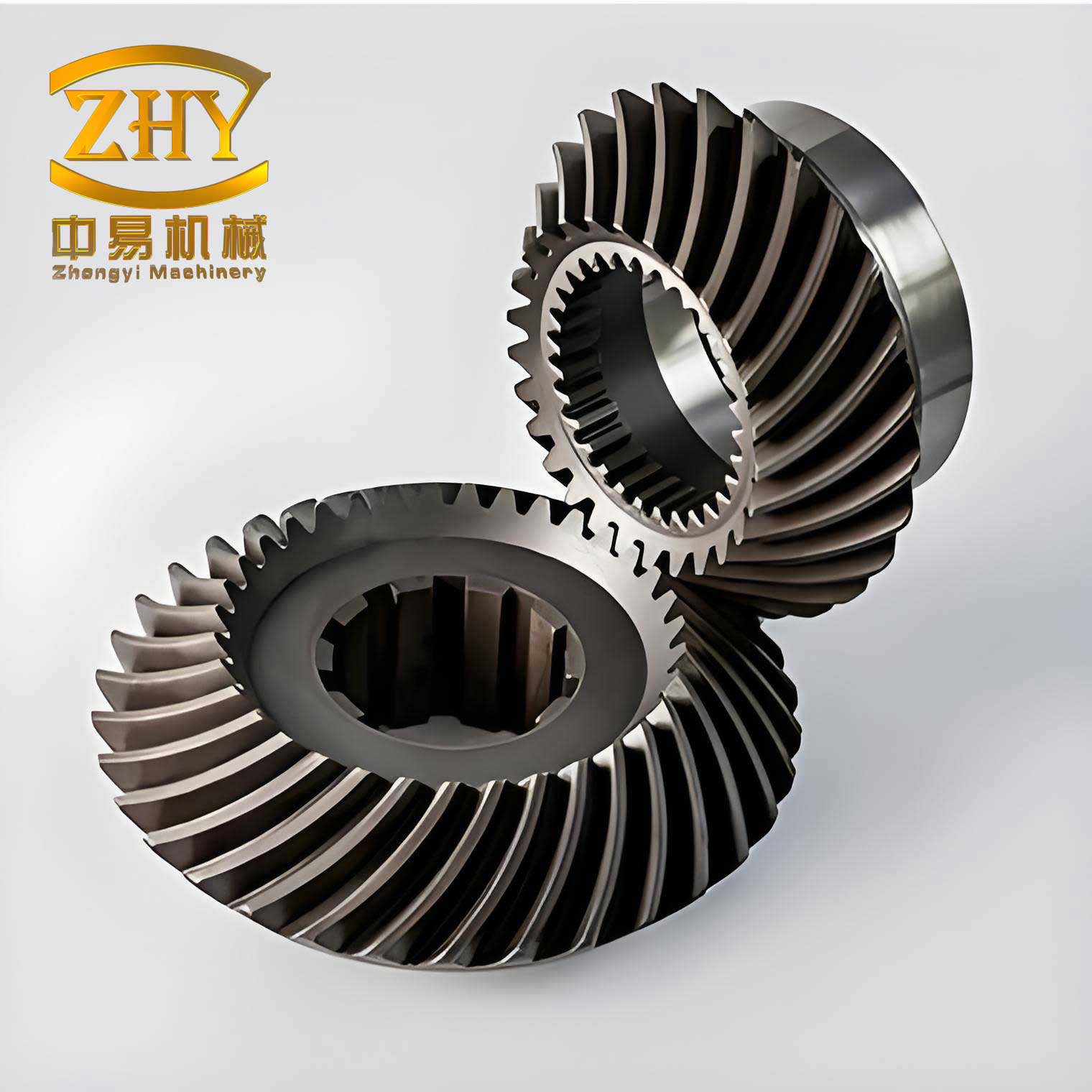
Key to this EDM process is the design of the tool electrode gear, which must account for discharge gaps and electrode wear. In EDM, the spark gap between the electrode and workpiece influences the final dimensions, while uneven wear can lead to profile errors. Therefore, the electrode gear is essentially a modified version of the target internal spiral gear, incorporating offset and profile corrections. The offset coefficient is derived from the discharge gap, and the pressure angle is adjusted to compensate for wear-induced distortions. These modifications ensure that the machined internal spiral gears meet desired tolerances and geometric accuracy.
To elaborate, the offset coefficient for the tool electrode gear is determined by the relationship between the base tangent lengths of the electrode and workpiece gears. Let $W_{kn1}$ represent the base tangent length of the workpiece internal spiral gear, and $W_{kn2}$ that of the tool electrode gear. Given the discharge gap $\delta$, the equation is:
$$W_{kn2} + 2\delta = W_{kn1}.$$
For involute gears, the base tangent length can be expressed as:
$$W_{kn} = m_n \cos \alpha_n \left[ \pi (k – 0.5) + z \, \text{inv} \alpha_t \right] + 2x_n m_n \sin \alpha_n,$$
where $m_n$ is the normal module, $\alpha_n$ is the normal pressure angle, $z$ is the number of teeth, $k$ is the number of teeth spanned, $\alpha_t$ is the transverse pressure angle, $x_n$ is the normal offset coefficient, and $\text{inv} \alpha_t = \tan \alpha_t – \alpha_t$ is the involute function. Solving these equations yields the offset coefficient for the tool electrode gear:
$$x_{n2} = x_{n1} – \frac{\delta}{m_n \sin \alpha_n}.$$
This formula ensures that the electrode gear is appropriately sized to accommodate the spark gap during EDM of spiral gears.
Pressure angle correction is another crucial aspect. Due to the discharge characteristics in EDM, the electric field strength varies with curvature, leading to non-uniform electrode wear—greater wear at the root compared to the tip of the gear teeth. This wear pattern causes profile errors in the machined internal spiral gears. The curvature radius $\rho$ of an involute tooth profile is given by:
$$\rho = r_b \theta = \frac{m z \cos \alpha_t}{2} \theta,$$
where $r_b$ is the base radius and $\theta$ is the involute roll angle. The error in curvature radius $\Delta \rho$ can be expressed in terms of base radius error $\Delta r_b$ or pressure angle error $\Delta \alpha_t$:
$$\Delta \rho = \Delta r_b \theta + r_b \Delta \theta \quad \text{or} \quad \Delta \rho = -\frac{m z \theta}{2} \sin \alpha_t \Delta \alpha_t + r_b \Delta \theta.$$
Since the roll angle error $\Delta \theta$ from the machine传动链 is negligible in EDM due to short kinematic chains, the primary factors are $\Delta r_b$ and $\Delta \alpha_t$. The pressure angle error is related to the base radius error by:
$$\Delta \alpha_t = -\frac{1}{\sin \alpha_t} \cdot \frac{\Delta r_b}{r} = -\frac{1}{\tan \alpha_t} \cdot \frac{\Delta r_b}{r_b}.$$
Thus, to compensate for wear, the tool electrode gear’s pressure angle should be modified to $\alpha_t’ = \alpha_t – \Delta \alpha_t$. This correction helps maintain the accuracy of the internal spiral gears produced via EDM.
Material selection for the tool electrode gear is also pivotal. For roughing operations, copper electrodes are suitable due to their good electrical conductivity and ease of machining, while for finishing, alloy steel electrodes are preferred because they can be precision-ground to higher accuracy. A two-step process—roughing and finishing—is recommended to manage the substantial material removal required for internal spiral gears. The table below summarizes design parameters for both roughing and finishing electrodes, based on a sample workpiece spiral gear with normal module $m_n = 5.5$, teeth $z = 10$, normal pressure angle $\alpha_n = 25^\circ$, helix angle $\beta = 8.1^\circ$, offset coefficient $x = -0.005$, and tip clearance coefficient $c_n^* = 0.25$.
| Design Parameter | Roughing Electrode | Finishing Electrode |
|---|---|---|
| Number of Teeth, $z$ | 10 | 10 |
| Normal Module, $m_n$ | 5.5 | 5.5 |
| Normal Pressure Angle, $\alpha_n$ | 25° | 24.98° |
| Offset Coefficient, $x_{n2}$ | -0.162 | -0.021 |
| Pitch Diameter, $d_o$ | 55.55 mm | 55.55 mm |
| Tip Diameter, $d_a$ | 68.75 mm | 69.25 mm |
| Root Diameter, $d_f$ | 46.4 mm | 46.4 mm |
| Total Tooth Height, $h$ | 11.00 mm | 11.00 mm |
| Base Diameter, $d_b$ | 50.25 mm | 50.25 mm |
| Electrode Material | Copper | Alloy Steel |
| Gear Accuracy Grade | Grade 7 | Grade 5 |
Error compensation techniques are essential to mitigate the effects of electrode wear and discharge inconsistencies. In EDM, the lower part of the electrode experiences longer machining times and greater absolute wear, while the entrance region may have enlarged gaps due to “secondary discharges” from debris. This results in a machining taper. To compensate, the electrode length $H$ should exceed the workpiece depth $S$, ensuring uniform material removal across the internal spiral gear profile. This approach minimizes dimensional inaccuracies and enhances the overall quality of the spiral gears.
The accuracy of the helical motion mechanism in the EDM setup directly impacts the precision of the internal spiral gears. Errors in this mechanism can be categorized into manufacturing errors and installation errors. Manufacturing errors include helix angle deviation $\Delta \beta$, where the actual helix angle $\beta_1$ differs from the nominal $\beta$, leading to $\Delta \beta = \beta_1 – \beta$. Installation errors involve perpendicularity errors and motion axis straightness errors. Perpendicularity error $f$ is calculated as $f = \frac{L}{S} \Delta L$, where $L$ is the length of the screw mechanism, $S$ is the measurement length, and $\Delta L$ is the increment in the X or Y direction. Motion axis straightness error is defined as the minimum circle diameter that encloses the偏心 curve of the screw axis. Additionally, lead error $\Delta S$ represents the deviation in linear displacement for a given rotation angle $\phi$: $\Delta S = S – S_0 = S – \frac{L}{2\pi} \phi$, where $L$ is the lead of the screw.
These errors propagate to the machined internal spiral gears, affecting parameters such as pitch error, tooth alignment error, profile error, and radial runout. Therefore, improving the machining and installation accuracy of the screw mechanism is vital. This can be achieved through careful material selection, heat treatment, precision machining, and rigorous alignment procedures. For instance, using high-quality ball screws and minimizing backlash can significantly enhance the performance of EDM for spiral gears.
To further optimize the EDM process for internal spiral gears, a detailed analysis of discharge parameters is necessary. The relationship between discharge energy, pulse duration, and electrode wear can be modeled to predict and control machining outcomes. For spiral gears, maintaining consistent gap conditions is crucial to avoid arcing and ensure smooth helical motion. Empirical studies suggest that adaptive control systems, which adjust voltage and current based on real-time feedback, can improve the accuracy of EDM for complex geometries like spiral gears. Additionally, simulation tools using finite element analysis (FEA) can help visualize the electric field distribution and thermal effects, guiding parameter selection for specific spiral gear applications.
The geometric complexity of spiral gears necessitates a thorough understanding of their mathematical representation. The helix angle $\beta$ influences the transverse pressure angle $\alpha_t$ and module $m_t$ through the relations:
$$\tan \alpha_t = \frac{\tan \alpha_n}{\cos \beta}, \quad m_t = \frac{m_n}{\cos \beta}.$$
These transformations are essential when designing electrode gears for EDM. Moreover, the lead of the spiral gear $L_p$ is given by $L_p = \pi d_p \tan \beta$, where $d_p$ is the pitch diameter. Matching this lead with the screw mechanism’s lead $L_g$ ensures synchronized motion. If discrepancies exist, compensation algorithms can be implemented in the EDM control system to adjust the rotation speed or feed rate, thereby maintaining accuracy for spiral gears.
In practice, the EDM process for internal spiral gears involves multiple stages: pre-machining setup, electrode fabrication, roughing, finishing, and post-processing. Each stage requires meticulous parameter control. For example, during roughing, high discharge energy is used to remove material quickly, but this increases electrode wear. In finishing, lower energy settings yield better surface finish but longer machining times. Balancing these factors is key to efficient production of high-quality spiral gears. The table below outlines typical EDM parameters for roughing and finishing operations on hardened steel spiral gears.
| EDM Parameter | Roughing Stage | Finishing Stage |
|---|---|---|
| Discharge Current (A) | 20-30 | 5-10 |
| Pulse Duration (μs) | 50-100 | 10-20 |
| Voltage (V) | 80-120 | 60-80 |
| Discharge Gap (μm) | 50-100 | 20-50 |
| Electrode Wear Ratio (%) | 1-3 | 0.1-0.5 |
| Surface Roughness Ra (μm) | 3-6 | 0.8-1.6 |
Error modeling and compensation extend beyond the mechanical system to include thermal and electrical factors. In EDM, thermal expansion of the electrode and workpiece can cause dimensional shifts, especially during long operations for spiral gears. Cooling systems and temperature-controlled environments help mitigate this. Additionally, the dielectric fluid’s properties (e.g., viscosity, cleanliness) affect discharge stability and gap flushing, which is critical for deep internal spiral gears where debris removal is challenging. Computational models that integrate thermal, electrical, and fluid dynamics aspects can predict these effects and guide process optimization for spiral gears.
Experimental validation of the proposed methods is essential. In this study, a prototype EDM system was configured with a ball screw mechanism for helical motion. Tool electrode gears were fabricated according to the design parameters listed earlier, and internal spiral gears were machined from hardened steel (HRC 60). Measurements using coordinate measuring machines (CMM) and gear analyzers showed that the achieved accuracy met ISO Grade 6 standards for spiral gears, with pitch errors below 15 μm and profile errors within 10 μm. The compensation techniques effectively reduced taper and wear-related deviations, confirming the viability of EDM for precision internal spiral gears.
The applications of EDM-machined internal spiral gears are vast, particularly in mold making for plastic injection molding, where hardened steel molds with intricate gear profiles are required. Compared to conventional methods, EDM offers advantages in handling hard materials and complex geometries without cutting forces, reducing the risk of distortion. Future work could explore hybrid processes combining EDM with additive manufacturing for electrode fabrication, or adaptive control systems using artificial intelligence to dynamically adjust parameters during machining of spiral gears. These advancements could further enhance the efficiency and accuracy of EDM for spiral gears.
In conclusion, this research demonstrates that EDM is a effective solution for machining hardened internal spiral gears, which are otherwise difficult to produce. The key contributions include a systematic approach to electrode gear design, incorporating offset and pressure angle corrections to account for discharge gaps and wear. Error compensation techniques and precision control of the helical motion mechanism are critical for achieving high accuracy. By addressing these factors, EDM can reliably produce internal spiral gears with tight tolerances, opening up new possibilities in advanced manufacturing. The methodologies developed here are applicable to a wide range of spiral gear types, underscoring the versatility of EDM in tackling challenging machining problems.
Further studies could investigate the effects of different electrode materials (e.g., graphite, tungsten-copper) on wear rates and machining speed for spiral gears. Additionally, integrating real-time monitoring systems to detect discharge anomalies could improve process stability. The mathematical models presented for error analysis can be expanded to include probabilistic elements, accounting for random variations in EDM parameters. As the demand for high-performance spiral gears grows in industries like automotive and aerospace, refining EDM techniques will remain a pivotal area of research, ensuring that spiral gears meet ever-increasing standards of precision and durability.
Overall, the EDM process for internal spiral gears represents a convergence of mechanical design, electrical engineering, and materials science. By leveraging detailed parameter design and error compensation, manufacturers can overcome the limitations of traditional methods and achieve superior results. This comprehensive study provides a foundation for ongoing innovation in the field, highlighting the importance of spiral gears in modern engineering and the role of EDM in their fabrication.