
In the design and manufacturing of herringbone gears, one critical aspect that ensures proper machining and functionality is the provision of an undercut or relief groove. This groove, often referred to as the退刀槽 in Chinese technical literature, allows the cutting tool, such as a hob, to exit smoothly without interfering with the gear teeth during the gear-cutting process. The width of this undercut, denoted as \( b_{\text{min}} \), must be carefully determined to avoid collisions between the tool and the gear while minimizing material waste. Traditionally, standard tables, such as Q/ZB 135-73, provide fixed values for \( b_{\text{min}} \) regardless of the gear’s tooth count, but in reality, this minimum width varies significantly with key parameters like the number of teeth, module, and helix angle. This article presents a comprehensive analysis, from a first-person perspective, on establishing a mathematical model to compute the undercut width for herringbone gears, emphasizing the relationship with tooth count and module. I will delve into the geometry, derive formulas, and present extensive tabulated results to aid designers in optimizing herringbone gear designs.
The herringbone gear, characterized by its double helical teeth that form a V-shape, is widely used in high-power transmission systems due to its ability to cancel axial thrust and operate smoothly. However, the machining of such gears, particularly via hobbing, necessitates precise calculation of the undercut width to ensure the hob can clear the gear profile without gouging. In my investigation, I simplify the hob and herringbone gear into geometric entities to develop a computational model. This model accounts for the interaction between the hob’s tooth tip cylinder and the gear’s root and tip cylinders under varying conditions. The goal is to derive \( b_{\text{min}} \) as a function of the normal module \( m_n \), helix angle \( \beta \), and number of teeth \( Z \), thereby providing a more accurate and flexible design tool than existing standards.
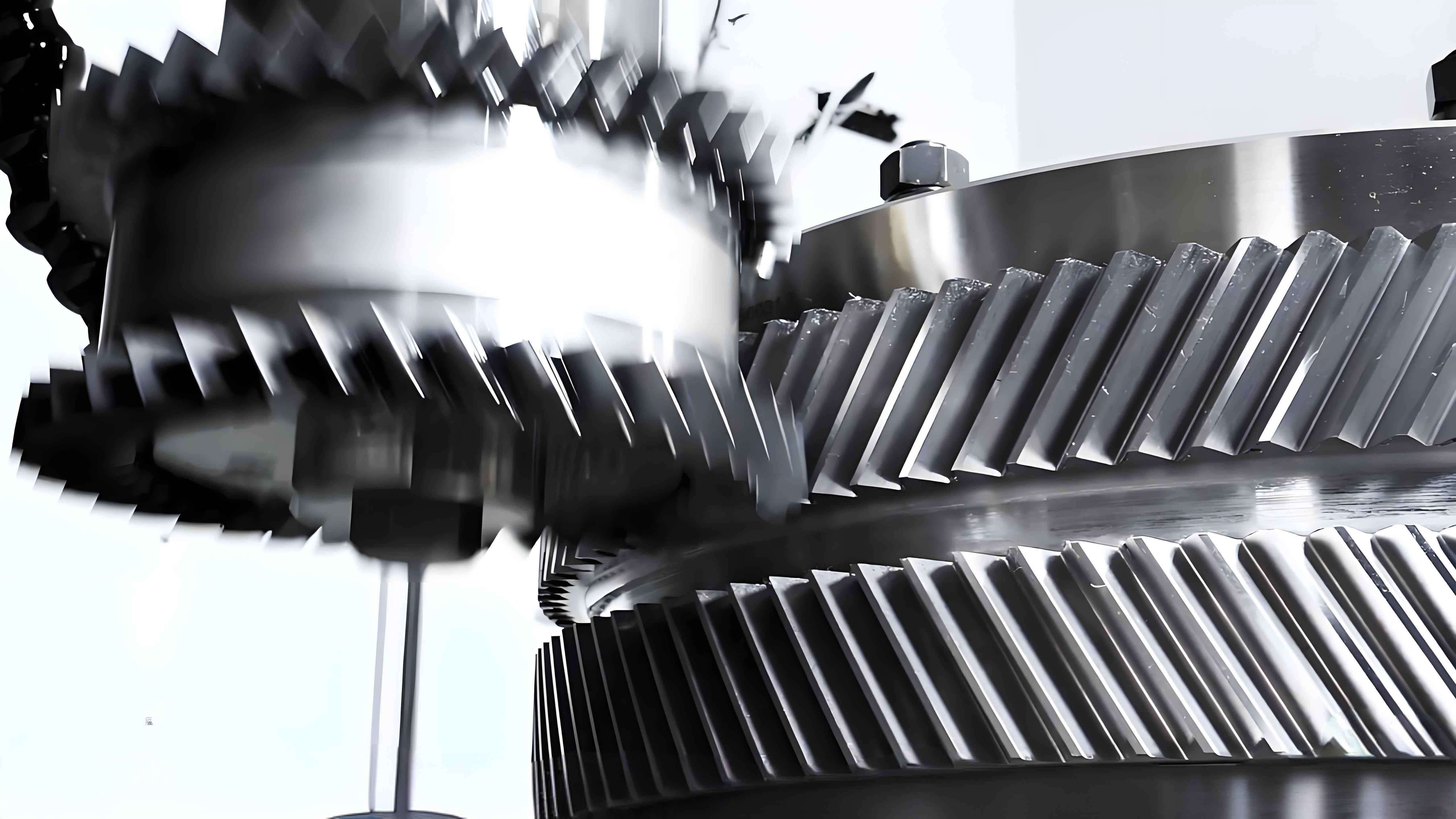
To begin, I establish a coordinate system to model the hob and herringbone gear interaction. Let the gear axis be aligned with the \( z \)-axis, with the \( x \)-axis and \( y \)-axis lying on one end face of the undercut groove, denoted as plane N. The hob axis is perpendicular to the \( x \)-axis and intersects it, forming an angle \( \phi \) with the \( z \)-axis. This angle \( \phi \) is related to the hob’s lead angle \( \lambda \) and the gear’s helix angle \( \beta \) by \( \phi = 90^\circ – (\lambda + \beta) \). The hob’s tooth tip cylinder, with diameter \( D \), is tangent to the gear’s root cylinder, with diameter \( D_1 \), at a point P. The distance between the hob axis and gear axis is given by \( x_0 = (D_1 + D)/2 \). The gear’s tip cylinder diameter is \( D_2 \), and the hob length is \( 2L \). The key is to find the maximum \( z \)-coordinate of the intersection between the hob’s geometry and the gear’s tip cylinder, which defines \( b_{\text{min}} \), the minimum undercut width required.
The mathematical model involves two scenarios based on the hob length. In the first scenario, when the hob is relatively short, the tooth tip circle at one end face of the hob (e.g., M1) intersects the gear’s tip cylinder at two points in the first octant. The larger \( z \)-coordinate of these intersection points gives \( b_{\text{min}} \). In the second scenario, when the hob is appropriately long or longer, the intersection may be a single point or none, and we derive \( b_{\text{min}} \) from the maximum \( z \)-coordinate along the curve of intersection between the hob’s tooth tip cylinder and the gear’s tip cylinder. I will now detail the equations for both scenarios.
For the first scenario, consider the hob end face M1. It passes through the point \( (x_0, L \cos \alpha, L \sin \alpha) \), where \( \alpha = \lambda + \beta \), and has a normal vector \( \mathbf{n} = (0, \cos \alpha, \sin \alpha) \). The equation of this plane is:
$$ \cos \alpha (y – L \cos \alpha) + \sin \alpha (z – L \sin \alpha) = 0 \quad (1) $$
The hob’s tooth tip cylinder surface is described by:
$$ (x – x_0)^2 + (-y \sin \alpha + z \cos \alpha)^2 = D^2 / 4 \quad (2) $$
The gear’s tip cylinder equation is:
$$ x^2 + y^2 = D_2^2 / 4 \quad (3) $$
To find the intersection, I introduce a parameter \( t \) and, considering only the first octant, set:
$$ x = (D_2 t) / 2 \quad (4) $$
$$ y = (D_2 \sqrt{1 – t^2}) / 2 \quad (5) $$
Substituting into equation (1) yields:
$$ z = L / \sin \alpha – (D_2 \sqrt{1 – t^2}) / (2 \tan \alpha) \quad (6) $$
Then, plugging equations (4), (5), and (6) into equation (2) gives:
$$ C_2 t^2 + C_1 t + C_0 = D_2 \sqrt{1 – t^2} \quad (7) $$
where the coefficients are defined as:
$$ C_2 = – (D_2 \cos \alpha) / (4L) $$
$$ C_1 = – (x_0 \tan \alpha \sin \alpha) / L = – (D + D_1) \sin \alpha / (2L) $$
$$ C_0 = \left( \frac{D_1^2 + 2D \cdot D_1}{4} + \frac{L^2}{\tan^2 \alpha} + \frac{D^2}{4 \sin^2 \alpha} \right) \frac{\sin \alpha}{D_2 L} $$
Squaring both sides of equation (7) leads to a quartic equation in \( t \):
$$ e_4 t^4 + e_3 t^3 + e_2 t^2 + e_1 t + e_0 = 0 \quad (8) $$
with coefficients derived from \( C_2, C_1, C_0 \). Since all coefficients are known from gear parameters, this equation can be solved numerically for \( t \). The larger \( z \)-value from equation (6) corresponding to the valid \( t \) solutions gives \( b_{\text{min}} \) for this scenario.
For the second scenario, I directly consider the intersection curve between the hob’s tooth tip cylinder and the gear’s tip cylinder. Using equations (4) and (5) in equation (2), I express \( z \) as a function of \( t \):
$$ z(t) = \frac{D_2 \tan \alpha \sqrt{1 – t^2}}{2} + \frac{ \sqrt{ D^2 / 4 – (D_2 t / 2 – x_0)^2 } }{ \cos \alpha } \quad (9) $$
taking the positive root. To find the maximum \( z \), I differentiate \( z(t) \) with respect to \( t \) and set the derivative to zero:
$$ \frac{dz(t)}{dt} = – \frac{D_2 \tan \alpha \cdot t}{2 \sqrt{1 – t^2}} – \frac{ D_2 (D_2 t / 2 – x_0) }{ 2 \cos \alpha \sqrt{ D^2 / 4 – (D_2 t / 2 – x_0)^2 } } = 0 \quad (10) $$
Simplifying this yields another quartic equation:
$$ A_4 t^4 + A_3 t^3 + A_2 t^2 + A_1 t + A_0 = 0 \quad (11) $$
where the coefficients are:
$$ A_4 = D_2^4 \cos^2 \alpha / 4 $$
$$ A_3 = -D_2^3 x_0 \cos^2 \alpha $$
$$ A_2 = D_2^2 \sin^2 \alpha / 4 – D_2^2 D^2 / 4 + D_2^2 x_0^2 \cos^2 \alpha $$
$$ A_1 = D_2 x_0 D^2 $$
$$ A_0 = -D_2^2 x_0^2 $$
Solving equation (11) for \( t \) and substituting into equation (9) gives \( z_{\text{max}} \), which is \( b_{\text{min}} \) for this scenario. The overall \( b_{\text{min}} \) is the greater value obtained from either scenario, ensuring a safe undercut width for all hob lengths.
Critical to this analysis are the gear dimensions. The root diameter \( D_1 \) and tip diameter \( D_2 \) depend on the normal module \( m_n \), number of teeth \( Z \), helix angle \( \beta \), addendum coefficient \( h_a^* \), dedendum coefficient \( c^* \), and profile shift coefficient \( x_n \). Specifically:
$$ D_1 = m_n \left( \frac{Z}{\cos \beta} – 2h_a^* – 2c^* + 2x_n \right) \quad (12) $$
$$ D_2 = m_n \left( \frac{Z}{\cos \beta} + 2h_a^* + 2x_n \right) \quad (13) $$
Thus, the distance \( x_0 \) becomes:
$$ x_0 = \frac{ D_1 + D }{2} = \frac{1}{2} \left[ m_n \left( \frac{Z}{\cos \beta} – 2h_a^* – 2c^* + 2x_n \right) + D \right] $$
I investigated the influence of the profile shift coefficient \( x_n \) on \( b_{\text{min}} \). When \( x_n > 0 \), the hob moves away from the gear by \( x_n m_n \), and the gear tip diameter increases by \( 2x_n m_n \); conversely, for \( x_n < 0 \), the hob moves closer and the tip diameter decreases. These effects partially offset each other. Moreover, comparing terms in equations (12) and (13), the \( 2x_n \) term is negligible relative to \( Z / \cos \beta \) for typical gear sizes. I performed calculations for \( x_n = 0, 0.1, \) and \( 0.2 \), and found minimal differences in \( b_{\text{min}} \). Therefore, for practical purposes, the effect of \( x_n \) can be ignored, simplifying the model to focus on \( Z \), \( m_n \), and \( \beta \).
To compute \( b_{\text{min}} \) efficiently, I developed a computer program that implements the mathematical model. The program iterates over ranges of \( m_n \), \( \beta \), and \( Z \), solving the equations numerically to determine the minimum undercut width. The results are compiled into comprehensive tables, which serve as a quick reference for designers. Below, I present a series of tables summarizing \( b_{\text{min}} \) values for various combinations. These tables are categorized by helix angle \( \beta \) and normal module \( m_n \), with columns for different tooth counts \( Z \). Two types of herringbone gears are considered: Type I for standard grades (A, B, C) and Type II for higher precision grades (AA).
Table 1: Minimum undercut width \( b_{\text{min}} \) (in mm) for herringbone gears with helix angle \( \beta = 25^\circ \).
| \( m_n \) | Z=40 | Z=60 | Z=80 | Z=100 | Z=120 | Type |
|---|---|---|---|---|---|---|
| 4 | 37 | 37 | 41 | 43 | 45 | I |
| 4 | 33 | 36 | 38 | 38 | 39 | II |
| 5 | 45 | 46 | 50 | 51 | 52 | I |
| 5 | 40 | 43 | 44 | 44 | 45 | II |
| 6 | 50 | 55 | 57 | 58 | 60 | I |
| 6 | 45 | 47 | 48 | 49 | 49 | II |
| 7 | 55 | 60 | 61 | 62 | 63 | I |
| 7 | 51 | 53 | 54 | 54 | 55 | II |
| 8 | 63 | 68 | 70 | 71 | 72 | I |
| 8 | 57 | 59 | 60 | 60 | 60 | II |
| 9 | 71 | 77 | 79 | 81 | 81 | I |
| 9 | 64 | 66 | 67 | 67 | 68 | II |
| 10 | 78 | 85 | 88 | 89 | 90 | I |
| 10 | 70 | 72 | 73 | 73 | 74 | II |
Table 2: Minimum undercut width \( b_{\text{min}} \) (in mm) for herringbone gears with helix angle \( \beta = 30^\circ \).
| \( m_n \) | Z=40 | Z=60 | Z=80 | Z=100 | Z=120 | Type |
|---|---|---|---|---|---|---|
| 4 | 41 | 45 | 49 | 47 | 48 | I |
| 4 | 38 | 41 | 41 | 41 | 41 | II |
| 5 | 43 | 53 | 56 | 56 | 57 | I |
| 5 | 45 | 46 | 47 | 47 | 48 | II |
| 6 | 56 | 61 | 63 | 64 | 65 | I |
| 6 | 50 | 51 | 51 | 52 | 52 | II |
| 7 | 63 | 65 | 65 | 66 | 67 | I |
| 7 | 56 | 57 | 58 | 58 | 58 | II |
| 8 | 72 | 75 | 76 | 77 | 77 | I |
| 8 | 62 | 63 | 64 | 64 | 64 | II |
| 9 | 81 | 80 | 81 | 81 | 82 | I |
| 9 | 69 | 71 | 72 | 72 | 72 | II |
| 10 | 89 | 90 | 91 | 92 | 92 | I |
| 10 | 75 | 77 | 77 | 78 | 78 | II |
Table 3: Minimum undercut width \( b_{\text{min}} \) (in mm) for herringbone gears with helix angle \( \beta = 35^\circ \).
| \( m_n \) | Z=40 | Z=60 | Z=80 | Z=100 | Z=120 | Type |
|---|---|---|---|---|---|---|
| 4 | 45 | 49 | 50 | 51 | 51 | I |
| 4 | 42 | 43 | 43 | 43 | 43 | II |
| 5 | 55 | 59 | 60 | 61 | 61 | I |
| 5 | 49 | 50 | 50 | 50 | 50 | II |
| 6 | 64 | 66 | 68 | 69 | 69 | I |
| 6 | 53 | 54 | 54 | 54 | 54 | II |
| 7 | 68 | 70 | 71 | 71 | 71 | I |
| 7 | 56 | 57 | 58 | 58 | 58 | II |
| 8 | 78 | 80 | 81 | 81 | 82 | I |
| 8 | 60 | 60 | 60 | 61 | 61 | II |
| 9 | 88 | 90 | 91 | 92 | 92 | I |
| 9 | 66 | 66 | 67 | 67 | 67 | II |
| 10 | 97 | 100 | 102 | 102 | 102 | I |
| 10 | 69 | 69 | 70 | 70 | 70 | II |
Table 4: Minimum undercut width \( b_{\text{min}} \) (in mm) for herringbone gears with helix angle \( \beta = 40^\circ \).
| \( m_n \) | Z=40 | Z=60 | Z=80 | Z=100 | Z=120 | Type |
|---|---|---|---|---|---|---|
| 4 | 51 | 53 | 53 | 54 | 54 | I |
| 4 | 45 | 45 | 45 | 45 | 45 | II |
| 5 | 61 | 63 | 64 | 64 | 64 | I |
| 5 | 51 | 52 | 52 | 52 | 52 | II |
| 6 | 70 | 71 | 71 | 72 | 72 | I |
| 6 | 56 | 56 | 56 | 57 | 57 | II |
| 7 | 73 | 74 | 74 | 74 | 74 | I |
| 7 | 62 | 63 | 63 | 63 | 63 | II |
| 8 | 83 | 84 | 85 | 85 | 85 | I |
| 8 | 69 | 69 | 69 | 69 | 70 | II |
| 9 | 94 | 95 | 96 | 96 | 96 | I |
| 9 | 77 | 78 | 78 | 78 | 78 | II |
| 10 | 107 | 107 | 108 | 108 | 108 | I |
| 10 | 84 | 84 | 84 | 84 | 84 | II |
These tables are generated based on standard gear parameters: addendum coefficient \( h_a^* = 1.0 \), dedendum coefficient \( c^* = 0.25 \), and hob diameter \( D \) assumed as 100 mm for calculation consistency. The values are rounded to the nearest millimeter for practicality. Designers can interpolate for intermediate values or use the computational program for precise results.
To use these tables effectively, follow these guidelines. First, identify the normal module \( m_n \), helix angle \( \beta \), and number of teeth \( Z \) of the herringbone gear. Then, locate the corresponding table for the given \( \beta \). Within the table, find the row for \( m_n \) and column for \( Z \). The value listed under Type I applies to standard herringbone gears of grades A, B, and C, while Type II is for higher precision AA-grade herringbone gears. This distinction accounts for tighter tolerances in AA gears, which may require slightly smaller undercuts due to more controlled machining processes. Second, note that the profile shift coefficient \( x_n \) is neglected, as its impact is minimal; thus, these tables are valid for gears with or without profile shifting. Third, ensure that the hob length and diameter match the assumptions in the model; if using non-standard hobs, recalculation may be necessary. Finally, always verify the undercut width in the context of the overall gear design to avoid interference in adjacent components.
The development of this model highlights the importance of parametric analysis in herringbone gear design. By understanding how \( b_{\text{min}} \) varies with \( Z \), \( m_n \), and \( \beta \), engineers can optimize gear geometry for space constraints and performance. For instance, increasing the helix angle generally reduces \( b_{\text{min}} \) for a given module and tooth count, as seen in the tables, because the hob’s inclination allows for closer clearance. Similarly, larger modules necessitate wider undercuts, but the effect diminishes with higher tooth numbers due to the larger pitch diameter. This insight is crucial for compact transmissions where herringbone gears are employed, such as in marine propulsion, industrial machinery, and aerospace applications.
In conclusion, I have presented a detailed mathematical framework for determining the minimum undercut width in herringbone gears. The model, derived from first principles, considers the geometric interplay between the hob and gear, leading to quartic equations that can be solved computationally. The tabulated results provide a practical reference, eliminating the guesswork associated with fixed standard values. This approach not only enhances design accuracy but also promotes efficiency in manufacturing herringbone gears. Future work could extend this model to account for different hob profiles or multi-start hobbing processes, further refining the analysis for advanced gear systems. Ultimately, by leveraging such computational tools, the design and production of herringbone gears can achieve higher precision and reliability, contributing to smoother and more powerful mechanical transmissions.