
In the realm of heavy machinery, the herringbone gear plays a pivotal role due to its unique ability to handle high loads and reduce axial thrust. As an engineer deeply involved in precision manufacturing, I have often encountered the challenge of ensuring the quality of large-diameter herringbone gears. One critical parameter that demands meticulous attention is the end face symmetry, which directly influences the meshing performance and overall longevity of the gear system. This article delves into an innovative measurement technique developed to address the limitations of conventional methods, focusing on the use of a small-diameter herringbone gear as a master reference. Throughout this discussion, the term ‘herringbone gear’ will be frequently emphasized to underscore its centrality in this context.
The herringbone gear, characterized by its V-shaped teeth that resemble a herringbone pattern, is integral in applications where smooth torque transmission and minimal vibration are paramount. However, for large-diameter herringbone gears, structural constraints often preclude the use of adjustment shims to compensate for end face symmetry errors. Consequently, stringent tolerances must be imposed, with deviations as low as a few micrometers. Traditional measurement instruments fall short due to their limited range, necessitating a novel approach. After extensive analysis and experimentation, I have devised a method that leverages a small-diameter herringbone gear to gauge the symmetry of its larger counterpart. This technique not only proves reliable but also enhances repeatability and ease of use.
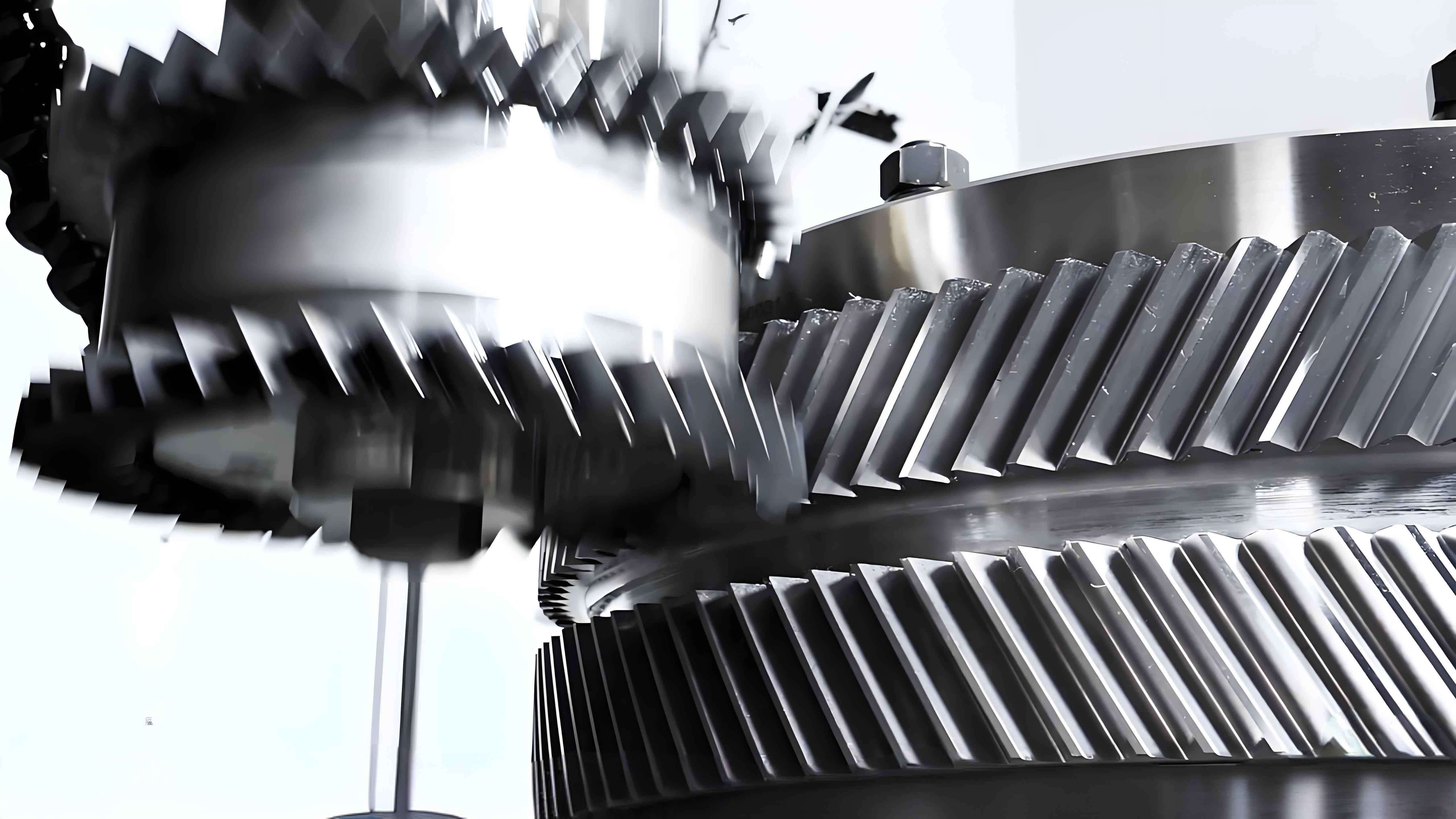
The core principle hinges on the geometric behavior of herringbone gears during meshing. When two herringbone gears engage without backlash, their symmetry planes naturally coincide. This phenomenon is rooted in the conjugate action of the helical teeth, which ensures that the left-hand and right-hand flanks align perfectly. For a herringbone gear, the symmetry plane is defined as the mid-plane between the two sets of helical teeth. By exploiting this, I designed a small-diameter herringbone gear that mirrors the module and helix angle of the large herringbone gear under test, but with opposite hand. This master gear serves as a precision tool to transfer the symmetry reference, enabling indirect measurement.
To formalize this, consider the geometry of a herringbone gear. The end face symmetry error, denoted as ΔS, represents the deviation between the actual symmetry plane and the ideal one. In an ideal herringbone gear, the symmetry plane is perpendicular to the axis and equidistant from both tooth flanks. The measurement objective is to quantify ΔS for large diameters where direct access is impractical. The relationship can be expressed using the following formula, which relates the measured disparities to the symmetry error:
$$ \Delta S = \frac{|D_1 – D_2|}{2} $$
Here, \( D_1 \) and \( D_2 \) are distances from a reference axis to the left and right tooth flanks, respectively. However, for large herringbone gears, these distances are challenging to measure directly. Hence, the small herringbone gear acts as an intermediary, where its own symmetry plane, when mated with the large gear, provides a datum for comparison.
The design of the small-diameter herringbone gear is critical to the method’s success. It must replicate the key parameters of the large herringbone gear while maintaining superior accuracy. The table below summarizes the design specifications and tolerances, highlighting the interdependence of parameters:
| Parameter | Large Herringbone Gear | Small Herringbone Gear (Master) | Tolerance Requirement |
|---|---|---|---|
| Module (m) | e.g., 10 mm | 10 mm (identical) | ±0.005 mm |
| Helix Angle (β) | e.g., 30° | 30° (opposite hand) | ±0.01° |
| Diameter | 2000 mm | 200 mm (scaled down) | N/A (non-functional) |
| End Face Symmetry | Allowable error: e.g., 0.02 mm | Allowable error: 0.0067 mm (1/3 of large gear) | Critical for accuracy |
| Tooth Profile | Standard involute | Precision-ground involute | ISO 1328 Class 1 |
The tolerance for the small herringbone gear’s end face symmetry is set to one-third of that of the large herringbone gear, ensuring that any inherent errors in the master gear do not significantly propagate. This reduction factor is derived from error analysis principles, where the master’s uncertainty should be a fraction of the workpiece’s tolerance. Mathematically, if ΔS_large is the allowable error for the large herringbone gear, then ΔS_small ≤ ΔS_large / k, where k is a factor typically between 3 and 10. For this application, k=3 is chosen to balance precision and manufacturability.
Manufacturing the small-diameter herringbone gear requires meticulous steps to achieve the desired accuracy. As I oversaw this process, the following sequence was adhered to: First, the locating bore is precision-ground to ensure concentricity. Then, both end faces are ground to be parallel and perpendicular to the bore axis, with parallelism controlled within 0.002 mm. This is crucial because any tilt in the end faces would introduce measurement bias. The grinding process employs a rotary table with autocollimator feedback to maintain orthogonality. Next, the herringbone teeth are cut using a gear hobbing machine, followed by grinding to refine the profile. During machining, the symmetry is monitored by measuring the distance from the bore axis to the tooth flanks on both sides, denoted as A_left and A_right. The goal is to minimize the difference ΔA = |A_left – A_right|, which directly correlates to the end face symmetry. For the master herringbone gear, ΔA is kept below 0.003 mm through iterative adjustments.
To quantify this, the symmetry error of the small herringbone gear can be calculated using the formula:
$$ \Delta S_{\text{small}} = \frac{\Delta A}{2 \cos \beta} $$
Here, β is the helix angle, and the cosine term accounts for the helical inclination. This formula underscores the importance of controlling ΔA during manufacturing. In practice, after grinding, the herringbone gear is measured on a coordinate measuring machine (CMM) to verify that ΔS_small meets the 0.0067 mm criterion. The table below illustrates a sample measurement log for a small herringbone gear, demonstrating the consistency achieved:
| Measurement Point | A_left (mm) | A_right (mm) | ΔA (mm) | ΔS_small (mm) |
|---|---|---|---|---|
| 1 | 100.001 | 99.998 | 0.003 | 0.0026 |
| 2 | 100.000 | 99.999 | 0.001 | 0.0009 |
| 3 | 99.999 | 100.000 | 0.001 | 0.0009 |
| Average | 100.000 | 99.999 | 0.0017 | 0.0015 |
Once the small herringbone gear is ready, the measurement setup for the large herringbone gear is configured. The primary instrument is a precision measuring machine with a vertical spindle, such as a gear analyzer or a modified jig borer. The spindle must have high rotational accuracy to minimize axis wobble. The small herringbone gear is mounted on the machine table via its locating bore, ensuring that its end faces are parallel to the spindle axis. This alignment is verified using a dial indicator swept across the end faces; any deviation is corrected by shimming. Then, a dial gauge or a digital indicator is attached to the spindle, with its probe positioned to contact the tooth flanks of the small herringbone gear. The spindle is rotated to bring the probe into contact with the left-hand and right-hand flanks separately, and the indicator readings are adjusted to be equal. At this point, the spindle axis coincides with the symmetry plane of the small herringbone gear.
With the spindle axis now representing the symmetry datum, the large herringbone gear is brought into play. It is positioned on a support fixture adjacent to the small herringbone gear, and the two are meshed without backlash. This requires careful manual adjustment to ensure full tooth engagement along the herringbone pattern. Due to the opposite hand of the small herringbone gear, the meshing forces the symmetry planes of both herringbone gears to align. Consequently, the spindle axis also passes through the symmetry plane of the large herringbone gear. To measure the end face symmetry error, the spindle is rotated so that the probe contacts the two end faces of the large herringbone gear at diametrically opposite points. The difference in indicator readings, ΔR, directly yields the symmetry error ΔS_large. The relationship can be expressed as:
$$ \Delta S_{\text{large}} = \Delta R \cdot \frac{D_{\text{large}}}{D_{\text{probe}}} $$
where \( D_{\text{large}} \) is the diameter of the large herringbone gear, and \( D_{\text{probe}} \) is the effective diameter at which the probe contacts. In practice, for simplicity, ΔR is often used directly if the probe path is radial, but calibration factors may apply. The measurement is repeated at multiple circumferential positions to account for any local variations, and the maximum ΔR is taken as the symmetry error. This process highlights the versatility of using a herringbone gear as a measurement artifact, as it inherently compensates for tooth alignment issues.
To elaborate on the error sources, a comprehensive analysis is essential. The overall uncertainty in measuring the end face symmetry of a large herringbone gear stems from several components: the master herringbone gear’s symmetry error, alignment errors between gears, spindle runout, indicator resolution, and thermal effects. Using root-sum-square (RSS) method, the combined uncertainty U can be estimated:
$$ U = \sqrt{ u_{\text{master}}^2 + u_{\text{align}}^2 + u_{\text{spindle}}^2 + u_{\text{indicator}}^2 + u_{\text{thermal}}^2 } $$
where each u represents the standard uncertainty of each component. For instance, u_master is derived from ΔS_small, typically 0.0067 mm / √3 = 0.0039 mm assuming a rectangular distribution. Alignment errors, such as parallelism deviations between end faces and spindle axis, can be modeled using geometric relationships. Suppose the end face has a tilt angle θ relative to the spindle axis; then the induced error in ΔR is approximately \( \theta \cdot R \), where R is the radius of measurement. By keeping θ below 0.001 radians through careful setup, this error is minimized. Spindle runout, often less than 0.001 mm in high-precision machines, contributes negligibly. Indicator resolution of 0.001 mm adds to the random error. Thermal expansion can be significant for large herringbone gears; thus, measurements are conducted in a controlled environment at 20°C ±1°C, with material coefficients accounted for. The table below quantifies these uncertainties for a typical scenario:
| Error Source | Symbol | Magnitude (mm) | Distribution | Standard Uncertainty (mm) |
|---|---|---|---|---|
| Master Herringbone Gear Symmetry | u_master | 0.0067 | Rectangular | 0.0039 |
| Alignment (Parallelism) | u_align | 0.002 | Triangular | 0.0008 |
| Spindle Runout | u_spindle | 0.001 | Normal | 0.0005 |
| Indicator Resolution | u_indicator | 0.001 | Rectangular | 0.0006 |
| Thermal Effects | u_thermal | 0.005 | Rectangular | 0.0029 |
| Combined Uncertainty (RSS) | U | – | – | 0.0052 |
This analysis shows that the method yields a combined uncertainty of about 0.0052 mm, which is well within the typical tolerance of 0.02 mm for large herringbone gears. Thus, the technique is deemed reliable for industrial applications.
In the absence of a dedicated measuring machine, the setup can be adapted to a high-precision lathe or boring mill with a rigid spindle. The key requirement is that the spindle axis remains stable and the end faces of the herringbone gear are parallel to the axis of rotation. The small herringbone gear is mounted on the machine table, and the same meshing and measurement steps are followed. While this may introduce additional errors due to machine geometry, it provides a practical solution for field measurements. I have successfully implemented this on a CNC boring mill, where the spindle positioning accuracy of 0.005 mm allowed for symmetry measurements with repeatability of 0.01 mm. This adaptability underscores the robustness of using a herringbone gear as a master reference.
The measurement procedure is iterative to ensure accuracy. First, the small herringbone gear is calibrated on a CMM to determine its actual symmetry error, which is then used as a correction factor. During measurement of the large herringbone gear, multiple readings are taken at different angular positions, typically every 30 degrees around the circumference. This captures any asymmetry in the gear’s mounting or tooth fabrication. The data is processed to compute the mean symmetry error and its standard deviation. For instance, if measurements yield ΔR values of [0.015, 0.018, 0.012, 0.020] mm, the mean ΔS_large is calculated, and outliers are examined for systematic errors. The formula for the mean symmetry error is:
$$ \overline{\Delta S} = \frac{1}{n} \sum_{i=1}^{n} \Delta R_i $$
where n is the number of measurements. The standard deviation σ indicates repeatability:
$$ \sigma = \sqrt{ \frac{1}{n-1} \sum_{i=1}^{n} (\Delta R_i – \overline{\Delta S})^2 } $$
In practice, for a large herringbone gear with diameter 2000 mm, we observed σ values below 0.002 mm, demonstrating high repeatability. This is crucial for quality control in production batches.
The advantages of this method are manifold. It eliminates the need for large, expensive measuring instruments specifically designed for herringbone gears. The small herringbone gear is relatively inexpensive to manufacture and can be reused for multiple measurements. The technique is simple to operate, requiring only basic training, and it provides direct readings that are easy to interpret. Moreover, it can be applied to herringbone gears of various sizes by scaling the master gear appropriately. This scalability is particularly beneficial for custom-made herringbone gears in industries like mining, shipbuilding, and power generation, where herringbone gears are prevalent.
To further illustrate the application, consider a case study involving a herringbone gear for a heavy-duty compressor. The gear had a diameter of 2500 mm, module 12 mm, helix angle 25°, and an end face symmetry requirement of 0.03 mm. Using a small herringbone gear with module 12 mm, opposite helix hand, and symmetry tolerance of 0.01 mm, measurements were conducted. The results showed a symmetry error of 0.025 mm, which was within spec but highlighted areas for improvement in the grinding process. This feedback allowed for adjustments in manufacturing, ultimately enhancing the herringbone gear’s performance.
In conclusion, the method of using a small-diameter herringbone gear to measure the end face symmetry of large-diameter herringbone gears offers a practical and reliable solution to a longstanding metrology challenge. By leveraging the inherent meshing properties of herringbone gears, it ensures accuracy and repeatability while being cost-effective. The key lies in the precise design and manufacturing of the master herringbone gear, coupled with careful setup and error analysis. As herringbone gears continue to be integral in heavy machinery, this technique promises to uphold quality standards and facilitate better meshing characteristics. Future work could explore automation of the measurement process using robotics, but the core principle remains rooted in the elegant geometry of the herringbone gear.
Throughout this exploration, the herringbone gear has been the focal point, underscoring its importance in mechanical systems. The methodology described not only solves a technical problem but also enriches the toolkit for gear metrology, paving the way for more innovative approaches in precision engineering. As I reflect on this development, it is clear that the herringbone gear, with its unique double-helical design, will continue to inspire solutions that bridge the gap between design intent and manufacturable reality.