
In the field of heavy machinery, large-module herringbone gears are widely applied in rolling mills and other critical equipment. These gear shafts typically have a module exceeding 10 mm. Their manufacturing is challenging, the processing cycle is lengthy, and the cost is high. However, the current service life of such herringbone gears is often disappointingly short. Therefore, enhancing the durability of large-module herringbone gear shafts holds significant economic importance. This pressing issue demands an immediate solution. Numerous factors influence the lifespan of herringbone gears. In our work, we focus specifically on the production process of pre-cutting tooth grooves followed by high-hardness quenching and tempering, aiming to improve the service life of large-module herringbone gear shafts.
Theoretical Basis for Pre-Cutting Tooth Grooves and High-Hardness Quenching and Tempering
Currently, two main production methods exist for large-module herringbone gear shafts in domestic manufacturing. The first method involves: rough turning of the blank, quenching and tempering to a hardness below 260 HB, semi-finish turning, gear milling, and finish turning. The second method follows a similar sequence but adds a surface hardening step after gear milling: rough turning, quenching and tempering (below 260 HB), semi-finish turning, gear milling, finish turning, and then tooth surface induction hardening.
The key difference between these two approaches lies in whether the tooth flanks are hardened. In the first method, the herringbone gear shaft only receives conventional quenching and tempering. The resulting tooth surface hardness is relatively low, typically referred to as a soft tooth surface. Since the gear diameters of large-module herringbone gear shafts are generally large—often around 600 to 800 mm—the rough machining before quenching and tempering leaves an allowance of about 6–10 mm on the blank diameter. After quenching and tempering, the part hardness is below 260 HB, usually around 220–240 HB. After gear milling, the tooth groove depth can be 30–50 mm or even deeper. Because the tooth grooves are cut after quenching and tempering, the hardness near the tooth tip is somewhat higher, while the hardness decreases toward the tooth root. In the lower portion of the tooth, the material often remains in a normalized state, with hardness dropping to 180–200 HB. Such a soft tooth surface leads to low contact strength and poor wear resistance. Moreover, due to the high contact pressure on the tooth flanks, adhesive wear (scoring) occurs easily, which damages the surface finish and correct tooth profile, leaving tearing scars. Nevertheless, soft tooth surfaces have an advantage: they retain the machined tooth profile accuracy all through the process, and after a short running-in period, satisfactory meshing performance can be achieved.
The second method yields higher tooth surface hardness, typically around HRC 40–45. This surface hardening technique improves wear resistance and extends service life to some extent, and it is widely adopted in domestic factories. However, it also has weaknesses. The induction hardening process causes significant distortion of the tooth profile, degrading the original machining accuracy and surface finish. Since grinding of the hardened tooth flanks is currently not feasible for these large gears, the distortion destroys the conjugate condition between a pair of meshing herringbone gear shafts, leading to localized contact. Furthermore, the high hardness prevents any running-in to improve the meshing condition. The hardened layer from surface induction hardening is relatively thin, generally 2–4 mm, and this thin layer rests on a softer core. During gear operation, localized contact under high pressure initiates micro-cracks on the tooth flanks. The ingress of lubricating oil under dynamic pressure accelerates crack propagation. Therefore, the predominant failure mode for herringbone gears produced by this method is pitting and spalling. Additionally, invisible internal injuries—extremely fine cracks—may exist after surface hardening due to transformation stresses, further promoting pitting and spalling. Once localized pitting appears, it spreads rapidly, causing uneven hardness distribution on the tooth flank. Metal debris from spalling accumulates in the gearbox oil, effectively turning the herringbone gear shaft into an abrasive environment. When the hardened layer largely spalls off, the tooth surface reverts to a soft state, with hardness even lower than the original quenched-and-tempered core. The service life of herringbone gears made by either of these two methods is unsatisfactory, prompting the search for a new process.
To overcome these shortcomings, we have experimented with a novel approach: pre-cutting the tooth grooves before high-hardness quenching and tempering. By machining the tooth grooves in the rough state and then subjecting the herringbone gear shaft to high-hardness heat treatment, we can achieve a more uniform hardness distribution from the tooth tip to the tooth root. The tooth flank hardness can reach HRC 40–48. This significantly improves the wear resistance. Moreover, because the high-hardness quenching and tempering is performed before the final gear finishing, we can restore the correct tooth profile and meshing performance through precision machining. Another advantage is that the hardened layer from high-hardness quenching and tempering is much thicker than that from surface induction hardening. All these favorable factors combine to prolong the service life of herringbone gear shafts.
High-Hardness Quenching and Tempering Heat Treatment Process
After rough milling of the tooth grooves, the geometry of the part becomes complex. If we use oil as the quenching medium, the tooth surface hardness tends to be low. Conversely, if we use plain water, we can achieve the required high hardness, but the risk of cracking becomes high. To address this, our factory adopts a water-quenching followed by oil-cooling process. We add polyvinyl alcohol (PVA) at a concentration of 0.1% to 0.3% to the water as a quenchant. This additive slows down the cooling rate, reduces the rate of martensite formation, and thus decreases internal stresses, preventing cracking of the herringbone gear shaft. In mechanical processing, we also take precautions: the rough-milled tooth flanks are finished to a surface roughness of at least Ra 6.3 μm, and all sharp edges on the part are chamfered or rounded to avoid stress concentrations.
Bending distortion during quenching poses a major challenge for the subsequent precision gear cutting. Therefore, we pay special attention to controlling distortion. During heating, temperature uniformity is crucial. We load the herringbone gear shaft into a preheated furnace so that it heats up evenly, minimizing the time inside and reducing distortion. If the part is placed into a cold furnace, the uneven heating, with the middle portion heating faster, can cause a “hump” effect, leading to significant bending.
To achieve high quality, we strictly control the holding time and cooling time. Considering that the tooth grooves have already been cut and that high hardness is required for the teeth rather than the entire part, and to minimize surface oxidation and decarburization, the holding time is calculated based on the tooth thickness. The empirical formula we use is:
$$ \tau = a \cdot s $$
where:
- \(\tau\) = quenching holding time (minutes)
- \(s\) = circular tooth thickness at the pitch circle (mm)
- \(a\) = coefficient (min/mm), taken as 1.5–2.0 in our practice
The cooling time in the water-based quenchant is determined to ensure that the tooth region is sufficiently hardened. The formula is:
$$ t_w = c_w \cdot D $$
where:
- \(t_w\) = water cooling time (seconds)
- \(D\) = pitch circle diameter (mm)
- \(c_w\) = coefficient (s/mm), taken as 0.5–0.8 s/mm for herringbone gears
For the water-quench plus oil-cooling process, we use:
- Water cooling time: 0.5–0.8 s per mm of pitch circle diameter
- Oil cooling time: 1.2–1.5 s per mm of pitch circle diameter
By reducing the water cooling time, we can prevent cracking. Although this may slightly reduce hardenability, it does not significantly affect the overall quality. Extending the oil cooling time allows the heat from the core to dissipate gradually, preventing the core’s residual heat from tempering the hardened tooth flanks after removal from the oil. To ensure that the tooth hardness is not affected by the core’s heat, we transfer the herringbone gear shaft from the water quench into the oil bath quickly. When the part cools in oil to around 150–200°C, we transfer it to a tempering furnace.
We have manufactured three sets of high-hardness quenched-and-tempered herringbone gear shafts using this process. The material is 40CrNiMoA or similar low-alloy steel. Based on the above theory and formulas, we established the heat treatment cycle as shown in the table below.
| Parameter | Symbol / Value | Remarks |
|---|---|---|
| Preheat temperature | 600–650 °C | Slow heating, ensuring uniformity |
| Austenitizing temperature | 840–860 °C | For 40CrNiMoA steel |
| Holding time (t) at austenitizing | \(\tau = (1.5 \text{ to } 2.0) \times s\) | s = circular tooth thickness (mm) |
| Quenching medium (first stage) | Water + 0.1–0.3% PVA | Temperature 30–40 °C |
| Water cooling time | \(t_w = (0.5 \text{ to } 0.8) \times D\) | D = pitch circle diameter (mm) |
| Oil cooling (second stage) | Oil at 60–80 °C | Time: \(t_o = (1.2 \text{ to } 1.5) \times D\) |
| Oil exit temperature | ~150–200 °C | Immediate transfer to tempering |
| Tempering temperature | 180–220 °C | To achieve HRC 40–48 |
| Tempering holding time | 3–5 hours | Depends on cross-section |
Herringbone Gear Shaft Manufacturing Process
The manufacturing process for large-module herringbone gear shafts with pre-cut tooth grooves and high-hardness quenching and tempering differs from the conventional approach. A typical process flow is as follows:
- Rough machining of the blank before gear cutting: Except for the gear portion, which retains an allowance of 6 mm on the outer diameter, all other surfaces are left with 3–4 mm allowance.
- Rough milling of tooth grooves: The tooth grooves are cut according to the gear parameters, leaving 0.6–1.0 mm per side for final finishing.
- High-hardness quenching and tempering: The part undergoes the heat treatment described above, targeting a surface hardness of HRC 40–48.
- Semi-finish turning of non-gear surfaces: The outer diameter of the gear portion is turned to the drawing dimensions, while other surfaces are semi-finished.
- Precision gear milling: The tooth flanks are finished to the required profile using high-speed steel finger cutters (e.g., M42 cobalt HSS) that are quenched and nitrided for high hardness and cutting performance.
- Final finishing: All other features of the herringbone gear shaft are machined to final dimensions.
Compared with conventional herringbone gear shafts, the process for high-hardness pre-machined gears is more complex. The allowance left on the rough-milled tooth blank (6 mm on the outer diameter) accounts for both distortion during quenching and the formation of surface scale. The single-side allowance of 0.6–1.0 mm on the tooth flanks, based on our production experience, is sufficient for precision milling. However, strict control of heat treatment distortion is essential. If the bending distortion exceeds 1.0 mm, it may become impossible to finish the tooth flanks within the allowance. Therefore, we require that the maximum bending deformation of the herringbone gear shaft after quenching and tempering be less than 1.0 mm. Additionally, torsional distortion must be monitored because it directly affects the helix angle, potentially causing machining difficulties.
The determination of the finishing allowance depends not only on heat treatment factors but also on machine tool accuracy and operator skill. During rough milling of the tooth grooves, the large module and large helix angle generate significant cutting forces. These forces act on the machine tool, causing slight displacements of the cutter head and elastic deformation of the machine transmission chain. When the finishing pass is taken, the cutting forces are much smaller, so the machine returns to a different elastic state. Consequently, the finishing tool path cannot perfectly match the rough-milled trajectory; a deviation exists. In addition, the operator’s visual alignment introduces further error. To compensate, we use high-performance M42 cobalt HSS finger cutters that are specially hardened and nitrided, providing high hardness and good cutting performance.
Although the new process increases machining time and cost, the resulting improvement in service life of the herringbone gear shafts makes it economically worthwhile. The following table summarizes the comparison of key characteristics among the three manufacturing methods for large-module herringbone gear shafts.
| Characteristic | Method 1: Soft Tooth Surface (Q&T only) | Method 2: Tooth Surface Induction Hardening | Method 3: Pre-Cut Grooves + High-Hardness Q&T |
|---|---|---|---|
| Tooth flank hardness | 220–240 HB (soft) | HRC 40–45 (thin layer) | HRC 40–48 (uniform through tooth) |
| Hardness uniformity | Tip higher, root much lower | Thin layer on soft core | Uniform from tip to root |
| Tooth profile accuracy | Good (machined after heat treatment) | Degraded due to distortion | Excellent (finished after heat treatment) |
| Contact pattern | Uniform after running-in | Localized due to distortion | Uniform, no running-in required |
| Failure mode | Scoring, wear | Pitting, spalling | Increased fatigue life |
| Relative service life | Short | Moderate | Significantly longer |
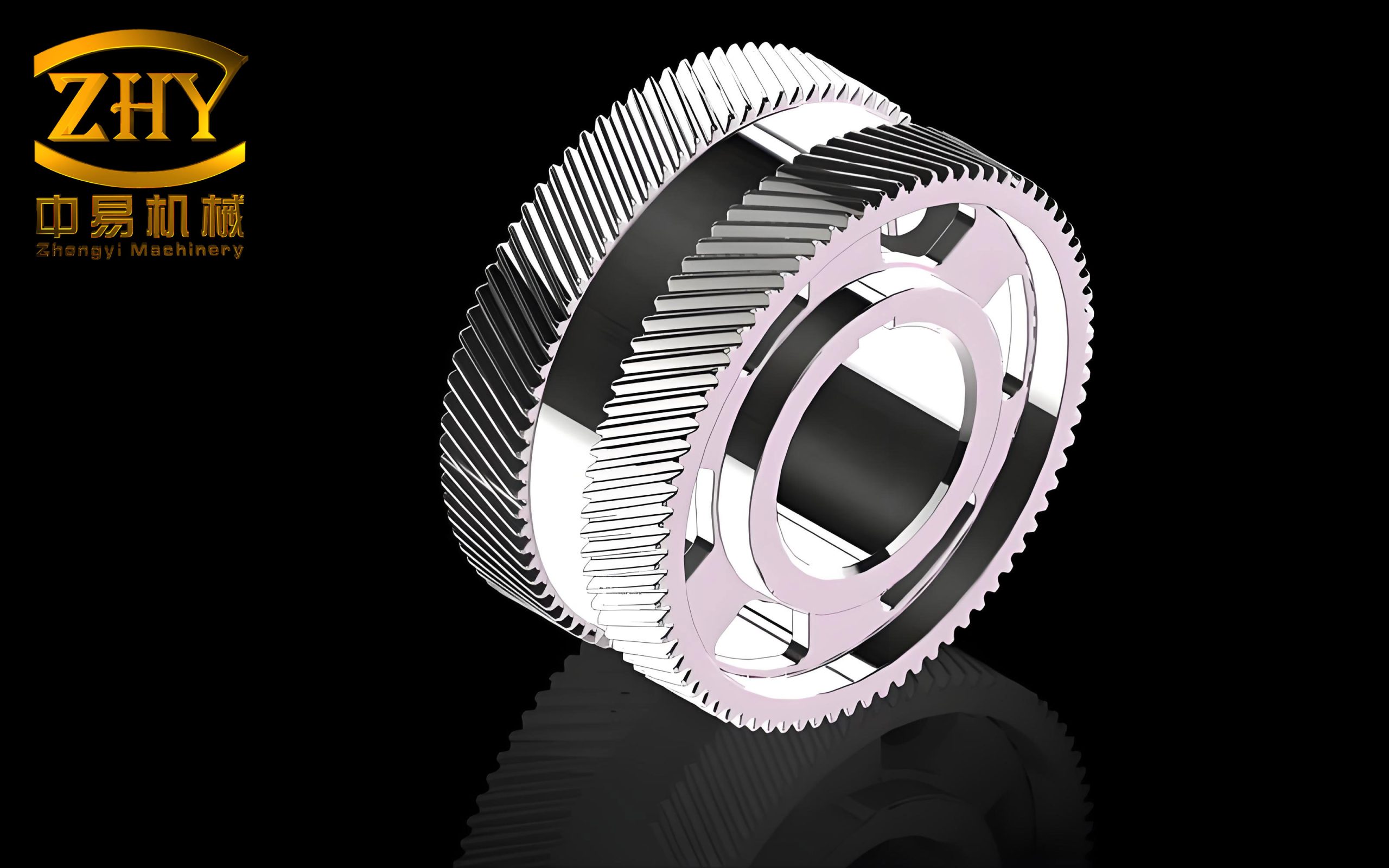
In conclusion, the high-hardness quenching and tempering process for large-module herringbone gear shafts with pre-cut tooth grooves overcomes the limitations of both traditional methods. It delivers a uniformly hardened tooth flank with high hardness, preserves the gear profile accuracy through post-heat-treatment finishing, and provides a thick hardened layer resistant to pitting and spalling. Although the manufacturing cost is slightly higher and the process requires careful control of distortion, the substantial increase in service life of herringbone gears justifies the investment. We believe that this technology offers a valuable solution for extending the durability of herringbone gear shafts in heavy-duty applications. Further optimization of the quenchant formulation and cooling parameters may yield even better results, and we continue to explore these avenues.