
The reliable operation of mechanical transmission systems is fundamentally dependent on the performance and longevity of their gear components. Among these, spur gears are a quintessential element due to their simplicity and effectiveness in power transmission. A dominant failure mode limiting their service life is contact fatigue, manifesting as micro-pitting, pitting, and spalling on the active tooth flanks. These failure mechanisms directly threaten the operational safety, efficiency, and durability of gearboxes across industries such as automotive, wind energy, and heavy machinery. Consequently, developing accurate models to predict the risk of contact fatigue in spur gears is a critical engineering challenge.
Traditional standards like ISO 6336 and GB/T 3480 provide established methodologies for calculating the load capacity of spur gears based on Hertzian contact theory and nominal material properties. While essential for initial design, these approaches often treat the gear material as homogeneous. In reality, high-performance spur gears are subjected to surface hardening processes like carburizing and quenching. This thermochemical treatment modifies the near-surface material, creating a layer with a gradient in key mechanical properties such as hardness and residual stress. This gradient layer significantly enhances the contact fatigue resistance but introduces complexity that standard calculations do not fully capture. The failure initiation mechanism shifts, becoming a competition between surface-initiated micro-pitting (often linked to tribological conditions) and subsurface-initiated pitting/spalling (linked to shear stress maxima below the surface). Therefore, a predictive model must integrate the multiaxial stress state from gear meshing with the spatially varying material strength resulting from the carburizing process.
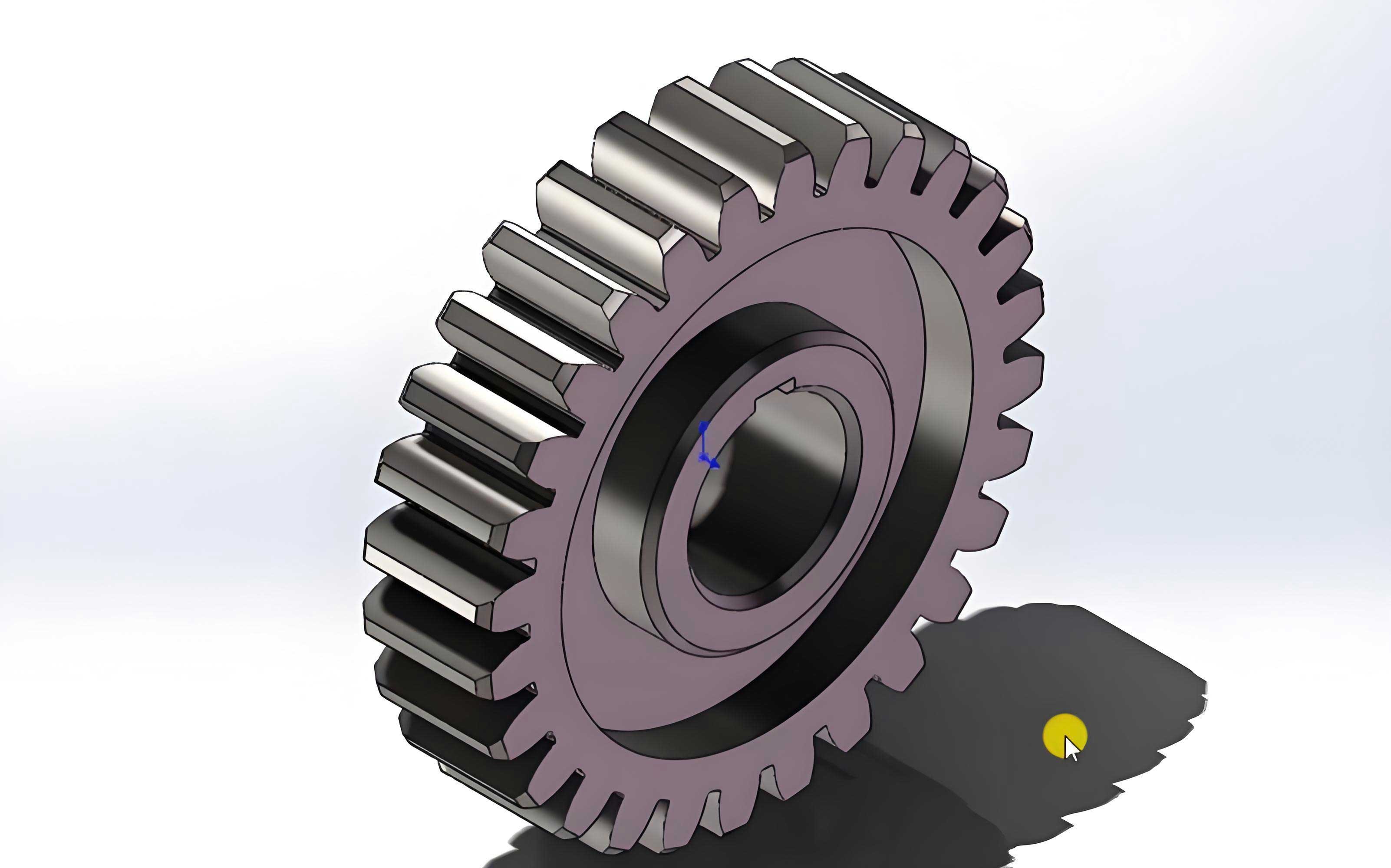
This study presents a coupled analytical-numerical model for predicting contact fatigue risk in case-hardened spur gears. The model synthesizes the load history along the path of contact, a discrete numerical method for efficient stress field calculation, empirical formulations for property gradients, and a multiaxial fatigue criterion. The primary objective is to elucidate how characteristic post-carburizing parameters—hardness gradient, residual stress profile, applied load, and interfacial friction—influence the location and magnitude of the fatigue failure risk within the tooth of a spur gear. By bridging the gap between process-induced material states and operational mechanical response, this model aims to provide a more physically grounded tool for the design and life assessment of high-performance spur gears.
Methodology: Integrated Modeling Approach
1. Gear Meshing and Equivalent Contact Model
The contact between mating teeth of spur gears is modeled as the rolling/sliding contact of two equivalent cylinders. For any instantaneous point of contact along the line of action, the local radii of curvature determine the equivalent geometry. The fundamental relationships for a gear pair are given by:
$$
\rho_{pm} = \frac{m z_p \cos \alpha}{2} \tan \alpha_{pm}, \quad \rho_{qm} = \frac{m z_q \cos \alpha}{2} \tan \alpha_{qm}
$$
$$
\frac{1}{\rho_{eq}} = \frac{1}{\rho_{pm}} + \frac{1}{\rho_{qm}}
$$
where \( \rho_{pm} \) and \( \rho_{qm} \) are the radii of curvature of the pinion and gear at the contact point, \( m \) is the module, \( z_p \) and \( z_q \) are the number of teeth, \( \alpha \) is the standard pressure angle, and \( \alpha_{pm}, \alpha_{qm} \) are the operating pressure angles at the contact point. The equivalent radius \( \rho_{eq} \) is then used in Hertzian theory. The normal load per unit face width \( F/B \) is calculated from the transmitted torque. For a given contact stress \( p_0 \), the semi-contact width \( b \) is:
$$
b = \sqrt{ \frac{4 F}{\pi B} \rho_{eq} \left( \frac{1-\nu_p^2}{E_p} + \frac{1-\nu_q^2}{E_q} \right) }
$$
where \( E \) and \( \nu \) are the elastic modulus and Poisson’s ratio, respectively. In this analysis, we focus on the stress state near the pitch point, a critical region for contact fatigue in spur gears.
2. Discrete Numerical Method for Subsurface Stress Field
Calculating the complete subsurface stress field (\( \sigma_x, \sigma_z, \tau_{xz} \)) due to combined normal (\( p \)) and tangential (\( q \)) traction distributions is a classic elastic half-plane problem. The stress at any point (x, z) is given by integrals of the influence of surface loads. For arbitrary load distributions, a discrete numerical approach is efficient. The contact pressure and traction distributions are discretized into \( n \) uniform rectangular load blocks of constant pressure \( p_j \) and traction \( q_j \).
The stress components at a subsurface point \( i \) due to a single rectangular load block \( j \) have explicit analytical solutions. For example, the stress in the x-direction is:
$$
\{\sigma_x^p\}_{ij} = -\frac{p_j}{\pi} \left[ \arctan\left(\frac{s-x_{ij}}{z_j}\right) + \arctan\left(\frac{s+x_{ij}}{z_j}\right) – \frac{z_j(s+x_{ij})}{r_1^2} + \frac{z_j(x_{ij}-s)}{r_2^2} \right]
$$
$$
\{\sigma_x^q\}_{ij} = -\frac{q_j}{\pi} \left[ \frac{z_j^2}{r_2^2} – \frac{z_j^2}{r_1^2} + 2\ln\left(\frac{r_2}{r_1}\right) \right]
$$
where \( s \) is the half-width of the load block, \( x_{ij}, z_j \) are the relative coordinates, and \( r_1^2 = (s-x_{ij})^2 + z_j^2 \), \( r_2^2 = (s+x_{ij})^2 + z_j^2 \). These solutions can be expressed in terms of influence coefficients or shape functions \( T_{p,j-i} \) and \( T_{q,j-i} \). The total stress at point \( i \) is the superposition from all load blocks:
$$
\sigma_{x,i} = \sum_{j=1}^{n} \left( T_{p,j-i} \cdot p_j + T_{q,j-i} \cdot q_j \right)
$$
Similar expressions are formulated for \( \sigma_z \) and \( \tau_{xz} \). This method allows for rapid computation of the full multiaxial stress tensor \( \boldsymbol{\sigma}(x,z) \) for any given surface loading condition on the spur gear tooth flank.
3. Characterization of Material Property Gradients
Carburizing and quenching of spur gears creates a hardened case with gradients in hardness and residual stress. These gradients are crucial for accurate fatigue risk assessment.
Hardness Gradient: The Vickers hardness (HV) as a function of depth (z) from the surface can be modeled using an empirical piecewise function. A common formulation is:
$$
HV(z) =
\begin{cases}
a_a z^2 + b_a z + c_a, & 0 \leq z < D_{CHD} \\
a_b z^2 + b_b z + c_b, & D_{CHD} \leq z < z_{core} \\
HV_{core}, & z_{core} \leq z
\end{cases}
$$
where \( D_{CHD} \) is the effective case hardening depth (e.g., depth to 550 HV), \( HV_{core} \) is the core hardness, and \( z_{core} \) is the transition depth to the homogeneous core. The coefficients are fitted to match surface hardness, case depth, and core hardness. The material’s tensile strength \( R_m \) is strongly correlated with hardness. A linear fit derived from standard data can be used for conversion:
$$
R_m(z) [MPa] \approx 3.2 \times HV(z)
$$
The fatigue strength parameters, such as the fully reversed bending fatigue limit \( \sigma_{-1} \) and torsional fatigue limit \( \tau_{-1} \), can also be estimated from hardness.
Residual Stress Gradient: The process-induced residual stress \( \sigma_{RS}(z) \) is typically compressive at the surface and transitions with depth. A sigmoidal function provides a good fit to experimental data:
$$
\sigma_{RS}(z) = \sigma_D + \frac{\sigma_z – \sigma_D}{1 + e^{-k(z + \delta)}}
$$
where \( \sigma_D \) is the minimum (maximum compressive) residual stress, \( \sigma_z \) is the asymptotic residual stress in the core (often tensile), and \( k \), \( \delta \) are fitting parameters controlling the gradient slope and inflection point. This residual stress field is treated as a mean stress component that superimposes on the mechanically induced stresses.
4. Multiaxial Fatigue Risk Model (Dang Van Criterion)
To predict the risk of high-cycle contact fatigue crack initiation, a multiaxial fatigue criterion is necessary due to the complex, non-proportional stress state under rolling-sliding contact. The Dang Van criterion is well-suited for this purpose. It postulates that fatigue crack initiation occurs on a critical plane where a linear combination of the shear stress amplitude and the hydrostatic stress is maximal.
For a given material point and time \( t \) in the load cycle, the Dang Van parameter is calculated on multiple material planes defined by their normal vector. For each plane orientation \( \alpha \), the shear stress amplitude \( \Delta \tau_{max}(\alpha, t) \) and the hydrostatic stress \( \sigma_H(t) = \frac{1}{3}\text{tr}(\boldsymbol{\sigma}(t)) \) are determined. The Risk Factor Parameter (RFP) is defined as:
$$
\text{RFP}(\alpha, z, t) = \frac{\Delta \tau_{max}(\alpha, t) + a_D \cdot \sigma_H(t)}{b_D}
$$
The material constants \( a_D \) and \( b_D \) are derived from the basic fatigue limits: \( a_D = 3 \left( \frac{\tau_{-1}}{\sigma_{-1}} – \frac{1}{2} \right) \) and \( b_D = \tau_{-1} \).
To incorporate the material gradients specific to carburized spur gears, the local fatigue strength \( \tau_{-1}(z) \) and \( \sigma_{-1}(z) \) become depth-dependent, making \( a_D(z) \) and \( b_D(z) \) functions of depth. Furthermore, the residual stress \( \sigma_{RS}(z) \) is added as a static component to the hydrostatic stress. The modified, gradient-aware RFP is:
$$
\text{RFP}'(\alpha, z, t) = \frac{\Delta \tau_{max}(\alpha, t) + a_D(z) \cdot \left[ \sigma_H(t) + \sigma_{RS}(z) \right]}{b_D(z)}
$$
The fatigue risk at a material point is defined by the maximum value of \( \text{RFP}’ \) over all possible plane orientations \( \alpha \) and over the loading cycle \( t \):
$$
\text{RFP}’_{max}(z) = \max_{\alpha, t} \left[ \text{RFP}'(\alpha, z, t) \right]
$$
A value of \( \text{RFP}’_{max} \geq 1 \) indicates a high risk of fatigue crack initiation at that location. Mapping \( \text{RFP}’_{max} \) across the x-z plane beneath the contact reveals the spatial distribution of the fatigue risk zone.
Results and Parametric Analysis
The model is applied to a representative spur gear pair with parameters listed in the table below. The base case considers a contact pressure of 1500 MPa at the pitch point with a coefficient of friction \( \mu = 0.05 \), simulating lubricated rolling-sliding conditions.
| Parameter | Symbol | Value |
|---|---|---|
| Module | m | 6.5 mm |
| Number of Teeth (Pinion/Gear) | \( z_p / z_q \) | 24 / 25 |
| Pressure Angle | \( \alpha \) | 20° |
| Face Width | B | 30 mm |
| Surface Hardness | \( HV_{surf} \) | 700 HV |
| Core Hardness | \( HV_{core} \) | 450 HV |
| Case Hardening Depth | \( D_{CHD} \) | 2.1 mm |
| Max. Residual Compressive Stress | \( \sigma_D \) | -400 MPa |
1. Subsurface Stress State
The discrete numerical method effectively computes the stress field. The principal stresses \( \sigma_1, \sigma_2, \sigma_3 \) (with \( \sigma_1 > \sigma_2 > \sigma_3 \)) are compressive near the surface. The orthogonal shear stress \( \tau_{max} \) reaches its maximum value not at the surface, but in the subsurface region. For the base case, the peak of \( \tau_{max} \) is located approximately 0.3 mm below the surface at the center of contact (x=0). This is the classical driver for subsurface-originated pitting.
2. Effect of Residual Stress and Hardness Gradient
Incorporating the hardness gradient means the material’s resistance to fatigue (\( b_D(z) \)) decreases with depth. Including the residual compressive stress at the surface effectively reduces the local hydrostatic stress component in the Dang Van equation. The combined effect is demonstrated in the table below, which compares the maximum risk factor \( \text{RFP}’_{max} \) and its location for different model configurations.
| Model Configuration | Max \( \text{RFP}’_{max} \) Value | Location of Max Risk (x, z) | Dominant Failure Mode Indication |
|---|---|---|---|
| Homogeneous Material (No Gradients) | 0.95 | (0.0 mm, 0.30 mm) | Subsurface Pitting |
| With Hardness Gradient Only | 1.05 | (-0.1 mm, 0.42 mm) | Subsurface Pitting (Risk > 1) |
| With Hardness & Residual Stress Gradients | 0.71 | (-0.1 mm, 0.40 mm) | Safe (Risk < 1) |
The results clearly show that ignoring the hardness gradient leads to non-conservative predictions (risk > 1). The residual compressive stress provides a highly beneficial effect, significantly lowering the RFP value and potentially preventing failure. This quantifies the critical role of case-hardening in enhancing the contact fatigue life of spur gears.
3. Parametric Study of Operational and Material Factors
The model is used to investigate the sensitivity of the fatigue risk to key parameters.
A. Coefficient of Friction (Lubrication Condition): The coefficient of friction \( \mu \) is varied to simulate changes in lubrication quality. The tangential traction \( q(x) = \mu \cdot p(x) \) is applied.
| Coefficient of Friction (μ) | Max \( \text{RFP}’_{max} \) Value | Location of Max Risk (x, z) | Implication |
|---|---|---|---|
| 0.0 (Pure Rolling) | 0.65 | (-0.1 mm, 0.40 mm) | Lowest risk, subsurface |
| 0.05 (Good Lubrication) | 0.71 | (-0.1 mm, 0.40 mm) | Slightly higher, subsurface |
| 0.10 (Moderate Lubrication) | 0.82 | (-0.08 mm, 0.25 mm) | Risk zone shifts upwards |
| 0.20 (Poor Lubrication/Boundary) | 1.15 | (0.02 mm, 0.05 mm) | High risk, very near surface |
This analysis reveals a critical trend: as friction increases, the location of maximum fatigue risk migrates from the subsurface towards the surface. High friction (poor lubrication) leads to surface-near stress concentrations, promoting conditions for micro-pitting. Lower friction keeps the critical zone in the subsurface, associated with classical pitting. This successfully captures the competing failure mechanisms observed in spur gears.
B. Surface Hardness: The surface hardness \( HV_{surf} \) is varied while keeping the case depth and core hardness constant. This simulates different levels of surface carbon concentration or quenching intensity.
| Surface Hardness (HV) | Max \( \text{RFP}’_{max} \) Value | Location of Max Risk (x, z) |
|---|---|---|
| 600 | 0.85 | (-0.1 mm, 0.38 mm) |
| 670 (Base) | 0.71 | (-0.1 mm, 0.40 mm) |
| 750 | 0.60 | (-0.1 mm, 0.41 mm) |
Increasing surface hardness directly strengthens the material in the critical near-surface region (increases \( b_D(z) \)), leading to a monotonic decrease in the RFP value. The location of the risk zone remains relatively stable. This highlights the direct benefit of achieving high surface hardness in carburized spur gears.
C. Applied Contact Pressure (Load): The maximum Hertzian pressure \( p_0 \) is varied to study the effect of operational load.
| Contact Pressure \( p_0 \) (MPa) | Max \( \text{RFP}’_{max} \) Value | Location of Max Risk (x, z) |
|---|---|---|
| 1300 | 0.54 | (-0.1 mm, 0.35 mm) |
| 1500 (Base) | 0.71 | (-0.1 mm, 0.40 mm) |
| 1700 | 0.91 | (-0.1 mm, 0.45 mm) |
| 1900 | 1.15 | (-0.1 mm, 0.50 mm) |
As expected, increasing the load raises the RFP value non-linearly. At 1900 MPa, the RFP exceeds 1, predicting a high probability of fatigue failure. The depth of the critical point also increases slightly with load because the stress field penetrates deeper. This demonstrates the model’s ability to predict the classical S-N (stress-life) trend for spur gears.
Discussion and Conclusion
The developed coupled model integrates the essential physics governing contact fatigue in case-hardened spur gears. By marrying an efficient elastic contact solver with gradient-aware material properties and a multiaxial fatigue criterion, it provides a more nuanced prediction than standard homogeneous-material approaches.
The parametric studies yield several key insights that align with empirical knowledge and experimental observations on spur gears:
- The Critical Role of Gradients: Ignoring the hardness gradient can lead to non-conservative life predictions. The beneficial effect of residual compressive stress is quantitatively significant, often being the factor that pushes the design into a safe operating regime.
- Friction Governs Failure Mode: The model clearly delineates the conditions for surface-initiated micro-pitting versus subsurface-initiated pitting. Low friction maintains a subsurface risk zone, while high friction shifts the dominant risk to the surface. This underscores the paramount importance of maintaining effective lubrication in spur gear systems.
- Design Levers: The analysis confirms that increasing surface hardness and maximizing beneficial residual stresses are effective strategies for enhancing contact fatigue resistance. The model allows for optimizing the case depth and hardness profile relative to the applied load to ensure the critical shear stress maximum resides within a sufficiently strong material zone.
In conclusion, this study presents a robust framework for the risk-based prediction of contact fatigue in carburized and quenched spur gears. The model successfully links manufacturing process outcomes (property gradients) with operational parameters (load, friction) to predict both the likelihood and the potential mode of failure. This represents a step forward from traditional rating standards towards a more mechanistic and predictive design methodology for high-performance spur gears. Future work could involve coupling this model with dynamic tooth load calculations, incorporating the effects of non-metallic inclusions, and validating predictions against extensive gear rig testing data across a wider range of materials and geometries.