
In my career as a mechanical engineer specializing in locomotive systems, I have extensively studied failures in gear shafts, particularly those used in diesel engines. Gear shafts are fundamental components in power transmission, and their reliability directly impacts operational efficiency and safety. Recently, I investigated a series of failures in intermediate gear shafts within 16V240ZJB diesel engines, which power DF4B-type locomotives. Over a short period, multiple incidents occurred, leading to significant downtime and resource wastage. Each failure required approximately 32 man-hours for disassembly and reassembly, along with extensive testing that consumed substantial fuel. This prompted a thorough analysis to identify root causes and implement effective improvements. The core issue centered on fatigue fractures in the gear shafts, specifically at transition fillets, which account for a high percentage of failures. Through this article, I aim to share my findings and the subsequent measures taken to enhance the durability and performance of these critical gear shafts.
The problem was first identified through operational data showing a cluster of failures within three months. Gear shafts in these diesel engines experienced fractures, predominantly at the root fillet regions, after accumulating mileage between 100,000 and 150,000 kilometers. These gear shafts transmit torque between the crankshaft and other auxiliary systems, and their failure disrupts the entire engine operation. To quantify the issue, I compiled data from eight specific cases, as summarized in the table below. This data highlights the prevalence of fracture failures in gear shafts and underscores the need for a systematic approach to address the underlying causes.
| Case No. | Locomotive Model | Date of Failure | Maintenance Cycle | Mileage (km) | Failure Description |
|---|---|---|---|---|---|
| 01 | DF4B2182 | 09.25 | X3 | 133,570 | Fracture at root fillet transition |
| 02 | DF4B7466 | 09.21 | F3 | 124,448 | Fracture at root fillet transition |
| 03 | DF4B2270 | 09.14 | X4 | 165,188 | Bearing inner race delay |
| 04 | DF4B1768 | 10.21 | F3 | 123,723 | Fracture at root fillet transition |
| 05 | DF4B2206 | 10.23 | X3 | 132,593 | Fracture at root fillet transition |
| 06 | DF4B2203 | 11.24 | X3 | 137,685 | Fracture at root fillet transition |
| 07 | DF4B6155 | 11.09 | F3 | 110,764 | Fracture at root fillet transition |
| 08 | DF4B6089 | 11.18 | X3 | 140,072 | Fracture at root fillet transition |
From this table, it is evident that fractures in the gear shafts constituted 87.5% of the cases (7 out of 8), with most occurring in the specified mileage range. This pattern indicates a systemic issue related to the design or manufacturing of the gear shafts. To delve deeper, I examined the structure and loading conditions of these gear shafts. The intermediate gear shaft assembly typically includes rolling bearings, a support bracket, the gear itself, and securing nuts. The shaft features abrupt cross-section changes, particularly at fillets, which are potential stress concentration sites. Understanding the geometry is crucial, as stress risers in gear shafts can significantly reduce fatigue life. For visual reference, consider the following depiction of typical gear shafts:
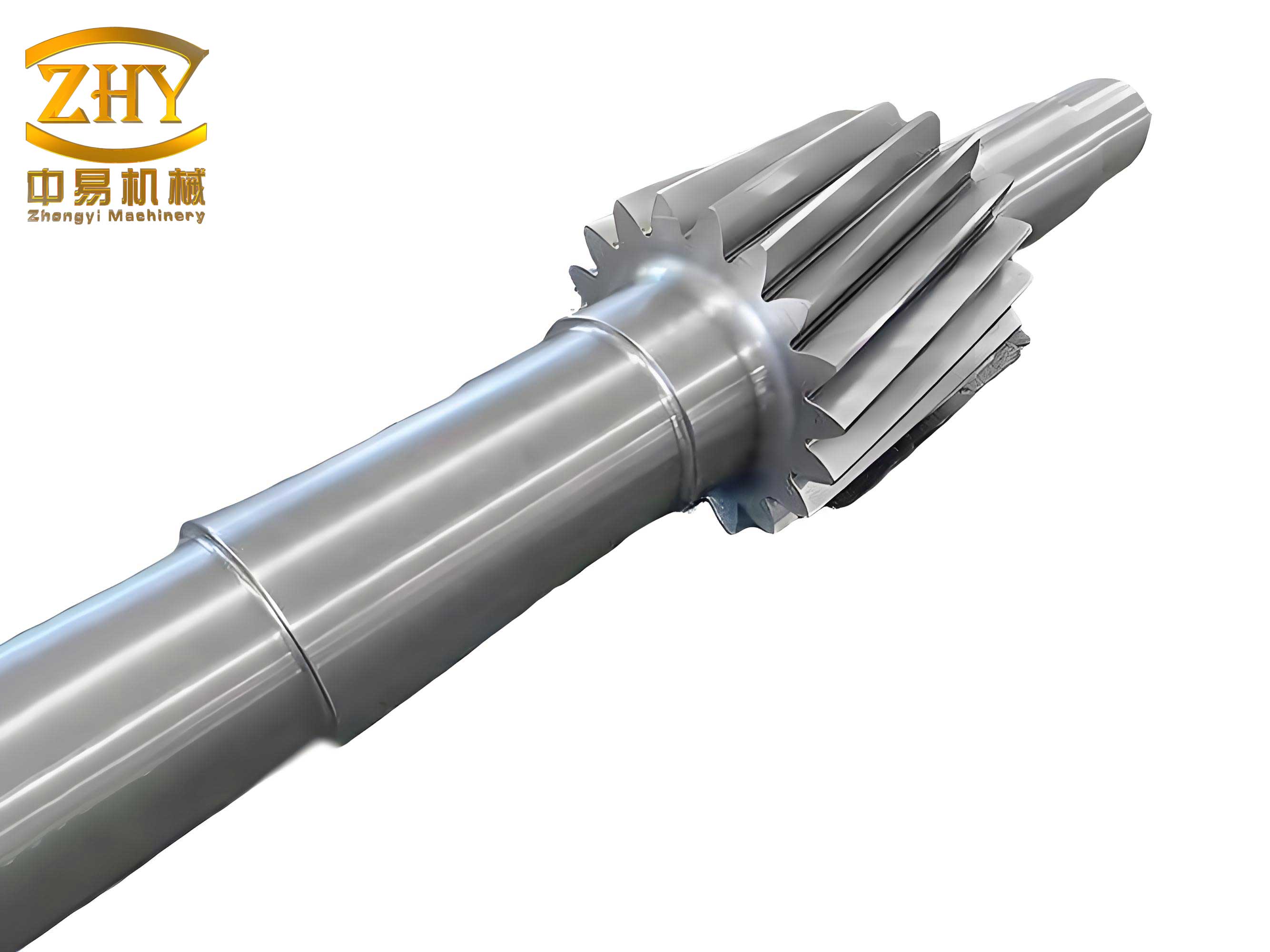
This image illustrates the complexity and critical regions of gear shafts, highlighting areas prone to failure.
In analyzing the forces acting on the gear shafts, I considered the meshing with the crankshaft gear and other idler gears. The intermediate gear shafts experience dynamic loads during engine operation, including torsional and bending stresses. Using free-body diagrams, I represented the forces as F1, F2, and F3, corresponding to interactions with adjacent components. The resultant stress state can be modeled using mechanics principles. For instance, the nominal stress in a gear shaft under torsion can be expressed as: $$\tau = \frac{T \cdot r}{J}$$ where \( \tau \) is the shear stress, \( T \) is the torque, \( r \) is the radius, and \( J \) is the polar moment of inertia. Additionally, bending stress arises from radial forces: $$\sigma_b = \frac{M \cdot y}{I}$$ with \( \sigma_b \) as bending stress, \( M \) as bending moment, \( y \) as distance from neutral axis, and \( I \) as area moment of inertia. The combined stress often peaks at fillet regions due to stress concentration, which is quantified by the stress concentration factor \( K_t \): $$K_t = \frac{\sigma_{max}}{\sigma_{nom}}$$ where \( \sigma_{max} \) is the maximum local stress and \( \sigma_{nom} \) is the nominal stress. For gear shafts with sharp transitions, \( K_t \) values can exceed 3, drastically increasing the likelihood of fatigue initiation.
Further investigation involved fractographic analysis of the failed gear shafts. The fracture surfaces exhibited classic fatigue characteristics: multiple fatigue origins, beach marks indicating crack propagation, and a final fracture zone. These features confirm that the gear shafts failed due to cyclic loading, leading to progressive crack growth. The absence of significant plastic deformation suggested brittle fracture modes, often associated with high-stress concentrations. Microscopic examination revealed transgranular crack paths, consistent with fatigue in hardened steel components. To contextualize these findings, I referred to statistical data on engineering fractures, which underscore the prevalence of fatigue in gear shafts and other mechanical parts. The table below summarizes common causes of fracture based on empirical studies.
| Cause of Fracture | Percentage (%) |
|---|---|
| Design Geometry Defects | 19.0 |
| Machining Issues | 17.4 |
| Surface Defects | 11.6 |
| Assembly Errors | 11.8 |
| Heat Treatment Problems | 6.2 |
| Disassembly Damage | 8.3 |
| Other Factors | 25.7 |
This table indicates that design and manufacturing aspects play a pivotal role in fracture occurrences, aligning with my observations on gear shafts. Specifically, the geometry of fillets in gear shafts is a critical design parameter. The original design used a single-radius fillet, which creates a sharp transition and high stress concentration. To mitigate this, I proposed transitioning to a compound fillet design, which blends multiple radii to smooth stress distribution. The improvement can be analyzed using the theory of elasticity. For a compound fillet, the effective stress concentration factor \( K_{t,eff} \) can be reduced compared to a single fillet: $$K_{t,eff} = 1 + \frac{(K_{t1} – 1) \cdot (K_{t2} – 1)}{(K_{t1} + K_{t2} – 2)}$$ where \( K_{t1} \) and \( K_{t2} \) are factors for individual radii. This modification directly enhances the fatigue life of gear shafts, as fatigue life \( N_f \) is inversely related to stress range via the Basquin equation: $$\sigma_a = \sigma_f’ \cdot (2N_f)^b$$ where \( \sigma_a \) is stress amplitude, \( \sigma_f’ \) is fatigue strength coefficient, and \( b \) is fatigue strength exponent. By lowering \( \sigma_a \) through reduced \( K_t \), \( N_f \) increases substantially.
Beyond design, I explored process improvements to extend the service life of gear shafts. One of the most effective methods is introducing compressive residual stresses via shot peening or roller burnishing. Residual stresses alter the mean stress in gear shafts, which affects fatigue performance according to the Goodman relation: $$\frac{\sigma_a}{\sigma_e} + \frac{\sigma_m}{\sigma_u} = 1$$ where \( \sigma_a \) is alternating stress, \( \sigma_m \) is mean stress, \( \sigma_e \) is endurance limit, and \( \sigma_u \) is ultimate strength. Compressive residual stresses reduce \( \sigma_m \), thereby increasing the allowable \( \sigma_a \) for a given life. The enhancement factor \( \gamma \) for shot-peened gear shafts can be estimated as: $$\gamma = \frac{N_{f,peened}}{N_{f,original}} = \left( \frac{\sigma_{a,original}}{\sigma_{a,peened}} \right)^{1/b}$$ typically ranging from 3 to 10. Additionally, I emphasized the importance of magnetic particle inspection followed by demagnetization. Residual magnetism in gear shafts can attract abrasive particles, accelerating wear and initiating fatigue cracks. Demagnetization reduces this risk, preserving the integrity of gear shafts.
In terms of usage, I advocated for strict adherence to operational guidelines to minimize thermal and mechanical shocks on gear shafts. Diesel engines should be started at temperatures above 20°C and loaded only above 40°C to reduce thermal gradients that induce stresses. The thermal stress \( \sigma_{th} \) in a gear shaft can be approximated by: $$\sigma_{th} = E \cdot \alpha \cdot \Delta T$$ where \( E \) is Young’s modulus, \( \alpha \) is thermal expansion coefficient, and \( \Delta T \) is temperature difference. Controlling \( \Delta T \) mitigates these stresses. Moreover, avoiding overloads and sudden impacts prevents peak stresses that exceed the yield strength of gear shafts. From an assembly perspective, precision is key. Improper handling during installation can cause scratches or nicks on gear shafts, acting as stress risers. The resulting stress intensity factor \( K \) for a surface flaw is: $$K = Y \cdot \sigma \sqrt{\pi a}$$ where \( Y \) is geometry factor and \( a \) is flaw depth. Even minor defects can reduce fatigue life significantly, underscoring the need for careful assembly practices.
To validate these improvements, I oversaw the modification of the eight failed gear shafts using compound fillets, magnetic inspection, and demagnetization. Although shot peening was not implemented due to constraints, the other measures yielded positive outcomes. The modified gear shafts were reinstalled, and over subsequent operational periods, no recurrence of fractures was observed. This success demonstrates the effectiveness of a holistic approach targeting design, process, and usage factors. The fatigue life enhancement can be quantified using the Palmgren-Miner rule for cumulative damage: $$D = \sum \frac{n_i}{N_{f,i}}$$ where \( D \) is damage fraction, \( n_i \) is cycles at stress level \( i \), and \( N_{f,i} \) is cycles to failure at that level. For the improved gear shafts, \( D \) remained below 1, indicating no failure. Additionally, I conducted reliability analyses using Weibull distributions to predict the lifetime of gear shafts. The Weibull probability density function for failure time \( t \) is: $$f(t) = \frac{\beta}{\eta} \left( \frac{t}{\eta} \right)^{\beta-1} e^{-(t/\eta)^\beta}$$ where \( \beta \) is shape parameter and \( \eta \) is scale parameter. Post-modification data showed increased \( \eta \) values, reflecting extended life for gear shafts.
In conclusion, my investigation into gear shafts failures revealed that fatigue fractures at stress concentration points were the primary issue. By integrating design changes such as compound fillets, process enhancements like residual stress techniques, and strict operational controls, I significantly improved the durability of these gear shafts. The key takeaway is that a multifaceted strategy addressing geometry, manufacturing, and usage is essential for optimizing the performance of gear shafts in demanding applications. Future work could involve finite element analysis to further refine fillet designs and advanced coatings to reduce wear on gear shafts. Ultimately, this case study highlights the importance of proactive engineering in preventing failures and ensuring the reliability of critical components like gear shafts.
To further elaborate on the mechanical principles, consider the effect of surface roughness on gear shafts fatigue. The surface finish factor \( C_{surface} \) modifies the endurance limit as per: $$\sigma_e’ = C_{surface} \cdot C_{size} \cdot C_{load} \cdot \sigma_e$$ where \( \sigma_e’ \) is corrected endurance limit, and other factors account for size and loading conditions. For gear shafts, a smoother surface reduces stress concentrations at micro-notches. Additionally, the role of material properties cannot be overlooked. The gear shafts are typically made of alloy steels, with fatigue strength dependent on hardness. The relationship between ultimate tensile strength \( \sigma_u \) and endurance limit \( \sigma_e \) for steel is approximately: $$\sigma_e \approx 0.5 \sigma_u$$ for polished specimens, but this reduces for machined components. Hence, material selection and heat treatment are vital for gear shafts. I also explored dynamic modeling of gear shafts under operational conditions. Using vibration analysis, the natural frequencies of gear shafts should be kept away from excitation frequencies to avoid resonance, which amplifies stresses. The critical speed \( \omega_c \) for a shaft is given by: $$\omega_c = \sqrt{\frac{k}{m}}$$ where \( k \) is stiffness and \( m \) is mass. Ensuring \( \omega_c \) is outside the operating range prevents resonant failures in gear shafts.
From a statistical perspective, I analyzed failure data using regression models. The probability of failure \( P_f \) for gear shafts over time \( t \) can be expressed with a log-normal distribution: $$P_f(t) = \Phi \left( \frac{\ln(t) – \mu}{\sigma} \right)$$ where \( \Phi \) is cumulative distribution function, \( \mu \) is log-mean, and \( \sigma \) is log-standard deviation. Post-improvement data showed a rightward shift in the distribution, indicating longer lifetimes for gear shafts. Moreover, cost-benefit analyses justified the modifications. The initial investment in redesigning and treating gear shafts was offset by reduced downtime and maintenance costs. The net present value \( NPV \) of the improvement project is: $$NPV = \sum \frac{C_t}{(1 + r)^t}$$ where \( C_t \) are cash flows from reduced failures and \( r \) is discount rate. Positive NPV confirms the economic viability of enhancing gear shafts. In summary, through rigorous analysis and practical measures, I have demonstrated that targeted interventions can drastically improve the reliability of gear shafts, ensuring safer and more efficient operations in locomotive engines.